


He was a vision in dark red and bright smile and he helped me start my day with a chuckle.
I laughed because he was a Buddhist monk who was counting currency notes, and I had never seen one doing that before.
The ones I had seen growing up in the hills typically stayed to themselves, would be deep in silence with a prayer wheel in hand, and were a picture of solemnity and maroon robes.
The one before us, well, he was silent and solemn too… but that was because of the task at hand. It was not prayer beads or a wheel or some other meditation kit but a slim wad of cash that he held.
And he was counting the bills solemnly.
Counting over – checked and double-checked – the monk kicked at an errant soccer ball that had strayed into his path, and the robes be damned. He then proceeded to give some dribbling tips to a cluster of noisy boys in school uniform playing football on the busy road.
Advice dispensed with, my sociable monk thereafter struck up an animated conversation with a lady who sold noodles. Her shop was located below a monastery, from where I presumed the happy monk had earlier emerged.
How can a journey to the tea gardens in Darjeeling be complete without running into Buddhist monks and their brightly colored flags by the roadside?
But one such as this, a spirited one with money, I thought was a hoot.
I need not have been amused, I guess. I had seen two playful monks the previous evening too and should have been prepared.
My photographer friend Uday and I were on the way from Mim tea estate to Avongrove and we decided to rest overnight at Sukhia Pokhri – the town where the monastery-on-shop was.
It was the third evening of a weeklong trip in the hills, and we were dead beat after driving for hours. We were also hungry, and stopped for a bite at a roadside eatery in Sukhia where, moments earlier, we had seen the two monks disappear.
We placed our orders: Uday wanted a plate of momo or chicken dumplings with a bowl of light soup on the side, and I went for my childhood favorite, a bowl of thukpa – noodles in chicken stock with chopped vegetables and floating chunks of meat.
The monks seated at the next table seemed oblivious to food; they asked for a board of ludo. Two young local boys in jeans joined them in their board game.
As we waded through our fare, the excitement at the adjacent table grew by decibels. The monks were as loud as the laity, and equally vocal in their analysis of the proceedings. The game proceeded amid much backslapping and loud guffaws.
When I called out for a plate of momo and the proprietor failed to hear me above the din, it was one of the monks who alerted her. The cloak of aloofness had slipped away good and proper.
The monks and the monastery above the noodle shop intrigued Uday. In fact, my shutterbug colleague said monasteries in the hills in general intrigued him. “Great photography subject,” he educated me.
The journey from Mim tea estate – from where we were headed to Avongrove – involves a long drive through thick pine trees towering above the road; we often saw a monk trudging through the fog or resting by the roadside during the drive to and from the plantation.
This was on a separate hill from the one on which the monastery at Sukhia Pokhri was located, and perhaps there was another Buddhist priory nearby that accounted for these monks.
Uday would hop out of the car whenever he spotted one of them. They were invariably withdrawn and remote, and would not let my colleague rattle them if he went too close for comfort to take photographs.
Their indifference sent us a message loud and clear: we were too insignificant to ruffle them. Uday could not have asked for more.
So when he told me he wanted to pay a visit to the unusual monastery at Sukhia Pokhri that morning, I was hardly surprised.
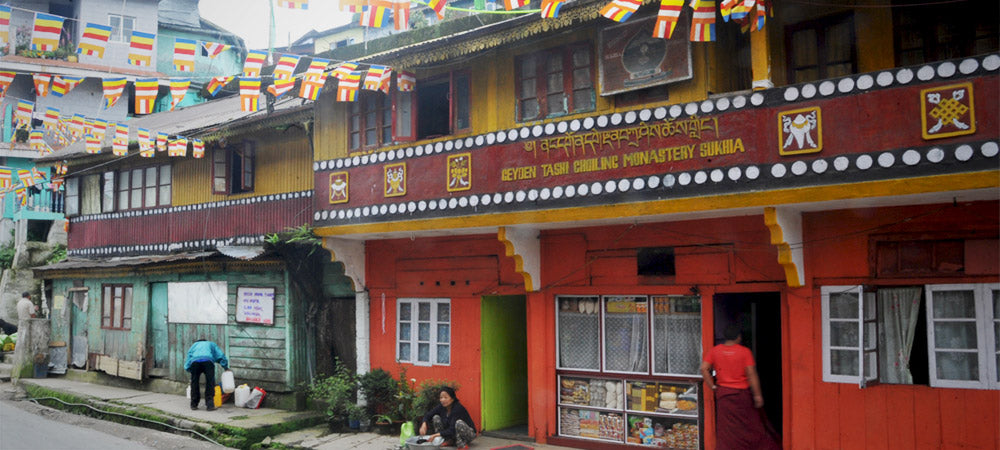
The monastery was unlike anything I had ever seen; not only was it on top of a shop, it was right in the middle of a marketplace. Uday, who had bought bootlegged whiskey at a similar shop the night before, suspected alcohol was found here too.
Having grown up in the hills, I was used to seeing monasteries situated away from habitation, all secluded and fine examples of ancient Tibetan architecture.
Secluded this one definitely was not. So much so that colorful buntings hung between the monastery and the hotel we spent the night at.
But it was soothingly tranquil inside; the idol of Lord Buddha, the incense sticks and the dimmed lights transported me to another world. The rhythmic tattoo a monk was beating on a big Tibetan drum added to the aura of the place.
Just when we were about to leave town for Avongrove, a young monk – he could have been a novitiate, I had no way of knowing – started blowing his dungchen or the Tibetan horn.
It was, I am sure, an auspicious moment in a Buddhist’s day and had nothing to do with us, but I like to think the monk was saying “Fare thee well.” Yes, it is a nice feeling.
Featured photograph of the monastery-on-top-of-shop by Uday Bhattacharya
From our readers
Comments left on the original Still Steeping post.
Mariah · September 28, 2015
More pictures. More photos, ….more visual culture, without modern trinkets in the photo, such as cars, friends with cameras, or out of place attire. Just the “culture”,….the local people, gardens, and waterfalls, hills, monasteries?temples, tea gatherers, etc.. I understand sometimes for perspective photographers insert cars, Pepsi bottles, etc.. Please do not, as it ruins the ‘journey’!
Originally published on Still Steeping, the Teabox blog, on September 16, 2015. Lightly edited for clarity in October 2026.

Leave a comment
All comments are moderated before being published.
This site is protected by hCaptcha and the hCaptcha Privacy Policy and Terms of Service apply.