


First published in May 2016; references to recent films are as of that time.
In my family, we consider Eid an occasion to get together to do what we do best – eat elaborate meals, have long, detailed discussions about elaborate meals, and drink several cups of tea in between those elaborate meals.
Most Eids begin with what is known as mutta surka, one of the many quintessential dishes that the Malabari Muslims, the Mappilas, have invented using rice flour and eggs. It has been said that if you give a Mappila a few eggs and rice flour, you’ll be presented with a feast with twenty different dishes. If you add bananas to the list of ingredients, you’ll get another fifty.
As it is, mutta surka is the staple Eid breakfast at my parents’. Eggs and rice flour are beaten into a flurry and deep-fried until the little blobs puff up to their full might and turn golden. It is served with – you guessed it – more eggs. The eggs are a Malabari version of bhurji, and are scrambled with onions, fennel seeds and green chilies. A true breakfast of champions, this meal sets the indulgent and celebratory tone for the day. To reinforce the feeling of merrymaking, a round of tea, or chaya as we call it, is to be had.
A few hours in, and many glasses of tea later, it is time for what I suspect is everyone’s favorite part of the day – lunch. Mutton biryani is the pièce de résistance, with sweet and spicy date pickle and coconut chutney playing supporting roles. If you ask me, the hush that falls over the room as aunts, and uncles, and cousins tuck into their plates of biryani might just be the most sacred part of the day. The silence, however, is short-lived, because invariably someone wants to know what’s for dessert.
What follows the biryani and dessert is the rarely acknowledged but crucial part of the meal, without which no feast is complete – a glass of sulaimani tea. Biryani and sulaimani. The names even rhyme. One of the most complex Mappila dishes, followed by the simplest. No matter how elaborate the meal, how many different types of desserts were on offer, or that every guest has been stuffed to within an inch of his or her life, there is still a little room left for a sulaimani.
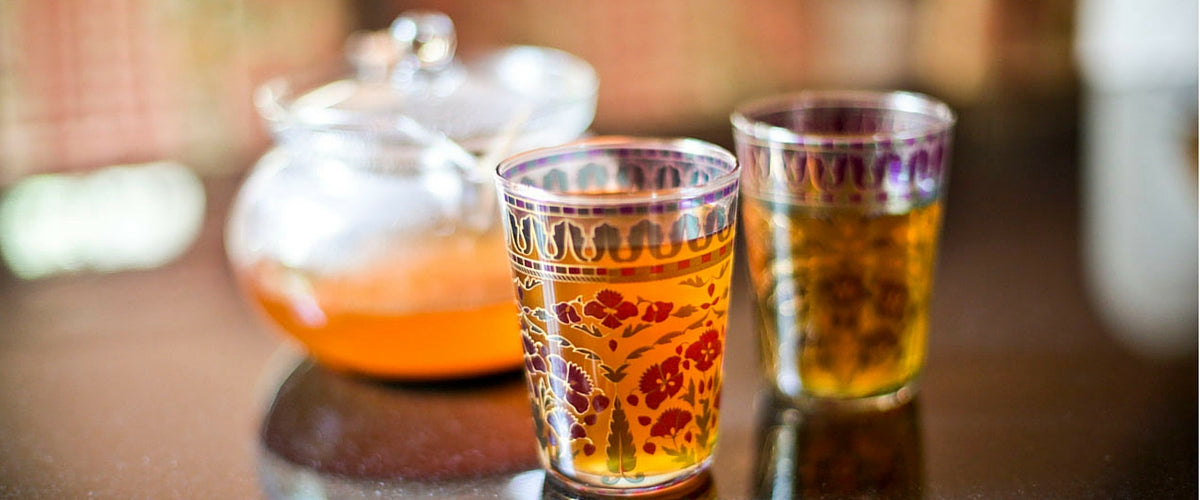
Besides being a postlude to a heavy lunch, it is privy to every joy and celebration that takes place. Served in tiny glasses, usually with cardamom, occasionally with a few strands of saffron, but always with lime, it involves steeping black tea leaves, sweetening it, and brewing it until it reaches the right shade of golden. The color of a deep sunset, this is the tea that smells of celebration. At weddings, huge vats of black tea are constantly simmering away on the fire, and small paper cups of the piping-hot tea are passed around throughout the day, even in the peak of summer.
One of the most popular Malayalam movies in recent times, Ustad Hotel, is about a Malabari Muslim family that, like every other self-respecting Malabari Muslim family, is obsessed with eating well. In one of the most endearing scenes in the movie, the protagonist, a young aspiring chef straight out of college, sits by the sea with his grandfather, spending quality time with him for the first time in his adult life. Between them sits a kettle of piping-hot sulaimani.
The movie and this particular scene inspired a social initiative in Kozhikode, the town the movie was set in, to provide quality food for anyone in need of a hot meal. The name of the project? Operation Sulaimani. The unsung hero of the Malabari meal, a cup of tea, it appears, can change lives.
Sulaimani tea recipe
Ingredients
- 3 cups water
- 1 tsp tea leaves
- 1-inch piece of cinnamon
- 2 cardamom pods
- A pinch of saffron
- 2 tsp lime juice
- 3 tsp sugar, or to taste
Method
- Crush the cardamom and cinnamon with a mortar and pestle.
- Bring the water to a boil, adding the crushed spices as the water heats up.
- When the water has come to a boil, pour it over the tea leaves and let it steep for a minute.
- Add the lime juice, sugar and saffron, and stir to dissolve.
- Serve immediately.
From our readers
Comments left on the original Still Steeping post.
Bryan · July 24, 2018
Thank you for posting this recipe. What kind of tea leaves should I use?
Yuxelle · October 27, 2019
Hi, I’m from Turkey. I am a muslim turkish woman. I watch the movie Ustad Hotel at the moment. I am very impressed . I wondered suleimani tea and googled it, then found your blog and this article which is very fascinating. Thank you.
Kalyan Sharma replied to Yuxelle · May 31, 2020
Same here. Only after watching the movie Ustad hotel, I googled this Tea…Same pinch.
Melba · February 4, 2020
Hi .. recently we had a food for cause event at our college and there I tasted sulaimani tea…it was served with pudina leaf on top and I could get cinnamon flavour from it . So today I sat to check what’s the recipe and thanks to you ..you have given the recipe along with a beautiful narration about how it is used in muslim cuisine ..
Originally published on Still Steeping, the Teabox blog, on May 17, 2016. Lightly edited for clarity in October 2026. Make your own sulaimani with one of our black teas.


Leave a comment
All comments are moderated before being published.
This site is protected by hCaptcha and the hCaptcha Privacy Policy and Terms of Service apply.