


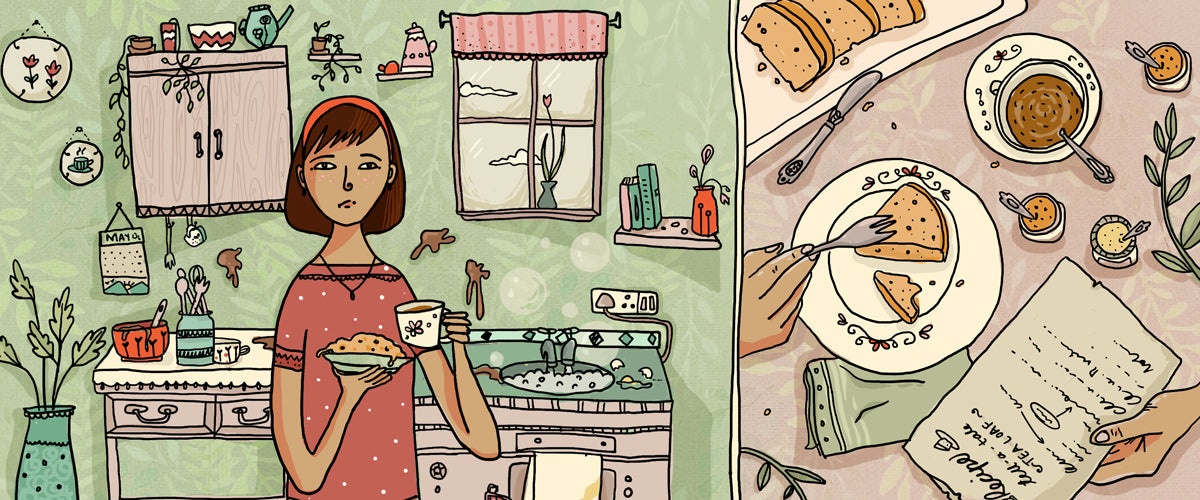
‘Didimoni, do you need help?’ At the kitchen door stands our wild-haired cook, addicted to all-night jatra folk theater in Midnapore and fine Bengali cuisine. His frown intensifies as he scans the scene around me that blazing May afternoon in Kolkata.
Probably an unusual sight, by any yardstick. An uncooked, semi-scrambled egg lies amidst shell shards on his impeccably swabbed floor. A dozen cake-friendly ingredients occupy the marble countertop. Ants scamper through scattered sugar. Another yolk drips half-heartedly off the sink ledge.
Neither Ma nor the cook has ever seen me in their gleaming kitchen before. Ma is deep in her siesta, the single sea-green wall in her cool room probably enhancing her deep-sea dreams.
Both are unaware of the fact that, at 13, I have just taken a secret vow. To be the best experimental cake-maker in a family of lauded cooks. Mainly because tea is my favorite meal of the day. Besides, it seems daunting to take on the perfection of Thakurma’s crab curry or Didibhai’s sugared coconut flakes of gangajali (her recipe vanished with her ashes, my Mashi moans), or even Ma’s milk-cured lamb chops.
My inspiration is at hand – a glossy Victoria Sandwich in Ma’s bulky, brand-new recipe book. It calls for whisked eggs, which leaves me floundering. So, I cast the cook as a co-conspirator, swearing him to silence. He mops up the mess, neatly cracks open two eggs, offers me Ma’s balloon whisk, sets the gas oven to Mark 3 – and vanishes from the scene, spooked by my insistence on going it solo.
I measure caster sugar, dainty teaspoons at a time for accuracy, into a big glass bowl. Using an outsize wooden spoon, I beat the sugar with softened butter. Whisking the eggs into the sugary fat, my skinny arms threaten to come apart at the joints while I glare the curdling edges into submission. The flour is quickly tossed in, half mounded on the counter. Undeterred, I pour the pale yellow batter into buttered sandwich pans.
The coast is clear. My older brother is deep in a Second World War book; our younger sibling immersed in artwork with his thumbprints.
Edging the door semi-closed, I sit cross-legged in front of the cooking range for 30 minutes. The batter in one pan seems to breathe, rising and falling, threatening to overflow. In the other, it flops dramatically to the semblance of a tortured pancake.
As the timer pings, I examine the near-ruins of my first baking caper. I lack the heart to toss it out. Instead, I spoon Ma’s fresh strawberry jam on the risen sponge, firmly capping it with the flop half. It bears little resemblance to the Victoria Sandwich in Ma’s book, yet my brothers devour the experiment.
Declaring it delicious at first bite, Ma gently asks, ‘Shall I teach you a simple dal tomorrow?’ I decline on the double. I am willing to live on cake through the day, the year, the decades to come.
Even as a writer today, I realize baking is my hidden superpower. One I use to woo select souls with. Yet a niggling but simple quest underlies my days. Is there a recipe for a cake, bread or loaf with tea as a main ingredient? Coffee is often listed as a significant cake-changer. But somehow, tea – as leaf or dust – never quite makes the grade.
I add brewed tea (white, green or black) to cupcakes with disastrous results. Neither ginger tea nor chai masala with leaf tea proves appetizing. The results? Either a pulpy brown at the core, or closer to curry than cake. An attempted matcha chiffon cake in a pale green hue results in puzzled glances at every nibble. The flavor is too subtle, almost undetectable, leaving me yearning for a moreish tea taste.
Jasmine tea lacks flower power in cake, I find, even when pounded in a gorgeous green Kota stone mortar. As for garam masala with powdered tea, it tastes soapy to my tongue.
For way too long, all seems quiet on the tea loaf front. Until a breakthrough, right out of the blue.
Just five years ago, as I sip kahwa in New Delhi with R, her grandparents recall their lost orchards in Kashmir. With every green drop laced with saffron, cinnamon and cardamom, I eye the slivered almonds at the bottom of my porcelain cup.
‘You always lusted for more almonds than we normally put into our kahwa,’ R teases, radiant in her stone-gray pheran with burnt-orange aari embroidery. ‘Even at college…’
I blush at the memory. ‘Remember how we jumped out of the ground-floor classroom window in Kolkata to avoid two hours of the…’
‘History of English Literature!’ she shrieks. We roar with laughter, imagining our scrawny college selves slinking past the beefy, mean-eyed watchman.
‘Is kahwa always made this way?’ I ask when we are calmer.
‘Let’s see,’ R says. Two hours later, our rummaging results in a genuine find – her late Daadi’s notebook, replete with recipes in her fading copperplate script. As R flips pages, a yellowing, dog-eared paper lands at my feet. I pick it up casually. Within seconds, I dance with glee, unintentionally spilling kahwa on her Shyam Ahuja rug. On the ruled sheet, I read, ‘Tea Loaf (not Cake).’ At the top of the listed ingredients is… tea!
R looks puzzled, so I briefly explain the backstory. ‘Somebody has tried this,’ I whoop, fingering the stains. ‘It should work.’
Voilà! It does. My first guinea pig normally shuns cake, declaring himself a committed ‘utthapam man.’ His verdict? ‘I actually prefer it to my Ajji’s Mysore Pak,’ adding with a wink, ‘When did you learn to cook?’ A four-year-old niece engages with the recipe hands-on, challenging me to a raisin-gobbling contest. I demur. Four days later, she says, ‘Can we bake that kismis with brown tea thingummy again? Not like brownies, but still kind of… yummy.’

Over the years, this zero-fat fruity loaf – it has now earned the moniker Tell-a-tale Tea Loaf – that packs a mighty tea punch has gained fans across ages and tastes. Part of its appeal lies in the subtle zing of marmalade in each rich brown slice. A cross between cake and bread, this loaf serves 6 to 8 people.
While you sip your aromatic Darjeeling, oxidized oolong or smoky Lapsang Souchong, perhaps you could swap tales of favorite teatime treats? Or even your best-ever tea-inspired recipe?
Tell-a-tale Tea Loaf
Serves: 6 to 8
Ingredients
- 1 cup cold, strong black tea
- 1 ½ cups mixed dried fruit (raisins, sultanas, cranberries, chopped nuts, etc.)
- 1 ½ cups self-rising flour (or 1 ½ cups refined flour sifted with 1 ½ teaspoons baking powder)
- ¾ cup superfine or caster sugar
- 1 large egg, well beaten
- 2 tablespoons orange marmalade
Method
- Place the fruit in a glass or stainless steel bowl. Pour the cold tea over it. Leave to soak overnight, if possible, or till the fruit plumps out by absorbing the tea.
- Either the next day or at least four hours later, grease a 700 g loaf tin with butter or oil. Line the base with greaseproof paper.
- Preheat the oven to 180°C (Gas Mark 4).
- Combine the flour, sugar, egg and marmalade.
- Pour in the fruit and any tea left in the steeping bowl.
- Stir gently but thoroughly.
- Place the batter in the loaf tin. Smooth the top with the back of a spoon.
- Bake for about an hour. When done, a skewer or toothpick should come out clean.
- Allow to cool, then ease out of the tin.
- Slice to serve.
- Serve with butter, if you like.
From our readers
Comments left on the original Still Steeping post.
Tanu · May 10, 2016
A delightful read! And yes this recipe will be tried asap! And the illustrations- gorgeous.
Aditi replied to Tanu · May 10, 2016
Thanks so much, Tanu. I hope your cake turns out a treat, as mine recently did.
Monica Nanjunda · May 10, 2016
It was truly fun reading it Aditi 🙂
Aditi replied to Monica Nanjunda · May 10, 2016
Thanks a lot, Monica.
Rita Nayyar · May 10, 2016
I chuckled as i read this thoroughly enjoying the tale as it was told..i love teas of any kind and am willing to try new ones, not an expert at baking but would love to try this tell a tale tea loaf..
Aditi replied to Rita Nayyar · May 11, 2016
Super, Rita. I can hear you chuckling in Jaipur, even in faraway Bangalore. 🙂 Thanks. Try the loaf, please. This is by far one of the simplest recipes ever.
Aditi · May 11, 2016
Thanks a bunch, Leela. So thrilled that you enjoyed the read. I’m sure the loaf will be a cakewalk for a baking pro like you. Enjoy!
rohini Bhola · May 12, 2016
What a joyous story you weave and a no fat no guilt tea cake. Delightful.
Aditi replied to rohini Bhola · May 12, 2016
Thanks a zillion, Rohini. Tea Loaf treat coming up, one day soon. 😉
Sunondo · May 15, 2016
Very nice short story. Great reading on a Sunday morning. I’m sure I’ll try the recipe as is, but may not be able to resist a few edits to bypass the raisins, a pet peeve of mine. The texture of soft raisins just doesn’t do it for me. Hopefully a skilled baker can come up with a slightly modified recipe without raisins. As a substitute, maybe craisins (dried cranberries here in the US), dried cherries or even candied orange peel to compliment the marmalade. Another option to take it into a completely different direction is to add candied ginger, walnuts and a little cinnamon and saffron. This last redux definitely to be sampled with a Chai type concoction.
Aditi replied to Sunondo · May 18, 2016
Thank you. Of course you can juggle ingredients to suit your tastes, Sunondo. For instance, a friend in California did her version with almonds, walnuts and cranberries, reducing the sugar in the recipe to suit her family’s tastes. She found she had no orange marmalade at home, either, so she used a combination of pineapple and apricot jams, with a dash of orange juice and some grated zest. That worked well, too. Good luck with your experiments!
Asha Nehemiah · May 24, 2016
What an evocative piece! I love the imagery of the egg yolk ‘dripping half-heartedly over the ledge’ and your Ma’s ‘deep sea dreams’. Will try baking the tea loaf too!
Aditi replied to Asha Nehemiah · May 24, 2016
Thanks a million, Asha…. and happy baking!
Aysha · August 4, 2016
How to make it eggless?
Aditi replied to Aysha · June 20, 2017
I can’t answer that with great confidence. But you might try skipping the egg and stepping up the baking powder instead. Or you could use 1/4 cup of whisked plain yoghurt. This acts as a binder, just as the egg would. It doubles as a raising agent.
Originally published on Still Steeping, the Teabox blog, on May 10, 2016. Lightly edited for clarity in October 2026. Bake this loaf with a strong brew of one of our black teas.


Leave a comment
All comments are moderated before being published.
This site is protected by hCaptcha and the hCaptcha Privacy Policy and Terms of Service apply.