


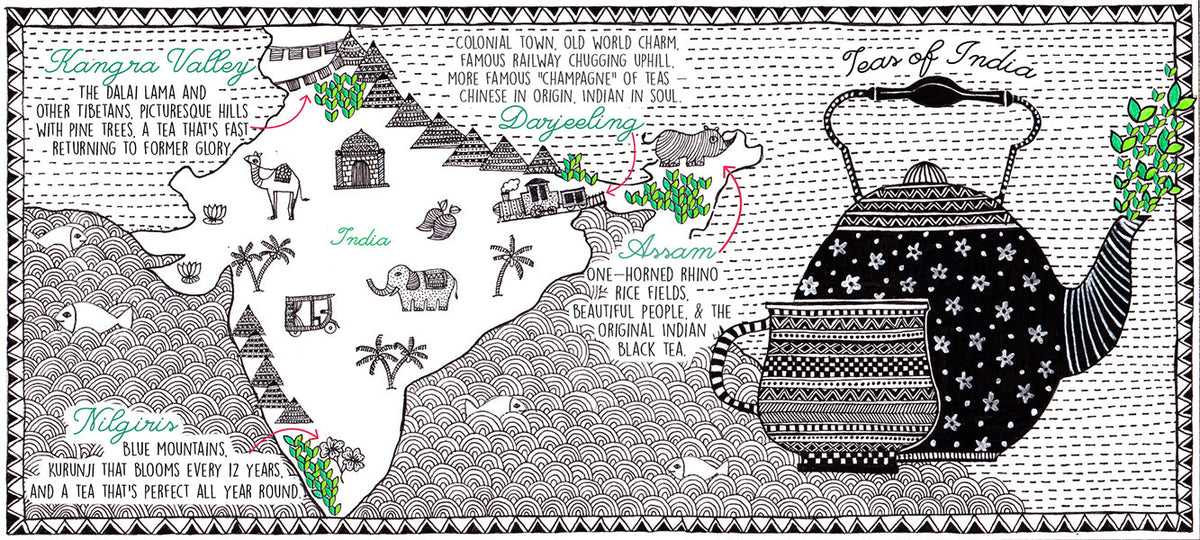
It’s an oft-told story of how the British smuggled tea plants into India from China and successfully broke the Chinese monopoly over it. India’s hills were fertile for tea and by the 1860s a tea industry had come into existence. The most famous of the tea-growing regions are Darjeeling, Assam, the Kangra valley, the Nilgiris and Sikkim, collectively producing over a whopping 1200 million kg of tea in a year!* And the teas that come from each of these regions are as distinctive as the place itself. So here’s a quick guide to four of India’s best-known teas and where they come from.
Darjeeling
Situated by the Himalayan ranges, the Darjeeling valley belongs to the eastern Indian state of West Bengal. It’s picturesque, enjoys great weather and is hugely popular among tourists. The Darjeeling toy train, part of the Darjeeling Himalayan Railway and a pleasant way to view the hills, holds UNESCO World Heritage status. But perhaps its most famous export has been its teas. Famous as the champagne of teas, Darjeeling tea is known for its complex and ethereal flavors. In summer, a special variety is produced, described as muscatel, referring to the tea’s spicy fruitiness. A tea lover’s delight, Darjeeling teas are suitable for both critical drinking and a leisurely sip.
Assam
Assam lies in the northeastern corner of India, beyond the strip leading from West Bengal. The Himalayas lie on one side and the mighty Brahmaputra flows through, creating a very fertile plain. It’s a biodiversity zone and home to the one-horned rhinoceros, the Bengal tiger, the gharial and the pink-headed duck. Suffice it to say, several endangered species exist here and conservation is a big movement around these parts.
Assam is also the single largest tea-growing region in the world. Assam teas are native to the region; the story goes that a Scottish adventurer, Robert Bruce, found the plant growing wild and that local tribes were using it to brew what seemed like tea to him. His brother, Charles, was the one who sent samples of the plant to Calcutta, where the species was identified as a variant of the Camellia sinensis. Assam teas are bold, brisk and the best tea to start your morning!
The Kangra valley
Situated in the northern parts of India, in the state of Himachal Pradesh, Kangra’s most famous resident is the Dalai Lama, the exiled Tibetan leader. The region is also home to a large settlement of exiled Tibetans and attracts followers of Tibetan Buddhism. As a tea region, Kangra is seeing a slow return to former glory. While tea grew here in the late 18th century, earthquakes left the region and its tea gardens floundering for an inordinately long time. Kangra tea is beginning to find its bearings among Indian teas and is fast growing in popularity for its high quality.
The Nilgiris
The Nilgiris are part of the mountain range of the Western Ghats lining the southwestern fringe. The Nilgiris, or blue mountains, are famous for the kurunji (Strobilanthus kunthianus) flower that blooms here, but only once in 12 years. For the tribes of these hills, the blooming of the kurunji has been a way to gauge their own age.
Tea arrived here with the British, who decided to experiment in tea planting. Samples were brought and planted, and they grew and flourished. Today, the Nilgiris produce some high-quality black tea (particularly the winter flush frost tea) that’s distinctive from its Darjeeling and Assam brethren, enough to merit its own GI status.
*Source – Indian Tea Association
Illustration by Handmade by Radhika
Originally published on Still Steeping, the Teabox blog, on May 12, 2015. Lightly edited for clarity in October 2026. Taste the regions in this guide: explore our single-estate Darjeeling teas or our single-estate Assam teas.

Leave a comment
All comments are moderated before being published.
This site is protected by hCaptcha and the hCaptcha Privacy Policy and Terms of Service apply.