


First published in October 2021, as Unilever was preparing to sell its tea business; the status of the Lipton brand is as it was at the time.
Recently, the world’s largest tea brand, Lipton, has been put on the block by FMCG giant Unilever, sounding the final note for a century-old company. Despite its tragic end, how the 131-year-old tea brand emerged from the slums of Glasgow is a fascinating tale of the entrepreneurial spirit of its iconic founder, Thomas J. Lipton.
Childhood
Born on May 10th, 1850, to Thomas Senior and Frances, Thomas Johnstone Lipton was the youngest of five children. His parents were of Irish origin, but they emigrated to Glasgow (Scotland) to escape the Irish potato famine, which lasted from 1845–1852 and wiped out a population consisting of millions of people. As emigrants, they lived in a four-room tenement at 10 Crown Street-Hutchesontown, in the poverty-stricken Gorbals area of Glasgow. Growing up in a penny-pinching environment, a young Lipton managed to attend St. Andrew’s Parish School, paying a fee of 3 pence a week. It is there that he mastered the basic three Rs of education: reading, writing, and arithmetic.
Early life and work
However, given the dire circumstances of the family, he was soon forced to leave school, early on in 1860. Needing to support his family economically, he got his first job as an errand boy at A & W Kennedy, Stationers, for half a crown. But the desire for more had already taken root in young Lipton, who soon left to cut shirt patterns for double the wage at Tillie & Henderson. Despite a raise, the overtaxing work left him feeling underpaid, leading him to demand a whopping 25% increase in wages.
Denied the much-needed raise, he quit and, in 1864, went on to work as a cabin boy on the Burns Line between Glasgow and Belfast. It earned him a wage of 8 shillings a week. The job held much appeal for the young Lipton, as stories from seasoned sailors steadily built his fascination with America.
In Lipton’s words, describing his experience with the Burns Line company: “it was good to be alive and better still to be a cabin-boy on a gallant Clyde-built steamship.” The joy of the job was short-lived, as he was soon dismissed for allowing a cabin lamp to smoke and discolor the ceiling. His main takeaway from the job, however, was his lasting fascination with America, and after his dismissal, he used his savings to buy a steerage passage to New York. At the time he leaves for America, he is barely 17 years old!
Life in America
In America, he soon immerses himself in a plethora of jobs available to immigrants, working on the tobacco and rice plantations of Virginia and South Carolina. He gains finance and bookkeeping skills at Coosaw Island, skills that later serve as a good grounding in running his enterprise. Later he returns to New York in search of another adventure. A chance encounter with another Irish entrepreneur, Alexander Turney, provides an opportunity, working at a department store, that would change his life later. Working in the store, he picks up the American way of salesmanship and advertising that would serve him for a lifetime.
It is in 1869 that he again goes against the grain. At a time when immigrants were traveling to America seeking opportunities, he displays an unconventional streak and decides to return to Scotland.
Return to Glasgow and a new beginning
Lipton’s arrival in Glasgow has remarkable historical significance. On his arrival, he hires a cab and places on top a rocking chair and a barrel of flour for his mother. He would later use this in his adverts. Soon after his return, he takes over his parents’ shop and turns its fortunes around using all his learnings. In 1871, at the age of 21, Lipton went on to open his first store, Lipton’s Market, at 101 Stobcross Street in Glasgow.
His store brings a new experience of retail to Scotland! Using attractive bright lights and displays, the store serves as a great attraction. Using another selling technique, learned from his mother, he cuts off middlemen and deals directly with Irish farmers for fresh farm produce.
He uses ‘fresh’ as bait to attract more customers.
Spending an average of 18 hours a day in his shop, often sleeping on a makeshift bed under the counter, his efforts paid off in heaps, with his shop at Stobcross doing so well that in 1876 he moved to larger premises at 21/27 High Street. By 1882 he had shops in Dundee, Paisley, Edinburgh, and Leeds.
It was with stunts and advertising that Lipton went on to make his mark. He employs the talents of Willie Lockhart, a leading cartoonist. Willie produces weekly posters for him that lead to a huge surge in popularity.
Turning to the tea trade
By 1890, with nearly 300 stores, Lipton turned his attention to the tea trade. By then, the growing demand for tea in England had caused much stir, and traders of all kinds began to see it as a profitable venture. Lipton, with his keen sense of business, soon started learning more about the tea trade from London brokers. That led him to the decision to do what he had been doing with much success: “cut out the middleman, with profit alike to myself and my customers.”
With his eyes on the next venture, he secretly booked a passage to Australia but disembarked at Colombo, Ceylon, to visit the tea plantations. The tea industry was still in its early years in Ceylon when Lipton arrived on the island in 1890. Originally, Ceylon had coffee plantations, but beginning in 1869, an outbreak of the fungus Hemileia vastatrix led to a decline. By 1878 the fungus had wiped out coffee cultivation in Ceylon, resulting in increased tea production.
Lipton wanted to reduce the price of tea, with the explicit aim of providing the poorer working classes in Scotland with an affordable product. He decides to cut out the middleman wholesaler; he buys his own tea estates, or ‘tea gardens,’ in Ceylon, Sri Lanka. He smartly decides to enter into a partnership with another Scot (James Taylor). Within a short period of time, he owns five plantations, with his favorite being Dambatenne, seizing the manufacturing process.
To attract blenders, he offers to double their current salary, and they soon start working for Lipton. The tea was fresher and, of course, he had a new slogan ready: “Direct from the tea garden to the teapot.” Drawing upon his grocery experience, he decides to modernize the packaging. Earlier, tea was sold straight out of large chests, by weighing the requested amount for each customer, leading to poor quality. Lipton introduces standard sizes: ¼ lb, ½ lb, and 1 lb.
He uses ingenious marketing to drive a demand for the tea that his 300 shops could not satisfy. In the process, Lipton became the trademark of a national commodity and a household name. His shops had made him a millionaire, but tea made him a multimillionaire.
Going public and Lipton today
In 1898 Lipton “yielded to the public clamor” to become a limited company. The professional view of the company was that while it was rock solid, slow and steady growth would help to make overall expansions.
Public affection for the brand leads to an unprecedented rush, with police regulating crowds at the National Bank of Scotland. Applications are received for almost £50m (a whopping £10B in today’s terms). On 2nd June 1898, Lipton directed his first shareholders’ meeting. In the same year, 1898, Lipton, at the age of 48, travels to the Isle of Wight to be knighted by Queen Victoria. He is also given a baronetcy in 1902, making him the Baronet of Osidge in Southgate, Middlesex. As a public company, Lipton’s continues to prosper, increasing turnover and dividends as predicted.
However, the situation changed in the 1920s. Large companies such as Home and Colonial Stores and Van den Berghs (later part of Unilever) enter the competition. In 1927 Van den Berghs acquired 25% of the shares. Lipton, now Sir Thomas, hands the chair to Sir Ferguson and retires as life president.
However, within two months he sold his interests to the Meadow Dairy Company (controlled by Home and Colonial). He is reputed to have been paid £1,000,000.
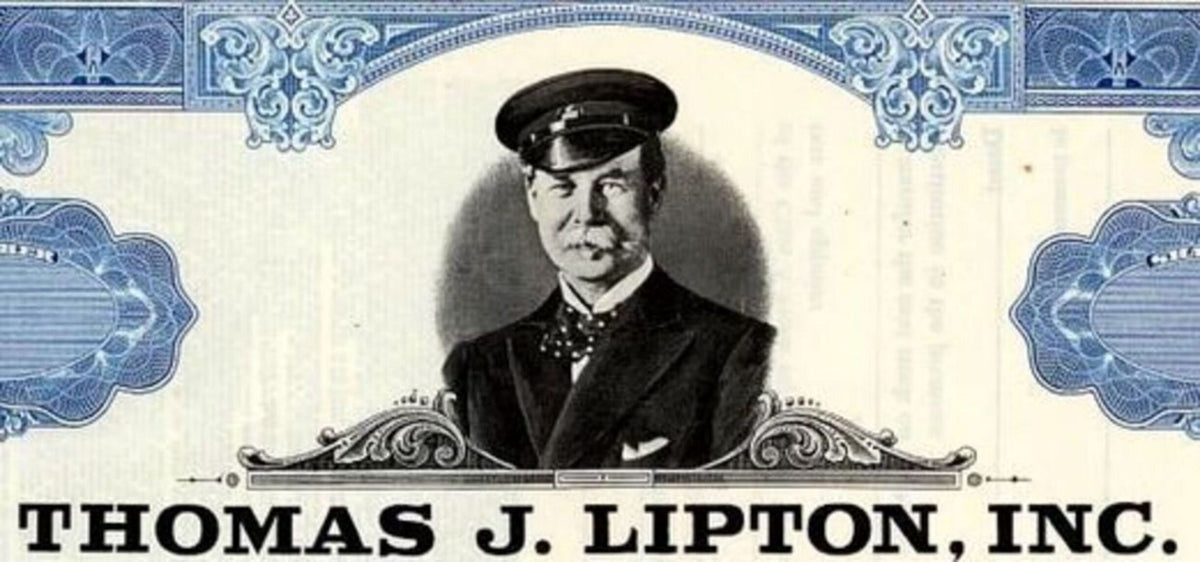
However, he does not relinquish control of his American company, Thomas J. Lipton Inc., or his tea interests in Ceylon. He passed away peacefully in his sleep at his home in Osidge on the 2nd October 1931. In 1937, a High Court order allowed his trustees to sell his interests, with the proceeds going to the Lipton Trust for the benefit of the poor in Glasgow. By 1946, the Lipton Trust had donated a total of £821,000 to the city. In 1972, the CPG giant Unilever bought the brand.
The legacy of Sir Thomas Lipton lives on, especially in Sri Lanka’s highlands, in Dambatenne Plantation. A statue and a seat, dedicated to his memory, facing the plantation still exist to this day. The place where the Glaswegian maverick decided to build his empire of tea.
Originally published on Still Steeping, the Teabox blog, on October 29, 2021. Lightly edited for clarity in October 2026.



Leave a comment
All comments are moderated before being published.
This site is protected by hCaptcha and the hCaptcha Privacy Policy and Terms of Service apply.