


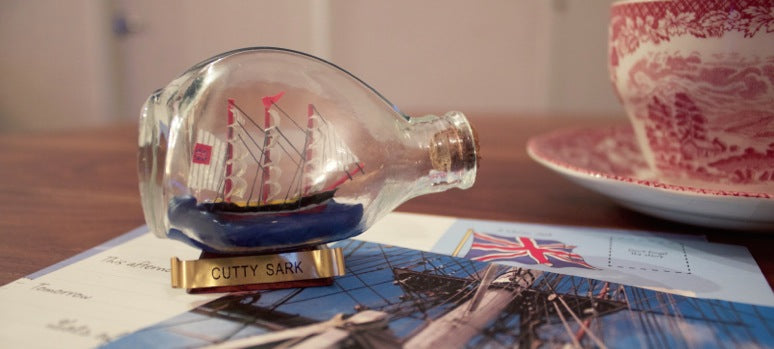
There’s an old Robert Burns’ poem, Tam O’Shanter. It’s a rather long narrative that tells the story of a Scotsman after whom the poem is titled.
Now, Tam O’Shanter, who likes his drink and fears his wife, is riding home one night when he sees a fire in the distance. A storm’s brewing, and he really ought to be going straight home, but of course he doesn’t. Instead he draws closer to the fire, and what he sees is frightening – a bonfire blazing by the church and several women dancing around it with gay abandon. He realizes they are witches, and that ought to send him packing in a hurry, but one of them, the youngest of the lot, wearing only a cutty sark (a short chemise given to young Scots girls by their mothers as a coming-of-age ritual), grabs his attention. He’s so immersed in the goings-on that he doesn’t realize what he’s doing when he shouts out, “Well done, Cutty Sark!”
The witches wheel around and catch sight of him. They are livid. A chase ensues. Tam is riding for his life. He eggs his horse on with the witches hot on his heels… And then he remembers: witches cannot cross over water, and so he makes for the river. At the bridge, Nannie “Cutty Sark” lunges forward and grabs his horse’s mane, but Tam manages to get on the bridge with his now maneless horse and make his escape.
If you enter Greenwich and make for the riverside, instead of the observatory to straddle the Prime Meridian, you’ll see a beautiful ship, buffed, polished, and inviting. She’s not in the water – dry-docked as she is – but the Thames flows nearby. On a clear day, she shines against the sky. Her name is Cutty Sark, named for that very line in the poem: “Well done, Cutty Sark.” She’s one of the last tea clippers ever built, and she was commissioned by a man named John Willis, a rather successful Victorian-era ship owner.

The 1800s saw the heyday of the sailing era, especially in the tea trade with China. But when the East India Company’s monopoly over the tea trade ended, and American clippers entered the fray, the seas began to see much action: tea races! The London tea brokers were probably responsible for this – starting in 1856, they offered a princely sum of £1 per ton of tea to the first ship to unload her tea on the dock.¹
The races became a regular feature, although it’s the 1866 one that’s now called the Great Tea Race. In May 1866, nine tea clippers gathered at the port of Foo Chow, awaiting their cargo of the first teas of the season. The race began. The top contender was the Fiery Cross, who had won the race in ’61, ’62, ’63 and ’65. In ’64, she was beaten by the Serica, who was also sailing now. Three ships arrived in London after 99 days – the Ariel, the Serica and the Taeping – all riding the same tide and displaying some pretty amazing nautical skill. What’s more, all three had Scotsmen as ship masters, something that has been a matter of great pride to their people.
Ship owner Jock Willis viewed these proceedings rather unhappily, having failed to see any of his ships win a race. He commissioned the firm of Scott & Linton to build him “a tea clipper to beat all others!” In 1869, the ship was ready, and, Scotsman that he was – and one who clearly enjoyed Burns’ poetry – Willis christened her the Cutty Sark.
But although she made eight voyages to China for tea, Cutty Sark was never the fastest tea ship. She never won a tea race.
By 1879, steamships had made their entry and began to be favored as tea carriers. The Cutty Sark began to take other cargo, mainly wool from Australia. And it was here that she finally came into her own. She had a successful run, making a name for herself as the fastest ship in the wool trade.
Cutty Sark was later acquired by Spanish owners, but in 1923 she was bought by an Englishman, Wilfred Dowman, who fancied her enough to pay more than her value. The ship returned home to England. It’s said that Dowman worked hard to restore her to her original glory.
Following Dowman’s death, his widow gave the ship to the Thames Nautical Training College. Cutty Sark’s journey continued from there on to the Cutty Sark Trust, which ensured she didn’t make for the scrapyard.
In 1954, Cutty Sark was brought to Greenwich. Lovingly and extensively restored, and open to the public since ’57, she continues to play host to millions who come to hear the stories of another era.
¹ https://www.keithdash.net/Mariners/MacLean.pdf
From our readers
Comments left on the original Still Steeping post.
Mary Murtagh · October 27, 2015
A wonderful story from both a literary and historical perspective. Well done.
Thank you,
Aravinda Ananth replied to Mary Murtagh · October 28, 2015
Thank you Mary, glad you enjoyed it.
Belli · November 13, 2015
Loved this article. When you mentioned Cutty Sark I thought it had something to do with the Scotch Whisky which is popular in the market. I looked it up and here is how that name came about.
CUTTY SARK BLENDED SCOTCH WHISKY
Cutty Sark blended Scotch whisky conceived on 23rd March at No. 3 St James’s Street. The partners of Berry Bros. & Rudd, Francis Berry and Hugh Rudd, meet with Scottish artist James McBey for lunch. The conversation turns to whisky and it is decided to create a new, lighter style of blended whisky for the USA. McBey suggests the name Cutty Sark as the ship had recently been retired to England for naval training. The famous yellow label was the result of a printer’s error!
Aravinda Ananth replied to Belli · November 13, 2015
Thanks Belli. And of course, made more famous by the whiskey now :).
Joyce Stein · December 2, 2015
A lovely article. One correction: Please correct the “Cutty Sark” date. It should be 1869 instead of 1969.
Aravinda Ananth replied to Joyce Stein · December 3, 2015
Thanks Joyce! And for pointing out the error too!
Originally published on Still Steeping, the Teabox blog, on October 23, 2015. Lightly edited for clarity in October 2026.


Leave a comment
All comments are moderated before being published.
This site is protected by hCaptcha and the hCaptcha Privacy Policy and Terms of Service apply.