


Oolong comes from Fujian province in southeast China, though no record says exactly when the first one was made; its name, wu long, means “black dragon,” and two old stories explain it.
Why is oolong called “black dragon”?
Two stories explain the name: a folk tale about a tea grower called Wu Long, and the older history of tribute teas pressed into cakes stamped with a dragon.Read more
The tea grower and the deer
In the popular folk tale, set in the Qing dynasty, a tea grower walking home from plucking was distracted by a deer and forgot to process his leaves. By the time he did, they had begun to wilt and darken, so he gave them only a little more oxidation.
The tea was like a black tea without the bitterness: smoother, sweeter and more fragrant. He named it after himself, Wu Long, which also means black dragon.
The tale is a fair picture of what oolong is. Leaf left to wilt and darken a little, then stopped, is exactly the partial oxidation every oolong maker still aims for.
Dragon and phoenix tribute cakes
The other story goes back to tribute teas, pressed into cakes stamped with a dragon or a phoenix (fenghuang). In the Song dynasty, says our 2014 blog, these cakes were also traded for horses, and the name “black dragon tea” grew from them.
Tea was big business by then. The same post notes that Song dynasty tea farms were already spread over “a whopping 242 counties.”
When pressed tea went out of fashion, the same teas were made loose: oxidized in bamboo baskets, rolled into small curls and baked, very much as an oolong is made.
How did oolong reach Taiwan?
Oolong as we drink it today took shape in Fujian during the Ming and Qing dynasties, in the 17th and 18th centuries, and settlers from Fujian carried it across the strait to Taiwan.Read more
Settlers from Fujian, pioneering tea makers among them, crossed the shallow Taiwan Strait in the mid-18th century. They carried their bushes and skills to Taiwan (then Formosa), whose tea makers refined them into the oolongs many drinkers now treat as the benchmark.
Taiwan in turn spread the craft. When demand for its small-batch, handmade oolongs outgrew supply, Taiwan began exporting Formosa tea cultivars and tea-making experts to Thailand, around Doi Mae Salong in Chiang Rai, and to Vietnam. Those farms now ship Formosa oolongs back to Taiwan, to Japan and to the West.
The Formosa style reached India’s hills too. In Kangra, the Dharmsala Tea Company makes Formosa pouchongs alongside its hand-rolled oolongs. More of the story is in The history of tea.
How is oolong drunk in Taiwan today?
In Taiwan, oolong is brewed in small pots with lots of leaf and very short steeps, poured into tiny cups and drunk plain, many rounds from the same leaves.Read more
Writer Zac O’Yeah watched it done for us in Pinglin, the Bao Jong country near Taipei. His host, Uncle Wang, first rinsed the leaves to wash away the tea dust, which Taiwanese drinkers see as an unwanted by-product.
He then steeped them “barely for a few seconds” and poured the tea into shot-sized cups, round after round, for more than ten cups. Cold tea there is never sweetened, and the standard weight for selling tea is 600 g.
Our guide to brewing oolong at home, both the everyday way and gongfu style, is in What is oolong tea?
When did India start making oolong?
India came late, in the 1990s, when green and oolong teas grew suddenly popular and Indian tea makers, long masters of orthodox black tea, began to offer semi-fermented teas as well.Read more
Frank Miller, writing for us in 2017, judged that the early ones were not up to the mark. But in the years since, he found, tea makers there had begun to turn out some very refined oolongs, though their take is different from Taiwan’s.
The first Darjeeling oolong came out of Sumon Majumder’s experiments with a “Formosa oolong” at the Namring estate in the early 1990s. His story, and the estates that make oolong today, are in Indian oolong tea.
Keep reading
Sources
- Teabox blog: Meet the man who created the Darjeeling oolong (2015), India vs. Taiwan: The Oolong Challenge (2017), How is tea made? (2015), The beginner’s guide to choosing a Darjeeling (2017)
- Teabox blog: A Nilgiri girl in Darjeeling (2017), In Kangra, for a tour of the tea gardens (2017), The tea navigation paths: artisan and agribusiness (2017), Mountain megabrands (2016), The finest cup of tea in Beijing (2017), A 9-step program to surviving the broken teapot (2016)
- Teabox blog (Still Steeping): An ode to oolong tea, 2014; 10 Most Expensive Teas in the World, 2021; Tea in Taiwan with Uncle Wang and Grandpa Hu, 2015; Caffeine in tea? Stop worrying!, 2016
- Teabox Tea 101: What is oolong tea?, A brief history of the oolong tea, How to choose an oolong tea, Types of tea
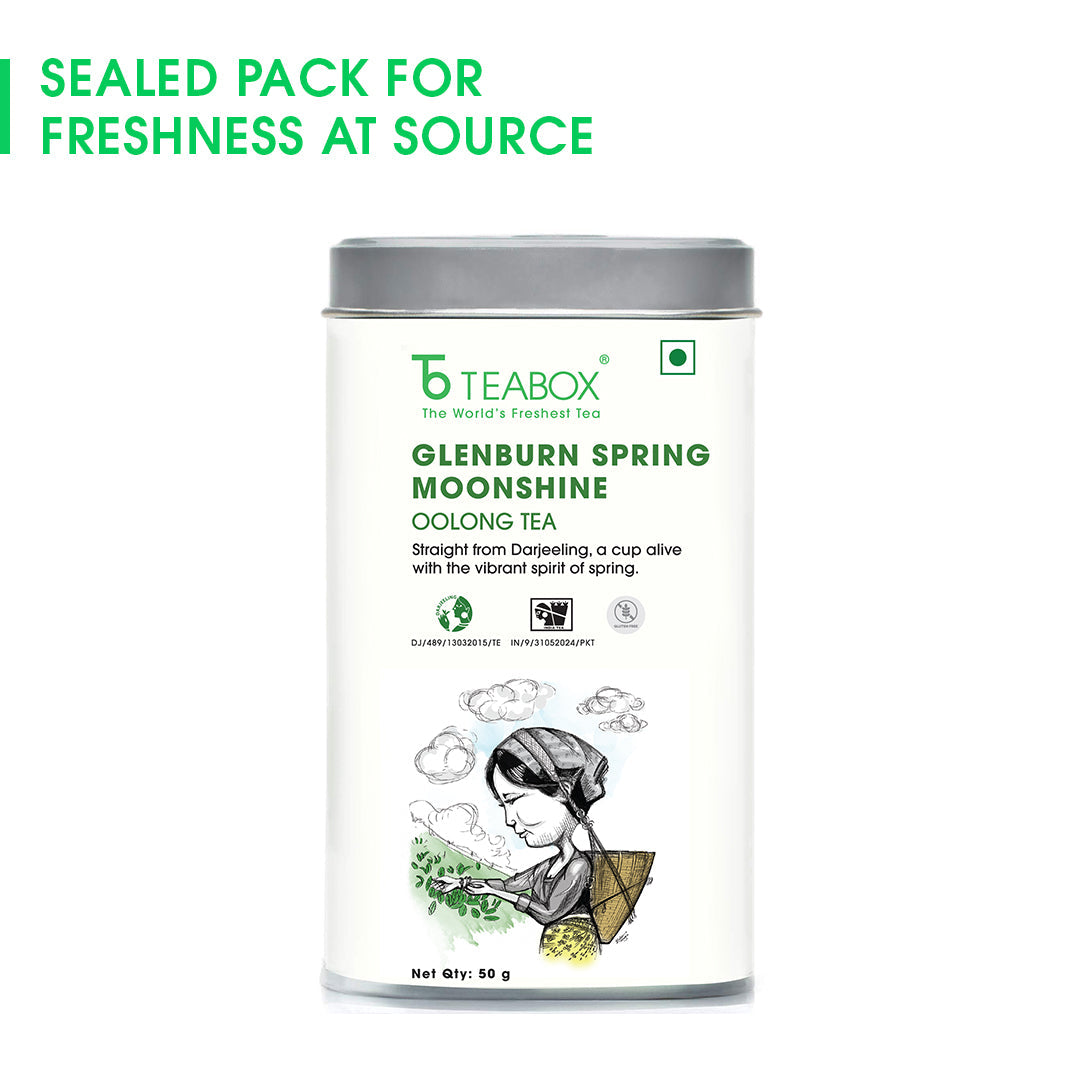
- Teabox product pages, 2026 season: Glenburn Spring Moonshine Oolong, Upper Namring Spring Clonal Black, Thurbo, Margaret’s Hope and Castleton; product data for Singbulli Spring Flowery Oolong and Himalayan Red Thunder Autumn Oolong (2022 lots, not on sale now)
- Teabox Drive: Teabox internal document, 2025; Teabox internal document, 2022; Teabox internal document, 2018; Teabox internal document, 2015; Teabox internal document, 2023; Teabox internal document, 2018; Teabox internal document, 2023; Teabox internal document; Teabox internal document, 2016; Donyi Polo and Darjeeling oolong product photos, factory and estate photos as credited
- Teabox on Instagram (@teabox.tea): Thurbo autumn oolong, Feb 2017, Donyi Polo summer oolong, Aug 2017, Marigold Berry Muse, Feb 2018, Glenburn spring oolong, Mar 2018, Kewra Delight Oolong, Oct 2018, Donyi Polo spring oolong, May 2019, Bermiok spring oolong, May 2019, Bermiok estate, May 2021, first oolong of 2021, Singbulli oolong launch, May 2021, our tasters, May 2021, Mann Tea Estate, Feb 2022, Singbulli tasting scores, Apr 2022
- Kausshal Dugarr on X (@Teapreneur): Da Hong Pao, Oct 2021, one plant, Apr 2022
- Teabox on YouTube: Bermiok Tea Estate, Prateek Poddar, Namring Tea Estate, Arunachal Pradesh, Teabox Masterclass


Leave a comment
All comments are moderated before being published.
This site is protected by hCaptcha and the hCaptcha Privacy Policy and Terms of Service apply.