


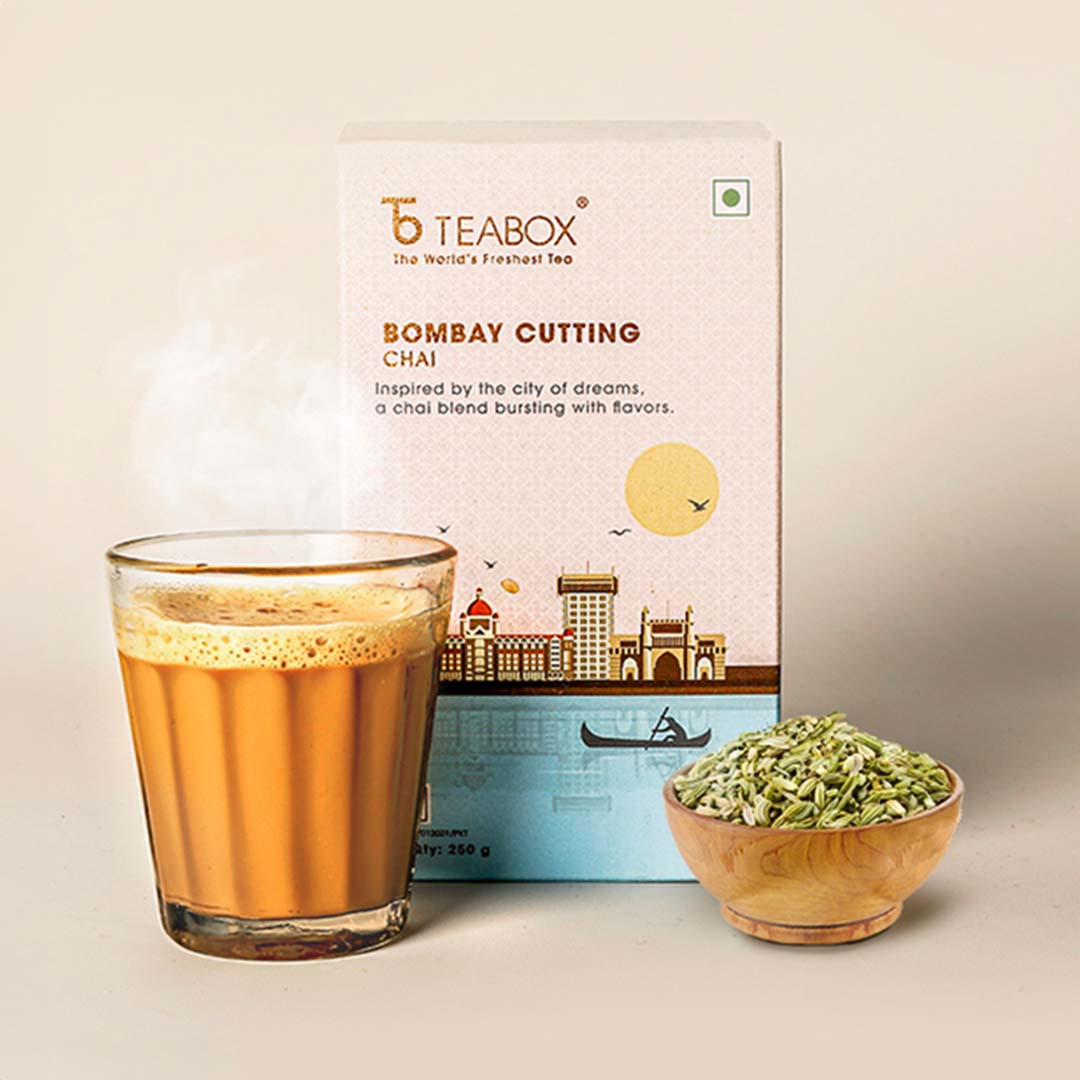
A cup of masala chai has four parts: a strong black tea, whole or ground spices, milk, and a sweetener. Tea 101 describes it as “a decoction of a strong black tea (orthodox or CTC) that’s simmered with sweetened milk.” Plain chai, without spices, is simply black tea boiled with milk and sugar.
Below we take each part in turn: what it adds to the cup, and the measures our own team works with.
What tea is used in chai?
Most chai in India is made with Assam tea, often the granular CTC kind, because it stays strong and malty under milk.Read more
Our own masala chais are made the same way: our chai FAQ describes them as “primarily made from black CTC tea.” CTC (crush, tear, curl) leaf is cut into small granules that give up their color and strength quickly, which is what a cup needs when it is about to be diluted with milk and sweetened.
Keen, writing for our blog in 2017, traced chai’s rise as India’s household and street drink to the shift from hand-processed whole leaf, mostly exported, to lower-cost CTC. CTC, he wrote, is “the base for tea bags and for chai,” fast-brewing and easy to add flavorings to.
How much leaf, and how much caffeine
Brewed tea has close to no calories. It does carry caffeine: Tea 101 puts a cup of chai at about the same as a cup of black tea, roughly 50 mg, though the real amount varies with the leaf, how much you use, the water temperature and how long it brews. Our chais made with tea leaf carry a High caffeine rating on our product pages.
How much leaf goes in matters as much as which leaf. Our steeping sheet gives one teaspoon, about 2.5 g, for every 150 ml cup of chai, and our training deck gives 2.5 g for 180 ml. For the full picture, including decaf and caffeine-free chais, see Does chai have caffeine?
Which spices go into masala chai?
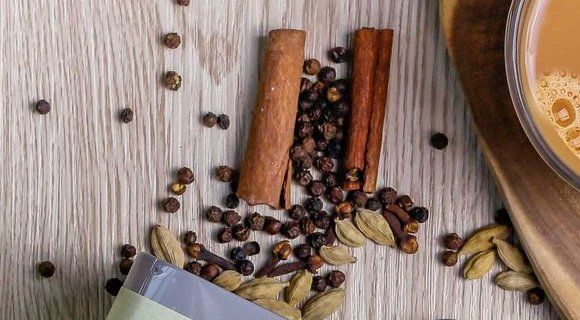
The usual masala is some mix of green cardamom, ginger, cinnamon, clove and black pepper, with fennel, star anise, nutmeg, lemongrass, mint or saffron in regional styles.Read more
The quantities are small: a pinch of masala or a small piece of ginger shared across two or three cups. In Indian homes a chai is often named for its main addition: ginger makes it adrak chai, fennel makes it saunf wali chai.
Our staff training manual adds ajwain (bishop’s weed) to the list of chai spices. Keen’s list for a fine masala chai was cardamom, cinnamon, ginger, cloves, mace, nutmeg and pepper, with fennel, lemongrass, saffron and “even ajwain,” which he called “a pungent and bitter herb.”
At home the choice is often whatever is at hand. One of our writers remembered her mother tossing in “anything she could reach in her spice box, cardamom, cinnamon, clove, fennel” when it was raining or nippy outside. More on blends in Chai spices and chai masala.

How much milk goes into chai?
Milk brings body, and most of a homemade chai’s calories; Tea 101’s method uses about two parts water to one part milk.Read more
That works out to roughly 75 ml of milk in a cup. Milk also contains its own natural sugar (lactose), about 5 g per 100 g, which is why a chai with no added sugar still shows a few grams of sugar on paper.
Home recipes vary widely, and the milk is where they vary most. Our 2016 blog recipe used three-quarters of a cup of water to half a cup of milk. One writer’s mother worked the other way around, with “one part water, two parts milk.” The more milk, the more calories, as the table on the main guide shows.
Ginger and milk
Ginger has an odd relationship with milk. A Mumbai chai lover who wrote for our blog found his ginger chai curdled whenever he made more than one cup. The reason, he learned from research on cheesemaking, is an enzyme in ginger that clots milk protein most actively above 60°C and is switched off above 70°C. His fix: boil the ginger in the water first, or add it only once the milk is very hot. Our founder’s verdict on that story, when he shared it in 2020: “If you love your Ginger Chai, this is a must read.”
The writer, Srinath Perur, found that the two fixes taste different. Boiling the ginger in water first gives the chai “a brash ginger burn,” while adding it to milk hot enough to sizzle against the side of the pan gives “a mellow glow.” Read the whole story in The Science Behind My Ginger Chai.
How much sugar is in chai?
Sugar is the part that varies most, from none at all to several spoonfuls a cup.Read more
A street-side chai in India is often generously sweet; the same blog writer called the chai at his local stall “a tea-flavored energy drink.” On high-altitude treks, one of our writers found that the camp cook, careful with his spices, “compensates with sugar,” so the last milky chai of the night “also doubles up as the dessert.”
Many home cups are far lighter. One writer’s mother made her chai with “just one short spoon of sugar.” Another remembered her mother’s “milky cardamom tea with half a teaspoon of sugar.” That half teaspoon is the sugar in our lighter chai recipe. On World Diabetes Day in 2024 we asked our own customers to “rethink our sugar habits,” and to add less sugar to their chai or choose chais that need little or none.
What is in the Instant Chai Latte Mix?
Our Instant Chai Latte Mix is the one Teabox chai that comes with milk already in it: tea extract, spices and dairy whitener, with no added sugar.Read more
Its listing names the spices as cardamom, ginger, cloves, cinnamon, black pepper, nutmeg and saffron, and declares “Contains Milk Solids,” so it is not suitable for anyone avoiding dairy. A pack holds ten 14 g sachets, each made up with 100 ml of hot water.
No added sugar is not the same as sugar-free, and the listing says so: “It is not sugar-free, but it contains No Added Sugar. Any sugar present comes naturally from the dairy whitener (lactose).” Its caffeine comes from the Assam tea extract, at a level the listing calls “similar to a regular cup of chai.”
Keep reading
Sources
- Teabox blog: The Science Behind My Ginger Chai (Srinath Perur, 2015); Would you like some sugar in your tea? Or a little tea in your sugar? (Peter G. W. Keen, 2017); The Journey of Our Beloved Chai (Samvit Kher, 2020); Tea on a trek (Sriparna Ghosh, 2015); Chai and snacks: The Indian tea time (Prachi Sibal, 2015)
- Teabox blog (Still Steeping): Vinayak Varma, A tea for all ailments, 2016; Ancient Remedies in Modern Times: Ayurveda and Yoga, 2020; Peter G. W. Keen, Tea vs health: You be the judge and the jury, 2016; Meeta Sharma, Chai: the way India drinks tea, 2015 (with her reply to a reader); Saloni Samant, How to make Indian masala tea, 2016
- Teabox Tea 101: Why everyone should drink chai tea? (Health and chai) (older version, rewritten here); What’s the difference between tea, chai, chai tea?; How to make chai; How to choose a chai; Caffeine in tea
- Teabox product descriptions, ingredient lists and product data (caffeine ratings, allergens), October 2026: Rajasik, Rasayana, Ashoka Ras, Ojas Ras, Abhay Ras, Amrita and Soma chais, Ayurvedic Chai Trial Pack, The Ramayana Chai Collection, Instant Chai Latte Mix, Kashmiri Kahwa, Assam Halmari Summer Black
- Teabox Drive: Teabox internal document, 2022; Teabox internal document, 2023; Teabox internal document, 2025; Teabox internal document, 2018; Teabox internal document, 2023; Teabox internal document, 2026 (internal); product photos as credited
- USDA FoodData Central, SR Legacy: milk, whole (171265); milk, nonfat (171269); sugars, granulated (169655)
- Starbucks US website, Chai Latte and Iced Chai Latte nutrition, Grande, checked October 2026
- Teabox on Instagram (@teabox.tea): chai latte concentrate method, Jan 2020; Rasayana ingredients, Nov 2024; World Diabetes Day and sugar, Nov 2024; Ayurvedic Chai Sampler launch, Jun 2025; winter chais, Vata and Kapha, Dec 2025; Instant Chai Latte Mix launch, Feb 2026
- Kausshal Dugarr on X (@Teapreneur): sharing The Science Behind My Ginger Chai, Jun 2020


Leave a comment
All comments are moderated before being published.
This site is protected by hCaptcha and the hCaptcha Privacy Policy and Terms of Service apply.