


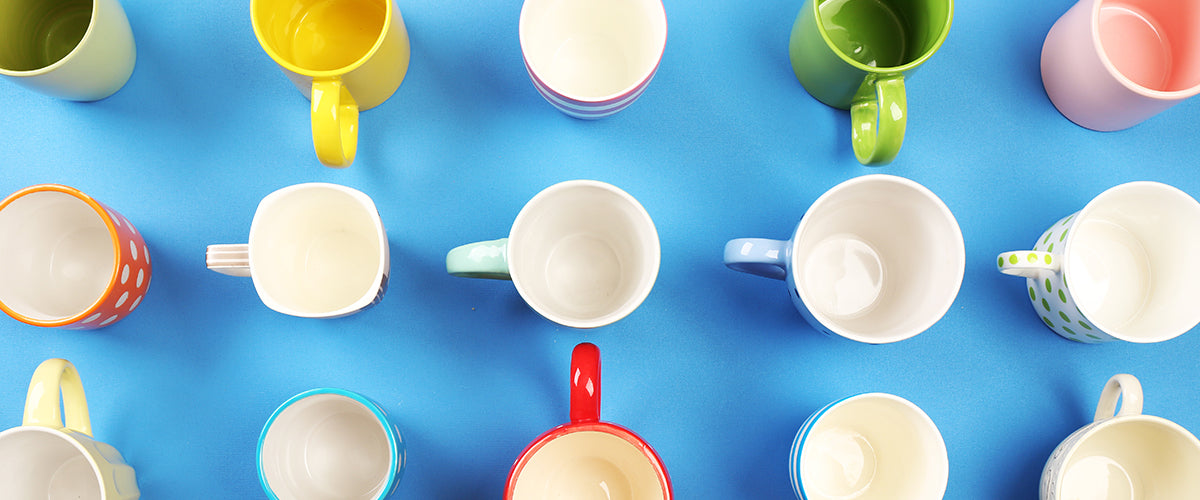
For most teas, the best cup is a thin-lipped porcelain or bone china cup, or a double-walled borosilicate glass; choose a sturdy glazed mug for strong milky teas, and a clay kulhad or small glass for chai. Pick by material first, then by shape and size. This part of our teaware guide takes each material in turn, with the cups we have sold and what our writers have learned drinking from them.
Why is porcelain the classic tea cup?
Porcelain is thin, smooth and essentially non-porous, so it adds nothing to the taste and lets the tea glide off a fine rim; that is why professional tasters still use it.Read more
Porcelain has been the material of choice for tea for centuries. Made from very fine kaolin, or china clay, and fired close to its melting point, it comes out thin, smooth, almost translucent and essentially non-porous, and its glaze does not react with tea.
Firing is what separates the clays. Our 2016 teacup essay gives earthenware as fired at 950 to 1,100°C and stoneware at 1,160 to 1,300°C, while porcelain is “typically fired at 2,300 degrees” Fahrenheit, around 1,260°C. Porcelain is hard to work because its clay lacks the plasticity of the others, and it “cracks and deforms easily in firing since the ideal density is achieved very close to the melting point.” The reward is a cup that is “thin, almost translucent, delicate and smooth.”
Bone china
Bone china adds bone ash to the clay and became the dominant material in English teaware; our essay credits its invention to Spode. Spode worked in Stoke-on-Trent, “a historic center of English ceramic production where the likes of Wedgwood, Spode, and Minton established their factories in the late eighteenth century,” as the art historian Romita Ray wrote for us.
Shape and the tasters’ choice
A porcelain tea cup feels fine on the lip and suits every tea, and porcelain is still what professional tasters use. Traditional porcelain cups are narrow at the base and widen toward the top, a shape that balances keeping the tea warm with opening up its aroma.
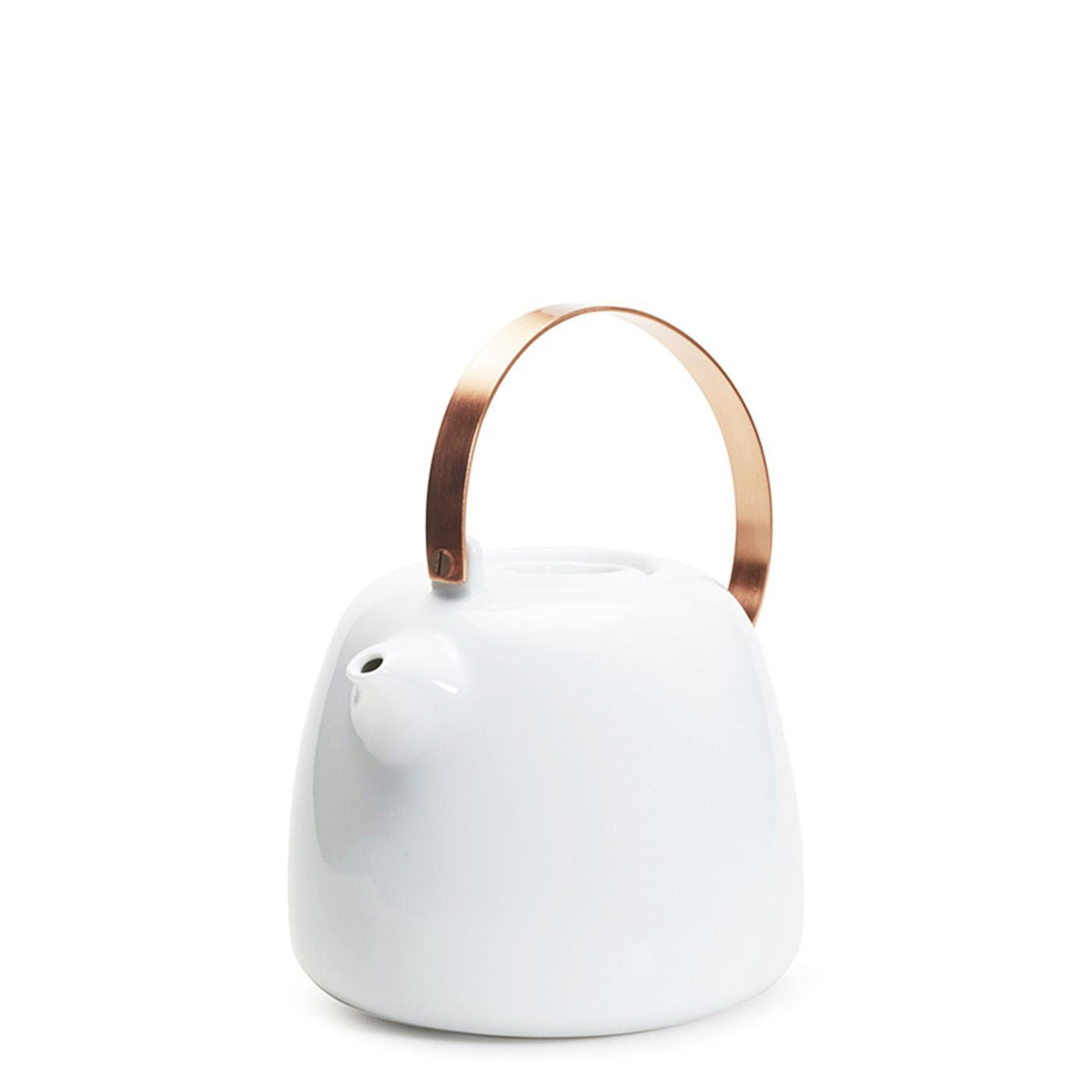
Our own porcelain has included the Heritage Holiday Tea Set of 2015, “handcrafted in porcelain,” with a teapot with a copper handle and four teacups, and the Jubilee Set of 2016, “a five-piece bone china tea set for two.” Our Heritage cup held 150 ml, the size a teapot “cup” is reckoned by.
Is a double-walled glass tea cup worth it?
Yes, for everyday tea: a double-walled borosilicate cup keeps the tea hot, stays cool to hold, never sweats, and shows you the color of the liquor.Read more
Glass is non-porous, very smooth and easy to clean, and borosilicate glass, which adds boric oxide to the usual ingredients, is tough and handles heat well. Its real pleasure is that you can see the tea: “the transparency of the glass shows both the color of the liquor and the unfolding of the leaf.” Peter Keen, writing for us, noted that it is “generally the same borosilicate that laboratory test tubes are made of,” and free of any plastic or metal taste.
How the double wall works
A double-walled tea cup is a cup within a cup, separated by a layer of air: the inner wall keeps the tea hot while the outer one stays cool to the touch. As we said when we first sold them: “No condensation. No coasters needed!” Of our Cyril cup and saucer we wrote that “being double-walled in design, it keeps the liquor hot for a long time and doesn’t burn your fingers too.”
Our Valencia Glass Teacup is double-walled borosilicate and works for hot and iced tea alike. Our spec sheet rates it from 0°C to 100°C.
Sizes we have sold
Glass cups come small. Our Duple Glass Teacup held 200 ml and our clear borosilicate Bolus Cup and Saucer 250 ml, while the Seidel infuser mug holds 300 ml. Measure your favorite cup before you weigh the leaf: about 2 to 2.5 g suits 250 ml, so a 200 ml cup wants a little less.
Treat a double-walled cup gently: its two thin walls are sealed around the air gap, so set it down softly and keep it clear of knocks against taps and counter edges. It also will not warm on a tea warmer, because the same air gap keeps the warmer’s heat out; see Teapots, infusers and tea makers.
Sit and Sip, or Glug and Go?
A thin porcelain rim slows you down and lets a delicate tea show its detail; a thick glass or stoneware rim invites a bigger gulp, which suits a bold breakfast tea.Read more
The biggest difference between porcelain and glass is not heat but the lip. Our tea essay summed it up as “SS for porcelain, Sit and Sip, and GG for glass, Glug and Go.” A thin porcelain rim lets the tea glide onto your tongue and invites you to slow down; a thick rim makes you take a bigger gulp, which is fine for a bold breakfast tea but hides the detail in a delicate one. The suggestion: a porcelain cup at home, and a double-walled glass with a built-in infuser for the office or travel.
The essay explains why: “The thinner the lip, the more you naturally let the tea glide onto your tongue,” while “the thick material of glass and stoneware retains the heat well, but it creates an autonomic reflex to take a big gulp of the tea.” Try it with the same Darjeeling in two cups and you will taste the difference.
And the saucer?
The saucer once had a job of its own. Peter Keen’s samovar story shows an 1860s St. Petersburg photograph by William Carrick of two carriers in a tea room; one is drinking from his saucer, “a habit among some of the working class in England and Ireland and prevalent in Russia for an obvious reason: cooling the hot tea quickly.”
Our writer Anik Basu found the habit in an unexpected place: Rabindranath Tagore poured his tea into his saucer at a tea in Japan in 1916 to 1917, though Anik doubts there is any Indian tradition of saucering.
What are kulhads and stoneware mugs like to drink from?
Stoneware makes sturdy, heat-holding everyday mugs with a thick lip for strong milky tea; the kulhad is India’s small clay chai cup, part of chai culture rather than fine-tea tasting.Read more
Clay covers a wide range. Earthenware is fired at lower temperatures and, unglazed, stays porous. Stoneware is fired hotter, is dense and heavy, holds heat well and makes most everyday mugs; its thick lip makes it a natural “Glug and Go” cup for strong milky tea. Our essay adds that because stoneware holds heat so well, it can crack under a sudden change of temperature, so do not pour boiling water into a cold stoneware mug straight from the fridge.
The kulhad
In India, clay means the kulhad, the small clay cup of the chai stall, also called a khullar or, in Kolkata, a matir bhaar. It belongs to chai culture rather than to fine-tea tasting. Kolkata, our founder wrote, is known for “its love for tea, matir bhaar & adda.”
The street kulhad is unglazed and used once. Our own kulhads were different: the Indus Kulhad (200 ml) and the Terra Mug (300 ml) were “handmade earthenware… hand-glazed & wood-fired ceramic,” made especially for us by master potters, a long-lasting version of what were “originally disposable mud pots.” Being handmade, each one had “some patches and spots on it and dissimilar finishes.” The glaze is what matters for taste: a glazed kulhad behaves like any glazed cup, while an unglazed one takes on the flavor of whatever it holds.
A potter in Kutch
For a gentle story of a clay cup of tea, read Pottering with Clay, about the Kutch master potter Ismail Siddiq. When Aditi De met him in February 1981, the National Award-winning potter, then 72, handed her “a warm khullar, a little clay cup of tea” while he fixed a handle to a cup with clay slip. “I am the only potter for a cluster of 20 villages near Bhuj in Kutch,” he told her. “Four times a year, the farmers come and take my pots… In return, they give me grain or goats.”
Are steel and plastic cups any good for tea?
Steel tumblers are nearly unbreakable but get too hot at the rim, and plastic is best kept away from hot tea; both are fine for travel and cold tea, not for tasting.Read more
Stainless steel tumblers are common in India and nearly unbreakable, but steel carries heat to your lips quickly, so the rim can feel too hot to sip. Plastic is light and cheap, but tea connoisseurs do not recommend it for hot drinks.
Steel is a different matter for brewing tools. A steel teapot “impresses tea with a metallic taste,” Adeline Teoh found, but a steel infuser spends only a few minutes in the cup and comes out clean. That is why our infusers and the Ideal Teaspoon are stainless steel.
The greener choice
There is a greener reason to choose well, too. We have long encouraged “100% borosilicate glass teapots, makers and cups, stainless steel infusers, and earthenware accessories in place of inferior quality material like plastic,” and loose leaf instead of teabags.
On Earth Day 2021 we pledged to cut our own plastic use by 80% by 2024, and asked tea drinkers to “use eco-friendly teawares such as borosilicate & stainless steel.” By November 2021 everything we shipped except teaware was wrapped in honeycomb paper instead of bubble wrap, and on Earth Day 2024 we reported that the pledge had been met.
Keep reading
Sources
- Teabox blog (Still Steeping): How the Teacup Got Its Handle (2016), Everything you needed to know about the kettle (2016), Pottering with Clay (2016), The Samovar: Kettle, Stove, Teapot and History (2016), A 9-step program to surviving the broken teapot (2016), A Mustache in a Teacup (2016)
- Teabox blog (Still Steeping): Microwaved, tepid, rolling boiling? Water for tea! (2016), The Teaspoon: Measure, Stir, Display or Steal? (2016), India vs. Taiwan: The Oolong Challenge (2017), Living the Life of a Tea Explorer (2015), Travel With Tea: Steep Anywhere, Anytime (2022)
- Teabox blog (Still Steeping): Good Tea Needs a Good Teacup, 2016; Not all teapots are created equal, 2016; ‘Attaining Tea Nirvana’ for the Lazy, 2015; The picky person’s guide to getting good tea while traveling, 2016; Beyond the tea bag, 2016; Drinking tea in Taiwan with Uncle Wang and Grandpa Hu, 2015; A saucerful of secrets: Tagore, the Orient and the Russians, 2016
- Teabox Tea 101: Choosing the perfect cup to serve tea; A brief history of tea makers
- Teabox product descriptions: Seidel Glass Tea Mug with Infuser, Valencia Glass Teacup, Elegant Ball Infuser, Ideal Teaspoon, Teabox Tea Timer, Indian Whole Leaf Trial Pack, Authentic Indian Chai Trial Pack (Festive Edition), and the teas named in the tables (October 2026)
- Teabox Drive: Teabox internal document, 2021; Teabox internal document, 2016; Teabox internal document, 2016; photos as credited
- Teabox on Instagram (@teabox.tea): testing accessories, Jun 2015, valve tea maker, Dec 2015, Heritage tea set, Dec 2015, Jubilee bone china set, Apr 2016, new glassware, May 2016, stoneware tea set, May 2016, Ash Gray mug, May 2016, double-walled cups, Jul 2016, infuser mug method, Nov 2019, chasen, Feb 2021, plastic pledge, Apr 2021, Cyril cup, Jul 2021, greener teaware, Aug 2021, borosilicate glass, Oct 2021, porcelain and glass, Oct 2021, three elements, Oct 2021, pledge progress, Nov 2021, loose leaf, Jun 2023, pledge met, Apr 2024
- Kausshal Dugarr on X (@Teapreneur): teacup thread, Nov 2021, tea bowls, Nov 2021, Kolkata, Nov 2021
- Teabox on YouTube: How to steep tea in a teapot, Handmade teaware collection, Seidel Glass Mug with Infuser

Leave a comment
All comments are moderated before being published.
This site is protected by hCaptcha and the hCaptcha Privacy Policy and Terms of Service apply.