


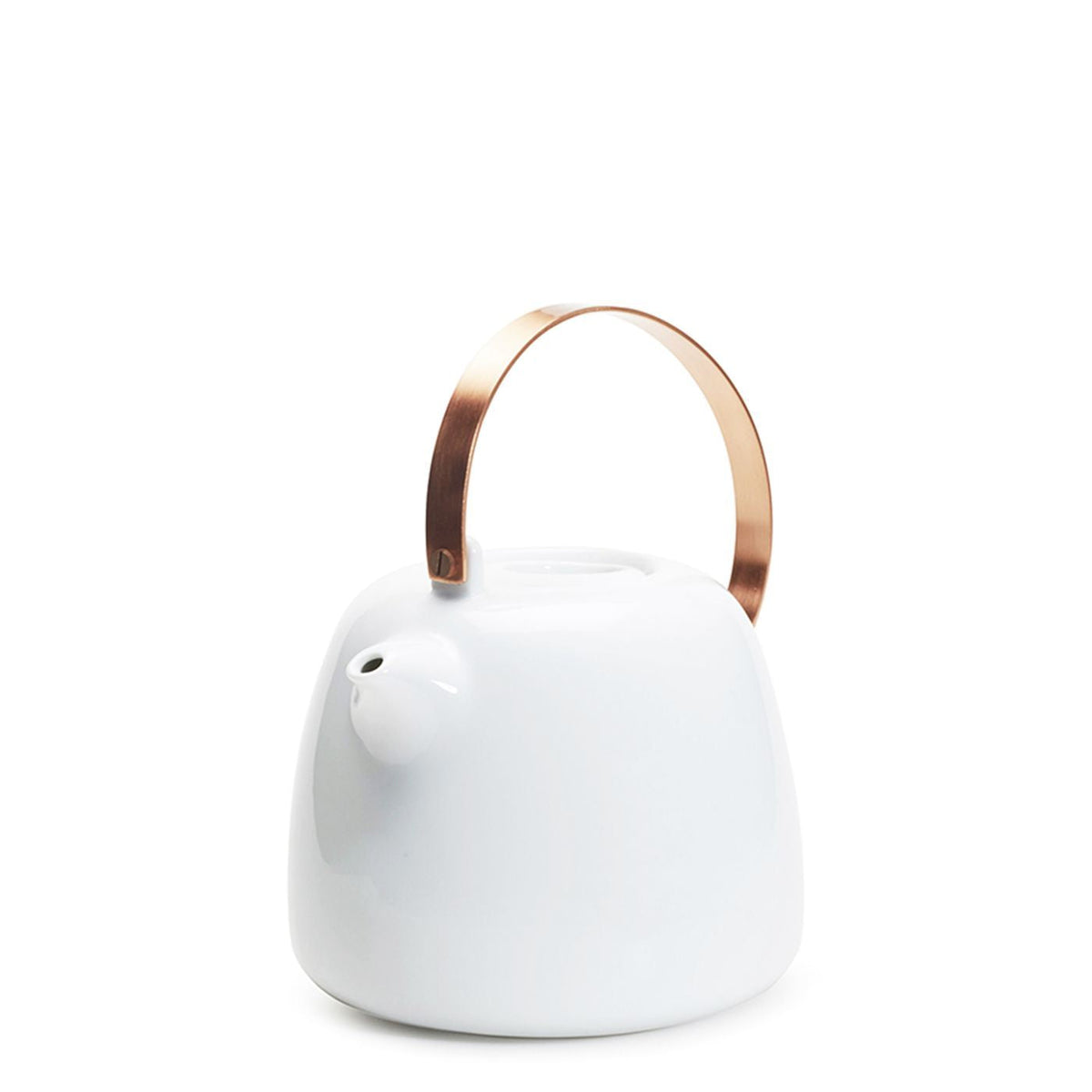
If you drink one cup at a time, a roomy infuser or a tea infuser mug is all you need; if you brew for several people, a teapot with a lift-out basket or a tea maker does the same job on a bigger scale. Every one of them solves the same problem: separating the leaves from the tea at the right moment. This part of our teaware guide draws on the pots, mugs and makers we have tested and sold since 2015.
How do you choose a teapot?
Choose a teapot by size first, then material: it should hold what you drink in one sitting, give the leaves room to open, pour cleanly, and let you take the leaves out (or pour off all the tea) once it has steeped.Read more
A pot gives whole leaves the space to unfurl, and room to move is how they release their full flavor. For brewing temperatures and times by tea, see How to brew loose leaf tea.
What to look for
- Size: tea left sitting on the leaves keeps steeping and turns bitter, so match the pot to the number of cups you will pour at once. For scale: our porcelain Moonset Teapot held 1,370 ml, “roughly 9 cups,” and our glass Urban Teapot held 500 ml. Adeline Teoh’s question is the right one to ask: “Are you looking for a teapot you can use at tea parties with several friends, or something for yourself when you’re tucking into a good book?”
- A removable infuser: a deep basket that sits in the pot and lifts out lets you stop the steep at exactly the right moment. A fine mesh keeps small leaf out of your cup. Our teapot instructions all said the same thing: “To avoid over steeping, remove the infuser before pouring the tea into your cup.” Adeline likes “a large infuser myself… and one that’s removable means I can control the strength of the brew.”
- A clean pour: the spout should pour without dribbling, and the lid should stay put when you tip the pot. Many pretty and novelty teapots “don’t pour very well,” Adeline warns, so “try before you buy if you can, even if it means making a cuppa to bribe the sales staff.”
- Easy to clean: a wide opening makes it simple to empty the leaves and rinse the pot.
- Warm it first: “it’s good practice to warm the teapot before preparing tea, whatever substance it’s made of,” by swilling a little hot water around it and pouring it out. A cold pot takes heat from the water before the leaves can use it. George Orwell preferred “placing it on the hob.”
How big a teapot? The pots we have sold
Our own spec sheets give a handy size ladder. Most of these pots are no longer sold, but they show what each size means at the table.
| Teapot | Material | Holds | Serves, as we rated it |
|---|---|---|---|
| Uno | Glass, with its own cup | 370 ml (250 ml cup) | One person |
| Neo | Borosilicate glass, steel infuser | 450 ml | 3+ cups |
| Urban | Glass | 500 ml | 3+ cups |
| Meraki | Glass | 600 ml | 4 cups |
| Heritage | Porcelain | 700 ml | 4+ cups |
| Celeste | Glass | 1,000 ml | 7 cups |
| Stony Brooke | Stoneware | 1,250 ml | 8 cups |
| Moonset | Porcelain | 1,370 ml | 9 cups |
The ratings work out at about 150 ml a cup, a teacup rather than a mug. If you drink from 250 ml mugs, expect fewer cups from each pot, and use about 2 to 2.5 g of leaf for each 250 ml of water.


Glass, porcelain, ceramic or clay: which teapot?
Glass and porcelain are the most neutral and suit every tea; glazed ceramic holds heat a little longer for strong black teas; unglazed clay and cast iron suit robust teas but not delicate ones.Read more
Glass or porcelain teapot?
Both are excellent, and both are neutral in taste. Glass, especially heat-resistant borosilicate, lets you watch the leaves open and judge the color of the tea by eye, which makes it a fine teacher. Porcelain is smooth, non-porous and holds heat a little better, so the last cup is warmer. As we put it: porcelain is for “Sit and Sip,” glass for “Glug and Go.” Glazed stoneware pots are sturdy and hold heat well for strong black teas, and enamel-lined cast iron keeps a pot hot for a long time (see the materials table).
Adeline Teoh’s 2016 scorecard for us adds the character of each one. Glass has a “neutral effect on taste; you can make eyes at your tea while it’s brewing,” and it “loses heat quickly, which is good for green tea,” though it is “thoroughly breakable.” Porcelain is just as neutral and “has the most chance to impress mother-in-law.” Ceramic loses heat less quickly than either, “making it a good all-rounder.”
Our own pots showed the trade-offs. The Neo glass teapot weighed only 235 g, with a borosilicate body and a stainless steel infuser. The porcelain Moonset, at the other end of the range, had a “heat-lock design to keep tea hot for a long duration,” for “a lavish afternoon tea, or your never-ending chai parties.”
Clay, cast iron and steel pots
Unglazed clay, especially Yixing, works differently: it “absorbs flavor, making it ideal for oolong, black tea and pu’er,” and for the same reason “a bad choice for delicate teas.” Keep one clay pot for one kind of tea. Cast iron, once properly heated, “will retain warmth for a long time,” but “takes a while to heat properly” and “does not play well with delicate teas.”
Stainless steel is the one material Adeline would not brew in: a steel pot is unbreakable and cheap, but “impresses tea with a metallic taste; I’ve never met a stainless steel teapot I’ve liked.” Steel is a fine material for infusers, which spend only a few minutes in the tea, and that is how we use it.
Our Stony Brooke tea set, launched in 2016 as a “rustic Scandinavian stoneware tea set,” came with a care line that suits any stoneware pot: “Do not use soaps or detergents. Invert the pot to air dry before replacing the lid.”
Tea infusers and infuser mugs: which do you need?
For one cup, a roomy stainless steel infuser or a tea infuser mug is all you need, as long as the leaves have room to open and come out when the tea is ready.Read more
Infusers
A stainless steel infuser sits in your cup or pot and comes out when the tea is ready. The Elegant Ball Infuser opens when you press its handles, closes on a scoop of leaf, and has an ultra-fine mesh that keeps small pieces out of the cup. At just under 2 inches (1.97 in) across, it is sized for “brewing exactly one cup of tea.” Our product sheet adds one small habit: “Always ensure your infuser is dry when you measure in the tea leaves before steeping.”
Do not overfill a ball infuser: whole leaf swells as it opens and needs room to move. For large-leaf Darjeelings and oolongs, a deep basket gives the leaves more space. Our 2016 travel guide put it plainly: “Tea balls constrain the space for the tea to expand… The best overall choice is a wire mesh basket that fits into the top of the mug and rests on it.”
Fine leaf needs a fine mesh. Our spring-loaded Perfect Pincer was for “loose-leaf teas only. CTC teas or chais are unsuitable,” because the small granules slip through. In our 2015 trial, pincers and paper bags lost out for whole leaf too: “they do not allow leaves to unfurl as well as a proper tea maker would. And it makes a world of difference.”

Tea infuser mugs
A tea infuser mug combines a tall mug, a removable infuser and usually a lid, so you can brew and drink from one vessel at your desk. Our Seidel Glass Tea Mug with Infuser is double-walled borosilicate glass with a fine mesh stainless steel infuser, so the tea stays hot while the outside stays cool to hold. It holds 300 ml and comes with a glass lid.
In our 2015 trial of accessories, the infuser-included teacup was the only tool to score a full five out of five for ease: “You steep and sip out of the same little tool, and apart from a spoonful of fine tea, there is nothing more you need.” Its one drawback: “it’s for the solitary indulgence.”
The method is the same for any infuser mug. Spoon the leaf into the infuser, set it in the mug, pour over recently boiled water (cooler for green and white teas), cover and steep. “When tea is ready, remove infuser to avoid over steeping,” and rest it on the upturned lid.
Our earlier Clear Tea Mug, a roomier 450 ml, came with a coaster that could “hold the infuser or be used to keep your tea warm.”

What is a tea maker, and what kettle do you need?
A tea maker is a cross between a kettle and a teapot that brews and strains in one piece; a kettle with temperature settings is worth having if you drink green, white and oolong teas as well as black.Read more
Tea makers
A modern tea maker brings brewing and straining together in one piece of equipment. You add about a teaspoon of leaf per cup to its basket, pour in hot water and let it steep. Then you either lift the basket out or, with the bottom-valve kind, set the maker on top of your cup; the valve opens and the tea drains through, leaving the leaves behind. Some electric models time the steep for you.
Our Classic Tea Maker was the valve kind. It held up to 500 ml, about three cups, and its instructions were simple: place it “right on top of your cup,” and “to stop the infusion flow, just lift the tea maker.” Set it on an even surface, or it may leak. In our 2015 trial a direct-immersion tea maker scored four out of five: “Easy to steep and pour. Suits clumsy hands. Ideal for steeping for two.”
Our Compact Tea Maker took the idea on the road: a double-walled borosilicate body with a bamboo lid, said to keep tea hot “for an hour-long period.”
Kettles
A kettle with temperature settings is worth having if you drink green, white and oolong teas as well as black, and it should switch itself off so it cannot boil dry. Our Still Steeping guide to kettles goes through pouring, build quality and safety.
Peter Keen, who wrote it, says most kettles with settings “offer five or so, ranging from 170–212°” Fahrenheit, about 77°C to 100°C, which covers every tea from green to Assam. He also likes “a large lid, so that it is easy to fill and clean inside.”
Two warnings from the same writer. A hotel coffee machine is no substitute: “Most coffee makers are limited to 180° Fahrenheit versus the boiling point of 212,” about 82°C, too cool for black tea. And for tea water, his rule is short: “Do not touch the microwave.”
Spoons, timers and warmers
Measuring helps as much as any pot: an Ideal Teaspoon takes the guesswork out of the leaf, and the Teabox Tea Timer, a sand timer in dark glossy wood, takes it out of the steep.
The Ideal Teaspoon holds 5 ml, one level measure of leaf. Peter Keen’s rule of thumb for spoons: “10 g equals four teaspoons equals four cups.” Our tea timer is described in our spec sheet as a minute glass that measures “three, four, and five minutes,” the steeps most of our teas need.
One tip if you use a tea warmer. Our old Noir Electric Tea Warmer kept tea between 40°C and 65°C but did not heat cold tea, and its cups “should not be double-walled and must have a flat bottom for conduction.” The air gap that keeps a double-walled glass cool in your hand also keeps a warmer’s heat out.
What goes in a portable tea set?
For travel, a portable tea set can be as simple as a double-walled tea infuser mug, a small tin of leaf and a spoon.Read more
Our guide to making good tea while traveling covers travel infusers, packing leaf and brewing without a kettle. Mohona Banerjee’s list for us is short: “Carry your teas in tins, airtight pouches, or tea filters,” with a ball infuser or a pincer and a mug with a “double-walled design with an easy-to-remove stainless steel infuser.”
Our 2016 guide for frequent travelers goes further. Pack a tall tumbler of “strong ceramic or double-walled glass,” like those “taxi drivers in China” carry, and leave behind “anything that sticks out,” such as spouts, handles and infuser baskets. Take “around six loose leaf teas in small tins or jars with very tight lids”; small baby food jars hold up to eight spoonfuls of leaf.
Without a thermometer, the same guide reads the bubbles. “When you see the initial small bubbles start to appear, the temperature is about 85°C (180°F). As they get bigger, ‘fish eyes,’ it’s 90–95°C (195–205°F).” In our 2015 trial, a travel tea maker scored three out of five: “You need a mug to carry along for the pour. And a bag to discard leaves.”
Our 2016 starter kit was a good definition of the minimum at home, too: “a direct-immersion tea maker, a pair of cups which are dual-walled for better insulation, an air-tight tin container in which to store your tea, and a precisely crafted teaspoon.”
Keep reading
Sources
- Teabox blog (Still Steeping): How the Teacup Got Its Handle (2016), Everything you needed to know about the kettle (2016), Pottering with Clay (2016), The Samovar: Kettle, Stove, Teapot and History (2016), A 9-step program to surviving the broken teapot (2016), A Mustache in a Teacup (2016)
- Teabox blog (Still Steeping): Microwaved, tepid, rolling boiling? Water for tea! (2016), The Teaspoon: Measure, Stir, Display or Steal? (2016), India vs. Taiwan: The Oolong Challenge (2017), Living the Life of a Tea Explorer (2015), Travel With Tea: Steep Anywhere, Anytime (2022)
- Teabox blog (Still Steeping): Good Tea Needs a Good Teacup, 2016; Not all teapots are created equal, 2016; ‘Attaining Tea Nirvana’ for the Lazy, 2015; The picky person’s guide to getting good tea while traveling, 2016; Beyond the tea bag, 2016; Drinking tea in Taiwan with Uncle Wang and Grandpa Hu, 2015; A saucerful of secrets: Tagore, the Orient and the Russians, 2016
- Teabox Tea 101: Choosing the perfect cup to serve tea; A brief history of tea makers
- Teabox product descriptions: Seidel Glass Tea Mug with Infuser, Valencia Glass Teacup, Elegant Ball Infuser, Ideal Teaspoon, Teabox Tea Timer, Indian Whole Leaf Trial Pack, Authentic Indian Chai Trial Pack (Festive Edition), and the teas named in the tables (October 2026)
- Teabox Drive: Teabox internal document, 2021; Teabox internal document, 2016; Teabox internal document, 2016; photos as credited
- Teabox on Instagram (@teabox.tea): testing accessories, Jun 2015, valve tea maker, Dec 2015, Heritage tea set, Dec 2015, Jubilee bone china set, Apr 2016, new glassware, May 2016, stoneware tea set, May 2016, Ash Gray mug, May 2016, double-walled cups, Jul 2016, infuser mug method, Nov 2019, chasen, Feb 2021, plastic pledge, Apr 2021, Cyril cup, Jul 2021, greener teaware, Aug 2021, borosilicate glass, Oct 2021, porcelain and glass, Oct 2021, three elements, Oct 2021, pledge progress, Nov 2021, loose leaf, Jun 2023, pledge met, Apr 2024
- Kausshal Dugarr on X (@Teapreneur): teacup thread, Nov 2021, tea bowls, Nov 2021, Kolkata, Nov 2021
- Teabox on YouTube: How to steep tea in a teapot, Handmade teaware collection, Seidel Glass Mug with Infuser

Leave a comment
All comments are moderated before being published.
This site is protected by hCaptcha and the hCaptcha Privacy Policy and Terms of Service apply.