


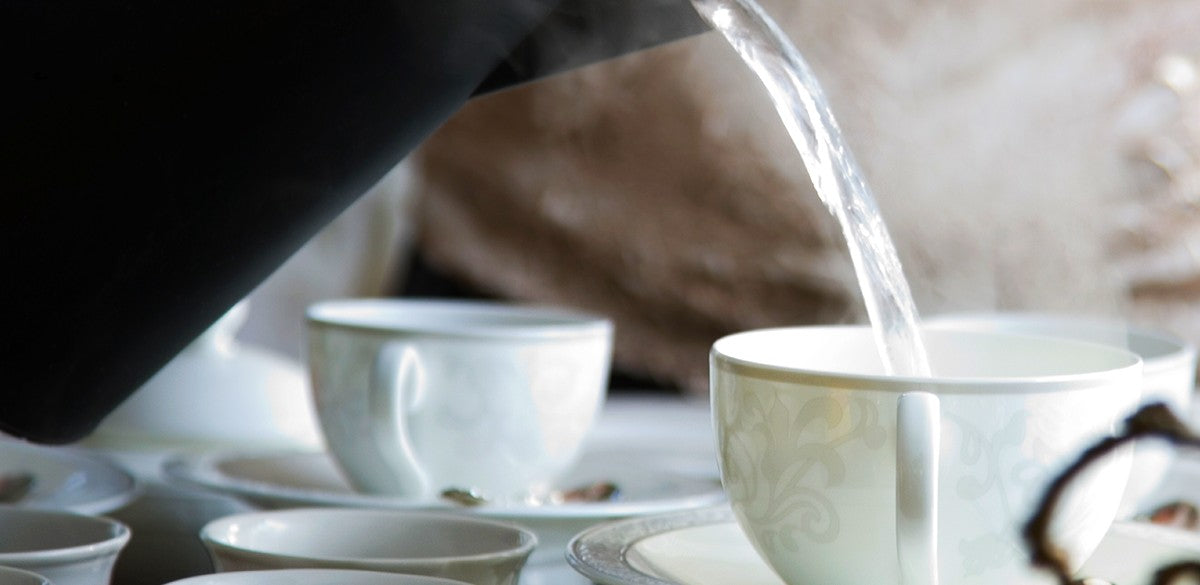
To brew loose leaf tea, use about 2 to 2.5 g of leaf (a heaped teaspoon) for each 250 ml (8 oz) cup, pour water at the right heat for that tea, steep for the right time, then strain. Black teas want water at or near the boil and 3 to 5 minutes; green and white teas want cooler water and a lighter hand. Get the amount, the heat and the time right, and almost any tea will taste the way its maker intended.
At a glance
- Leaf per cup2–2.5 g per 250 ml (8 oz), about a heaped teaspoon
- Black tea90–100°C · 3–5 min
- Green tea75–80°C · 2–3 min
- White tea80–85°C · 3–5 min
- Oolong85–95°C · 3–5 min · rebrew 2 to 4 times
How long to steep tea, and how hot: a brewing chart for every type
Steep black tea for 3 to 5 minutes in water at or near the boil, green tea for 2 to 3 minutes at 75–80°C, white tea and oolong for 3 to 5 minutes, and herbal tisanes for 5 to 7 minutes in boiling water.Read more
These are the starting points our tasters use. Each Teabox tea page gives the steep for that tea, and your own taste is the final judge.
| Tea | Water | Steep | Milk? |
|---|---|---|---|
| Darjeeling first flush | 85–90°C (185–195°F) | 3–4 min | No, drink it plain |
| Darjeeling second flush | 90–95°C (195–203°F) | 3–5 min | Best plain; a splash if you like |
| Darjeeling autumn flush | 90–95°C (195–203°F) | 4–5 min | Plain or a splash |
| Assam black (orthodox) | 95–100°C (203–212°F) | 4–5 min | Milk welcome |
| Nilgiri black and frost teas | 90–95°C (195–203°F) | 3–4 min | Your choice |
| Green tea | 75–80°C (167–176°F) | 2–3 min | No |
| White tea | 80–85°C (176–185°F) | 3–5 min | No |
| Oolong | 85–95°C (185–203°F) | 3–5 min, then rebrew 2 to 4 times | No |
| Herbal tisane | 100°C (212°F) | 5–7 min | Usually no |
| Matcha | Hot, not boiling | Whisk 1 tsp into 150–165 ml until frothy, do not steep | Plain |
All figures are for about 2 to 2.5 g of leaf in a 250 ml (8 oz) cup. Two rules sit behind the chart:
- Delicate means cooler: the more delicate and less oxidized the tea, the cooler the water.
- Small leaf brews faster: broken leaf gives up its flavor in a minute or two, while large whole leaves take longer.
Why time and heat work together
Peter GW Keen, who wrote about brewing for our blog, put the timing in one line: the median steep is just three minutes, with black teas going up to five. His advice when you are unsure: “When in doubt, choose 3 minutes.”
Heat matters just as much. Keen’s range runs from about 77°C to 100°C (170–212°F). A green tea brewed at the boil turns “nastily bitter,” while a black tea brewed too cool comes out flat and lacking flavor. Keen explains why: heat and time set the balance of what the leaf releases, from the compounds that bring lightness and sweetness to those that bring fullness and boldness, and the tannins that bring astringency. Brew a green tea too hot for too long and the tannins overwhelm the cup.
Not sure which kind of tea you have? Start with Types of tea: a beginner’s guide. Darjeeling’s flushes each have their own small adjustments, set out in How to brew Darjeeling tea. Iced tea has its own methods, covered in How to make iced tea. Masala chai is simmered, not steeped, and has its own method in How to make masala chai at home.
How to make loose leaf tea, step by step
Heat fresh water, warm your cup or pot, measure the leaf, pour, time the steep, then lift the leaves out completely.Read more
This is the classic infusion, the simplest way to brew and the one that works for every tea on the chart except matcha and chai. It is a practice more than a thousand years old with some ancient principles behind it, and because our teas are the best of the harvest, they need a certain amount of care when you steep them.
 Measure the leafAbout 2 to 2.5 g, a heaped teaspoon, per cup.
 Pour the waterAt the right heat for the tea, over all the leaves.
 Steep and time itLeaves open as they brew; give them room.
 Lift the leaves outSo the tea stops brewing and never turns bitter.
- Heat fresh, cold water to the temperature your tea needs: just boiled for black and herbal teas, well short of the boil for green and white.
- Warm the pot or cup. Swirl in a little hot water and pour it away. Pouring hot water into a cold cup makes the temperature drop too quickly, and the full flavor of the tea is not drawn out.
- Measure the leaf into an infuser or straight into the pot: about 2 to 2.5 g per 250 ml cup.
- Pour the water over the leaves until they are fully covered, and cover the cup or pot to hold in the heat.
- Time it. Use a timer rather than guesswork. Taste a little before the end if you are unsure; you can always steep longer, but you cannot undo a bitter cup.
- Remove the leaves completely. Lift out the infuser or strain the tea. Leaves left sitting in the water keep brewing and turn the cup harsh.
- Taste before you add anything. Many fine teas are best plain. If you take milk, sugar, honey or lemon, add it now.
How much loose leaf tea per cup?
Use about 2 to 2.5 g of leaf, roughly one heaped teaspoon, for each 250 ml (8 oz) cup, and weigh it if you can.Read more
How our tasters measure
The amount matters more than most people think. In Indian tea, a tasting serving has long been 2.5 g of loose leaf for 6 to 8 oz of hot water, weighed on a brass scale against a 25 paise coin, a practice that goes back to the early days of the industry. The scale has a wooden base and its own set of weights; once the two pans are even, the leaf is the right measure for tasting that batch.
Our tasters are exact about it: each sample is 2.5 g, not 2.4 g nor 2.6 g. A session can run to three tables, each with at least ten cups, and only the same measure in every cup lets them pick the best one fairly.
At our tasting bench in Siliguri, every sample is weighed, steeped for its set time, strained and poured the same way, so that no cup is steeped wrongly. In 2022 that ritual covered 11,456 Darjeeling cups by late October alone, by the count of Arun Kumar Gomden, the veteran Darjeeling tea maker and master taster who worked with our tasting team. To brew and judge tea the way our tasters do, see How to taste tea like an expert.
How many cups in a pack?
The same arithmetic tells you how far a pack will go. Keen’s rule of thumb is that 10 g equals four teaspoons equals four cups. Our product pages count a 100 g pack of teas such as Darjeeling Green Tea and Seeyok Summer Muscatel as about 40 cups.
What you need to brew loose leaf tea
You need only a kettle, something to steep the leaves in, a measure and a timer.Read more
A good kit for one person:
- A kettle, ideally electric with temperature settings, since a choice of heats is worth having if you drink green or oolong as well as black tea. Avoid the microwave: it superheats water rather than boiling it, and gives you no control over the temperature.
- Something to steep in. The Elegant Ball Infuser is a fine-mesh ball that works in any cup or pot. The Seidel Glass Tea Mug with Infuser is a double-walled borosilicate glass mug with a removable stainless steel infuser, so you brew and drink from one mug. With any infuser mug, take the infuser out when the tea is ready, to avoid over-steeping.
- A measure. The stainless steel Ideal Teaspoon gives you the same scoop every time. A small kitchen scale is even better.
- A timer. Your phone works. The Teabox Tea Timer is a sand timer with three timed settings.
Choosing a kettle
Keen, who reviewed kettles for our blog, found that most models with temperature control offer five or so settings between about 77°C and 100°C (170–212°F). He advised choosing one with an automatic cut-off, so it never boils dry. A coffee maker is no substitute: most heat water only to about 82°C (180°F), too cool for black tea.
Sizes worth knowing
Our Ideal Teaspoon holds 5 ml, the standard teaspoon. Keen called the teaspoon “a precision instrument”: defined usefully, he wrote, “it is 5 milliliters,” and that is what a tea’s instructions mean by one teaspoon.
The Seidel mug holds 300 ml and is made for water from 0 to 100°C, so a full mug takes a little more leaf than a 250 ml cup. The Elegant Ball Infuser, just under 5 cm (1.97 in) across, is sized for brewing exactly one cup.
Glass or porcelain?
The main difference between a porcelain cup and a borosilicate glass one is a slight one in how they hold heat, and a big one in the thickness of the lip you drink from. We sum it up as “Sit and Sip” for porcelain and “Glug and Go” for glass. Borosilicate glass is tough and handles heat well, and it lets you watch both the color of the liquor and the leaf unfolding.
Give the leaves room: whole leaves open out to several times their dry size, and a cramped infuser makes a thinner cup. For teapots, cups and infusers in more depth, see Choosing teaware.
Does water matter for tea?
Yes, more than most people expect: a cup of tea is almost entirely water, so use fresh, filtered water, boiled once.Read more
As our founder, Kausshal Dugarr, puts it: “Tea is 99.9% water and somehow the most unobtrusive element that gets neglected when steeping.” Which water to choose, how to judge the heat without a thermometer, and why the same tea tastes different in the hills each have their own answer.
Read nextWater for teaWhich water to use, how hot to heat it, and why tea tastes different at the sourceHow to make green tea without bitterness
To make green tea, steep about 2 to 2.5 g of leaf in water at 75–80°C (167–176°F) for 2 to 3 minutes, then strain.Read more
Green tea is the tea most often ruined by boiling water, which scalds the leaf and pulls out bitterness. There are many styles of green tea, so treat this as a base and adjust it to your taste.
- Measure 2 to 2.5 g of leaf, about a heaped teaspoon, for each cup.
- Heat the water to 75–80°C. Without a thermometer, boil the kettle and let it stand for about three minutes, a tip Peter GW Keen gave in a starter’s guide for our blog. Small bubbles, often called “crab eyes,” rising from the bottom of the kettle mark a little more heat, about 85°C, which our old Tea 101 recipe set as the most a green tea should get; stop before them. White tea, at 80–85°C, needs a slightly shorter wait.
- Rinse the cup or pot with hot water so it does not cool the brew.
- Add the leaves, pour, and steep for 2 to 3 minutes, tasting as you go.
- Strain as soon as it tastes right, then add honey or lemon if you like.
Why some green teas are always bitter
The leaf matters as much as the heat. Most bitter green teas are made of dust, broken leaf or fannings. Dust has far more surface area, so its tannins spread into the water quickly; in a whole leaf they take their time, and the cup stays pleasant to sip. That is why our Darjeeling Green Tea is made with 100% whole leaf.
Japanese greens are more exacting still. Keen brewed a deep-steamed sencha at about 66°C (150°F) for a minute and a half, and found that at 77°C (170°F) for two and a half minutes the same tea went “from exquisite to truly execrable.”
If your green tea is still bitter, cool the water first, then shorten the steep. Delicate white teas work the same way, a little warmer. More on the leaf itself in What is green tea?
Common tea brewing mistakes, and how to fix them
Most bad cups come from water that is too hot, a steep that is too long, or too little leaf.Read more
Longer does not mean stronger, only more bitter. If a tea is too weak, add more leaf next time rather than more minutes. Bitter, weak and flat cups each have their own cause, and some teas forgive a careless brew far better than others.
Read nextTea brewing mistakesBitter, weak and flat cups: what causes each, how to fix it, and which teas forgive a careless brewHow to brew tea in a teapot
Warm the pot, add about 2 to 2.5 g of leaf for every cup of water it holds, pour, time the steep, and then separate the tea from the leaves.Read more
Brewing for two or more works just as it does for one cup; the difference is what you do when the time is up.
If the leaves stay in the pot, the tea keeps brewing and each cup gets stronger and more bitter. Either use a pot with a removable infuser basket and lift it out, or strain the whole pot into a second warmed pot or jug. A tea cozy keeps it hot without stewing it.
The old habit of one extra spoonful “for the pot” makes a stronger brew; with fine teas, start with one spoonful per cup and adjust to taste. For a delicate tea and a table of guests, brew smaller pots and steep the leaves again rather than making one big, long brew.
How many cups does a pot hold?
A cup in teapot terms is smaller than a mug. Our Moonset porcelain teapot held 1,370 ml, which we described as roughly 9 cups, or about 150 ml each. So measure the leaf by the cups the pot pours, not by the mugs you plan to fill.
Our instructions for our glass teapots were simple: spoon the leaf into the infuser, pour recently boiled water over it, avoid filling the pot to the brim so the leaves have room, and lift the pot to pour once the tea is ready.
For anyone new to loose leaf, Keen’s simple answer for a first pot was a glass tea maker with a valve. You brew in it, set it on top of your cup and watch the tea drain through a mesh filter that keeps the leaves behind, which also ends the steep.

Can you re-steep loose leaf tea?
Yes. Good whole-leaf tea can usually be steeped at least twice, and oolongs two to four times.Read more
“Steep twice every long leaf tea” is one of our own standing tips, and it means less waste too. Our product pages put a number on it: our green teas are marked for two steeps, and our chais for one.
Keep the water at the same temperature and add a minute or so to each new steep, since the opened leaves have less left to give. Fine spring white teas reward this well: we suggest steeping Badamtam Moonlight White three times, and one customer got three fine cups from Badamtam Spring White at 70°C, steeping for 4, 5 and then 6 minutes. Of our Singbulli Spring Flowery Oolong, we suggested a second steep to bring out its fruity, floral aromas.
Which teas hold up
Not every tea holds up the same way. When a researcher, Abhinav Subramanian, brewed nine Teabox teas twice for our blog, some kept their flavor in the second cup, among them a Seeyok muscatel, while others turned more bitter. The Seeyok stayed free of bitterness and kept its flavor, and the Panitola Classic tasted even more pronounced the second time. The Lopchu Flowery Orange Pekoe went the other way: a tinge of bitterness in the first cup became pronounced in the second.
Broken leaf and tea bags give most of their flavor in the first steep, so a second cup is usually thin. Keen’s rule was that small-leaf teas, like tea bags, are good for a single cup, while a really fine white or oolong holds up to at least two re-steepings.
In Kolkata, re-steeping even has a name. “Foot” in colloquial Bengali also means a boil, so a “two-foot tea” is made from leaves brewed twice. As Anik Basu wrote in Two-Foot Tea and the Bengali, you can gauge the number of “foots” from the grimace on the drinker’s face.
Loose leaf tea vs tea bags: what’s the difference?
Loose leaf tea is usually whole or large leaf that has room to open and gives a fuller, more layered cup; most tea bags hold small broken pieces that brew fast, strong and dark.Read more
Much bagged tea is made by the CTC (crush, tear, curl) method, while fine loose teas are made the orthodox way. Learn the difference in Orthodox vs CTC tea. Bags still have their place, for travel or a busy desk, which is why we make our own TeaPacs.
Read nextLoose leaf vs tea bagsFlavor, freshness, our TeaPacs, and why loose leaf is the lower-waste choiceShould you add milk, sugar or lemon to tea?
It depends on the tea: strong, malty Assam teas take milk well, while delicate teas such as first flush Darjeeling, white and most green teas are best plain.Read more
Our tasters go further: single-estate teas are “self drinking” cups, best without milk, sugar, honey or lemon. Our 2016 brewing notes put it in a purist’s voice: “If not always, just try it plain once; you’ll be surprised how many layers are there to a cup of tea.”
Still, there is no rule you must follow. Milk in tea is mostly a matter of where you grew up: in England, people drank Chinese black tea with milk before Indian tea arrived in the 1840s, and the habit spread across the Commonwealth with strong Indian and Ceylon teas.
Ian Bersten, who wrote that history for our blog, ties London’s habit to the opening of a model dairy there in 1855. He also notes that the small-leaf black teas of the late 19th century were brewed for 3 to 5 minutes, like large-leaf teas, which made them bitter enough to need milk and sugar. He found even Darjeeling fannings delicious with milk and sugar when brewed for just 30 seconds. His advice was simple: make it the way you like and drink it the way you like. Our advice is to taste every new tea plain first.
- Milk: best with full-bodied black teas such as Classic Assam Black, a full, malty blend with notes of raisin and date. Which Assams suit milk, and how to make milk tea and bubble tea, is in Assam tea for milk tea.
- Lemon or honey: a slice of lemon suits black and green teas, but keep it out of milky tea, which it curdles. Our product pages also mark a number of Darjeeling teas, some spring teas among them, as good with a slice of lemon; taste them plain first, then try the slice. Recipes are in How to make lemon tea.
- Sugar: a little softens a strong black tea. If you find yourself needing a lot, the tea probably steeped too long.
- Chai: milk and spices are part of the brew. Even then, some like chai with milk and some don’t, and we believe the way you like it is the best way to drink it. And please, not from a tea bag. Our founder’s view, in full: “NEVER EVER NEVER EVER EVER EVER EVER....DO THAT! Making chai from a teabag.”
More brewing guides
Once you have the basics, these guides go deeper into particular teas and ways of drinking them.Read more
Tasting is the natural next step after brewing. Our own method is the 4S: smell the dry and infused leaves; steep gently, treating the tea with care and never boiling it; sip, giving the cup a moment to settle so you can taste every note; and savor the experience.
Start brewing
New to loose leaf? A trial pack lets you try several teas side by side and find your own best steep.
How to brew tea: FAQ
How much loose leaf tea should I use per cup?
About 2 to 2.5 g, roughly one heaped teaspoon, for a 250 ml (8 oz) cup. Large, fluffy leaves such as white tea take up more room in the spoon, so weigh them if you can. For a stronger cup, add more leaf rather than steeping longer.
How many cups does 100 g of loose leaf tea make?
About 40 cups at 2.5 g a cup, which is how our product pages count a 100 g pack. As a rule of thumb, 10 g of leaf makes about four cups.
How long should I steep tea?
Black tea 3 to 5 minutes, green tea 2 to 3, white tea and oolong 3 to 5, and herbal tisanes 5 to 7. Start at the shorter time, taste, and then remove the leaves completely so the tea stops brewing.
Should I use boiling water for all teas?
No. Water at or near the boil (95–100°C) is right for Assam and other strong black teas and for herbal tisanes, but it scalds green and white teas and makes them bitter. Use 75–80°C for green tea, 80–85°C for white, 85–95°C for oolong and 85–90°C for Darjeeling first flush.
Why does my tea taste bitter?
Usually the water was too hot or the leaves steeped too long. Cool the water, shorten the steep and strain the leaves out completely. Squeezing the leaves or tea bag and leaving tea standing on its leaves also make it bitter.
Can I reuse loose tea leaves?
Yes. Good whole-leaf tea can usually be steeped at least twice, and oolongs two to four times. Use water at the same temperature and add a minute or so to each new steep.
Can I make tea in the microwave?
We do not recommend it. A microwave superheats water rather than boiling it and gives you no control over the temperature, and temperature is what makes or breaks a cup. A kettle, ideally one with temperature settings, does the job better.
Keep reading
Sources
- Teabox Tea 101: How to make a basic tea; How to make green tea
- Teabox blog (Still Steeping), Peter GW Keen: Microwaved, tepid, rolling boiling? Water for tea! (2016), Everything you needed to know about the kettle (2016), The Teaspoon: Measure, Stir, Display or Steal? (2016), Tea Bags 101: Past, Present and Potential (2017)
- Teabox blog (Still Steeping): Like water for tealeaves (Adeline Teoh, 2015), The Element of Water: Get Your Tea Right (Mohona Banerjee, 2021), Should you add milk to tea? (Ian Bersten, 2015), Two-Foot Tea and the Bengali (Anik Basu, 2016), What I Learned at My First Ever Tea Tasting (Meeta Sharma, 2016)
- Teabox blog (Still Steeping), stories: Peter GW Keen, Beyond the tea bag: a starter’s guide to leaf tea, 2016; Peter GW Keen, The picky person’s guide to a good cup of tea while traveling, 2016; Peter GW Keen, How much does good tea cost?, 2016; Ian Bersten, Why Teabags Will Never Beat the Real Thing, 2015; Abhinav Subramanian, How not to make a bitter cup of tea, 2015
- Teabox product descriptions and product data (steeping blocks, cups per pack, lemon pairings), October 2026: Elegant Ball Infuser, Seidel Glass Tea Mug with Infuser, Ideal Teaspoon, Teabox Tea Timer, Indian Whole Leaf Trial Pack, Classic Assam Black, Darjeeling Green Tea, Seeyok Summer Muscatel Black
- Teabox Drive: Teabox internal document, 2016; Teabox internal document, 2022; Teabox internal document, 2016; Teabox internal document, 2021; photos as credited
- Teabox on Instagram (@teabox.tea): warm the pot, Feb 2016, TeaPacs launch, Nov 2016, TeaPacs nitrogen flush, May 2018, glass teapot method, Nov 2019, infuser mugs, Nov 2019, matcha, Jan 2020, steep twice, Apr 2020, four enemies of tea, May 2020, brass tasting scale, May 2020, chai your way, Sep 2020, sustainable tea habits, Apr 2021, 2.5 g samples, Apr 2021, the 4S, May 2021, bitter green tea, Sep 2021, borosilicate glass, Oct 2021, porcelain or glass, Oct 2021, water at the source, Oct 2021, plastic pledge progress, Nov 2021, customer white tea steeps, Apr 2022, Singbulli oolong, Apr 2022, Masterclass steeping, Aug 2022, 11,456 cups, Oct 2022, tasting ritual, Nov 2022, Badamtam Moonlight White, Mar 2023, plastic pledge met, Apr 2024, brewing mistakes video, Dec 2024
- Kausshal Dugarr on X (@Teapreneur): the 4S, Oct 2021, tea is 99.9% water, Oct 2021, Lu Yu on water, Oct 2021, chai from a tea bag, Dec 2021, fine teas and bags, Aug 2022
- Teabox on YouTube: How to steep tea in a teapot

Leave a comment
All comments are moderated before being published.
This site is protected by hCaptcha and the hCaptcha Privacy Policy and Terms of Service apply.