


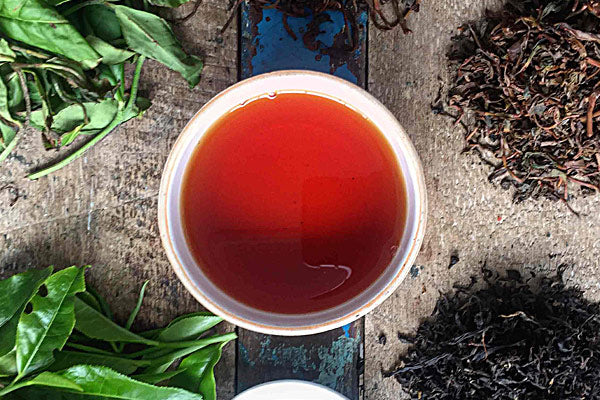
There are four main types of tea: black, green, white and oolong, and all four come from the same plant, Camellia sinensis. What makes them different is how the leaf is processed after plucking, above all how much it is allowed to oxidize. Herbal teas, flavored blends and chai sit alongside them. This guide explains the different kinds of tea, compares them side by side, and suggests where to start.
At a glance
- Main typesBlack, green, white, oolong
- PlantAll from Camellia sinensis
- What changesProcessing, especially oxidation
- Most oxidizedBlack tea (fully)
- Least processedWhite tea (withered and dried)
How many types of tea are there, and do they all come from one plant?
All true teas come from one evergreen plant, Camellia sinensis, and fall into four main types: black, green, white and oolong.Read more
Chinese tradition counts six, adding yellow tea and dark teas such as pu-erh, but those two are rarely seen outside China. Everything else people call “tea,” from chamomile to rooibos, is an infusion of a different plant.
Four is also the number we teach our own team. Our training deck counts “4 broad categories of tea: Black, Oolong, White and Green,” all made from the leaves of the same plant.
This surprises almost everyone: all teas, whether black, white, oolong, green or CTC, come from the same tea plant.
One plant, more than one bush
The plant has two main varieties: the small-leaved China type and the large-leaved Assam type. Many Indian gardens also grow clonal bushes bred from the best of both.
The bush shows in the cup. Arun Kumar Gomden, the veteran Darjeeling tea maker and master taster who later worked with our tasting team, notes that the flavors of old Chinary bushes “differ significantly from place to place,” while clonals “more or less produce the same flavor profiles.”
The variety, the garden and the season all shape the flavor, but the type of tea is decided in the factory. More on the plant itself in What is tea?
Oxidation: the step that makes the difference
After plucking, a tea leaf is withered to soften it. If it is then rolled or bruised, its cells break and natural enzymes react with the air, turning the leaf darker and changing its flavor.
As our tasting team explains it, “chlorophyll is broken down to release tannins, similar to the browning of bananas, apples and other foods.” More exactly, an enzyme in the leaf turns its green catechins into orange and brown compounds.
The tea maker decides how far to let it go, then stops it with heat, a step called fixing:
- Green tea: stop it at once and you get green tea.
- White tea: skip rolling and simply wither and dry the leaf and you get white tea.
- Oolong: let it go part of the way and you get oolong.
- Black tea: let it run its full course and you get black tea.
Even black tea has degrees. Our 2017 training notes point out that a Darjeeling first flush is only partly oxidized, which is why so many spring Darjeelings look greenish.

Each step, from plucking and withering to rolling, oxidizing and drying, is covered in How tea is made: from leaf to cup.
What are the four main types of tea?
Black tea is fully oxidized, green tea is heated early so it never oxidizes, white tea is only withered and dried, and oolong is partly oxidized, which puts it between green and black.Read more
What about herbal teas, flavored blends and chai?
Herbal teas are not made from the tea plant at all; flavored blends and chai are made from real tea combined with other ingredients.Read more
Types of tea compared: taste, caffeine and brewing
Black tea is the strongest and highest in caffeine, green and white are lighter and lower, oolong sits in between, and herbal teas usually have none.Read more
Here is the tea types list at a glance. Use about 2 to 2.5 g of leaf (roughly one heaped teaspoon) per 250 ml (8 oz) cup, then adjust. Our tasters are stricter still: every tasting sample is weighed at exactly 2.5 g, not 2.4 g or 2.6 g.
| Type | Oxidation | Taste | Cup | Caffeine (about) | Water and steep |
|---|---|---|---|---|---|
| White | Withered and dried only | Soft, floral, honeyed, fruity | Pale gold | Often on the lower side of green; varies | 80–85°C (176–185°F) · 3–5 min |
| Green | None (heated to stop it) | Fresh; toasty and nutty, or grassy and marine | Pale yellow | 20 to 45 mg | 75–80°C (167–176°F) · 2–3 min |
| Oolong | Partial, roughly 10% to 80% | Floral to fruity, honey, toasted | Gold to amber | Between green and black | 85–95°C (185–203°F) · 3–5 min · rebrew 2 to 4 times |
| Black | Full | Malty, brisk, fruity, bold | Amber to red | 50 mg | 95–100°C (203–212°F) · 4–5 min (Darjeeling: see below) |
| Herbal | Not tea | Depends on the plant | Any color | Usually none | 100°C (212°F) · 5–7 min |
Our training deck describes the cup colors more finely: white tea runs from Champagne to light gold, green from pale green to yellowish green, oolong from light gold to gold, and black from light gold to dark amber. An Assam with milk turns a bright yellowish orange.
Caffeine
Caffeine figures are from our Tea 101 caffeine guides. For comparison, they put a cup of coffee at about 90 to 95 mg, and a cup of masala chai at about the same as black tea, since it is black tea.
Caffeine varies with the leaf, how much you use, the water temperature and how long you steep.
Brewing Darjeeling and Assam
Darjeeling black teas are the exception to the boiling-water rule:
- First flush: brew a first flush at 85–90°C (185–195°F) for 3 to 4 minutes.
- Second flush: brew a second flush at 90–95°C (195–203°F) for 3 to 5 minutes.
- Autumn flush: brew an autumn flush at 90–95°C for 4 to 5 minutes.
Assam takes water just off the boil and welcomes milk.
If any tea tastes bitter, the water was too hot or it steeped too long. For more strength, add leaf rather than time. White teas and oolongs reward a second steep: our 2017 notes call multiple steeping “a win win,” and suggest clear glass cups so you can watch the color.
Which type of tea should a beginner try first?
Start from what you already like: a strong, milky cup points to Assam black tea or chai; something light and fragrant points to a Darjeeling first flush or a white tea; and no caffeine at all points to an herbal tea.
| If you like… | Try |
|---|---|
| Coffee, or a strong cup with milk | An Assam black tea such as Halmari Summer Black, or masala chai |
| Something light, floral and fragrant | A Darjeeling first flush black tea, or a white tea, both plain |
| Something fresh with less caffeine | A green tea, brewed cool and short so it stays sweet |
| A bit of everything | An oolong, which spans flowery to roasted |
| A clear, familiar flavor | A classic blend such as Earl Grey or jasmine green |
| No caffeine | An herbal tea such as chamomile or hibiscus |
Two of our teas were written up with newcomers in mind. Our Darjeeling Spring Clonal Black is robust for a spring tea, and “even a Darjeeling newbie will be able to appreciate and enjoy” it. Our Darjeeling Special Spring White is, in our tasters’ words, “an entry level white tea.”
Offer something different, not just better
One tip from our blog’s starter guide to leaf tea: offer a new drinker a tea that is different from what they know, not just better.
- English Breakfast fans: someone who likes English Breakfast may be won over by a smoky Lapsang Souchong.
- Green tea doubters: someone who thinks green tea is bitter may change their mind over a jasmine green.
- Tea bag drinkers: a Darjeeling second flush is a gentle first step beyond the tea bag.
The same guide makes a case for Darjeeling as the first leaf tea, since “Assams can overwhelm and China congous be a little too subtle.” It suggests gardens such as Thurbo, Namring, Ambootia, Tindharia and Giddapahar, and grades beginning FTG rather than SFTG.
Our founder’s first rule is blunter: “Fine teas are rarely available in bags.” Kausshal Dugarr adds that fine teas have no room in a bag to be seen and enjoyed.
Still choosing between two? Our comparison guides set them side by side: Black tea vs green tea, White tea vs green tea and Oolong vs green tea. To try many at once, our Indian Whole Leaf Trial Pack has samples of our whole-leaf teas.
Which types of tea does India make?
India is best known for black tea, but its gardens make every main type: black, green, white and oolong, as well as the CTC tea behind its chai.Read more
Each region has its strengths:
| Region | Best known for | Also makes |
|---|---|---|
| Darjeeling | Seasonal black teas: first flush, second flush muscatels, autumn | Green, white, oolong |
| Assam | Malty orthodox black teas and strong CTC for chai | Green |
| Nilgiris | Bright black teas and winter frost teas | Green, white, oolong |
| Kangra | Black tea | Green, oolong, white |
The regions also differ in how they make tea. Darjeeling tea is all orthodox, while Assam makes both CTC and orthodox. The Nilgiris make both too, with twirled black teas, whites and oolongs. In Kangra, the Dharmsala Tea Company told us it makes all four base teas, black, green, oolong and white, along with its own blends.
Darjeeling sells most of what it makes abroad: more than 80% of its roughly 8.5 million kg a year is exported.
Smaller regions worth knowing
Beyond the big four, we buy from smaller gardens across the Northeast.
Temi, Sikkim’s estate, was set up by the Government of Sikkim in 1969 and covers 177 hectares; our Sikkim Temi Spring Chinary Black comes from there. Its teas are neither as brisk as Assam nor as light as Darjeeling. In Meghalaya, Lakyrsiew sits at about 4,000 feet on the southern bank of Umiam Lake and makes our Lakyrsiew Summer Clonal Black.
In Arunachal Pradesh, the Donyi Polo estate, founded in 1985, is known for aromatic silver needles and golden tippy teas.
Teabox sources from 250+ Indian tea estates and ships direct from India, and every tea is tasted and selected in Siliguri before it is listed.
For how Indian and Chinese teas differ in style, see Indian vs Chinese tea; for each growing area, see Indian tea regions.
Guides in this section
Types of tea FAQ
What are the main types of tea?
The four main types are black, green, white and oolong. All are made from the leaves of Camellia sinensis and differ in how they are processed, especially how much the leaf oxidizes. Chinese tradition adds yellow and dark teas to make six, and herbal teas, flavored blends and chai sit alongside them.
Is herbal tea real tea?
Not strictly. Herbal teas, or tisanes, are infusions of other plants, such as chamomile, hibiscus or mint, and contain no tea leaf, so most are naturally caffeine-free. See our herbal tea guide.
Which type of tea has the least caffeine?
Herbal teas usually have none. Among true teas, white and green are generally lower than black: Tea 101 puts green tea at about 20 to 45 mg a cup and black tea at about 50 mg. Caffeine varies with the leaf, the amount you use, the water temperature and the steeping time.
Which type of tea is the strongest?
Black tea gives the strongest, most robust cup, especially Assam and the CTC teas used for chai. It also has the most caffeine of the four main types, at about 50 mg a cup.
Is chai a type of tea?
Chai is a way of preparing tea rather than a separate type. It is usually strong black tea, often Assam CTC, simmered with milk, sugar and spices such as cardamom and ginger. Read What is chai? to learn more.
Do different teas come from different plants?
No. Black, green, white and oolong teas all come from the same plant, Camellia sinensis. The variety, garden and season shape the flavor, but the type is decided by how the leaf is processed after plucking.
What is the difference between orthodox and CTC tea?
Orthodox tea is rolled to keep the leaf whole or in large pieces, and aims to show the character of one garden. CTC (crush, tear, curl) cuts the leaf by machine into small granules for a fast, strong, consistent cup, so there is no whole-leaf CTC. Darjeeling tea is all orthodox; Assam makes both. See Orthodox vs CTC tea.
What is a Moonlight white tea?
In Darjeeling, a Moonlight is a white tea made from very small two leaves and a bud in the first flush, withered for about 12 to 16 hours, rolled very briefly and gently, then dried. The name recalls a Yunnan tradition of harvesting buds by moonlight. Badamtam and Margaret’s Hope are known for them.
What is the difference between a single-estate tea and a blend?
A single-estate tea comes from one garden and is sold under that garden’s name, with its invoice number. A straight blend mixes two or more teas of the same kind, as in English Breakfast; a flavored blend adds flowers, spices, fruit or flavoring to a base tea, as in Earl Grey.
Can I cold-brew tea?
Yes. For green tea, our guidance is about 1 teaspoon of leaf for every 150 ml of cold water, or about 14 g for a 1-liter pitcher, left in the fridge overnight or for at least four hours. Our 2017 notes cold-steep 2.5 g of white tea for about 2 hours, for a rounder cup with more aroma.
Keep reading
Sources
- Teabox blog (Still Steeping): Meet the man who created the Darjeeling oolong (2015), Make Tea Not War (2016), Moonlight Sonatas: The great white teas (2016), English Breakfast: The baseline black tea (2016)
- Teabox blog (Still Steeping): A short lesson on Asian green tea (2017), India vs. Taiwan: The oolong challenge (2017), In Kangra, for a tour of the tea gardens (2017), A Tryst with History (2020), The journey of our beloved chai (2020)
- Teabox blog (Still Steeping): Beyond the tea bag: a starter’s guide to leaf tea, 2016; Black tea: All you need to know, 2014; White tea: A quick and dirty guide, 2014; An ode to oolong tea, 2014; In defense of the tisane, 2015
- Teabox Tea 101: What are the different types of tea, and why you should try them?, FAQs, What is white tea?; caffeine posts
- Teabox product descriptions and product data, 2026: Assam Halmari Summer Black, Darjeeling Green Tea, Nilgiri Glendale Autumn Twirl Green, Pure Japanese Matcha, Special Spring Silver Needle White, Darjeeling Special Spring White, Darjeeling Exotic Moonlight White, Badamtam Spring Moonlight White, Margaret’s Hope Spring Moonlight White, Castleton Summer Moonlight White, Ivory Geranium Blossom White, Glenburn Spring Moonshine Oolong, Darjeeling Spring Clonal Black, Sikkim Temi Spring Chinary Black, Meghalaya Lakyrsiew Summer Clonal Black, Pure Chamomile, Hibiscus Lemongrass Tisane, Butterfly Blue Pea Flower, Classic Earl Grey, English Breakfast Black, Mountain Rose Black, Green Tea Jasmine Soothe, Kashmiri Kahwa, Assam Masala Chai, Kadak Chai
- Teabox Drive: Teabox internal document, 2023; Teabox internal document, 2017; Teabox internal document, 2017; Teabox internal document, 2017; Teabox internal document, 2020; Teabox internal document, 2023; Teabox internal document, 2016; photos as credited
- Teabox on Instagram (@teabox.tea): oxidation, May 2020, Assam and Darjeeling profiles, Jun 2020, 2.5 g samples, Apr 2021, Darjeeling exports, Aug 2021, whole-leaf green tea, Sep 2021, Masterclass launch, Jan 2022, how India took to tea, Jan 2022, Sikkim, Feb 2022, Arunachal, Feb 2022, one plant, Mar 2022, the 2022 Masterclass on types of tea (part 1, part 2), blue pea, Apr 2022, tasting count, Oct 2022, autumn Darjeeling, Nov 2022, matcha, Feb 2019, Shizuoka matcha, Sep 2018
- Kausshal Dugarr on X (@Teapreneur): one plant, Apr 2022, first flush tasting, May 2022, fine teas and bags, Aug 2022, second flush tasting, Sep 2022

Leave a comment
All comments are moderated before being published.
This site is protected by hCaptcha and the hCaptcha Privacy Policy and Terms of Service apply.