


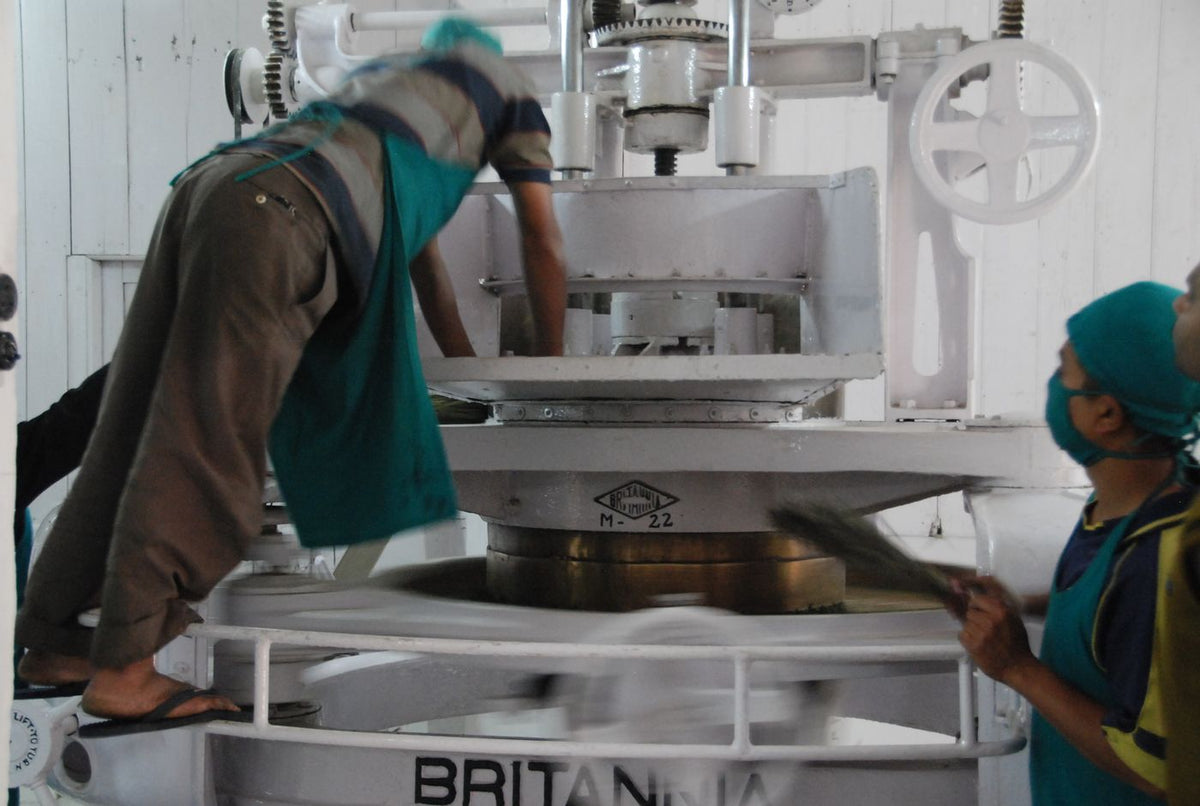
Tea is made by plucking young shoots of the tea plant, then withering, rolling, oxidizing and drying the leaves before they are sorted into grades. Every white, green, oolong and black tea comes from the same plant, Camellia sinensis. Which of these steps the tea maker uses, and for how long, is what turns one fresh leaf into so many different teas.
At a glance
- Main stepsPlucking, withering, fixing or rolling, oxidation, drying, sorting
- The plantCamellia sinensis, for every true tea
- Leaf pluckedTwo leaves and a bud for fine tea
- What decides the typeHow much the leaf is oxidized
- Time in the factoryAbout a day for most teas
How is tea made?
Tea is made in a factory on or near the tea garden, usually within a day of plucking: the fresh leaf is wilted, rolled or heated, left to react with the air if it is meant to be dark, then dried until it keeps.Read more
Tea makers usually count between two and seven steps, and adding, skipping or lengthening any one of them gives a different tea.
We do not make tea ourselves. The estates make it in their own factories, and our work is to taste it, choose it and look after it. We buy from more than 250 Indian estates and select every lot at our facility in Siliguri, at the foot of the Darjeeling hills.
What it takes to make a kilogram
Fine tea starts with a very small harvest. In Darjeeling, a single kilogram of fresh leaf takes about 20,000 shoots, picked by hand on slopes of 40 to 60 degrees.
In Assam, a plucker fills two or three baskets a day, each holding about 8 kg of green leaf. Those 16 to 24 kg make only 3 to 5 kg of finished tea.
The rest is water. About three-quarters of a freshly plucked leaf is moisture, and the factory’s job is to take most of it out without losing the flavor. When Seeyok in Mirik made a summer batch for us in June 2021, its 150 kg of plucked leaf was expected to give 35 kg of tea, “following the thumb rule of 1:4.”
Darjeeling, every one picked by hand
Assam; a plucker fills two or three a day
Seeyok, 2021: 150 kg of leaf for 35 kg of tea
Our cold store in Siliguri, after vacuum packing
From the garden to our store in Siliguri
Most of that work happens within a day or two of plucking. Our Castleton Summer Muscatel shows the timing: the leaf was picked and processed at Castleton on 12 and 13 July 2022 and reached our facility, about 42 km away, on 14 July. It was sorted, cleaned, vacuum packed and stored at -5°C that same day, and was ready to ship on 15 July.
That is our usual pattern. Our team tastes each tea at the garden once it is made, checks it against eight quality parameters, and brings the lots that pass into our facility within 24 to 48 hours of production. There they are vacuum packed in bulk, hand sorted, graded and packed in 100 g vacuum packs. Between packing and shipping, the tea is kept at -5°C.
Six types from one plant
Tea experts could sort teas by the bush they grow on, the look of the dry leaf or the color of the cup. The system they actually use is based on processing, and it was first worked out in China. By processing there are six types: white, green, yellow, oolong, black and post-fermented (dark) tea. Each type has many styles shaped by the cultivar, the region, the season and the tea maker.
Black, white, oolong, green and CTC teas all come from one plant. For the plant itself, start with What is tea? The tea plant explained.
What are the steps of tea making?
In order, the steps of tea making are plucking, withering, fixing (for green, yellow and oolong teas), rolling, oxidation, drying, and sorting into grades.Read more
 PluckingThe bud and two youngest leaves, picked by hand.
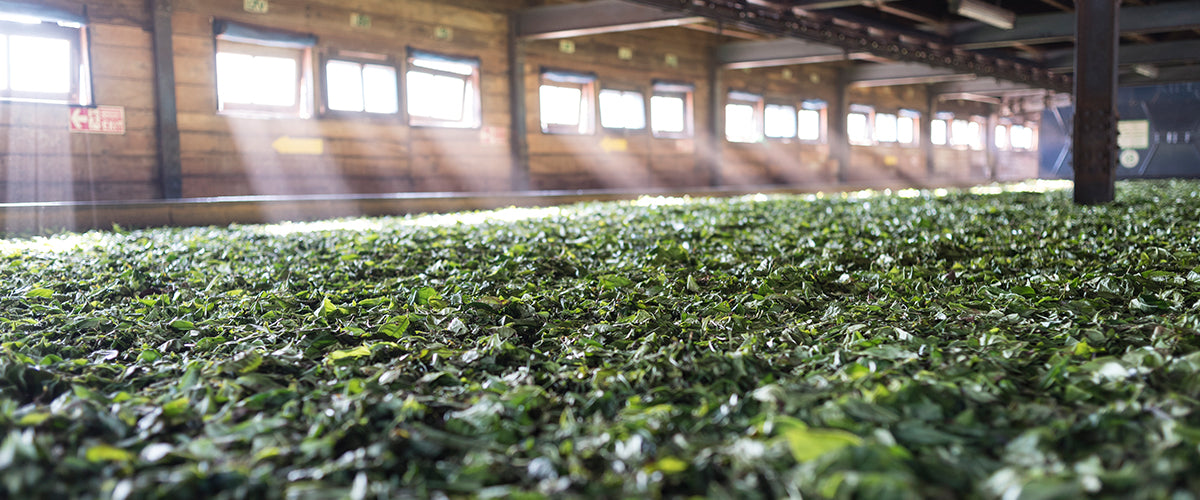
 WitheringLeaf rests on troughs for hours until it is soft.
 RollingTwisting the leaf breaks its cells and releases the juices.
 OxidationThe leaf darkens as it reacts with the air.
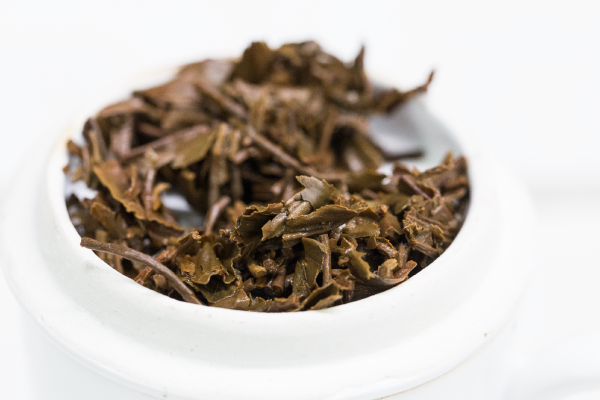
 DryingHot air stops oxidation and dries the leaf for keeping.
 SortingSieves separate whole leaf from broken pieces.
The whole sequence is quicker than most people expect. One summer batch made for us at Seeyok in June 2021 went from the last leaf plucked at 9.15 pm to the first tasting cups at 12.15 pm the next day, about 15 hours in all.
Read nextTea making step by stepPlucking, withering, fixing, rolling, oxidation, drying and sorting, one step at a timeHow is each type of tea made?
Each type of tea is a different path through the same steps: white tea is barely handled, green tea is heated early to stay green, oolong is partly oxidized, black tea is fully oxidized, and dark teas are aged with the help of microbes.Read more
| Type | Main steps | Oxidation | In the cup | Teabox example |
|---|---|---|---|---|
| White | Plucking, long wither, drying | Very light, natural | Pale, soft, sweet | Silver Needle White |
| Green | Plucking, short wither, fixing, rolling, drying | None | Fresh, vegetal or toasty | Darjeeling Green Tea |
| Yellow | As green, with an extra slow, gentle step before drying | Very light | Mellow, smooth | None at present |
| Oolong | Withering, rolling, partial oxidation, fixing, drying | Partial | Floral to toasty, amber | Glenburn Moonshine Oolong |
| Black (orthodox) | Withering, rolling, full oxidation, drying | Full | Brisk, rich; fruity in Darjeeling, malty in Assam | Castleton Summer Muscatel |
| Black (CTC) | Withering, crush-tear-curl, fast oxidation, drying | Full | Strong, dark, made for milk | Kadak Chai |
| Dark (post-fermented) | As green, then microbial fermentation and aging | Varies | Earthy, deep | None at present |
How is white tea made?
White tea, often only the young buds, is simply withered, usually for a long time, and dried, sometimes in the sun.
Our Special Spring Silver Needle shows how little is done. It is made only from unopened buds, plucked at first light in gardens between 4,000 and 5,500 feet and then withered slowly and gently in the open air. Tea 101 describes the buds being left to wilt for up to 72 hours, then dried at around 110°C until a little less than 1% moisture is left.
It is not rolled or deliberately oxidized, though some natural oxidation happens as it withers. Because the leaf is never heated early, its enzymes stay active through the long wither, and some white teas end up about as oxidized as a lighter green tea.
Our tasters describe the Silver Needle’s dry leaf as “long, unopened greenish silvery buds with downy,” and its cup as floral, softly sweet and clean. Brew it at 80–85°C for 3 to 5 minutes. More in What is white tea?
How is green tea made?
Green tea is plucked, given a short wither, then fixed with heat (by steaming or pan firing) before it can oxidize, rolled into shape and dried. Because the enzymes are switched off early, the leaf stays green and the cup stays fresh and light.
In India, green tea is generally fixed in hot metal pans, and only occasionally by steam. In the Nilgiris, Pascoes Woodlands, one of Craigmore’s two factories, makes high-grown pan-fired greens, close to 0.7 million kg a year. Burnside, also in the Nilgiris, rolls its green tea into semi-balls, and our notes credit its high-fired flavor to heavy roasting and pan firing.
How the heat is applied changes the cup: slowly pan-fixed green tea tastes sweeter than tea fired hard and fast. At Namring in Darjeeling, Sumon Majumder made a green tea by “steaming the leaf and not fermenting it,” with only a light rolling.
Drying then takes the leaf down to about 1% moisture. Brew it cooler than black tea, at 75–80°C (167–176°F) for 2 to 3 minutes. More in What is green tea?
How is oolong tea made?
Oolong leaves are withered and rolled or tossed so that their edges bruise and start to oxidize, then fixed with heat partway, once they have reached the level the tea maker wants.
That level can be anywhere from about 10% to 80%, and above 50% an oolong is closer to a black tea. Indian oolongs are mostly made on the orthodox black tea template, with changes at the withering and oxidation stages, rather than with the sun withering and sun drying of many Taiwan and China oolongs. The first Darjeeling oolong came out of Sumon Majumder’s experiments with a “Formosa oolong” at Namring.
Our Glenburn Spring Moonshine comes from an estate founded in 1859 that keeps a balance of heirloom China bushes and select clonals, all plucked by hand. Of an earlier Glenburn spring oolong we wrote that “an oolong needs careful picking and some precise and minimal processing to achieve a refined flavor profile.”
That is why oolongs range from light and floral to dark and toasty, and why they can be brewed two to four times at 85–95°C. More in What is oolong tea?
How is black tea made?
Black tea is plucked, withered for many hours, rolled (orthodox) or cut into granules (CTC), left to oxidize fully, then dried.
The Seeyok batch made for us in June 2021 gives the timings for a Darjeeling summer tea. The leaf withered overnight for 10 hours, its moisture falling from 75–80% to 63%. It was then rolled for 40 minutes with the pressure raised gradually, oxidized for about 2 hours 20 minutes, and dried for 23 to 24 minutes at 245–250°F, about 120°C.
Assam black can take longer. Mangalam, an all-clonal Upper Assam garden planted at 42,480 bushes a hectare, makes the Mangalam Gold Summer Black for which our tasters chose 3 hours 30 minutes of oxidation (see Is tea fermented? below). Darjeeling’s spring teas go the other way: they are only partly oxidized, which is why most first flush Darjeelings look greenish.
It is the most processed of the main types, and it takes water just off the boil: an Assam black at 95–100°C for 4 to 5 minutes, with milk if you like. More in What is black tea?
What about yellow and dark tea?
We do not sell yellow or dark tea at present, so we describe them only briefly here.
Yellow tea is made like green tea, with an extra slow, gentle step before drying in which the warm, fixed leaf is kept covered so that it turns slightly yellow. The cup is mellower and smoother than a green. Tea 101 notes that fixing “is carried out for green teas and yellow teas.”
Dark, or post-fermented, teas such as Chinese pu-erh are made like green tea and then fermented by microbes and aged, often pressed into cakes. Frank Miller, writing for us in 2015, noted that high-quality raw pu-erh “may be improved by aging.”
India’s nearest relative is the Singpho bamboo tea of Margherita in Upper Assam. When our team visited, the leaf was slow-roasted in a wok, dried in the sun, crushed and packed into bamboo hollows, then left over the cooking hearth to smoke for as long as two months before being sliced into coins. Ravi Kothari, our tea buyer, said it “reminded me of the Chinese pu-erh, fermented and smoky”: brewed for 3 minutes it tasted like a green tea, and for 5 minutes like a black. The full story of Singpho coin tea is on our blog.
For every type side by side, see Types of tea: a beginner’s guide.
What is the difference between orthodox and CTC tea?
Orthodox tea is rolled to keep the leaf whole or in large pieces; CTC tea, short for crush, tear, curl (sometimes cut, tear, curl), is shredded by machine into small, even granules that brew a strong, dark cup.Read more
Both are usually black teas, and both start with plucking and withering; they part ways at the rolling stage. In CTC, the withered leaf passes between cylindrical rollers with serrated blades that crush, tear and curl it into pellets.
Inside a CTC line
At the heart of the line is the rotorvane, which Peter Keen, writing for us, described as, in essence, a shredder. It is a set of fast rotor drums turning in opposite directions, with crushers and tearers running at 600 to 1,200 revolutions per minute, and broken pieces and dust are fed back into the flow.
Breaking the leaf so finely starts oxidation early and makes it faster, and the granules give up their color and strength quickly, which suits tea bags and milky chai. CTC cuts processing time roughly in half, and Tea 101 has put the machine stage at about two hours, against about a day for orthodox tea. In the cup the gap is wider still: a whole-leaf black takes 3 to 4 minutes to open up, a CTC tea bag about half a minute.
When CTC arrived
CTC was developed in the 1930s and spread through the industry over the following decades. It spread widely from the 1950s, reached India’s chai market in the 1960s, and by 2017 was used for about 80% of the world’s black tea.
Same garden, different bushes
Assam makes both: Halmari, one of India’s most prestigious gardens and the source of our orthodox Halmari Summer Black, was also making what was then the country’s most expensive CTC when we visited in 2016.
Halmari grows different clones for each method. P126, also called Pani Tola, is the clone it makes its top orthodox teas from; it is very high in pubescence, which gives an attractive show of golden tips. TV1 is used to make good quality CTCs, with a lovely combination of flavor and cup color. Doomni, another Assam garden we buy from, makes about 88% CTC and 12% orthodox, and its orthodox teas consistently command premium prices.
- Orthodox: about the character of one garden and one season, and usually drunk plain or with a splash of milk.
- CTC: about speed and consistency, and there is no whole-leaf CTC. For our Kadak Chai, for example, we buy premium CTCs from Assam gardens.
CTC in our chai
Our chai range leans on CTC. In 2018 our training deck counted 11 chais, seven made with CTC and four with orthodox tea. The tea in them is the first grade of the lot, not dust. The grade matters: Tea 101 suggests a small CTC grade such as BP (Broken Pekoe) for small spices like cardamom, and a larger grade such as BOPSM for big, chunky ones like star anise.
The full comparison, with grades and a guide to which suits chai, is in Orthodox vs CTC tea.
Is tea fermented?
Mostly not, despite the name: the tea trade calls the oxidation step “fermentation,” but it is a reaction with oxygen driven by the leaf’s own enzymes, not the work of microbes.Read more
Only dark, post-fermented teas such as Chinese pu-erh are truly fermented, and some are aged for years, much like wine.
What our tasting sheets say
The habit runs so deep that our own tasters use the word. In September 2021, our master tasters and procurement managers tasted the Mangalam Gold Summer Black at four oxidation times, and their sheets recorded the “fermentation timings” like this:
- 2 hours 30 minutes: “The flavors in this cup are muted.”
- 2 hours 45 minutes: “A light malty cup with some character towards the end.”
- 3 hours: “Slightly brisker with higher layer of malt and a hint of maple syrup.”
- 3 hours 30 minutes: “Let’s launch this! A perfect combination of strength, briskness with notes of maple syrup and hints of cocoa!”
A sample left longer was turned down because its flavors had deteriorated “due to excessive oxidation.” So when a tea maker, or one of our own tasting sheets, talks about “fermentation timings,” it means oxidation.
The word is everywhere in the trade. The small working factory at the Tocklai Tea Research Institute lists its stages as “withering, rolling, fermenting, drying, grading, cleaning and packing.”
What actually happens
Oxidation starts when rolling breaks the leaf’s cells and lets its juices meet the air. An enzyme in the leaf, polyphenol oxidase, then turns the green catechins into orange theaflavins, which join up into brown thearubigins. It is the same kind of browning you see on a cut apple or banana.
As it goes on, the leaf turns from green to coppery brown and the cup grows darker and brisker. The heat of the dryer then stops it. No yeast or bacteria take part, which is the real difference from pu-erh, where microbes do the work over months or years.
Taste the difference processing makes
The easiest way to understand tea processing is to taste teas made in different ways side by side.
All of these but the Kadak Chai come from single Darjeeling or Assam estates, and they run from the barely touched to the fully oxidized. As you go, watch how the dry leaf, the cup color and the brewing temperature change: the Silver Needle wants 80–85°C, the green 75–80°C, the oolong 85–95°C and the Assam black 95–100°C.
To compare them the way our tasters do, weigh 2.5 g of each, not 2.4 g or 2.6 g. Then look at three things in turn: the dry leaf for bloom and aroma, the wet leaf after brewing for its color and smell, and the liquor for color, strength, body, bitterness and aftertaste.
The dry leaf alone shows the processing. Giddapahar’s spring tea is “lightly rolled, mix of olive and emerald-green leaves,” while its summer black is “wiry, tightly rolled, blackish leaves with a grayish hue,” the same garden a season later, with a harder roll and fuller oxidation showing in the leaf.
Our guide to brewing loose leaf tea has the details, and How to taste tea like an expert shows how to compare them.
How tea is made: FAQ
What are the steps of tea processing?
The main steps are plucking, withering, fixing (for green, yellow and oolong teas), rolling, oxidation, drying, and sorting into grades. Some dark teas are also aged. Which steps are used, and for how long, decides the type of tea.
How is green tea made differently from black tea?
Green tea is heated soon after plucking (fixing, or kill-green) so the leaf cannot oxidize and stays green. Black tea is withered, rolled and left to oxidize fully before drying, which turns it dark and gives a stronger, richer cup.
Is tea fermented?
Not in most cases. The trade calls oxidation “fermentation,” but it is the leaf’s own enzymes reacting with oxygen. Only dark, post-fermented teas such as pu-erh are truly fermented by microbes.
How long does it take to make tea?
Most white, green, oolong and black teas are made within about a day of plucking, with withering and oxidation taking the longest. One Seeyok batch made for us in 2021 went from the last leaf plucked to the first tasting cups in about 15 hours. In one 2021 trial, our tasters chose 3 hours 30 minutes of oxidation for an Assam black. Some dark teas are then aged for months or years.
What is the difference between orthodox and CTC tea?
Orthodox tea is rolled to keep the leaf whole or in large pieces and shows the character of its garden. CTC (crush, tear, curl) is cut by machine into small granules that brew a strong, dark cup for milk and tea bags. See Orthodox vs CTC tea.
How much fresh leaf does it take to make tea?
A lot. In Assam, 16 to 24 kg of green leaf, a plucker’s two or three baskets, makes only 3 to 5 kg of finished tea, because most of the fresh leaf is water. Tea makers work to a rule of thumb of about 4 kg of leaf for every 1 kg of tea.
Does Teabox make its own tea?
No. The estates make the tea in their own factories. We taste and choose each lot at the source, bring it to our facility in Siliguri within 24 to 48 hours of production, then sort, vacuum pack and store it at -5°C until it ships.
Keep reading
Sources
- Teabox blog: How is tea made? (2015), A tour of the Tocklai Tea Research Institute (2016), Assam Diaries: A tour of Halmari (2016)
- Teabox blog: The beginner’s guide to choosing a Darjeeling (2017), Meet the man who created the Darjeeling oolong (2015), India vs. Taiwan: The oolong challenge (2017), Assam Diaries: Margherita, the Singphos and coin tea (2016), The Teabox team in Assam (2016)
- Teabox blog: The tea navigation paths: artisan and agribusiness (2017), The journey of our beloved chai (2020), A beginner’s guide to Assam teas (2017)
- Teabox blog (Still Steeping), Roll Britannia: the early history of machinery in tea making, 2016 (draft in Drive: Teabox internal document)
- Teabox blog (Still Steeping), The chemistry of tea: a lab, not a leaf, 2016; The true colors of the white tea, 2016; Ancient wild-crafted tea, 2015
- Teabox blog (Still Steeping), How Teabox ensures its teas are fresh, 2015
- Teabox Tea 101: How is tea processed and classified, What is white tea?, What is green tea?, What is oolong tea?, Indian vs Chinese teas, Orthodox vs CTC, FAQs
- Teabox product descriptions and product data (dry leaf notes, freshness journey), 2026: Special Spring Silver Needle White, Darjeeling Green Tea, Glenburn Spring Moonshine Oolong, Castleton Summer Muscatel Black, Mangalam Gold Summer Black, Doomni Gold Summer Black, Giddapahar Spring Chinary and Exotic Summer Black, Kadak Chai
- Teabox Drive: Teabox internal document, 2021; Teabox internal document; Teabox internal document, 2018; Teabox internal document, 2017; Teabox internal document; factory photos as credited
- Teabox on Instagram (@teabox.tea): CTC rollers, Sep 2016, Glenburn spring oolong, Mar 2018, -5°C storage, May 2020, 2.5 g samples, Apr 2021, Halmari clones, Jul 2021, Mangalam oxidation trial, Sep 2021, three tasting checks, Apr 2022, garden to pack, Jan 2026
- Kausshal Dugarr on X (@Teapreneur): Kadak Chai sourcing, Jan 2022, one plant, Apr 2022, plucking yields, Aug 2022

Leave a comment
All comments are moderated before being published.
This site is protected by hCaptcha and the hCaptcha Privacy Policy and Terms of Service apply.