


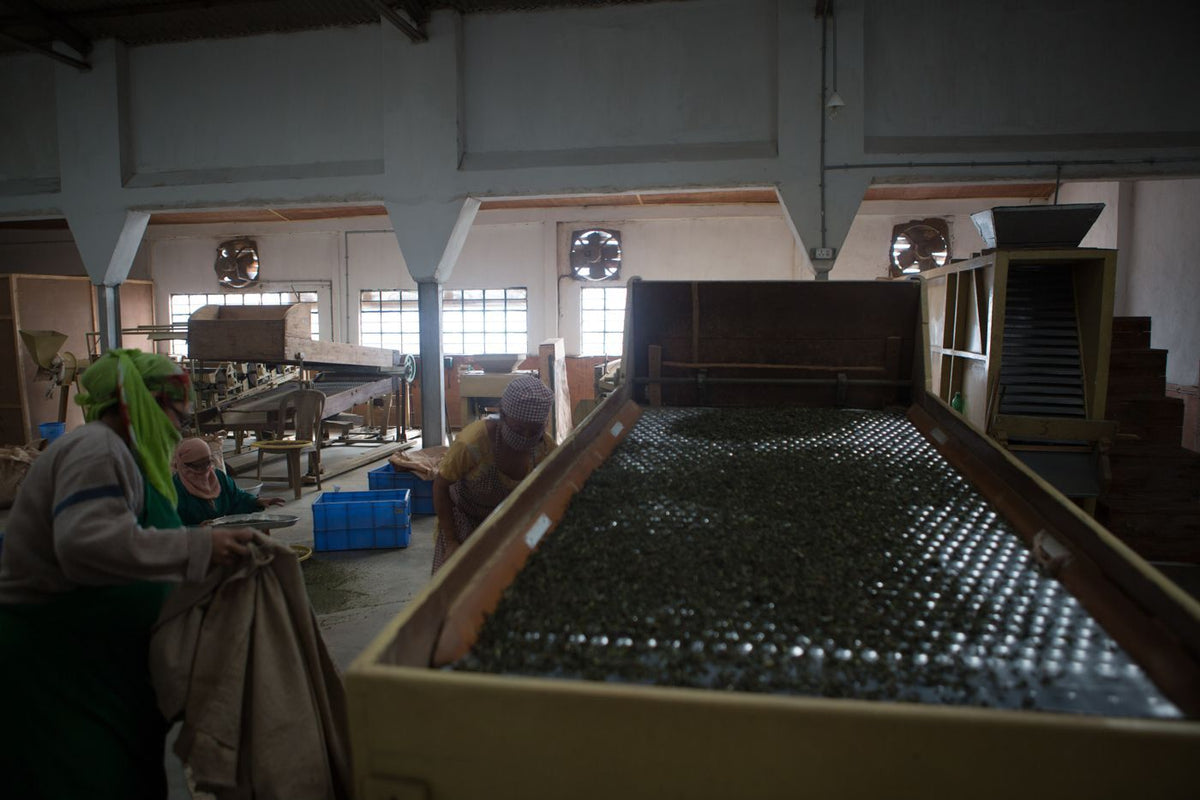
Tea grades are letter codes that describe the size and makeup of dry black tea leaf, from whole leaf grades like OP and FTGFOP down to broken leaf, fannings and dust. The longer the code, the more buds and tips the tea usually holds. A grade tells you about the leaf, not the full flavor: the estate, the season and the tea maker matter just as much.
At a glance
- What a grade measuresLeaf size, shape and how many buds (tips) it holds
- Used forMainly orthodox black tea from India, Sri Lanka, Africa and Indonesia
- Four broad groupsWhole leaf, brokens, fannings, dust
- Highest whole leaf gradeSFTGFOP1
- Most common on TeaboxFTGFOP1, on about half our graded teas (36 of 69)
What are tea grades?
Tea grades are a sorting system: after black tea is made, the leaf is sifted by size and given a code that says how whole it is and how many buds and tips it contains.Read more
Grading helps buyers judge a tea’s style and value at a glance, and it began as a way to classify teas for sale at the auctions that long dominated the Indian tea trade. Peter Keen, writing for us, dates the system to the late 1800s, when it emerged “to classify Indian and Ceylon teas for auction.” The Calcutta tea auctions themselves began in 1861.
Once the leaf has been rolled, oxidized and dried (see How tea is made), it goes over vibrating trays and sieves of different mesh sizes. Each pile is graded on the size of the leaf, the kinds of leaf in the mix, the sheen or “bloom” on it, and, when tasted, the aroma, taste and color of the liquor. There are more than thirty grades in all.
Our own staff training is blunt about what a grade does not do. Grading terms “don’t refer to sensory aspects of the tea”: they do not describe its body, texture or aroma, but “give information about the appearance of the leaf that may be helpful when buying teas from a catalogue.” The same training teaches that a word like “Special” in a code usually signals a high-quality lot, while a code with no “Special” or “Flowery” in it normally means a plainer tea.
There is no single world system. The codes in this guide are used for teas from India, Sri Lanka, Africa, Indonesia and Malaysia; China, Japan, Vietnam and South Korea grade their teas in their own ways. In India the system applies mainly to orthodox black teas and some green teas. CTC tea, the granular kind used for most chai, has a separate set of grades, covered in CTC tea grades.
Broadly, tea divides into four grade groups: dust, fannings, brokens and whole leaf. Dust is the lowest grade and whole leaf the highest.


What does orange pekoe mean?
Orange pekoe (OP) is a grade meaning whole leaf black tea; it has nothing to do with oranges or orange flavor.Read more
On the bush, the same words name the parts of the shoot: Tea 101 calls the bud the flowery pekoe, the first leaf the orange pekoe and the second leaf the pekoe, the part pluckers take when they pick “two leaves and a bud.”

Where the words came from is debated. “Orange” is often said to refer to the Dutch House of Orange-Nassau, since the Dutch dominated the early European tea trade and the word suggested a royal seal of approval. Peter Keen put it the same way for us: the name was “used by traders and growers to imply a Royal Warrant certification of quality,” and it was the Dutch who “created the orange pekoe leaf grading system.”
Another common explanation is the coppery color of well-made leaf. “Pekoe” is usually traced to a Chinese term for the fine white down on young buds. Whatever its origin, orange pekoe became the base word of the whole leaf grading system, and every longer code is built on it.
Keen also had fun with the brands that print it proudly: in essence, he wrote, it means “just average black tea leaf.” In his beginner’s guide to Assam teas, he said OP “has nothing to do with orange anything, nor is it an indicator of a superior tea. It stands for real leaf, as contrasted with the bits and pieces.”
The vocabulary is old. A grower’s note from Australia in 1901, quoted on our blog, found “the broken Orange Pekoe was very choice, fresh and flavory; the Pekoe and Souchong also being of a good useful character.” It also lives on as a regional label: the winter teas of the Nilgiris are known around the world as the “Nilgiri orange pekoes.”
Many people know orange pekoe from supermarket boxes that print it as if it were a flavor or a type of tea. It is neither. For the names of each part of the shoot and the bushes they grow on, see Chinary, Assam and clonal tea plants.
What do the whole leaf grades mean, from OP to SFTGFOP1?
Whole leaf grades build up letter by letter, from OP (whole leaf) to SFTGFOP1 (Special Finest Tippy Golden Flowery Orange Pekoe One), and each added letter promises more buds, more tips or a finer selection.Read more
What are broken grades, fannings and dust?
Broken grades such as BOP are pieces of leaf smaller than whole leaf, and fannings and dust are the smallest particles of all; the smaller the piece, the faster, stronger and darker the cup.Read more
Do higher tea grades taste better?
Not necessarily: a grade describes the leaf’s size and tips, not how good the tea will taste to you.Read more
A long code from an ordinary garden can be outshone by a modest one from a great garden in a good season. Grades are “about the size and cut of the leaf, rather than quality,” as a 2015 piece on our blog put it: “don’t let these symbols prejudice your palate.” Our Darjeeling beginner’s guide agrees: the grade “is not a measure of the quality of the tea itself.” Peter Keen compared grades to the Prime and Choice grades of beef: “The quality of the cooked steak still depends on the chef.”
Our own catalog shows why. Of the teas we currently list with a whole leaf grade, about half (36 of 69) carry FTGFOP1, from spring Chinarys to summer muscatels. Castleton Summer Muscatel, from the garden where the word “muscatel” was first used, is graded FTGFOP1, while Giddapahar Summer Muscatel is SFTGFOP1. That does not make the Castleton the lesser tea; its grade simply records its leaf. The Castleton lot that set a world auction record in 1992 was graded FTGFOP1 too, not SFTGFOP1.
We train our own staff the same way. A question in our employee tea quiz asks which grade gives more flavor in the cup; the right answer is simply “Whole Leaf,” and “Whole Leaf SFTGFOP1” is marked wrong. The group of the grade matters more than the longest code.
As a rule:
- Whole leaf grades give more aroma and nuance, especially with plenty of buds. They cost more and are best drunk plain or with a splash of milk.
- Broken grades, fannings and dust give strength and briskness in a hurry. They suit strong breakfast cups and chai.
- Grading is not fully standardized. Producers apply the same code a little differently, and a grade says nothing about the estate, the flush or the skill of the tea maker.
That last point is the one our founder, Kausshal Dugarr, returns to: “The early tastings give a clear idea of the weather in the area. At a deeper level the personality of the maker comes through.” How professional tasters judge a tea, beyond its grade, is in How to taste tea like an expert.
How do our tasters judge a tea beyond its grade?
Before a tea joins our collection, our tasters screen the dry leaf, the infused leaf and the cup on eight quality parameters, and the lots that pass are hand sorted again before they are packed.Read more
How do you read a Teabox tea label?
Read a Teabox label from the broad to the specific: region, estate, season, bush type, tea type, then grade.
We name our teas by region, estate, season and bush, because those tell you most about what is in the cup; the grade is listed with the tea’s details. Take Darjeeling Castleton Spring Chinary Black, graded FTGFOP1. Taken apart, it tells you:
- Region: Darjeeling, an orthodox tea from the Himalayan foothills.
- Estate: Castleton, the single garden it came from.
- Season: spring, the first flush. See What is first flush tea?
- Bush: Chinary, the China variety of the tea plant.
- Type: black tea. See What is black tea?
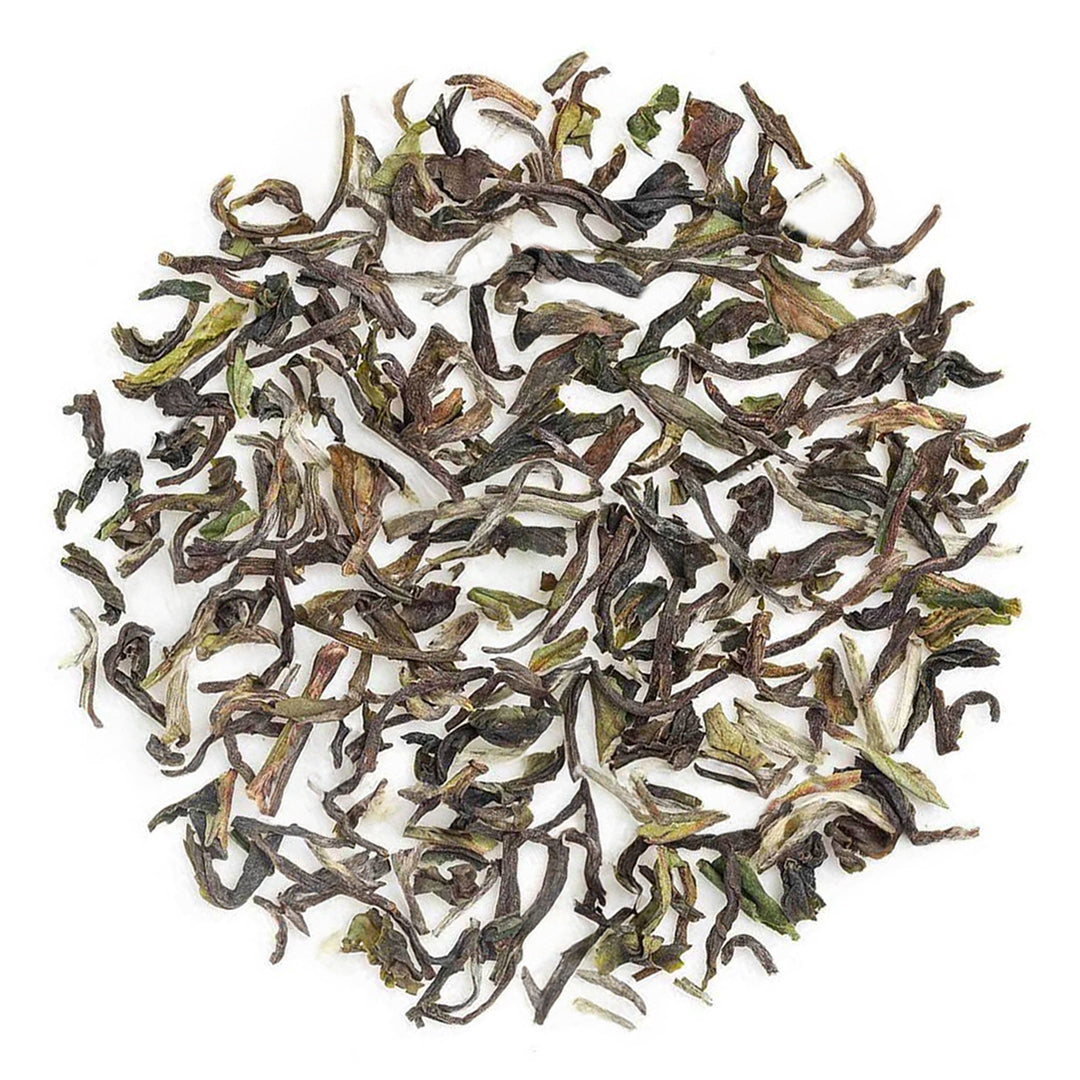
- Grade: FTGFOP1, a top whole leaf grade rich in tips. Our tasters describe the dry leaf as “short, tightly rolled, blackish-green leaves with some silvery buds.”
The product page adds the lot’s invoice number, the batch’s own ID from the garden: DJ-237 on one lot of Castleton Summer Muscatel, OR-424 on Doomni Gold. Our internal tasting notes record a tea in the same order: place, process, cultivar, elevation and invoice.
Our Darjeeling beginner’s guide goes further: the flush and the year tell you more than the grade. “2017 first flush” or “autumn flush” on a pack is a better flag than a long code; if no flush is named, you are likely buying a blend of harvests. On our chais the label says “CTC Black Tea,” not a whole leaf code.
Grades on teas we sell
Some of our current teas, with the grade from our tasting records:
| Tea | Grade | Dry leaf, in our tasters’ words |
|---|---|---|
| Castleton Summer Muscatel | FTGFOP1 | Short, blackish-brown leaves with some luminous, mahogany buds |
| Castleton Spring Chinary | FTGFOP1 | Short, tightly rolled, blackish-green leaves with some silvery buds |
| Mangalam Gold Summer | FTGFOP1 | Short, blackish leaves interspersed with attractive golden tips |
| Doomni Gold Summer | TGFOP1 | Medium-sized, blackish leaves interspersed with ample golden tips |
| Lopchu Flowery Orange Pekoe | FOP | Mixed, slightly bold, blackish-brown leaves with a few stems |
| Lopchu Golden Orange Pekoe | GOP | Mixed, short, lightly twisted blackish leaves with some brown leaf cuttings |
| Assam Masala Chai | CTC BP | Brownish-black granules with cardamom, clove, cinnamon, black pepper and dry ginger |
Notice the Lopchu pair. They are whole leaf teas from one of Darjeeling’s oldest gardens, sold under grade names rather than a season. The flowery orange pekoe makes a mellow, sweet cup with hints of cocoa and cherry wood; the golden orange pekoe is stronger and smokier.
Tea grades FAQ
What does FTGFOP mean?
FTGFOP stands for Finest Tippy Golden Flowery Orange Pekoe. It is a high whole leaf grade with plenty of buds and tips, common on fine Darjeeling and orthodox Assam teas. FTGFOP1 is the best selection within it. Tea people remember it as “Far Too Good For Ordinary People.”
What is the highest grade of tea?
In the system used for Indian black tea, the highest whole leaf grade is SFTGFOP1, Special Finest Tippy Golden Flowery Orange Pekoe One. It is used for exceptional, very tippy lots. A top grade still does not guarantee the tea will suit your taste.
What is TGFOP1?
TGFOP1 is Tippy Golden Flowery Orange Pekoe One, the finest selection within TGFOP and one step below FTGFOP. Our Doomni Gold Summer Black from Assam is graded TGFOP1.
Does orange pekoe taste of orange?
No. Orange pekoe (OP) is a grade meaning whole leaf black tea. It has nothing to do with orange flavor; the word “orange” is often linked to the Dutch House of Orange-Nassau.
Is tea bag tea lower quality?
Most mass-market tea bags hold fannings or dust, the smallest grades, which brew quickly into a strong cup but lack the aroma and nuance of whole leaf tea. A bag is only a container, though: what matters is the grade and the tea inside it.
What is BOP tea?
BOP stands for Broken Orange Pekoe, the main broken leaf grade. It brews faster and stronger than whole leaf tea and is common in breakfast teas.
Are grades used for chai?
Yes, but chai uses CTC grades rather than whole leaf codes. Our masala chais are graded CTC BP (Broken Pekoe), a small grade that infuses at the same pace as small spices like cardamom.
Do grades apply to green tea?
In India, grades are used mainly for orthodox black tea and for some green teas. China, Japan and other countries grade their teas in their own ways. We use the same codes on some of our whites, our Glenburn Moonshine Oolong and our Glendale Autumn Twirl Green, which is graded SFTGFOP1. See What is green tea?
Keep reading
Sources
- Teabox Tea 101: Know your tea grades, What is black tea?, FAQs, Glossary of tea terms
- Teabox blog: The Beginner’s Guide to Choosing a Darjeeling (2017), A Beginner’s Guide to Assam Teas (2017), English Breakfast: The Baseline Black Tea, Is Tea-Tasting Only for Experts? (2015)
- Teabox blog: A Tryst with History, The Muscatel Master, Remembering the Days of Manual Tea Auction (2016), In Assam for the Summer Flush, Going Clonal: How About a Nice Cup of AV2? (2016)
- Teabox blog: When Tea Came to Australia (2017), The Beginner’s Guide to Winter Flush Teas from the Nilgiris (2017), Tea or Coffee? I Swing Both Ways! (2015), Should You Add Milk to Tea?, Two-Foot Tea and the Bengali (2016), The Art of Tasseography: Reading Future in a Teacup (2021)
- Teabox blog (Still Steeping): How to judge the quality of tea (2015); 5 Words to Make You Sound Like a Tea Hotshot (2015); When Tea Was Gesmokkeld and Verschrikkelijk (2016); Beyond the tea bag: a starter’s guide to leaf tea (2016); The Delight of Margaret’s Hope; Tea and technology
- Teabox product descriptions and product data (grade, invoice and dry leaf fields), Shopify, October 2026: Castleton Spring Chinary and Summer Muscatel, Giddapahar Summer Muscatel, Mangalam Gold Summer, Doomni Gold Summer, Lopchu Flowery and Golden Orange Pekoe, Okayti Spring Chinary, Castleton Summer Moonlight White, Namsang Summer, Special Spring Silver Needle, Moonlight whites, Glenburn Moonshine Oolong, Glendale Autumn Twirl Green, Assam Masala Chai
- Teabox internal documents (Google Drive): Teabox internal document, 2020; Teabox internal document; Teabox internal document, 2023; Teabox internal document, 2017; Teabox internal document, 2022; Teabox internal document, 2020; Teabox internal document, 2022; Teabox internal document, 2016; Teabox internal document, 2015; Teabox internal document; factory photos as credited
- Teabox on Instagram (@teabox.tea): choosing black tea, Feb 2016, screening list, May 2020, four grade groups, Apr 2021, tasting-room volumes, May 2021, Halmari clones, Jul 2021, bitterness and leaf size, Sep 2021, tasting turnout, Nov 2021, Golden Needle, Feb 2022, Golden Pearl, Feb 2022, three tasting stages, Apr 2022, grades Masterclass clip, May 2022, hand sorting, Jun 2022, Masterclass recap, Jun 2022, Risheehat quality rating, Mar 2024, Mim quality rating, Apr 2024, garden to pack, Jan 2026
- Kausshal Dugarr on X (@Teapreneur): Thurbo FTGFOP1 tasting, Apr 2010, early tastings, 2022
- Teabox Masterclass videos on YouTube: What is tea grading, Different grades of tea, Grading and hand sorting in teas

Leave a comment
All comments are moderated before being published.
This site is protected by hCaptcha and the hCaptcha Privacy Policy and Terms of Service apply.