


A tea glossary explains the words tea makers, tasters and labels use: where a tea grew, how it was made and how it tastes. Learn a few dozen of them and any tasting note or tea label starts to make sense. The terms run from A to Z, each in a line or two, on three pages linked below, and most link to the Tea 101 guide that covers them in depth.
At a glance
- What it covers225 tea terms, A to Z, on three pages
- Kinds of wordsTasting, leaf and grades, making, seasons, types, chai
- Tasters judgeDry leaf, infused leaf and liquor
- Most askedMuscatel, astringent, liquor, flush
- Positive wordsBright, brisk, clean, malty, muscatel
How to use this tea glossary
Use this glossary to decode a tea label or a tasting note: look up the word, read the one-line meaning, then follow the link if you want the full story.Read more
Tea has two vocabularies. The first describes the tea itself: its type, region, season, grade and how it was made. The second is the language of tasting, the tea tasting terms professionals use to describe the dry leaf, the brewed liquor and the infused leaf.
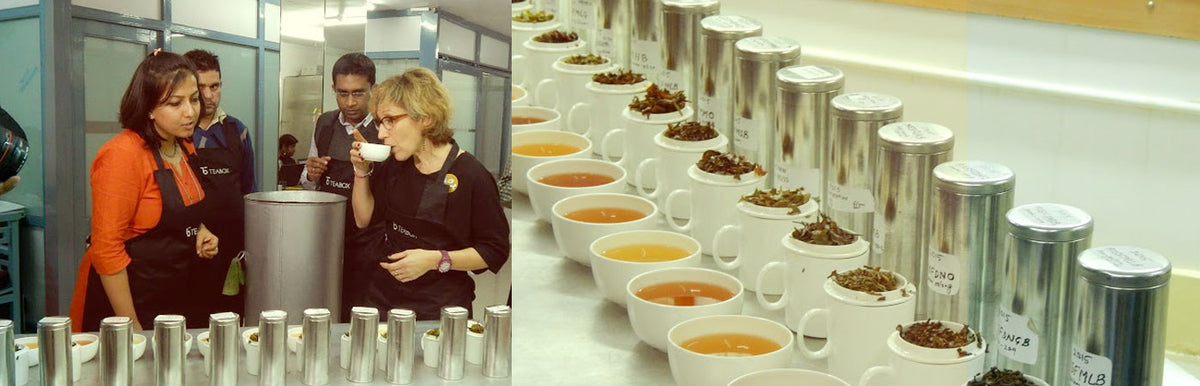
That second vocabulary exists for a practical reason. When a Paris-based perfumer and tea expert, Carine Baudry, ran a two-day sensory workshop for our buyers, blenders and marketers in Siliguri, she put it simply: “To talk about tea we need a common language so we can share and communicate each other’s experiences better.” Over those two days the team smelled more than 40 aromas from glass vials and tasted over 30 teas, from Darjeeling first flush to Japanese sencha.
Where our definitions come from
In February 2016 our quality team wrote down the words we use at the tasting bench in a glossary of tea terms, because, in its own words, the trade’s many terms and “the variations that exist in regard to some of their definition” called for “a degree of uniformity.” It follows India’s national glossary of tea terms, IS 4541, and groups the words by taste, dry leaf, aroma, color, buyer’s notes and general terms. Our 2023 training deck, used to teach new staff, adds the words we use in tasting notes today. Most definitions on these pages come from those two documents, in plain English.
The words matter because they can mislead. Customers sometimes write to us asking whether a tea named for a fruit contains that fruit, or whether “liquor” means there is alcohol in the cup. In tasting notes, a fruit or flower names a flavor the leaf itself gives, and liquor simply means brewed tea.
Some tasting words sound odd at first (who wants a “baggy” tea?), but each one points to something you can learn to spot. If you want to put them to work, start with How to taste tea like an expert; for the plant behind every word, see What is tea?; for quick answers to everyday questions, see Tea FAQs.
What words describe tea?
The most useful words to describe tea fall into three groups, matching the three things a taster looks at: the dry leaf, the infused (wet) leaf and the liquor in the cup.Read more
When our tasters assess a sample at the source, they check the dry leaf for bloom and aroma, the wet leaf for color and aroma, and the liquor for color, aroma, astringency, strength, flavor, bitterness, body and aftertaste. Our training deck teaches the same order. Good dry leaf should feel crunchy between your fingers, which shows it has not taken up moisture from the air, and it should smell fresh, never musty. With the infused leaf, the brighter it looks, the better the tea usually is.
| What you are judging | Words of praise | Words for faults |
|---|---|---|
| Dry leaf | Well-twisted, tippy, even, good bloom, well sorted | Uneven, stalky, dusty, poorly made |
| Infused leaf | Bright, even color, fragrant | Dull, dark and uneven, mixed colors |
| Liquor: look | Bright, clear, coppery, amber, golden | Cloudy, muddy, dull |
| Liquor: taste and feel | Brisk, clean, malty, muscatel, flowery, full-bodied, smooth | Flat, bakey, burned, baggy, harsh, bitter |


Smell does most of the work. Up to 90% of flavor is perceived through smell, which is why tasters slurp: “The louder the slurp, the better,” the deck says, because pulling air in with the liquor brings the flavors to life. Frank Miller, a tea buyer since 1990 who wrote for our blog, adds a warning every taster learns: “Never attempt to taste tea when you have a cold!”
When the tea is in your mouth, the deck asks you to check six things: body (light, medium or full), astringency (low to high), pungency, texture (creamy or velvety), how complex the flavors are, and how long they last (short, medium or long). Every one of those words has an entry in the A to Z.
How do tasters describe flavor?
Tasters describe flavor by family first (fruity, floral, vegetal, spicy, nutty, earthy, woody or smoky), then name the closest real thing: a muscat grape, an orchid, a forest floor after rain.Read more
These are the families and examples our training deck uses. A tasting note is built from them, from the first impression through the “heart” of the cup to the finish.
| Family | What tasters name |
|---|---|
| Fruity | Orange, zest, lemon, berries, peach, prunes, muscat grapes, green apple, raisins, dates, ripe tree fruit |
| Floral | Orchid, jasmine, iris, freesia, rose, amaryllis |
| Spicy | Nutmeg, pepper, licorice, malt |
| Vegetal and woody | Dry wood, tree bark, moss, undergrowth, forest floor, the scent of earth after a storm, freshly cut grass |
| Mineral and marine | Wet rocks, metal, salt; seaweed and sea air |
| Empyreal | Smoke, grilled and smoked notes, caramel, burnt notes |
Here is how those words sound in practice. In June 2021 our tasting team spent 55 minutes agreeing on the note for Castleton Spring Chinary Black. The final word went to Arun Kumar Gomden, the veteran Darjeeling tea maker and master taster credited with naming the muscatel teas at Castleton:
“A medium-bodied, well-balanced cup tipped with vibrant green attributes. It starts with clean notes of citrus which however subside to reveal a heart resounding with sweet green flavors which dominate throughout the length of the cup.”
Three of our tasters had each drafted a note first, and they disagreed about one thing: whether the roasted chestnut in the cup was subtle or heavy. Mr. Gomden kept it as a “subtle sensation of roasted chestnuts,” with ripe stone fruit around the edges, a woody undercurrent toward the finish and “furtive notes of elderberry” in the aftertaste.
Medium-bodied, clean, notes, heart: every one of those words is defined in the A to Z. Tasters also score what they taste. For a 2022 Singbulli oolong, our tasters gave scores of 9 and 9.5 and Mr. Gomden ranged from 8.95 to 9.25. On Frank Miller’s own 1 to 10 scale, 5 means “This is tea, not coffee!” and he would buy a chest of any tea he gave a 9.
Why can one tea word mean praise or a fault?
Because the trade glossary and modern tasting notes grew up for different jobs: the trade words were written for buyers judging bulk tea, so several of them name faults, while today’s tasting notes use some of the same words as praise.Read more
Our quality team’s glossary follows the trade standard, and our training deck and product notes follow how tea drinkers talk. Where the two differ, the entry in the A to Z gives both senses. The ones to know:
- Woody: praise in a tasting note (“evocative of freshly cut timber”), but in the trade a sawdust-like taste in tea made very late in the autumn.
- Sweet: praise and a rare quality in some light green teas and oolongs, but in the trade a plain, low-grade tea with nothing wrong and nothing special.
- Smoky: the whole point of a smoky blend, but in the trade a taste caused by a fault in the dryer.
- Earthy: a forest-floor note in the flavor wheel, but in the trade a sign of tea stored in poor conditions.
- Fully fired and high fired: faults in most teas, but an asset in certain Darjeelings.
- Thin and light: faults in a strong Assam, but acceptable in some delicate, flavory teas.
Our own teas show the reader’s sense. Teabox Roasted Darjeeling Black opens with “pronounced notes of burnt wood” and smoke, and Darjeeling Himalayan Wine is a “heady high-fired tea” with tobacco and cocoa. Despite its name, Himalayan Wine is pure tea: the trade’s “winey” is a fault, while the name describes the character of the cup.
Tea terms A to C: acidic to CTC
The A to C terms include the words people ask about most after muscatel: astringent, amber, autumnal, bloom, body, brisk, chai, creaming down and CTC.Read more
Tea terms D to M: Darjeeling to musty
The D to M terms cover dry leaf and dust, the flushes, grades like FTGFOP, golden tips, liquor, malty and muscatel.Read more
Tea terms N to Z: notes to woody
The N to Z terms run from notes, oolong and orthodox through pungent, second flush and tippy to withering and woody.Read more
Taste the words: teas that show each term
The fastest way to learn tea words is to taste two or three teas side by side and name what you find.
Brew a spring Darjeeling next to a summer Assam and you will meet bright, flowery, brisk and light-bodied in one cup, and malty, thick and full-bodied in the other. Add a muscatel and you have tasted the word most people ask about. Our tasters work the same way, cup after cup: they sampled 1,578 cups of First Flush 2022. Frank Miller suggests tasting no more than ten to twelve teas at once at home, and brewing them all the same way so the comparison is fair.
| Term | Taste it in | What to look for |
|---|---|---|
| Bright, brisk, flowery | Castleton Spring Chinary | Brisk citrus, raw mango, orchid florals |
| Muscatel | Castleton Summer Muscatel | Muscatel grape, stone fruit, honey, woody finish |
| Malty, tippy, full-bodied | Halmari Summer Black | Malt, date palm, caramel finish |
| Autumnal, mellow | Okayti Autumn Chinary | Stone fruit, gentle nuttiness, mellow finish |
| Oolong | Glenburn Spring Moonshine Oolong | White blossom, fruit, soft and smooth |
| Frost tea | Havukal Winter Frost Black | Tropical fruit sweetness, hints of wintergreen |
| Kadak | Teabox Kadak Chai | Strong, malty, made for milk and sugar |
| Geranium, champagne liquor | Badamtam Spring Moonlight White | White lily and geranium, raw mango, a pale champagne cup |
| Empyreal, burnt wood | Teabox Roasted Darjeeling Black | Burnt wood, smoke and firewood, red berries in the aftertaste |
The last two rows come from our product data.
Brew each at the right heat: see How to brew loose leaf tea, and keep the leaf fresh with How to store tea. For a wider first read, try Types of tea and Indian tea: the complete guide. For what the first harvest means to a tea buyer, see What’s the fuss about the first flush?
Tea glossary FAQ
What does muscatel mean in tea?
Muscatel is the rich, grape-like flavor of some Darjeeling second flush teas, named after the Muscat grape. It has nothing to do with musk, and it appears only in certain gardens for roughly 10 to 15 days around June. Arun Kumar Gomden, who named it, says he chose the word from the dictionary because it meant “grape” or “fruity.” See Second flush tea and muscatel.
What does astringent mean in tea?
Astringency is the dry, puckering feeling that tea leaves on your tongue and gums, caused mainly by tannins. A little gives tea a pleasant grip; too much, often from oversteeping, makes it harsh. It is a feeling, not a taste, so it is different from bitterness.
What is liquor in tea tasting?
Liquor is the tasters’ word for brewed tea. They judge its color, clarity, aroma, strength, body and aftertaste separately from the dry leaf and the infused leaf.
Is there alcohol in tea “liquor” or in a tea called “wine”?
No. Liquor is simply the trade’s word for brewed tea, and names such as Himalayan Wine or a fruit in a tea’s name describe the character of the cup. A note of raspberry or wine in a tasting note is a flavor the tea leaf itself gives.
What is a flush in tea?
A flush is a burst of new growth on the tea bush, and the harvest picked from it. North India has four main flushes: first (spring), second (summer), monsoon and autumn; Darjeeling adds a short in-between flush, and the Nilgiris a winter flush. See Seasons of tea.
What does CTC mean on a tea pack?
CTC stands for crush, tear, curl, a machine method that turns withered leaf into small granules. CTC tea brews fast and strong and is the base of most Indian chai. Because the machine cuts the leaf, there are no whole-leaf CTC grades. See Orthodox vs CTC tea.
What does FTGFOP mean?
FTGFOP stands for Finest Tippy Golden Flowery Orange Pekoe, a high grade of whole-leaf black tea with plenty of golden tips. On our product pages you will find a tea’s grade in the Harvest section. See Tea grades explained.
Keep reading
Sources
- Teabox quality team, Teabox quality team glossary, based on IS 4541, based on the Bureau of Indian Standards glossary IS 4541:1986
- Teabox, Teabox internal document, 2023 (tasting terminology, grades, tasting method, eight quality checks)
- Teabox Tea 101: Glossary of tea terms
- Teabox blog: What I Learned at My First Ever Tea Tasting (2016), Is Tea-Tasting Only for Experts? (2015), The Secrets of Tea-Tasting (2017), The Muscatel Master (2021), What’s the fuss about the first flush? (2015), The Beginner’s Guide to Winter Flush Teas from the Nilgiris (2017)
- Teabox blog (Still Steeping), 5 Words to Make You Sound Like a Tea Hotshot, 2015
- Teabox product descriptions and product data, 2026: Castleton Spring Chinary, Castleton Summer Muscatel, Halmari Summer Black, Okayti Autumn Chinary, Glenburn Spring Moonshine Oolong, Havukal Winter Frost Black, Teabox Kadak Chai, Badamtam Spring Moonlight White, Teabox Roasted Darjeeling Black, Darjeeling Himalayan Wine, Assam Koilamari Summer Raspberry Black
- Teabox customer questions to our support team, 2024 to 2026 (internal summary, paraphrased)
- Teabox on Instagram (@teabox.tea): Dry leaf, wet leaf and liquor, Apr 2022, Writing the Castleton Spring Chinary note, Jun 2021, Our screening checks, May 2020, Amber, Jun 2021, Jassids and the muscatel, Jul 2021, Autumn flush, Nov 2022, CTC, Sep 2025, “Chai tea,” Sep 2025
- Kausshal Dugarr on X (@Teapreneur): First Flush 2022 tasting, May 2022
- Teabox on YouTube: What is tea grading, Different Indian tea flushes
- Tea 101 guides on seasons, second flush and chai, for consistent definitions


Leave a comment
All comments are moderated before being published.
This site is protected by hCaptcha and the hCaptcha Privacy Policy and Terms of Service apply.