


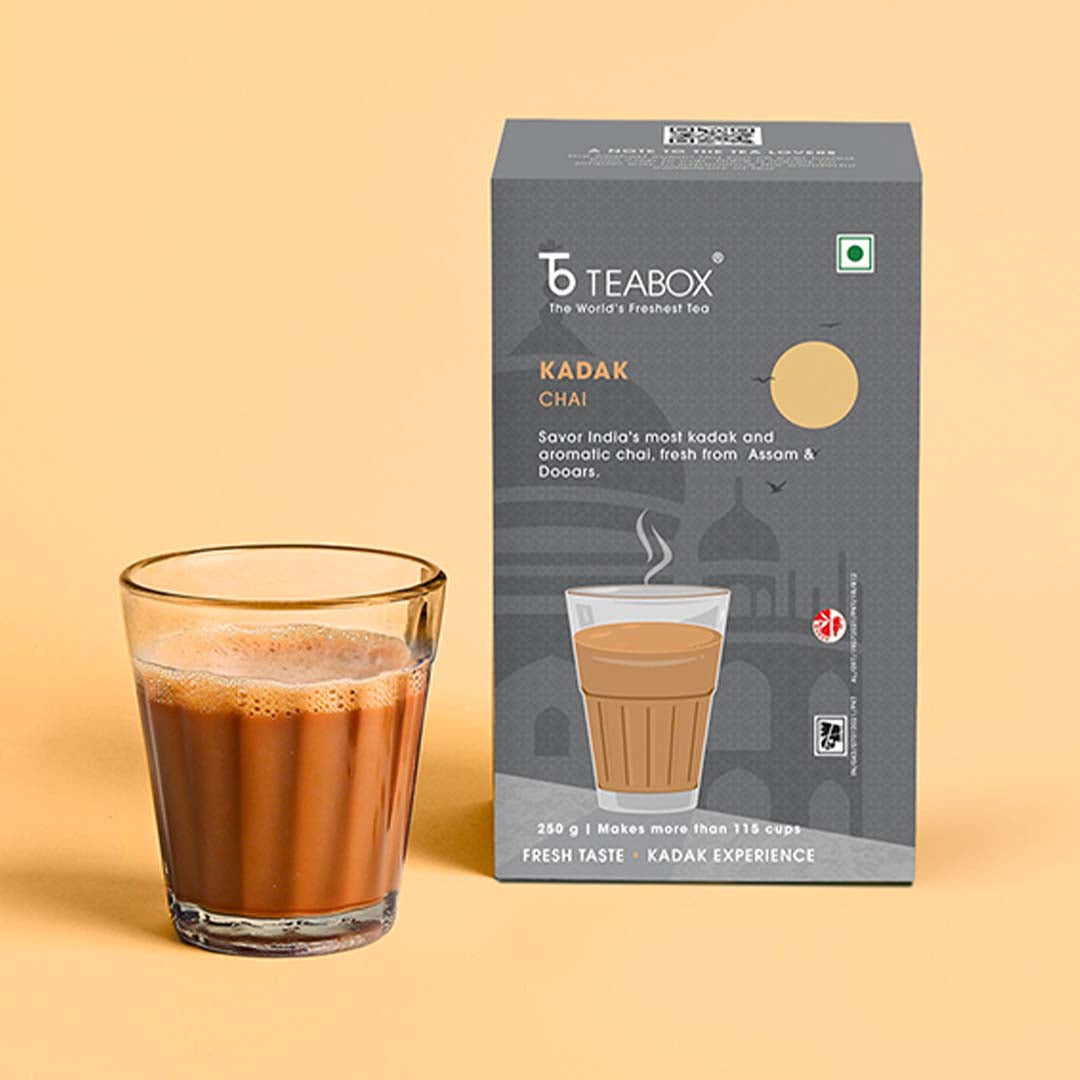
To make karak chai, boil strong CTC tea in water for about two minutes, add milk and sugar, then let the pan rise to the boil twice more until the chai turns the color of toffee, and strain. The recipe below follows the method our blog has published since 2016, made stronger the way kadak drinkers do it: one extra spoon of tea for the pan. For what karak is and how it differs from masala chai, start with Karak (kadak) chai.
What do you need for karak chai?
For two cups you need three level teaspoons of CTC tea, about 350 ml of water, 240 ml of full-cream milk and sugar to taste, plus a small saucepan and a fine strainer.Read more
Karak chai recipe card
At a glance
- Serves2 cups
- Total timeAbout 10 minutes
- TeaAssam CTC or Teabox Kadak Chai
- EquipmentSmall saucepan, fine strainer
Ingredients
- 3 level teaspoons CTC tea (one per cup, plus one for strength)
- 1½ cups (about 350 ml) water
- 1 cup (about 240 ml) full-cream milk
- Sugar, to taste (karak is traditionally sweet)
- Optional: 2 green cardamom pods, lightly crushed
Each ingredient has a job. The extra spoon of tea is the old kadak rule: one level teaspoon of leaf for each cup, and “if you want it really strong (emergencies, examinations), throw in one for the cup,” as the writer Jerry Pinto does at home.
Full-cream milk matters as much as the tea. Our writer Meeta Sharma uses full-fat milk, or milk with 3.25% milk fat, “mainly for its body/density,” because it makes the chai creamier and tastier than skimmed milk. Thin milk lets the tannic edge of a strong CTC show through; fuller milk rounds it off.
Sugar rounds the cup off further, and karak is meant to be sweet. If you add cardamom, crush the pods lightly so they open in the boiling water; our own cardamom chai is made with half-beaten pods for the same reason.
How do you make karak chai, step by step?
Boil the tea in water first, add milk only once the liquor is very dark, then let the chai rise to the boil twice before you strain it.Read more
Method
- Bring the water to a boil in a saucepan. Just as it starts to bubble, add the tea.
- Let the leaves boil for about 2 minutes, until the liquor is very dark. If you are using cardamom, add it now and simmer for 1 more minute.
- Pour in the milk and let the chai simmer for 2 to 5 minutes. The longer it simmers, the stronger and creamier it gets.
- Stir in the sugar.
- Let the chai rise to the boil, lower the heat as it climbs, then let it rise once more, until it looks toffee-colored.
- Turn off the heat, strain into cups and serve hot.
Why the order matters
The tea goes into water first, and the milk later, for control. Meeta Sharma adds milk once the leaves have had time to “play around in the now-dark brown liquor for good 2 minutes,” because this way you can control how milky or strong the chai turns out. Adding milk first, she found, upset the balance, and fixing it with more water or milk only made too much chai, and not a good one.
The two rises to the boil are where the flavors join. Simmering combines the tannic strength of a black tea with the milk to give a creamy liquor with a dense texture. Our old Tea 101 method stops when the chai takes on “a light milk chocolate color”; karak goes a shade further, to toffee.
Do not worry that you are “overbrewing.” You would never boil a delicate Darjeeling, but with CTC the boil is the point: it blends the tea, milk and spices together. The full family of methods, spiced and unspiced, is in How to make masala chai at home.
How much milk and water should karak chai have?
Start with about three parts water to two parts milk, as in the recipe, and adjust: more milk for a creamier cup, more water and a longer boil before the milk for a stronger one.Read more
Tea 101 suggests about two parts water to one part milk as a starting point, then adjusting to taste. Our 2016 recipe, which this one doubles, is a little milkier, at ¾ cup of water to ½ cup of milk.
Home cooks go much further. Meeta Sharma’s mother made her chai with “one part water, two parts milk, a heap of tea leaves and just one short spoon of sugar.” In Mumbai, Jerry Pinto met Marwari tea “made with only milk and with cloves to kill,” and Gujarati tea “sweetened until you could taste nothing but sugar.”
Mumbai’s tea stalls solve the question to order. Many keep two pots, tea leaves boiled in water in one and boiled milk in the other, and mix each glass the way the customer asks: paani kam doodh, less water and more milk, or doodh kam paani, less milk and more water. At home, the simplest way to the same control is to hold back some of the milk and add it at the end.
For a milder cup, go back to one teaspoon of tea per cup and a shorter simmer.
How do you make Gulf-style karak with evaporated milk?
Use evaporated milk in place of some or all of the fresh milk, and add it after the tea has boiled, since it is already thick and cooked.Read more
Gulf-style karak. A few strands of saffron with the cardamom give the café version. Evaporated milk gives a richer cup with a light caramel note, and it is easy to store in a hot climate.
The same tinned-milk habit runs through Malaysia’s teh tarik, and the reasons there explain the Gulf cup too. Teh tarik is strong black tea mixed with evaporated and condensed milk; when tea reached Malaysia after World War II the dairy industry was not well developed, so preserved milk had to suffice, and it is now needed to replicate the historic taste.
The condensed milk is not only for sweetness. Adeline Teoh writes that it gives the tea body and helps make a long-lasting froth, and that its sweetness counters any astringency in the tea. For anyone making teh tarik at home, she suggests Assam CTC or a strong blend like Irish Breakfast. The froth comes from pouring the tea from one jug to another, which also cools it.
India has its own version of the pour. In Tamil Nadu’s tea shops, the tea masters pour from several feet up to mix the milk, tea liquor and sugar into a frothy cup. Try it with a Gulf karak: pour between two jugs a few times before serving.
Can you steep Kadak Chai instead of boiling it?
Yes. For a lighter cup, steep one teaspoon (about 2.5 g) of Kadak Chai in 150 ml of water at 95 to 100°C for 5 minutes, then add milk and sugar.Read more
That is the steeping standard on our product page, and our internal steeping sheet for chai gives the same figures: 150 ml of water, 95 to 100°C, one teaspoon or 2.5 g, five minutes, one steep, with milk and sugar. The sheet says no to lemon for Kadak Chai: it is a tea for milk.
A steeped cup will not be karak. Chai is simmered, not steeped, and it is the simmering that turns tea and milk into a creamy liquor with a dense texture. The 2.5 g per 150 ml is already a strong dose, though: it works out at about 4 g for a 250 ml mug, nearly twice what we suggest for a cup of Assam drunk the steeped way.
Steeping suits mornings when you want the Kadak Chai taste in a hurry, or a quick mug at work. For brewing Assam with milk the gentler, steeped way, see Assam tea for milk tea.
Keep reading
Sources
- Teabox blog: Teabox’s favorite chaiwallah (2015), A Mumbai tea story (Jerry Pinto, 2015, with reader comments), Teh tarik milk tea: Pulling depth and sweetness from tea (Adeline Teoh, 2015), A blender of teas (2015)
- Teabox blog: The journey of our beloved chai (2020), Bombay’s Lifeline – Cutting Chai (2020), Teabox: 100 countries and counting (2017), From bush to cup: the logistics of tea (Peter G. W. Keen, 2016), Cricket: leg breaks and tea breaks (Peter G. W. Keen, 2016)
- Teabox blog: A beginner’s guide to Assam teas (Peter G. W. Keen, 2017), Assam Diaries: A tour of Halmari (2016), The tea navigation paths: artisan and agribusiness (Peter G. W. Keen, 2017), Cross country in search of the chai wallah (2015)
- Teabox blog (Still Steeping): How to make Indian masala tea, 2016; Chai: the way India drinks tea (Meeta Sharma, 2015, with reader replies); When tea was gesmokkeld and verschrikkelijk (Peter G. W. Keen, 2016); Tea in Islamic cultures (Peter G. W. Keen, 2016)
- Teabox Tea 101: Orthodox vs CTC teas; What’s the difference between tea, chai, chai tea?; How to make chai; Chai, the Indian way of drinking tea; FAQs; How to choose a chai
- Teabox product pages and product data: Kadak Chai (description, at-the-source notes, caffeine, steeping), Assam Masala Chai, Wayanad Cardamom Chai, Mangalam Gold and Coombergram Summer Black, Classic Assam Black, Halmari Summer Black, 2026
- Teabox Drive: Teabox internal document, 2021; Teabox internal document, 2021; Teabox internal document, 2022; Teabox internal document, 2026; Teabox internal document, 2023; Teabox internal document; photos as credited
- Teabox on Instagram (@teabox.tea): Halmari, Jul 2016, CTC rollers, Sep 2016, how Indians started to drink tea, Jan 2022, old tea campaigns, Jan 2022, Kadak Chai and pruning, Jan 2022, Assam region, Feb 2022, Kadak Chai back in stock, Mar 2022, what CTC means, Sep 2025
- Kausshal Dugarr on X (@Teapreneur): out of stock, Jan 2022, Kadak Chai sourcing, Jan 2022, back in stock, Mar 2022; a customer post on X, Nov 2025; Teabox on YouTube: Halmari Tea Estate, Assam


Leave a comment
All comments are moderated before being published.
This site is protected by hCaptcha and the hCaptcha Privacy Policy and Terms of Service apply.