


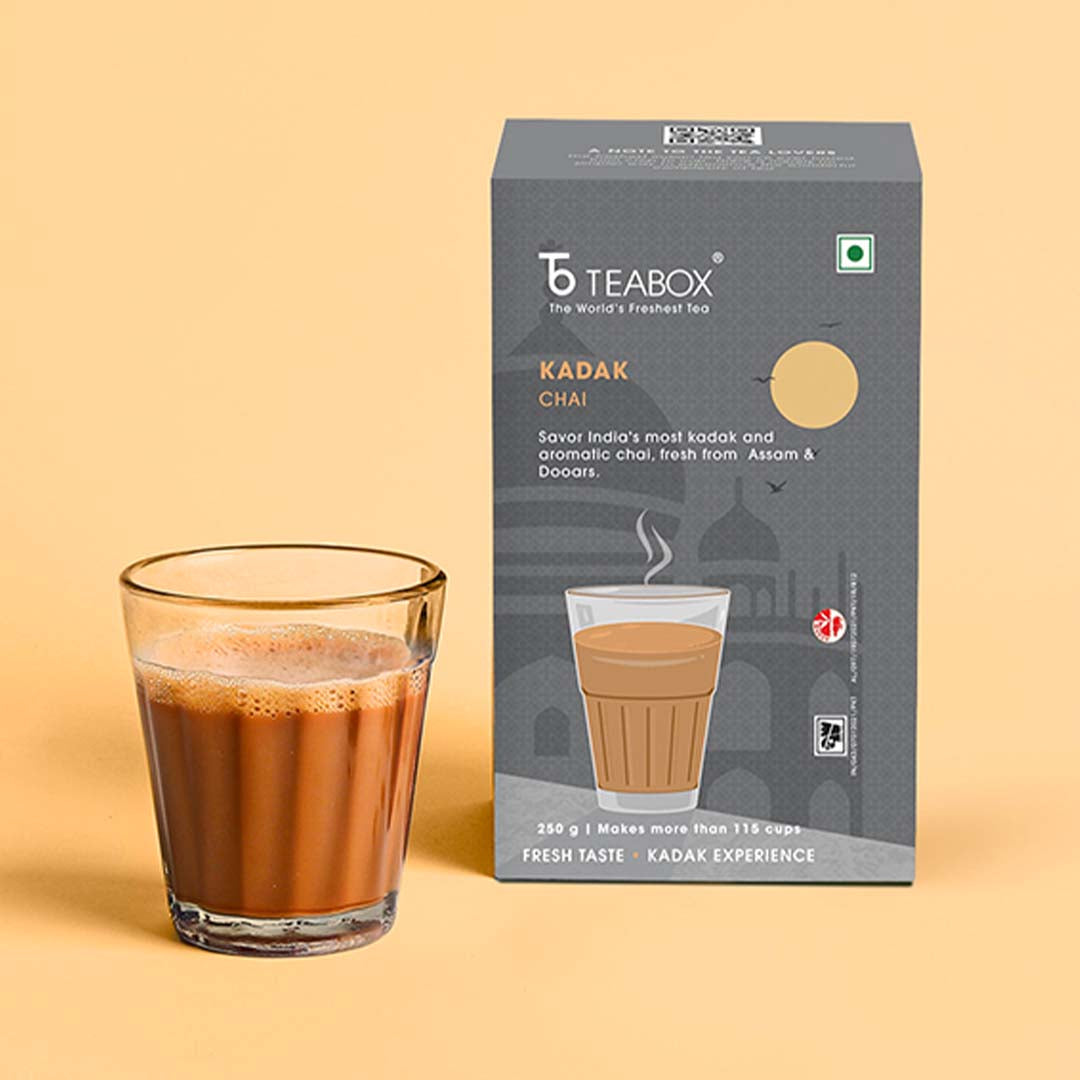
The best tea for karak chai is a fresh Assam CTC: small, even granules that brew fast, give a dark, malty liquor and keep their strength through a long boil and a lot of milk. A strong Assam whole-leaf black tea also works, especially blended with CTC. For what karak is, and our recipe, start with Karak (kadak) chai.
What is the best tea for karak chai?
Choose a strong, full-bodied Assam black tea, and for a true karak, its CTC form, because the small granules give up their strength and color quickly in a boiling pan.Read more
Our writer Meeta Sharma’s advice to a reader asking which tea suits chai was blunt: “To make chai you need a strong, kick-you-in-the-face kinda strong black tea.” Lowland teas, grown in tropical conditions nearer to sea level, are ideal because they have “a very dark, brisk and robust flavor profile.” Her pick was “a full-bodied Assam black tea – loose-leaf or CTC grain.”
Peter Keen, writing for our blog, called Assams “English Breakfasts with attitude,” best summed up as strong: assertive, brisk, bold, bracing and hearty. He also noted that assertive can shade into harsh, and brisk into bitter. In a karak, the milk and sugar are there to catch that edge and turn it into body.
That is why plain strength matters more here than subtlety. Strong black teas take milk easily, while greens and whites are best drunk plain. If you want more aroma, you can blend in a whole-leaf Assam, as the last section explains.
What is CTC tea, and why does it suit karak?
CTC is black tea cut into small pellets by machine, and it suits karak because the small pieces release a strong, dark, astringent liquor fast and stand up to milk.Read more
CTC stands for crush, tear and curl (some say cut, tear and curl). The leaf is passed through cylindrical rollers with serrated blades that turn it into small, even pellets, a process that takes about two hours. “Assam is all about CTC!” as we once put it.
The machine at the heart of the line is the rotorvane, a set of fast drum cylinders turning in opposite directions, whose teeth macerate the withered leaf; the crushers and tearers run at up to 600 to 1,200 revolutions per minute. Orthodox making moves the whole leaf slowly through each step; CTC, in Keen’s words, “speeds it up by breaking it up.”
What that does to the cup
Compared with orthodox whole leaf, CTC tea gives a stronger, darker cup with a distinctly astringent edge, and it takes milk far better. As Keen put it, “the smaller the leaf, the quicker the tea releases its flavor and the harsher it will be,” and “there is no whole-leaf CTC.” For a cup of plain tea that is a fault; for a karak, boiled with milk, it is exactly what you want.
That is why it became India’s everyday tea after CTC machines spread in the 1960s. CTC chai caught on because it was economical and brought aroma, taste and color within seconds of boiling. Worldwide, CTC now makes about 80% of all black tea. The full comparison is in Orthodox vs CTC tea.
Why is Assam tea used for karak chai?
Assam is used because its teas, grown at or near sea level, are known for body, briskness, malty flavor and strong color, the qualities that survive a long boil with milk.Read more
Why Assam? The region is mostly at or near sea level and its teas are known for body, briskness, malty flavor and strong color. “If you are a strong tea, milk-and-sugar habitué, the bigger the Assam the better,” as our Assam explainer says. The line comes from Peter Keen’s guide to Assam teas on our blog. More on the region in Assam tea.
A day at Halmari
Some gardens are as famous for their CTC as others are for whole leaf. On our 2016 Assam trip we spent a day at Halmari, which “has one of the best CTC teas in the country.” That year its tea was the most expensive CTC and was breaking its own price records every year.
Our team saw why. The estate manager then, DK Arora, began each morning with the plucking charts. Halmari keeps a six-day round, so each section is plucked once every six days, and the leaf is taken early, while it is still small, so that the tea keeps the most flavor and juice. “One third of your job is done if the plucking is done correctly,” he told us. At the end of the day our colleague Ravi sat with him to taste that day’s batch. Read the visit in Assam Diaries: A tour of Halmari, and taste the garden’s whole-leaf tea in Assam Halmari Summer Black.

Karak’s other home is the Dooars: Teabox Kadak Chai comes from gardens in both Assam and the Dooars.
How do you choose a CTC tea for karak?
Buy it fresh, look for even, black-brown granules with little dust, and match the grade to what else goes in the pan.Read more
A few tips when choosing:
- Freshness matters more than grade. CTC is made to give its strength quickly, and stale CTC gives a flat, dull cup however long you boil it. Tea 101 adds that the dry granules should have no moisture or off-notes, and that a good chai shows strength and brightness in the infusion.
- Look for even granules, black-brown and uniform, with little dust. CTC dust is the lowest grade. The chai we sell is the first grade of the lot, not dust. Grades are explained in Tea grades explained.
- Match the grade: for a karak with small additions like cardamom, Tea 101 suggests a smaller CTC grade such as BP (broken pekoe); for big, chunky spices like star anise, a larger grade such as BOPSM.
- Know the strongest grades: our 2023 training deck lists CTC grades from largest to smallest as BPS, BOP, BOPSM, BP, PF, OF, PD and D, with the small PF and PD grades giving stronger, more astringent cups than BP or BOPSM.
- Whole leaf adds depth. A malty Assam black such as Classic Assam Black can be boiled the same way, or blended with CTC for more aroma. For brewing Assam with milk the gentler, steeped way, see Assam tea for milk tea.
Whole leaf brings something CTC cannot. Keen describes the best whole-leaf Assams as more varied, “mellow, malty or ‘tippy,’” where broken and CTC grades are strong but plain. Half and half is a good starting point, and one of our longtime customers swears by it.
“My all time favorite that is my first cup in the morning, is a blend of Assam Mangalam Gold Summer Black and Teabox Kadak Chai (1:1 ratio).”
That customer’s tip is worth borrowing. Mixing Kadak Chai half and half with a golden-tipped summer Assam such as Mangalam Gold Summer Black or Coombergram Summer Black keeps the strength of Kadak Chai and brings in the malt and aroma of a golden-tipped summer tea. He takes his with very little milk; try the same blend in a boiled karak, too. More on golden tips in Second flush tea.
Keep reading
Sources
- Teabox blog: Teabox’s favorite chaiwallah (2015), A Mumbai tea story (Jerry Pinto, 2015, with reader comments), Teh tarik milk tea: Pulling depth and sweetness from tea (Adeline Teoh, 2015), A blender of teas (2015)
- Teabox blog: The journey of our beloved chai (2020), Bombay’s Lifeline – Cutting Chai (2020), Teabox: 100 countries and counting (2017), From bush to cup: the logistics of tea (Peter G. W. Keen, 2016), Cricket: leg breaks and tea breaks (Peter G. W. Keen, 2016)
- Teabox blog: A beginner’s guide to Assam teas (Peter G. W. Keen, 2017), Assam Diaries: A tour of Halmari (2016), The tea navigation paths: artisan and agribusiness (Peter G. W. Keen, 2017), Cross country in search of the chai wallah (2015)
- Teabox blog (Still Steeping): How to make Indian masala tea, 2016; Chai: the way India drinks tea (Meeta Sharma, 2015, with reader replies); When tea was gesmokkeld and verschrikkelijk (Peter G. W. Keen, 2016); Tea in Islamic cultures (Peter G. W. Keen, 2016)
- Teabox Tea 101: Orthodox vs CTC teas; What’s the difference between tea, chai, chai tea?; How to make chai; Chai, the Indian way of drinking tea; FAQs; How to choose a chai
- Teabox product pages and product data: Kadak Chai (description, at-the-source notes, caffeine, steeping), Assam Masala Chai, Wayanad Cardamom Chai, Mangalam Gold and Coombergram Summer Black, Classic Assam Black, Halmari Summer Black, 2026
- Teabox Drive: Teabox internal document, 2021; Teabox internal document, 2021; Teabox internal document, 2022; Teabox internal document, 2026; Teabox internal document, 2023; Teabox internal document; photos as credited
- Teabox on Instagram (@teabox.tea): Halmari, Jul 2016, CTC rollers, Sep 2016, how Indians started to drink tea, Jan 2022, old tea campaigns, Jan 2022, Kadak Chai and pruning, Jan 2022, Assam region, Feb 2022, Kadak Chai back in stock, Mar 2022, what CTC means, Sep 2025
- Kausshal Dugarr on X (@Teapreneur): out of stock, Jan 2022, Kadak Chai sourcing, Jan 2022, back in stock, Mar 2022; a customer post on X, Nov 2025; Teabox on YouTube: Halmari Tea Estate, Assam

Leave a comment
All comments are moderated before being published.
This site is protected by hCaptcha and the hCaptcha Privacy Policy and Terms of Service apply.