


Water is the one part of the cup you cannot bring from home, and it is what most often lets travelers down. “The key element that influences the taste of tea is water,” as our first travel tips began. This guide covers finding good water, getting a hotel kettle to the right heat, and making tea when there is no kettle at all: in a hotel room with only a coffee machine, on a plane and on a mountain trek.
How do you get good water for tea on the road?
Use fresh, low-mineral water, rinse any shared kettle before you use it, and match the heat to the tea as best you can.Read more
Choosing the water
- Avoid heavily mineralized water: old Tea 101 advice was to avoid mineral water for steeping altogether. Hard tap water and strongly alkaline mineral water leave tea dull and flat, so low-mineral bottled water or filtered water gives a cleaner cup.
- Go by taste: Peter Keen, writing for us in 2016, gives a simple rule: “if you wouldn’t use your tap water as a regular drink, then don’t make tea with it.” He aims for water close to neutral, around pH 7, avoids hard water with any taste of minerals, and finds filtered water consistently rated highest.
- In an office: bottled water is unreliable in his experience, but “the large bottles of spring water that are part of the office coffee and teabag scenery are pretty reliable.”
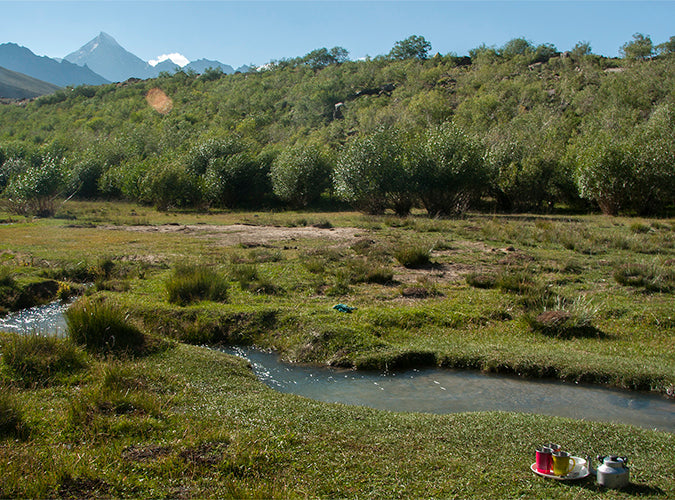
Treks are the hardest case. As one of our writers found in the Himalayas, “often on treks, the only water is boiled flat or chlorinated for safety,” and camp cooks answer it by boiling the strongest leaf or dust to “a viscous muddy liquid” that overpowers the flat water. Her answer is further down this page.
Even our own buyers notice it. Our tasting teams find the same tea tastes different at the estate and back in our facility, because water in high places such as Darjeeling, Meghalaya and Sikkim differs from water in the plains. They describe hill water as richer in minerals and oxygen, and say fine teas such as moonlights and muscatels show even more of their notes in it. In 2021 we even bottled a limited edition of Darjeeling stream water for steeping, called Boond.
If your favorite tea tastes different on holiday, the water is the likeliest reason. More on water in How to brew loose leaf tea.
Using a hotel kettle
- Rinse the hotel kettle: boil a first kettle and pour it away, especially if it smells stale or has scale inside. Then boil fresh water for your tea.
- Bring your own kettle if you are particular: Tea 101 suggested a portable electric kettle for anyone who cares about water temperature. Our guest writer travels with a small cordless kettle and finds he can “generally find an outlet for it close at hand and out of sight.” He prefers one with the handle on the side, since a top handle “too easily” burns you with escaping steam. He warns against the little immersion heaters that sit in a cup: in his experience they fail often, do not get the water hot enough and have very short cords. A reader of the same post checks temperatures with a simple instant-read thermometer.
Cooling the water for green and white teas
A hotel kettle only boils. For green tea, which wants 75–80°C, boil the water and let it stand for about three minutes before pouring. White tea wants 80–85°C, so a slightly shorter wait, or stop the kettle when small bubbles, often called “crab eyes,” first rise from the bottom. Both old Tea 101 and Peter Keen put those first small bubbles at about 85°C (185°F); as they grow into larger “fish eyes,” the water is at 90–95°C (195–203°F), right for most black teas.
Brewing at altitude
Expect weaker tea up a mountain. Water boils at a lower temperature at high altitude, so black teas brew more slowly. Use a little more leaf and steep a minute longer.
How do you make tea without a kettle?
Without a kettle, use the hottest clean water you can get for black tea, or cold-brew your tea overnight in a bottle, which needs no heat at all.Read more
Here are the usual situations and what works.
In a hotel room with only a coffee machine
Run one cycle of plain water through the machine first to clear old coffee smells, which tea picks up quickly. Our guest writer is blunt about in-room coffee makers (“at best, you will get a tepid dribble”), and about restaurant hot water, which comes from the shared coffee heater at around 200°F (about 93°C) in pots that may have cooled a long way by the time they reach your table, in his words “as low as the 130 degrees many coffee drinkers prefer,” about 54°C.
The machine itself is part of the problem. As Peter Keen noted in his kettle guide for us, “most coffee makers are limited to 180° Fahrenheit versus the boiling point of 212,” about 82°C against 100°C. Lukewarm water is wasted on a black tea, but it can make a decent cup of green or white tea given a little longer to steep. Skip the room microwave too: it heats water unevenly and, in his words, can superheat it.
Cold brew in a bottle
Cold brewing is the most reliable trick for travelers: no heat, no special kit, and smooth, ready-to-drink tea by morning. Tea 101’s method uses about 6 teaspoons of leaf for 1 liter of water, left covered overnight for at least 8 hours.
- Put 3 teaspoons of loose leaf into a clean 500 ml bottle or jar, loose or in fill-your-own bags.
- Fill with cold, fresh water and close the lid.
- Leave it overnight, at least 8 hours, in the minibar if there is one.
- Strain out the leaves or lift out the bags. Add a little water if it is too strong, and honey if you like it sweet.
Black teas and green teas both cold-brew well. A lidded pitcher or the Seidel mug works as well as a bottle, and our 2022 travel story suggests steeping ahead this way before a day of sightseeing. More methods and flavors are in How to make iced tea.
On a plane
Hot water on board is often not fully boiling, and our frequent-flyer writer refused to use it at all: “Above all, do not risk the water on a plane. Ever.” He is not alone. When we followed the guitarist Daniel Kenneth Rego on a tour day from Mumbai to Kolkata, he had brewed his Irish Breakfast at home before the flight, refused the airline tea he was offered, and at the hotel brewed Avongrove Spring Black from his own stash.
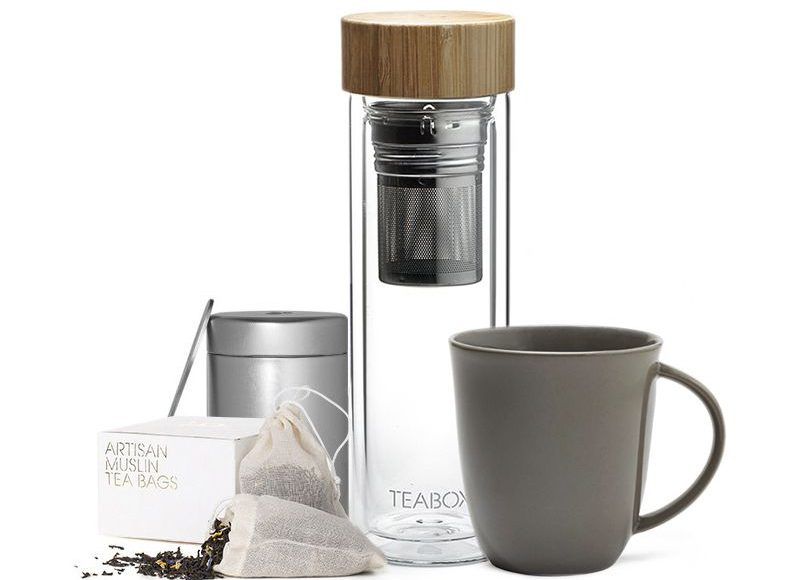
If you want tea in the air, the simplest answer is a good tea bag or a green or white tea that brews quickly in water below the boil. Many airports limit liquids in hand luggage, so a bottle of cold brew made the night before may not get through security; instead, buy a bottle of water once you are through and drop in a tea bag or a filled infuser for a slow cold steep.
How do you make good tea on a trek or a hike?
On a trek, ask the camp cook for boiling water, steep your leaf in one mug covered by a second, then pour the tea through a strainer into the warmed mug.Read more
Our writer Priti David worked out the best no-kettle method we know on treks in Sikkim, through the Kanchendzonga National Park. Her failures came first. On her first trek, a regular tea bag “waved … above the steel mug of tepid water” gave a brew “flavorless and cold.” Next time she packed Darjeeling tea bags and put them in a flask of truly boiling water; she got “a whiff of flavor before it turned bitter, the kind of bitter that leaves a taste of woolly steel in the mouth.”
What works is two mugs and a friendly cook. She asks for boiling water from the camp pan, then:
- Pour the boiling water into one mug and drop in your tea leaves.
- Cover it with a second mug turned upside down, which keeps the heat in while the empty mug warms.
- When the tea has steeped, pour it carefully through a clean strainer into the warmed mug, so it stays hot for longer.
Her other lessons are practical. Trek kitchens serve sweet, milky ginger tea because it has many takers and survives any number of reheats, so, as she advises, befriend the cook and ask for your own boiling water. Where there is a village tea shop, lemon tea is a fair fallback, since “the sugar drives out the bitterness of the strong decoction and the lemon lightens the flavor,” but national parks have no villages and so no tea shops.
Read her full account in Tea, Not Chai, on a Trek.
Keep reading
Sources
- Teabox Tea 101: How to make your perfect tea while traveling (Tea tips for the traveler); An easy recipe for making iced teas; How to make green tea
- Teabox blog: Travel with tea: steep anywhere, anytime (Mohona Banerjee, 2022), Tea, not chai, on a trek (Priti David, 2016), The musician and his tea (Paraj Singh, 2017), Tea with Ninjas (Pip Stoneham, 2015)
- Teabox blog: Microwaved, tepid, rolling boiling? Water for tea! (Peter GW Keen, 2016), Everything you needed to know about the kettle (Peter GW Keen, 2016), Introducing TeaPacs – Groundbreaking innovation from Teabox (2016)
- Teabox blog (Still Steeping): The picky person’s guide to a good cup of tea while traveling, 2016, with readers’ comments (written by Peter Keen); Beyond the tea bag: a starter’s guide to leaf tea, 2016; ‘Attaining tea nirvana’ for the lazy, 2015; Why teabags will never beat the real thing (Ian Bersten), 2015, with readers’ comments
- Teabox product descriptions for teaware, tea bags, Classic Assam Black, Irish Breakfast, Instant Chai Latte Mix and the Tea Timer, October 2026: Instant Chai Latte Mix, Tea Timer
- Teabox Drive: Teabox internal document, 2021; Teabox internal document, 2016; photos as credited
- Teabox on Instagram (@teabox.tea): chamomile at the airport, Jun 2017, TeaPacs, May 2018, infuser on the go, Dec 2019, four enemies of tea, May 2020, water at the source and Boond, Oct 2021, loose leaf while traveling, Jun 2023, dust tea in hotels, Feb 2024, chai premix launch, Feb 2026
- Teabox on YouTube: Artisan Muslin Teabags, Compact Tea Maker

Leave a comment
All comments are moderated before being published.
This site is protected by hCaptcha and the hCaptcha Privacy Policy and Terms of Service apply.