


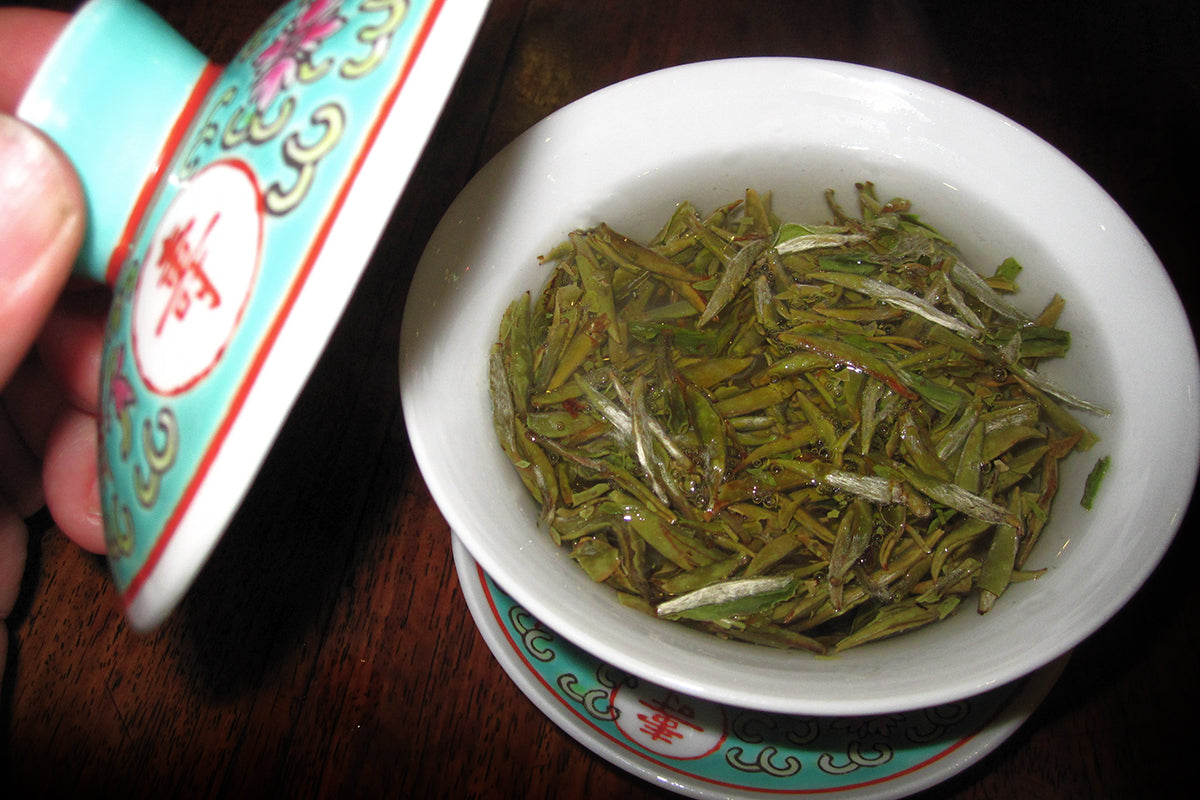
Black tea tastes fuller and rounder, malty, fruity or floral depending on where it grows, with a brisk finish; green tea tastes lighter and fresher, toasty and nutty when pan-fired, grassy and marine when steamed. Here is what that sounds like in our own tasting notes, for the teas we sell, and why the two cups are so different.


Why do black tea and green tea taste so different?
Because oxidation changes the leaf’s flavor compounds: green tea keeps its catechins, which taste light and fresh, while black tea turns many of them into theaflavins and thearubigins, which taste fuller and bolder.Read more
The fresh leaf holds polyphenols called catechins. In green tea they stay largely as they are. In black tea, oxidation turns many of them into theaflavins and thearubigins, the compounds behind black tea’s color and body. Peter G. W. Keen put it simply on our blog in 2016: very roughly, catechins bring lightness and sweetness, and the others bring fullness and boldness.
That briskness on the finish of a black tea, which tasters call astringency, is what makes it feel lively. Green tea has its own grip, but it shows differently: as a 2015 piece on our blog noted, green tea’s “tannin levels … are quite high, [but] they manifest differently.”
One thing both share: brewed too hot or too long, either turns bitter. Green tea is the less forgiving of the two. Our tasters have noted that Indian green teas “suffer in reputation for being a bit bitter,” and that a few stand apart, like the teas from Barnesbeg in Darjeeling. Most of that bitterness comes from brewing, not from the leaf; see How to make green tea.
Leaf size matters too. Dust has far more surface area, so its tannins rush into the water at once, while the tannins in whole leaf take their time to spread. That is one reason a whole-leaf green forgives a small brewing slip that a broken green tea bag will not.
What does black tea taste like?
Black tea has the bigger range, because region and season shape it so strongly: Assam is bold and malty, Darjeeling lighter and more aromatic, floral in spring and fruitier in summer.Read more
Assam: malt and dark fruit
Our Classic Assam Black is a full-bodied cup with malty aromas, hints of yellow raisins and date palm, and stone fruit at the end. It is a second flush straight tea blend of grade SFTGFOP1, with “short, tightly rolled, blackish leaves interspersed with attractive golden tips,” a dry aroma of biscotti, cocoa, vanilla and candied fruits, and a dark amber cup that will “accommodate the addition of milk and sugar well.”
A single garden can be just as distinct. Our Assam Halmari Summer Black comes from a 374-hectare estate in Moran, Dibrugarh, run by the Daga family with a quality-first approach since the 1980s. Its tasting note makes the point: “When you can recognize the estate by its tea in a blind tasting, you know its makers have done something right,” and here the giveaway is “the standout flavor of Asian jamun.”
Darjeeling: lighter, fruit and greens
A spring tea such as Darjeeling Castleton Spring Chinary Black, from the estate’s heritage China bushes, is a world away from an Assam. Our tasters describe a bright gold, medium-bodied cup with “distinct notes of pleasant greens which intermingle with delicious stone-fruity characters, akin to peach,” subtle nutty undercurrents and a finish “on lush citrusy intonations,” with furtive notes of green figs.
Castleton was founded in 1885 by Dr Charles Graham, sits between 1,000 and 1,830 meters, and was the first estate in Darjeeling to receive ISO 9002 certification. It is about 42 km from our facility. Notice the “sweet greens” in a black tea: a spring Darjeeling is only partly oxidized, so it shares some of green tea’s freshness.
What does green tea taste like?
Green tea is gentler: pan-fired greens, which include most Chinese and Indian teas, taste toasty, nutty and sometimes floral, while steamed Japanese greens taste grassier, more marine and savory.Read more
Indian greens tend to be soft and rounded, and corn comes up again and again in our notes. Our Nilgiri Glendale Autumn Twirl Green, from a garden at 5,000 to 6,500 feet, has “refreshing green notes balanced by subtle, sweet undertones.” Its product notes describe “a soft start of cooked corn,” “a delightful floral essence in the middle” and a “sweet jasmine finish,” in a spring-green cup. Our tasting card for a lot picked on 23 October 2023 reads: aroma “cooked corn, earthy and floral”; palate “sweet-floral, brisk, hint of greens.” Glendale, established in 1835, calls itself a “valley within a valley.”
The Darjeeling Green Tea is plain whole-leaf green with nothing added. Its aroma is “cooked corn, fresh legumes, cooked veggies along with hints of ripened tree fruit,” and the cup “starts on softer tones of cooked corn,” moving to sweet green flavors “akin to fresh legumes and celery-like greens” over muted floral undertones.
Kangra in Himachal Pradesh has a green tea style of its own. Its makers describe “citrusy and often nutty flavors, with very little bitterness.” For the full range, see Types of green tea.
What food and milk go with black tea and with green tea?
Strong black teas suit rich, savory breakfasts and take milk well; green teas suit lighter food, are usually drunk without milk, and work surprisingly well with cheese.Read more
Our Classic Assam Black pairs with “buttered toast, jam, bacon, eggs and fresh fruit,” the full breakfast its malt was made for.
Green tea is more surprising. A 2015 piece on our blog found that Longjing with a salty Fromage de Meaux makes “a round, creamy mouthfeel,” and that green and white teas pair with “delicate cheeses like bocconcini.” Read The Unusual Pairing of Green Tea with Cheese.
Milk is a matter of taste, not rules. The tea writer Ian Bersten, writing on our blog, traced milk in tea to where you grew up, and his advice still stands: “make it the way you like and drink it the way you like.” He noted that Chinese drinkers typically take green tea without milk, “although there seems to be no reason not to.” Read Should you add milk to tea?
The simplest way to learn the difference is to brew one of each side by side, plain, at their own temperatures, and taste them in turn. More in How to taste tea like an expert.
Keep reading
Sources
- Teabox Tea 101: The difference between black and green tea; Caffeine in tea
- Teabox blog: How is tea made? (2015), Should you add milk to tea? (2015), The Element of Water: Get Your Tea Right (2021), Microwaved, tepid, rolling boiling? Water for tea! (2016)
- Teabox blog: A short lesson on Asian green tea (2017), In Kangra, for a tour of the tea gardens (2017), Assam Diaries: The Jalans at Chota Tingrai (2016), The Beginner’s Guide to Choosing a Darjeeling (2017)
- Teabox blog: The Unusual Pairing of Green Tea with Cheese (2015), English Breakfast: The Baseline Black Tea (2016), Living the Life of a Tea Explorer (2015)
- Teabox blog (Still Steeping): White tea, a quick and dirty guide, 2014; 5 lies you’ve been told about tea, 2014; How to judge the quality of tea, 2015; A breath of fresh air in India’s tea gardens, 2015; Caffeine in Your Tea? Stop Worrying!, 2016 (with reader comments); The chemistry of tea: a lab, not a leaf, 2016; 10 most expensive teas in the world, 2021
- Teabox product descriptions and product data (tasting notes, grades, estate notes, caffeine tags), 2026: Classic Assam Black, Assam Halmari Summer Black, Darjeeling Castleton Spring Chinary Black, Nilgiri Glendale Autumn Twirl Green, Darjeeling Green Tea, Green Tea Jasmine Soothe, Pure Japanese Matcha Premium Green, Assam Chota Tingrai Summer Black
- Teabox Drive: Teabox internal document; Teabox internal document, 2023; Teabox internal document, 2015; Teabox internal document; Teabox internal document, 2018; Teabox internal document, 2023; photos as credited
- Teabox on Instagram (@teabox.tea): how tea is processed, May 2020, Mangalam oxidation trial, Sep 2021, whole leaf and dust, Sep 2021, water in the hills, Oct 2021, one plant, Mar 2022, Masterclass with Mohona Banerjee, Apr 2022, 11,456 Darjeeling cups, Oct 2022
- Kausshal Dugarr on X (@Teapreneur): one plant, Apr 2022, Tea Report, May 2022


Leave a comment
All comments are moderated before being published.
This site is protected by hCaptcha and the hCaptcha Privacy Policy and Terms of Service apply.