


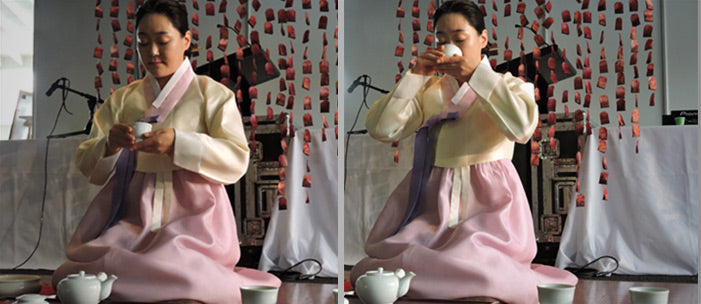
China has the oldest tea culture in the world, because tea was first drunk there, and Korea, Japan and Tibet all received tea from China. Three ceremonies grew from that root: gongfu cha in China, chanoyu in Japan and darye in Korea. This page visits each one, with what our writers saw in a Taiwanese tea shop, a Chengdu temple tea house and a Darjeeling tea bungalow.
What is the Chinese tea ceremony? Gongfu and the oldest tea culture
China’s best-known tea ritual is the gongfu tea ceremony, gongfu cha: tea brewed with skill, using plenty of leaf in a small pot and many short infusions. Chinese tea ceremonies are held at formal occasions such as weddings, and to welcome guests into the home.Read more
Gongfu (also written gong fu, or kung fu tea) is the same word as the martial art, and it means effort and skill rather than fighting. The tea, traditionally oolong, is first passed around so everyone can look at the dry leaf and smell it. It is then brewed in a small clay pot or a gaiwan, a lidded cup, and poured into tiny cups.
Each infusion lasts only moments, and each tastes a little different. Our old Tea 101 guide describes drinking each cup in three sips. When the leaves have been brewed several times, they are placed in a bowl and shown to the guests, who compliment the tea; that ends the ceremony, though more tea can be made once the pot is rinsed.
Gongfu at a Taiwanese tea counter
Our writer Zac O’Yeah watched the method up close in Pinglin, a tea village about an hour by bus from Taipei. The shop owner, Uncle Wang, set out a metal drip tray with a stainless steel mesh base, through which spilled water simply vanishes, and on it tiny earless cups, a glass pitcher, strainers and a black porcelain jar about the size of a mug, in which he brewed the tea.
He flushed the cups with boiling water, poured water over the leaves and threw it out at once, a quick rinse to remove the tea dust. Then he brewed “barely for a few seconds” and poured the tea through a strainer into the pitcher. Pale green in the glass, it looked lime yellow against the white porcelain cups. No milk or sugar was offered, and our writer lost count after more than ten cups.
The tea was baozhong, the pride of Pinglin, which sits between green tea and oolong. The village sells tea by the Chinese standard weight of 600 g, and Uncle Wang, who owns his own garden and factory, kept vacuum-sealed 300 g bricks under the counter for customers who bargained. Some Chinese ceremonies add an aroma cup. As the tea hobbyist Karel Thieme described it to our writer Anik Basu, the tea is poured into a tall, narrow cup, a low cup is placed upside down on top and the pair is turned over, so that the tall cup is used to smell the tea and the low one to drink it.
You can try the style with any whole-leaf tea that rewards repeat steeping. Our Glenburn Spring Moonshine Oolong from Darjeeling is a good one to learn on; the method is set out in How to brew Darjeeling tea, and the tea itself in What is oolong tea?
Tea still made by hand
Much of China’s finest tea is still made the old way. Small batches of green tea are often heated by hand in a vessel like a large wok, while larger batches may be twirled with a broom in a tub the size of a washing machine drum; as long as the leaves keep moving, they do not burn. Famous teas such as the flat longjing (dragon well) and the curly bi lo chun (spring snail) are still plucked and made by hand.
What are Chinese tea houses like? The tea houses of Chengdu
Ritual is only half of China’s tea life; the other half is the tea house, a cheap, unhurried place where a cup of leaves is refilled all afternoon. Chengdu, in Sichuan, is famous for them.Read more
A local saying, as our writer heard it on a 2016 visit, runs: “Here the sunny days are rare, but don’t worry since tea houses are everywhere.” In the tea house inside the Daci temple, ¥6 bought a cup full of leaves and a thermos of hot water, “sufficient for some fifteen cups at least,” and an afternoon of refills among older regulars playing mah-jongg.
The leaves changed as the hours went by. With each refill the tea tasted less sharp and a little mellower, yet it kept its essential flavor for a surprisingly long time. He had read that Sichuan tea that will not last three steeps is considered inferior, and that in the Tang dynasty there were about 400 tea houses in Chengdu.
Prices tell you the kind of tea house. The hundred-year-old tea house in the central People’s Park charged ¥15 to 25 a cup in 2016, and the exclusive tea houses of the Wide and Narrow Alleys (Kuanzhaixiangzi) could charge ¥100, while others staged Sichuan opera. In the bazaar outside the Wuhou temple, the same writer drank Tibetan yak butter tea. Younger Chinese, he was told, were turning to coffee as a drink of modernity, and the tea houses were reportedly less busy than they once were.
Chengdu’s tea history goes back much further than its tea houses. The earliest known written reference to tea is a contract of 59 BC between the poet Wang Bao and a widow of Chengdu, Lady Yang Hui, for a servant whose duties included boiling tea, filling the utensils for guests and walking to Wuyang, a market town near Chengdu, to buy tea. The full story of Wang Bao’s contract is on our blog.
What is the Japanese tea ceremony called?
The Japanese tea ceremony is called chanoyu, “hot water for tea,” and also chado or sado, “the way of tea”: a choreographed ritual in which a host whisks matcha, powdered green tea, and serves it with small sweets that balance its bitterness. Old Tea 101 also lists the name ocha, which simply means tea.Read more
“The ritualized drinking of tea in Japan, called Chado, or the way of tea, has existed for over 500 years,” our founder, Kausshal Dugarr, has written. Beyond steeping and drinking tea, he added, it takes in architecture, gardening, ceramics, calligraphy, flower arranging and cooking.
Tea itself had come from China with Buddhist monks, but it took root in the late 12th century, when the Zen monk Eisai brought tea seeds back from China and planted them in monastery grounds in Kyushu, Japan’s southwesternmost island.
The ceremony took its classic form in the late 16th century. Around 1590, the warlord Hideyoshi, one of the three unifiers of Japan, kept close to the tea master Rikyu, who turned an informal social gathering of the nobility into an art. Rikyu removed class boundaries inside the tea room and added hundreds of precise steps, down to how guests enter the room, sit and sip; he even built portable tea houses that traveled with the court. Steeped in Zen Buddhism, the ceremony became part of the samurai way: discipline, ritual, purification. Peter Keen, writing for us, noted an obituary of one famous general that praised both his battlefield record and his skill as a tea master.
The three Sen schools, and tea for women
Rikyu’s teaching passed down his family. His grandson Sen Sōtan revived it, and three of Sōtan’s four sons each founded a school of tea that still exists: Mushakōjisenke (the second son), Omotesenke (the third) and Urasenke (the youngest).
For centuries, chado was a male domain linked to the samurai class. That changed with Yukako Sen, known as Shinseiin (1850 to 1916), daughter of Gengensai, the 11th-generation master of Urasenke. As the samurai class faded in the late 19th century, the tea schools lost the rich families who had sent their sons to learn tea, and education opened up to everyone. Yukako petitioned for chado to be taught in the new girls’ schools and succeeded, which is why, as our writer Adeline Teoh put it, “today it is not unusual to have a female chado practitioner serve you tea.”
What is a Japanese tea house?
A Japanese tea house, or tea room (chashitsu), is a small, plain room built for the tea ceremony, where host and guests meet in calm attention. It is part of the ceremony rather than a setting for it.Read more
Everything in it, from the building and the garden path to the utensils, a hanging scroll of calligraphy and a single flower arrangement, is chosen to create a calm, attentive meeting between host and guests. The aim, as our old guide put it, is a relaxed setting for conversation between host and guest. As our founder summed it up in 2015, tea in Japan “marks a time of quiet contemplation, reflection, and rest.”

The tea in the bowl
The tea is as particular as the ritual. Matcha comes from bushes covered for about three weeks before harvest; the leaf is deveined and ground so slowly between stones that it can take an hour to make a single ounce. Whisking it takes care: by Peter Keen’s account, a few too many grams, seconds or degrees turn it into a bitter foamed sludge. Well made from ceremonial grade leaf, it is “subtle, grassy and slightly sweet.”
The shade-grown leaf is still picked by hand. Most Japanese tea is harvested by machine and sold by the farms as aracha, a semi-crude tea that companies then finish, but tencha, the shade-grown leaf used for matcha and gyokuro, and shincha, the first sencha of the year, are still hand picked and fetch high prices. Japan’s everyday greens are steamed, a method that tea producer Soen Nagatani worked out in 1738, which keeps the leaf vivid green with marine, herbaceous notes.
Our Pure Japanese Matcha Premium Green is stone-ground from shade-grown tencha leaf in Shizuoka. For Japan’s other greens, see What is green tea?
What is darye, the Korean tea ceremony?
Darye, roughly “etiquette for tea,” is Korea’s tea ceremony: a quiet, simple ritual of steeping Korean green tea in plain stoneware, shaped by Zen Buddhism and given its modern form in the 1970s. It is gentler than the Japanese ceremony, with steeped leaf rather than whisked matcha, and without the room decoration and many bows of chanoyu.Read more
Tea reached Korea from China with Buddhist monks in the early Koryo dynasty (918–1392), but political and cultural upheaval cost the country many of its old ways. After the Korean War, a monk named Choi Beom-sul, later known as Venerable Hyo-Dang, set out to recover them from surviving monasteries. His 1973 book, The Korean Way of Tea, describes a method called Panyaro, “dew of enlightening wisdom,” which modern darye formalizes. He also helped revive Korean tea growing, which had shrunk after many plantations were lost to Japan in the late 16th century.
How darye is performed
The equipment is simple, in neutral, natural tones of earthenware or stoneware: a tagwan, handleless cups, a cooling bowl, a bowl for waste water, a lid stand and a tea container, with wooden coasters and tongs, a kettle, a cotton cloth and a serving table.
The ritual is performed on a mat or low table covered with linen. The host, often in hanbok, cools hot (not boiling) water in a bowl, warms the pot and cups, then places four pinches of green tea into the tagwan, a teapot with a side handle, and steeps it for 2 to 3 minutes. The host pours a small taste first to check the tea is ready. Cups are filled half-full, from the farthest to the nearest, then topped up in reverse to three-quarters, so every cup tastes the same. Guests drink in three sips: one for the color, one for the aroma, one for the taste.
Our writer Adeline Teoh watched and photographed a darye ceremony at the 2015 Australian International Tea Expo, and found that its slow choreography now draws a modern audience: busy Koreans who yearn for a simpler life.
A Korean tea room, stocked from Darjeeling
Korea’s tea rooms now pour more than Korean green tea. At the Goomtee estate bungalow in Kurseong, our writer Anik Basu met Da-Hyoung Chung, a tea buyer from Seoul who had first learned about Goomtee’s teas while working for a Japanese tea retailer in Tokyo, and loved them so much that she spent her honeymoon at the Goomtee lodge in April 2012.
She and her husband had since opened a tea shop in Seoul that sells retail and wholesale and doubles as a tea room. On that trip she ordered about 9 kg of Jungpana’s second flush, but had samples sent home first, because “the water is very different in Korea and India.” Her morning cup at Goomtee was the estate’s own, “no milk, a little sugar and all flavor.”
Keep reading
Sources
- Teabox blog (Still Steeping): Darye, the Korean tea ceremony (2015), Teh tarik milk tea: Pulling depth and sweetness from tea (2015), Butter tea in Bhutan (2016), When Samurai Went to War And Drank Green Tea (2016)
- Teabox blog (Still Steeping): The Samovar: Kettle, Stove, Teapot and History (2016), Smetannik, a Russian tea tradition steeped in time (2016), Parsi Tea Parties for Two (2016), When Tea Came to Australia (2017), Women of tea (2017)
- Teabox blog (Still Steeping): A short lesson on Asian green tea (2017), Where can we find the earliest reference to tea? (2016), Seoul Searching for Darjeeling Tea (2015), Tea for War Horses (2017), Iced tea traditions from around the world (2017), From history, a long and complicated relationship with tea (2017)
- Teabox blog (Still Steeping): Tea in France: Not What You Might Expect (2016), Tea in Germany & its Darjeeling Connection (2016), Welsh tea, only in Patagonia (2017)
- Teabox blog (Still Steeping): Assam Diaries: Margherita, the Singphos and Coin Tea (2016), Bun-maska-chai, only in a Bombay Irani (2017), The Authentic Indian Chai Experience (2023)
- Teabox blog (Still Steeping), stories: Chengdu’s tea houses (People Who Love to Drink Tea From Morning to Evening), 2016; Tea in Taiwan with Uncle Wang and Grandpa Hu, 2015; Saucerful of secrets, 2016; Tea in Islamic cultures, 2016; Tea is for Tibet, 2016; The Year Britain Bought Up All the Tea in the World, 2016; For the love of afternoon tea, 2015
- Teabox Tea 101: Tea cultures and tea traditions from around the world
- Teabox product descriptions: Bombay Cutting Chai, Kolkata Street Chai, Kashmiri Kahwa, Pure Japanese Matcha, English Breakfast Black, Irish Breakfast Black, Glenburn Spring Moonshine Oolong, Special Spring Silver Needle White, Risheehat Spring Chinary, Assam Breakfast, Mint Green
- Teabox Drive photos: Teabox internal document, Teabox internal document, Teabox internal document, Teabox internal document, Teabox internal document
- Teabox on Instagram (@teabox.tea): Boston Tea Party, Feb 2016, Tibetan butter tea, Apr 2016, Singpho tea, Jul 2016, Middle Eastern spiced tea, Sep 2016, noon or kahwa, Aug 2021, railway tea vendors, Jan 2022, ginger chai and samosas, Apr 2023
- Kausshal Dugarr on X (@Teapreneur): tea in Japan, Sep 2015, Britain’s 1942 tea purchases, Oct 2021, chado, Jun 2022, tea at the cricket, Jul 2022


Leave a comment
All comments are moderated before being published.
This site is protected by hCaptcha and the hCaptcha Privacy Policy and Terms of Service apply.