


Tea came to Meghalaya late: the British judged the Shillong plateau ideal for tea in the 19th century but never planted it, and commercial tea arrived only after the Tea Board of India surveyed the hills in the 1970s. It is one of the youngest regions in our guide to Indian tea regions. Our 2015 story on the Lakyrsiew garden, A Secret Tea Garden in the Clouds, first told much of this history.
Why did the British never plant tea in Meghalaya?
The British found the Shillong plateau well suited to tea, but the Khasi ruler had a treaty with them that barred migrant labor, and without workers tea could not be grown.Read more
The tea that never came
When the East India Company sent prospectors across India looking for land to plant tea, they found Darjeeling, the Kangra valley and later the Nilgiris. One expedition reached Shillong and wrote a detailed report on its rainfall, soil and climate, concluding that the plateau was eminently suitable for tea.
The Khasis made sure it did not happen. The Khasi ruler had a treaty with the British that forbade bringing in migrant labor from Bihar or Bengal, and tea needs a great many hands. Without workers, Meghalaya dropped out of the plans, and the tea boom went to the Assam plains below.
The report itself was forgotten. More than a century later it turned up “lying dusty and unread” on a relative’s bookshelf in Shillong, and it gave Geert Linnebank and his wife, Nayantara, the idea for the Lakyrsiew garden; their story is in The Lakyrsiew tea estate.
Jeebon Roy’s Chinary bushes
A few bushes did take root: Jeebon Roy, remembered as the first Khasi entrepreneur, planted some Chinary bushes from Darjeeling on his land outside Shillong. He is also credited with the revival of Khasi culture and language, and he had bought a large stretch of land outside the town.
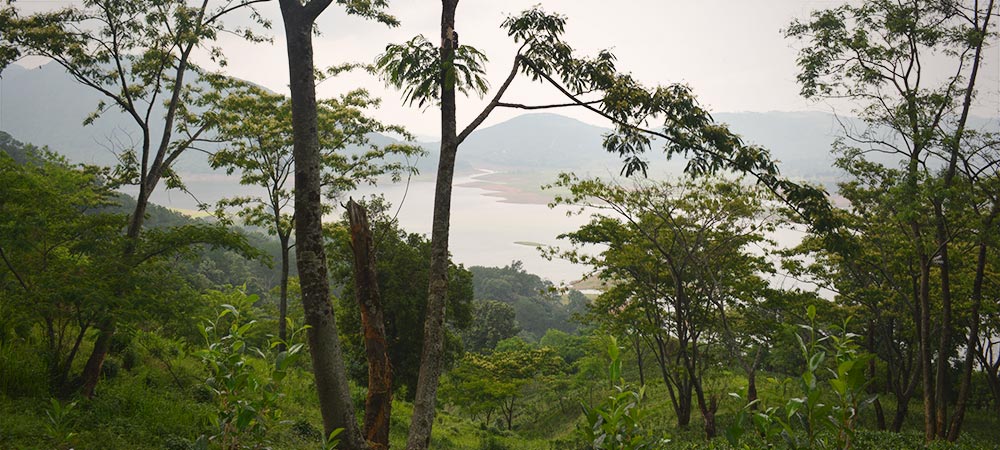
That land is the thread that joins the old story to the new one. Part of it passed down to his descendant Nayantara, on the edge of Barapani (Umiam) Lake, and that inherited plot is where Lakyrsiew’s tea grows today.
How did the 1970s survey start Meghalaya tea?
In the 1970s the Tea Board of India sent a team to the hills, judged them very good for tea, brought in plants from Assam and Darjeeling, and set aside three areas for planting.Read more
In the 1970s, the Tea Board of India sent a delegation to explore tea growing in Meghalaya. It found the conditions “immensely favorable,” and plants from both Assam and Darjeeling were brought in. Three areas were earmarked for tea: Umsning, in Ri-Bhoi district; Tebronggre, in the West Garo Hills; and Riangdo, in the West Khasi Hills.

The two kinds of plant went where they would do best. Assam varieties were planted in the lower, warmer parts of the Garo Hills, and Darjeeling-style teas higher up, at altitudes of 3,000 to 5,500 ft. The higher gardens grow more slowly in the cool air, and that slow growth is what gives the hill teas their aroma.
Private gardens followed. On the outskirts of Shillong, the 1990s saw the beginnings of Lakyrsiew, where mostly Chinary varieties were planted. The garden itself was cleared from 2002 on what had been virgin scrubland. Our estate notes describe it as “revived as early as 2002, after its initial discovery in the 1800’s,” a nod to the old Company report.
Who grows tea in Meghalaya today?
Meghalaya tea is still a small-grower story rather than one of vast estates: a state brand, a village cooperative and a few boutique gardens.Read more
The state government sells its own brand, Meg-Tea, in green and black orthodox versions, and about 20 farmers from Mawlyngot village formed a cooperative that sells green, black and white teas as Urlong Tea.
The writer Anjum Hasan has described the change well: when she was growing up in Shillong in the 1980s and 1990s, “no tea was really produced and marketed in Meghalaya,” and the local cup was boiled milk tea with plenty of sugar; now small plantations such as Sharawn, Urlong and La Kyrsiew experiment with organic black, green and white teas. She stocks up on all three whenever she visits. Read the full conversation in Teatime, Talktime (feat. Anjum Hasan and Zac O’Yeah) on our blog.
The old labor barrier has also eased. “Labor laws have relaxed to allow migrants,” Geert Linnebank told us in 2015, yet many of Lakyrsiew’s staff still come from the Khasi and Garo communities around the lake.
Of these gardens, Lakyrsiew is the one whose teas we sell, as its summer and autumn clonal blacks. For the wider picture of how Meghalaya fits among India’s regions, see Indian tea regions, and for Meghalaya’s big neighbor, Assam tea.
Keep reading
Sources
- Teabox Tea 101: Meghalaya: Tea for a new economy
- Teabox blog (Still Steeping): A Secret Tea Garden in the Clouds (2015, with the Teabox reply to readers); Teatime, Talktime (feat. Anjum Hasan and Zac O’Yeah) (2017); Meet the Growers (2020)
- Teabox product tasting notes, estate descriptions and product data (grade, invoice, freshness journey, time of day), 2026: Lakyrsiew Summer Clonal Black, Lakyrsiew Autumn Clonal Black
- Teabox Drive: Teabox internal document, 2020; Teabox internal document, 2024; photos as credited
- Teabox on Instagram (@teabox.tea): Eden’s Cloud, Feb 2016, abode of clouds, Jun 2018, Lakyrsiew film, Jul 2018, Lakyrsiew summer tea, Aug 2019, Meet the Growers with Nayantara, Jun 2020, Lakyrsiew on Umiam Lake, Aug 2020, Lakyrsiew leaf, Aug 2020, hill water and taste, Oct 2021, Masterclass: Meghalaya, Feb 2022, tasting at the garden, Jan 2026
- Kausshal Dugarr on X (@Teapreneur): Meet the Growers launch, Jun 2020
- Teabox on YouTube: Masterclass: Meghalaya (short), From The Source: Lakyrsiew Tea Estate


Leave a comment
All comments are moderated before being published.
This site is protected by hCaptcha and the hCaptcha Privacy Policy and Terms of Service apply.