


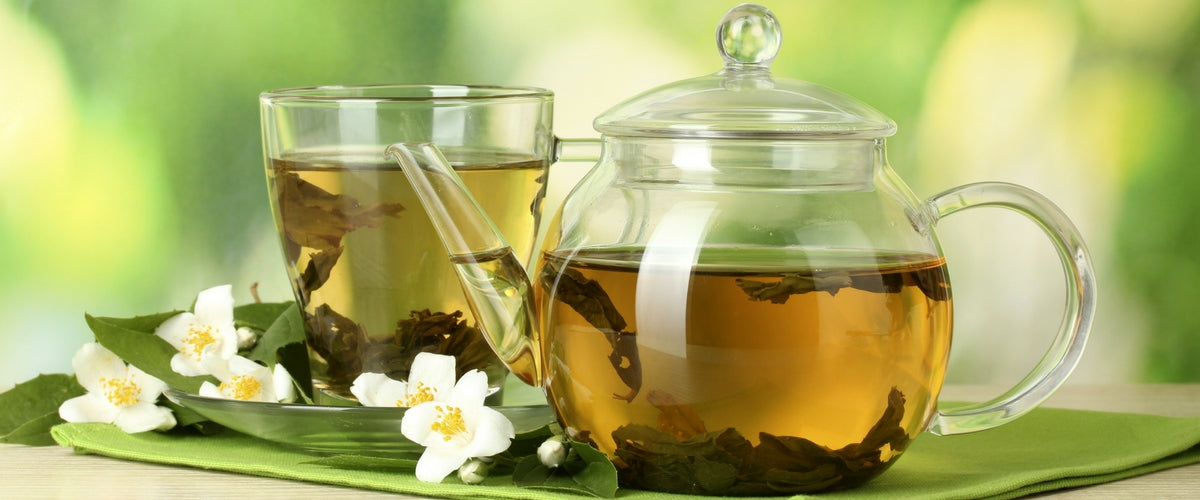
Jasmine tea is tea, usually green, that has been scented with fresh jasmine blossoms until the leaf takes on their perfume. It is the classic scented tea, and jasmine green tea is a category of its own. Jasmine is also used with white teas, oolongs and a few black teas. Our 2016 story on jasmine is still the best place to start: Jasmine Teas: A Scent of Perfection.
What kind of tea is jasmine tea?
Jasmine tea is a scented tea at the gentle end of the flavored range: the flower perfumes the leaf rather than covering it.Read more
Our 2016 story placed scented teas on a spectrum, “from the bold and fruity citrus bergamot flavor of Earl Grey to the soft scented aromatic infusions of jasmine, rose and osmanthus petals at the other end.” Jasmine sits at the soft end.
The range is wide. The same story names Jasmine Pearls, jasmine Silver Needle white, jasmine Jade oolong and jasmine green, and notes that jasmine has mainly been used to add a delicate scent to outstanding Chinese green and white teas, though blenders now add it to oolongs, white teas and a few black teas in the style of an Earl Grey. Jasmine oolong is a little fuller than jasmine green.
That makes jasmine a good first step for people who drink flavored teas from tea bags and expect a big, fruity jolt. It lets a subtler flavor unfold, and it pairs with light food, one of the few teas that does. For the base tea itself, see What is green tea?
How is jasmine tea scented?
Fresh jasmine petals are laid beside the tea leaf so it absorbs their scent, then removed; the best teas repeat this many times before the leaf is dried again.Read more
Traditional scenting is slow. Fresh petals are placed next to the leaf as it dries, not as an essence or dried blossom. It takes around four hours for the tea to absorb the scent, after which the petals are removed. The process is repeated two or three times for ordinary grades and up to ten times for the best, and the whole sequence may take a month before the leaf is fired again to dry it.
After the final firing, the blossoms may be removed or left in the tea. One reader put the purist case on our blog in 2016: the best jasmine tea should contain no petals at all, because thousands of fresh flowers are laid on the leaf and painstakingly removed the next day.
What decides the quality
- The flowers: single- and double-petal flowers give a subtler scent than multi-petal ones.
- The bud-petal ratio: how much flower is laid against how much leaf shapes the strength of the scent.
- The baking: how many times the jasmine and leaf are lightly baked to smooth the infusion.
- The leaf itself: a fine base tea makes a fine jasmine; some low-priced jasmine greens are undistinguished.
In all, scenting can take “anywhere from 24 hours to many weeks.” Cheaper jasmine teas use jasmine petals or jasmine flavoring instead of fresh-flower scenting.
What are jasmine pearls?
Jasmine pearls are scented green tea leaves rolled into small balls, which unfurl in the pot; a few dozen fill half a cup.Read more
Jasmine pearls are scented green tea leaves rolled into small balls, green leaf and white jasmine almost woven together. When brewed, just a few dozen pearls unfurl to fill half a cup. The leaves are rolled after scenting and formed into balls once they are dry, which is why the pearls look so striking.
That unfurling makes them a favorite for showing friends what loose leaf can do. In our starter’s guide to leaf tea, our founder suggested exactly this trick: brew a tea whose leaf expands from a dry spoonful to half a cup when wet, such as a Tie Guan Yin oolong or a jasmine pearl green.
Our 2016 blog called jasmine teas “a green tea for people who don’t like green tea,” because a good one has none of the bitterness or grassiness some people dislike, with a long, almost perfumed aftertaste. It also gave a fair warning: jasmine is a perfume, and many tea lovers prefer it as an occasional cup. Its advice for a friend who hates green tea: bring out the jasmine pearls.
Is jasmine tea made in India?
Yes. Gardens in the Nilgiris and Darjeeling add jasmine to their green teas, and our own jasmine green uses Indian jasmine with high-grown green tea.Read more
Indian gardens in the Nilgiris and Darjeeling have been adding jasmine to green teas to enhance good leaf rather than mask a poor one. That is very different from many scented teas, “most especially Earl Grey, where the flower or fruit flavor is very strong.”
Our own jasmine green is a blend of Indian jasmine and high-grown green tea. Try Green Tea Jasmine Soothe, whole-leaf green tea blended with jasmine flowers: mellow and refreshing, with a gentle floral aroma. Its ingredients are green tea, jasmine flowers and a natural jasmine flavor, so we call it a blended jasmine tea, not a scented one. In the cup it is bright green, opening on a delicate frame of jasmine that gradually gains intensity.
Our jasmine blends over the years
Jasmine has been in our range from the start. When our staff voted for their favorite teas of 2015, first place went to Jasmine Jade, a green tea with jasmine. Gopal, from our procurement team, called it “a perfect blend, where dry jasmine flower and curly tea leaves truly complements each other. Fragrant and delicate, and also very seductive.” A colleague in our design team liked it because other jasmine teas had tasted of “a strange artificial flavored-oil.”
Later jasmine blends included Morning Dew, a Nilgiri green with jasmine, marigold and cornflower, and a Jasmine Earl Grey of Nilgiri tea, jasmine, marigold, cornflower and bergamot. A Nilgiri Jasmine Black went into our 2019 Diwali heritage box.
How do you tell a good jasmine tea?
Look for whole leaf, a scent that sits lightly on the tea, and an honest ingredient list; be wary of jasmine greens that look unnaturally shiny or taste of perfume oil.Read more
This complex process invites shortcuts, and jasmine green, the most popular kind, is where they show. Our longtime contributor Peter Keen warned that jasmine green “is regularly enhanced with a little extra chemical sheen to make it bright, shiny and not the grade it is claimed to be.” The fine teas he admired, such as Chinese jasmine pearls and jasmine Silver Needle, “combine leaf and petal, not dust and additive.”
- Look at the leaf: whole, curled or rolled leaf is a better sign than leaf with an unnaturally bright, shiny sheen.
- Smell and taste: the jasmine should come across as fresh flowers, not as an artificial, flavored-oil taste.
- Taste the finish: the best stand out for their aftertaste, almost a perfume, with the tea still clear beneath it.
- Read the label: petals plus natural flavor make a blended jasmine; fresh-flower scenting is a slower, costlier process.
Brew jasmine green as you would any green tea: 75–80°C for 2 to 3 minutes. For more, see What is green tea?
Keep reading
Sources
- Teabox Tea 101: Types of tea: Flavored Blends
- Teabox blog: Tea: A Blended History (2016); 8 Tips for Creating Your Own Tea Blends (2015); Tea Blends That Didn’t Quite Make It (2015); A Blender of Teas (2015); Jasmine Teas: A Scent of Perfection (2016)
- Teabox blog: Behind the scenes: Making of our Diwali gifts (2016); Behind the Scenes: Making of Our Iced Tea (2015); English Breakfast: The Baseline Black Tea (2016); The Tea Navigation Paths: Artisan and Agribusiness (2017); The Beginner’s Guide to Choosing a Darjeeling (2017); Tea in France: Not What You Might Expect (2016)
- Teabox blog (Still Steeping archive): Shades of Earl Grey, 2015; How to Choose Your Earl Grey, 2016; The Teabox Top 10 Teas of 2015, 2015; How Much Does Good Tea Cost?, 2016; Beyond the Tea Bag: A Starter’s Guide to Leaf Tea, 2016
- Teabox product descriptions, tasting notes and product data, October 2026: Mountain Rose Black, Classic Earl Grey Citrus Black, Green Tea Jasmine Soothe, Green Tea Rose Glow, Champer’s Holiday, Ivory Geranium Blossom White, Kashmiri Saffron Rose Chai, Kashmiri Kahwa
- Teabox Drive: Teabox internal document, 2015; Teabox internal document; Teabox internal document, 2017; Teabox internal document, 2016; Teabox internal document, 2018; photos as credited
- Teabox on Instagram (@teabox.tea): Mountain Rose, Jun 2015, Black Opal, Apr 2016, tea-poached pears, Jan 2017, Rose Mist, May 2017, flavor families, Nov 2017, liquor-flavored teas, Dec 2017, Morning Dew, Aug 2018, Kewra Delight, Oct 2018, Mint Jamun, Jun 2019, Nilgiri Jasmine Black, Oct 2019, Champer’s Holiday, Nov 2019, Moroccan Mint, Jan 2020, R&D team, Mar 2020, jasmine green, Nov 2020, kewra notes, Nov 2020, tea mocktail, Dec 2020, Earl Grey plum cake, Nov 2021, Masterclass part 2, Apr 2022, Summer Blends, May 2022, freeze-dried fruit, Apr 2023, tasting team, Jun 2024
- Kausshal Dugarr on X (@Teapreneur): alcohol and tea flavors, Dec 2016, Mountain Rose orders, May 2022

Leave a comment
All comments are moderated before being published.
This site is protected by hCaptcha and the hCaptcha Privacy Policy and Terms of Service apply.