


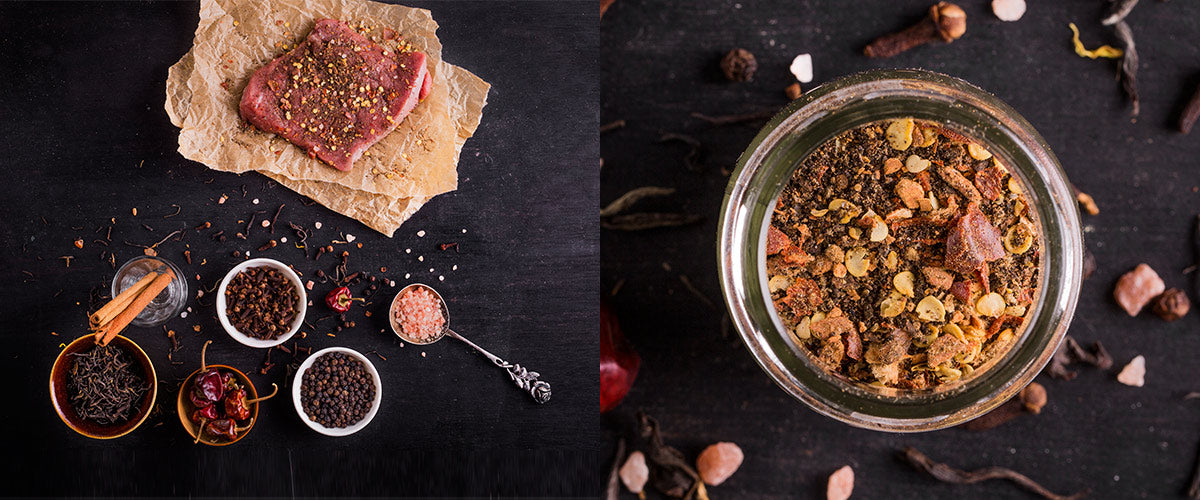
Yes, you can make your own flavored tea at home. Start with a tea you like, add one or two dried ingredients from your kitchen, keep the tea at about two-thirds of the mix, and taste as you go. Our blenders shared eight tips for home blending in 2015, and they hold up well. Below are those tips, how we build a blend in our own R&D kitchen in Siliguri, and the experiments that went wrong.
What are the basic rules for blending tea at home?
There are few fixed rules: use dried ingredients, keep the pieces a similar size, let the tea stay the hero, and start with just one or two additions.Read more
Our blenders’ eight tips, in short:
- Treat it as a rule-free game. There are no set recipes and no conventions; blending is driven by mood, and you never know what you may end up creating.
- Learn more flavors. Professional blenders spend years getting to know spices, fruits, vegetables and other aromatics. At home, a few spices, sprigs of herbs and flowers from the garden are enough to start; the key is learning to balance flavors.
- Be fearless. Do not hold back from throwing strawberries, lemongrass and hibiscus into a tea, because flavor can work in surprising ways.
- Taste the ingredients on their own first, so you can imagine how they will work together.
- Use dried ingredients. They have more concentrated flavor and brew better than fresh. A rosebud drying in the vase is a blend in waiting.
- Keep pieces a similar size. Crush spices, use single petals or small buds, and chop dried fruit evenly, or the small, heavy bits settle at the bottom of the jar.
- Keep the tea the hero: nearly two-thirds tea, and less of the added ingredient the lighter the tea.
- Start with one or two ingredients and build up; layered blends take time and skill.
The eighth tip in the original post is about iced tea, which has its own section below. The tips were written with input from Shruti, our blender at the time, whose own test was simple: a good blender must “love the tea in its pure form even before it enters a blend.”
How much tea should a home blend contain?
About two-thirds tea is a good starting point; use less of the added ingredient with lighter teas, and more only for bold dessert or spice blends.Read more
The two-thirds rule keeps the tea in charge. For a strong black tea such as an Assam, you can push the spices further; with a first flush Darjeeling, keep additions light and gentle, such as a few petals of lavender or chamomile.
It is a home guideline, not a law. Some of our own holiday dessert blends have carried far more cinnamon or nuts than that, because the spice was meant to lead. Natural liquid flavorings work the other way: our blenders use them in very small amounts, a tiny fraction of the blend by weight, because a little goes a long way.
Brew a home blend for its base tea, not for the additions: hotter water for black blends, cooler for green and white. For temperatures, see How do you brew flavored tea?
How do you make a blend for iced tea?
Start by tasting the plain tea over ice; if it tastes good cold, build the blend from there, and aim for a glass that stays bright and clear.Read more
For iced tea, taste the tea over ice first. Darjeelings take sugar syrup and mint well; Nepal teas like plenty of fresh fruit; Nilgiri and Assam teas accommodate spices and milk. A good iced tea is bright and clear, not cloudy.
When we made our first iced teas in 2015, the R&D team tasted every trial hot first, “since cold numbs the palate,” then again chilled. It was a cycle of “blending-steeping-tasting-adjusting” that ran for over a month, and it ended with 10 blends, including one inspired by the raw mango drink aam panna and, the surprise of the pack, a coffee-flavored iced tea. Many fruit, mint and floral blends work iced: see How to make iced tea.
Tea concentrates make good mocktails too. One of our holiday recipes stirs 120 ml of ginger tea concentrate with 80 ml of litchi juice, 5 ml of rose water and 15 ml of sugar syrup over ice, garnished with julienned ginger and rose petals.
How does Teabox create a new blend?
Our R&D team starts months ahead with a long list of ideas, makes and tastes prototypes over and over, and keeps only the few that work.Read more
Our R&D takes three to six months, and its calendar always runs ahead of the season. For our 2016 Diwali collection, Nagendranath Chiluvuru, then our R&D head in Siliguri, worked from what the festival meant to him and sourced ingredients to suit. “We developed prototypes … Every idea went through many iterations.” From 15 ideas in the beginning, the team arrived at 6 blends.
Tasting is the test at every stage. In 2015 Shruti tried each new blend on everyone around her, including the packers, though only “a rare few like Gomden sir (an old tea hand)” would give critical feedback; that was Arun Kumar Gomden, the veteran Darjeeling tea maker. Today every new blend is tasted again by our tasting team as a quality check before it launches.
Most blends are seasonal
Many of our flavored teas were made for one festival and then retired. Between 2015 and 2018 our Diwali and Christmas collections included Indian Marigold, Coco Berry, Cinnamon Pop, Sweet Serenity, Orange Spice, White Holly, Rose Drop Black, Creamy Coconut Black, Kewra Oolong and Merry Marshmallow Black. Only a handful lived on, among them Caramel Spice, a fruit and nut tisane, and Champer’s Holiday, the one survivor of our 2017 Christmas set. For a home blender the lesson is the same: start with many ideas and keep only the best.
Which blends didn’t make it?
Plenty. Even professional blenders get it wrong, and our team has burned roses, failed to taste pumpkin and made fifteen bad chais in a day.Read more
Even professionals get it wrong. Our blenders once smoked roses over wood, hoping for a sweet, woody tea; the rose simply burned. A pumpkin spice tea failed because fresh, dried and freeze-dried pumpkin were all too mild to taste. And a saffron vanilla chai ran to fifteen versions in one day, “the worst tea we’ve ever made.” Read the whole tale in Tea Blends That Didn’t Quite Make It.
Each failure echoes one of the tips. Smoking tea over wood such as teak, sal or pine usually works wonderfully; it was the rose that could not take it. The pumpkin was simply too mild, which is why it pays to taste each ingredient on its own first. And the saffron vanilla chai began as a straightforward blend of CTC chai, vanilla, saffron and spices; the team changed the concentrations of the spices, the saffron and the vanilla again and again, and nothing put it right. The team still dreams of a rose-flavored woody tea.
Can you cook with flavored tea?
Yes. A brewed flavored tea can poach fruit or flavor a cake, and our team has done both.Read more
Our team has poached pears in Mountain Rose black tea and served them with mascarpone cream and muesli. For a Thanksgiving plum cake, we gave a classic recipe a citrus twist with half a cup of Earl Grey black tea liquor, a teaspoon of lemon zest, and soaked raisins, walnuts, cashews and dates.
Keep reading
Sources
- Teabox Tea 101: Types of tea: Flavored Blends
- Teabox blog: Tea: A Blended History (2016); 8 Tips for Creating Your Own Tea Blends (2015); Tea Blends That Didn’t Quite Make It (2015); A Blender of Teas (2015); Jasmine Teas: A Scent of Perfection (2016)
- Teabox blog: Behind the scenes: Making of our Diwali gifts (2016); Behind the Scenes: Making of Our Iced Tea (2015); English Breakfast: The Baseline Black Tea (2016); The Tea Navigation Paths: Artisan and Agribusiness (2017); The Beginner’s Guide to Choosing a Darjeeling (2017); Tea in France: Not What You Might Expect (2016)
- Teabox blog (Still Steeping archive): Shades of Earl Grey, 2015; How to Choose Your Earl Grey, 2016; The Teabox Top 10 Teas of 2015, 2015; How Much Does Good Tea Cost?, 2016; Beyond the Tea Bag: A Starter’s Guide to Leaf Tea, 2016
- Teabox product descriptions, tasting notes and product data, October 2026: Mountain Rose Black, Classic Earl Grey Citrus Black, Green Tea Jasmine Soothe, Green Tea Rose Glow, Champer’s Holiday, Ivory Geranium Blossom White, Kashmiri Saffron Rose Chai, Kashmiri Kahwa
- Teabox Drive: Teabox internal document, 2015; Teabox internal document; Teabox internal document, 2017; Teabox internal document, 2016; Teabox internal document, 2018; photos as credited
- Teabox on Instagram (@teabox.tea): Mountain Rose, Jun 2015, Black Opal, Apr 2016, tea-poached pears, Jan 2017, Rose Mist, May 2017, flavor families, Nov 2017, liquor-flavored teas, Dec 2017, Morning Dew, Aug 2018, Kewra Delight, Oct 2018, Mint Jamun, Jun 2019, Nilgiri Jasmine Black, Oct 2019, Champer’s Holiday, Nov 2019, Moroccan Mint, Jan 2020, R&D team, Mar 2020, jasmine green, Nov 2020, kewra notes, Nov 2020, tea mocktail, Dec 2020, Earl Grey plum cake, Nov 2021, Masterclass part 2, Apr 2022, Summer Blends, May 2022, freeze-dried fruit, Apr 2023, tasting team, Jun 2024
- Kausshal Dugarr on X (@Teapreneur): alcohol and tea flavors, Dec 2016, Mountain Rose orders, May 2022

Leave a comment
All comments are moderated before being published.
This site is protected by hCaptcha and the hCaptcha Privacy Policy and Terms of Service apply.