


Made only from buds, Silver Needle is the most prized white tea and one of the most expensive; White Peony adds the first leaves, Shou Mei uses later leaf, and Moonlight is the name for an estate’s finest whites. Keen ranked them, in rough order of prestige: “Moonlight, Silver Needle, White Peony, and Shou Mei. All are excellent.” For how all white teas are made, start with What is white tea?
What is Silver Needle white tea?
Silver Needle (Bai Hao Yin Zhen) is a white tea made only from unopened buds covered in fine silvery down, handpicked in early spring; it gives the palest, silkiest cup of all.Read more
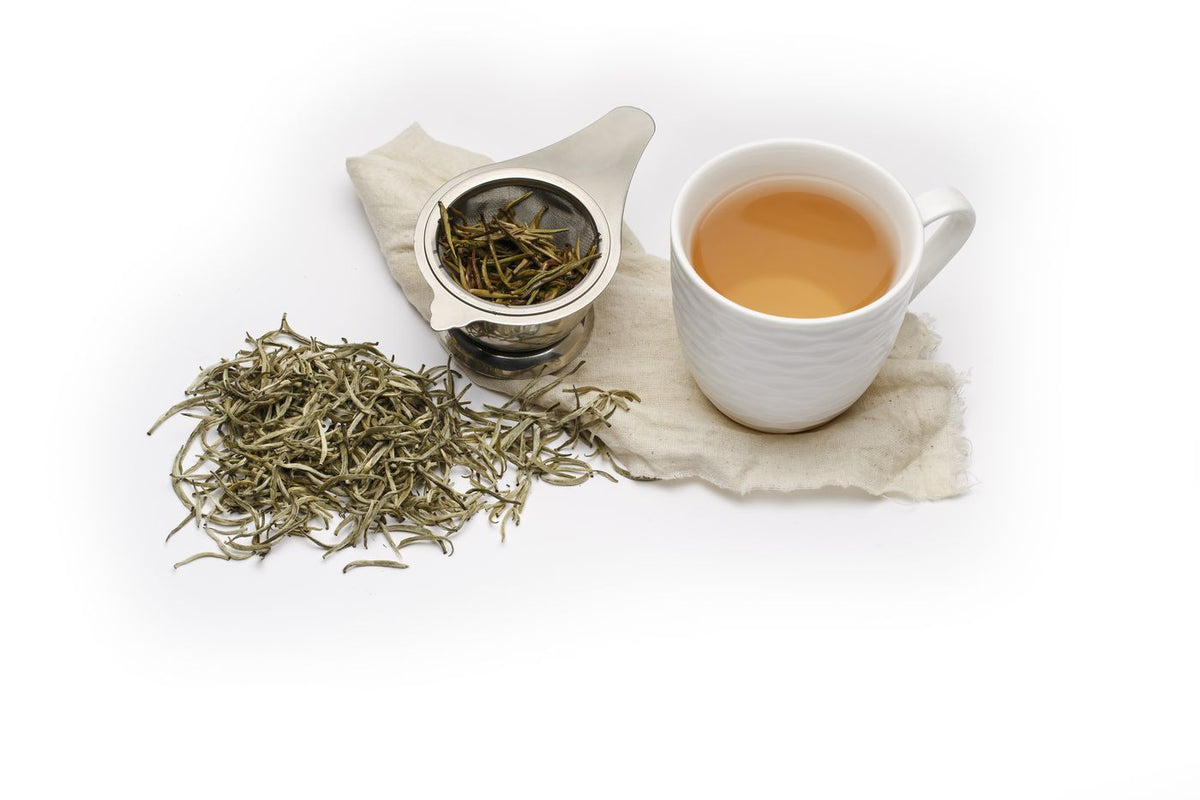
It was traditionally made from Fujian’s Da Bai bushes; today high-grown regions including Darjeeling and the Nilgiris make it from their own local bushes. In our own words, it is “a premium white tea grade made exclusively from unopened tea buds,” and those long, needle-like buds are what give it the name. Because there are no leaves, it has a lighter body and smoother texture than Moonlight White or White Peony.
Our Darjeeling Silver Needle
Our own Darjeeling Special Spring Silver Needle White is made from buds plucked at first light in gardens between 4,000 and 5,500 ft. It is not a single-estate tea: our tasters blend buds from two or three Darjeeling estates to keep the cup balanced from year to year.
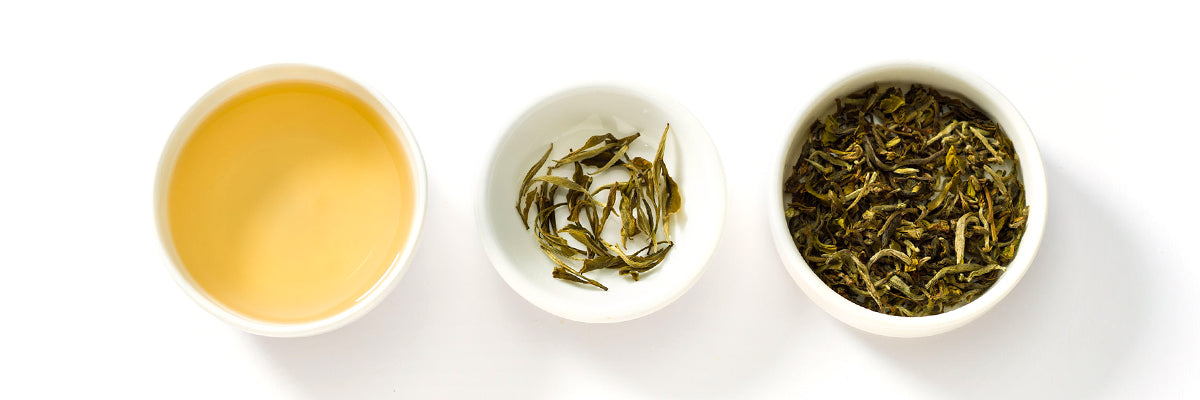
The 2026 lot was the first of our 2026 whites: picked on 13 and 14 March, it reached our facility on 16 March and was ready to ship on 17 March. Its label grade is SFTGFOP1. Our chief tea taster’s note gives “fresh floral aromas with soft green nuances, lifted by a gentle, natural honeyed sweetness,” and a Champagne-colored cup.
Our tasters describe it as “lightly floral, a bit creamy and smooth textured”; in 2024 we called it one of our best-selling teas around the world, with notes of white flowers and sweet honey.
Silver Needles elsewhere in India
In the Nilgiris, Glendale has made a spring Silver Needle for us. In Arunachal Pradesh, the Donyi Polo estate, founded in 1985, is known for “unique and aromatic silver needles and golden tippy teas.” More on these regions in Indian white tea.
Brew Silver Needle at 80–85°C for 3 to 5 minutes. For the most expressive cup our tasters recommend a single infusion; you can re-steep the buds, a little longer each time, for softer later cups.
What is White Peony (Bai Mu Dan)?
White Peony is a white tea made from a bud with the first one or two leaves below it, so it brews a little darker, fuller and more floral than Silver Needle, and usually costs less.Read more
White Peony adds the first one or two leaves below the bud. Its leaves oxidize a little as they wither, so it has a stronger flavor and a deeper cup than Silver Needle. That is the natural oxidation every white tea goes through; the extra leaf simply gives it more to work on. With demand rising, White Peony is now made alongside Silver Needle in Darjeeling, Nepal and the Nilgiris as well as China.
In Kangra, in Himachal Pradesh, the Dharmsala Tea Company, whose factory dates from 1882, counts “white peony teas” among its handcrafted teas, alongside hand-rolled oolongs. Read our visit: In Kangra, for a tour of the tea gardens.
Keen’s advice for a first white tea: “start with a medium-grade White Peony,” then move up to Silver Needle. A medium White Peony, he added, “costs little more than a high-end teabag.”
We do not sell a tea under the White Peony name. The closest in our range are the Darjeeling Moonlights, which are plucked the same way, as buds with young leaves; see the Moonlight section below.
What is Shou Mei?
Shou Mei, or “eyebrow” white tea, is made from leaf plucked later in the season, after the White Peony harvest; it is the darkest and strongest of the three classic whites.Read more
Shou Mei is made mainly in China, after the White Peony harvest, from leaf plucked later in the season. It is the strongest of the three classics, fruity and sometimes almost like an oolong.
The larger, later leaf is the reason: the same light wither and drying give it a darker, rounder cup than a bud tea. We do not stock a Shou Mei; if you like its fuller style, our summer whites, such as the Castleton Summer Moonlight White, lean the same way, with a “warmer, fruit-forward profile” than the spring whites.
What is Moonlight white tea?
“Moonlight white” is less a fixed style than a statement of quality: in Yunnan it usually means very large leaf from old trees, and in Darjeeling an estate’s finest buds and young leaves.Read more
In Yunnan, the name is believed to come from the tradition of plucking buds by moonlight, while they are most tender and still a little moist; there, it usually means very large leaf from old trees, and purists still debate whether it is a white tea or a pu-erh. In a Yunnan Moonlight, Keen wrote, “around 30% will be unopened,” which concentrates the subtle aromas that mark the style.
In Darjeeling, Keen wrote, it is “a fairly overt marketing claim”: the estate’s best mix of buds and leaf, plucked and dried with expert judgment. Darjeeling Moonlights tend to be made from buds with young leaves rather than buds alone, which gives them more body and fruit than a Silver Needle. Our 2019 Badamtam Heritage Moonlight, for instance, was made from “only the finest two leaves and buds.”
How we define Moonlight
On our product pages, “Moonlight” is “a unique style of white tea crafted using tender buds and young leaves, often harvested at dawn or under the moonlight,” with “minimal oxidation and natural withering.” Our launch notes add a gentle rolling before the leaf is dried.
The bush matters as much as the hour. All four of our 2026 Moonlights are made from AV2, a Darjeeling clone prized for its fragrance. Keen counted “around ten” Darjeeling estates making Moonlight whites that “match the reputation of even the superb Yunnan and Fujian Moonlights.” The gardens and the clone are covered in Indian white tea.
Which white teas are the rarest?
The rarest whites are the estate Moonlights of Darjeeling and Yunnan and a handful of single-origin Silver Needles such as Sri Lanka’s Adam’s Peak, made in quantities from a few kilograms to about 3,000 pounds (1,360 kg) a year.Read more
Keen’s path for a curious drinker runs from a medium White Peony up to Silver Needle, “then try a Darjeeling Thurbo, Badamtam or Margaret’s Hope, the even higher-rated Castleton and Jungpana, a highland Sri Lanka Needle and the sublime Adam’s Peak.”
How small the harvests are
Castleton’s Moonlight White came to just 4 kg (9 pounds) in the first flush of 2015 and 12 kg in the second. Adam’s Peak, the first white tea made outside China, is limited to 3,000 pounds a year, and “great care is taken to avoid any damage or bruising to a leaf, even down to how the bud is snapped from the branch.” Read Adam’s Peak: Higher and higher, better and better.
What they cost
In 2016, Keen put Silver Needle at about $120 a pound, or 80 cents a cup, and Castleton and Adam’s Peak at $300 to $600 a pound, still only $1.50 to $3 a cup. In 2021 we wrote that our Badamtam Moonlight White had been valued at about $2,800 a kilogram. Fine whites also go further than the price suggests, because they can be steeped more than once: Adam’s Peak “at least three times.”
Keep reading
Sources
- Teabox Tea 101: What is white tea?; Origins and history of white tea
- Teabox blog (Still Steeping): Moonlight Sonatas: The Great White Teas (2016); Going Clonal: How About a Nice Cup of AV2? (2016); Adam’s Peak: Higher and higher, better and better (2017); In Kangra, for a tour of the tea gardens (2017)
- Teabox blog (Still Steeping) stories: Clonals: the tea of the future, 2016; 10 Most Expensive Teas in the World, 2021
- Teabox product descriptions, FAQs and tasting notes, 2026: Special Spring Silver Needle White, Badamtam Spring Moonlight White, Castleton Summer Moonlight White
- Teabox Drive: Teabox internal document (2024 to 2026 single estate launches and FAQs); photos as credited
- Teabox on Instagram (@teabox.tea), linked where used

Leave a comment
All comments are moderated before being published.
This site is protected by hCaptcha and the hCaptcha Privacy Policy and Terms of Service apply.