


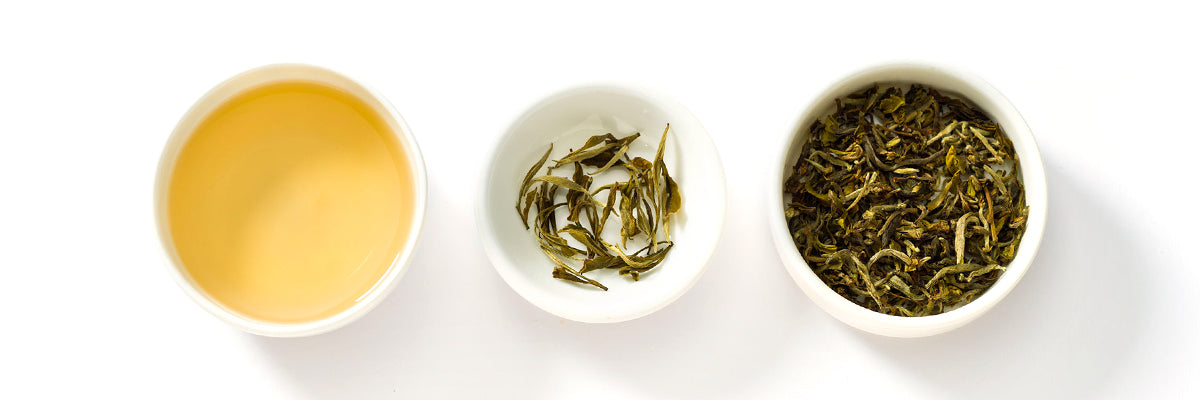
Darjeeling’s white teas are mostly made in the spring first flush, from March to mid-April, when the young leaf is at its most aromatic. A few gardens also make summer whites, and the Nilgiris, far to the south, make small amounts of fragrant, fruity white tea. Our Darjeeling tea guide covers the region and its gardens; for white tea in general, see What is white tea?
When is Darjeeling white tea made?
Most Darjeeling whites are plucked in spring, from March to mid-April, when the young leaf is at its most aromatic; a few are made in summer.Read more
A few gardens also make summer whites in the second flush, from late May into June, which are rounder, sweeter and darker in the cup. Castleton, which makes both from the same AV2 bushes, describes the summer lot as “a warmer, fruit-forward profile” with muskmelon and grape, against “the more delicate and floral character of spring.”
Our 2026 whites, by picking date
Every lot we buy is logged from the day it is picked to the day it is ready to ship. In 2026 our whites came in like this, each reaching our facility within one to three days of plucking:
| Tea | Picked | At our facility | Bush |
|---|---|---|---|
| Special Spring Silver Needle | 13–14 March | 16 March | Clonal, buds only |
| Badamtam Spring Moonlight | 20–21 March | 23 March | AV2 clone |
| Margaret’s Hope Spring Moonlight | 7–8 April | 9 April | AV2 clone |
| Exotic Moonlight White | 16–17 April | 18 April | AV2 clone |
| Special Spring White | 8–9 May | 11 May | Clonal blend |
| Castleton Summer Moonlight | 13–14 July | 15 July | AV2 clone |
Each lot is a short window: the most prized Moonlights are made from a single chosen section, plucked over one or two days. The color moves with the season too: Avishek Mondol, of our procurement team, describes spring liquors as ranging from “Sparkling gold to lighter shades of gold and even Champagne in case of Moonlight whites.”
What is AV2, and why do Moonlights use it?
AV2 is a Darjeeling clone, a bush bred and propagated from a selected parent, and it is behind many of Darjeeling’s finest Moonlight whites, including all four of ours in 2026.Read more
The name stands for Ambari Vegetative; Darjeeling clones are named for the estate that created them. Clonals, Keen wrote, “are not GMO,” but bushes developed through “generations of complex and meticulous selection, nursing and propagation,” and the lead time from introduction to full production “is typically at least seven years.”
What AV2 adds is aroma. Reviews single out “a marked but subtle floral boost, often described as ‘melon,’” and its teas “are not at all astringent.” That, Keen wrote, is what lets the Moonlight whites of “around ten estates” match the reputation of “even the superb Yunnan and Fujian Moonlights.” Read Going Clonal: How About a Nice Cup of AV2?
AV2 is usually a small part of an old garden. At Castleton about 70% of the estate is heritage chinary bush, some over 130 years old, with high-quality clones including AV2 on the rest; Margaret’s Hope is about 90% chinary, with AV2, Takdah 7-8 and N-436 making up the remainder. Our 2017 training notes list the clones used for Darjeeling white tea as B/6/24, B7372, B/5/63, AV2, B157, P126 and S3A3. More on clones in Chinary, Assam and clonal tea plants.
Which Darjeeling estates make the best white teas?
India’s finest white teas come from Darjeeling estates such as Badamtam, Margaret’s Hope and Castleton, which make prized Moonlight whites, with Mim, Thurbo and Turzum among the other gardens we have bought whites from.Read more
- Badamtam, in the Lebong Valley, was established in 1858 and takes its name from a Lepcha word meaning “bamboo water carrier.” Its Moonlight whites have come from single, carefully chosen sections: in 2019, a section at 4,800 ft, plucked on 14 March; in 2023, section 9 of the Lamas division, at 4,500 ft. The 2021 lot was made from the AV2 clone. The current Badamtam Spring Moonlight White blends the AV2, P126 and B157 clones.
- Margaret’s Hope, in the Kurseong Valley, grows tea between 3,500 and 6,000 ft and was renamed in 1927 by Mr. Cruickshank in memory of his daughter, Margaret. Its Moonlight whites are “one of the most coveted white teas across the globe,” we wrote in 2018; in 2017 we called its Moonlight first flush white “one of the best in Darjeeling.”
- Castleton, also in Kurseong, makes a limited Summer Moonlight White from AV2 clonal bushes each summer. Keen called Castleton’s Moonlight “near-legendary.”
- Mim, in 2018, gave us a spring white after a bit of hail fell over the garden; we wrote that the hail “released flavors never before tasted.”
Badamtam
Badamtam was founded by the British planter Christine Barnes, and looks across to Kanchenjunga, with the Rangeet and Majhitar rivers running through the estate and a 14-foot Buddha statue in the garden. The Lamas section of 2023 was plucked by “a select group of highly trained specialist pluckers,” and the lot was made exclusively for Teabox. Our 2026 lot, picked on 20 and 21 March, opens with gardenia, raw mango and “a soft sweetness of ripe cantaloupe,” and we recommend steeping it three times.
Margaret’s Hope
As the estate tells it, Margaret was the young daughter of J.G.D. Cruickshank, manager from 1896 to 1927, when the garden was still called Bada Rington; she fell in love with it on a visit, promised to return, and died on the voyage home to England. Its Moonlight shows how a fine white changes in the pot. Our 2026 note for the first steep gives raw mango, citrusy melon, rose and lavender over hints of vanilla; in the second, the florals “take center stage”; by the third, the cup turns more delicate and the vegetal notes come forward. Our tasters have also found in it “a certain amount of restraint which is uncommon in white teas from Darjeeling.”
“For the past couple of years, Darjeeling’s production has been excellent. We had seen some excellent Moonlights and decadent spring teas which were terrific in terms of quality and flavor.”
Castleton, Mim and the other white tea gardens
Beyond Badamtam and Margaret’s Hope, our Darjeeling whites have come from Castleton, Mim, Thurbo and Turzum, each with its own bushes, height and season.Read more
Castleton
Castleton was founded in 1885 by Dr. Charles Graham; it was first called Kumseri, and took its new name from a castle-like bungalow on the slopes. It spreads from about 1,000 to 1,830 m. Its Summer Moonlight is grown at 5,000 ft from AV2 bushes. Our 2023 lot was picked on 27 June, with notes of “Honeysuckle, Peony Blossom, Hint of honey”; the 2026 lot on 13 and 14 July.
Castleton’s Moonlight has long been a favorite at Teabox. In 2015 Ravi, who ran our procurement, called it “the perfect cup of Darjeeling,” and it was our founder’s pick of the year. Castleton also makes a spring Moonlight, from 130-year-old chinary bushes rather than clones.
Mim, Thurbo and Turzum
Mim made the hail-touched spring white of 2018 described above, and both Mim and Badamtam appear in our From The Source films below. Thurbo, founded in 1872 in the Mirik Valley, made a Moonlight that our team traveled to the estate to taste fresh; it was picked on 22 May 2025. Turzum, in the Rung Bong valley, dates to the 1860s and merged with the Sungma garden after the 1934 earthquake; it grows tea at 1,100 to 1,700 m, and its 2025 Moonlight was picked on 23 April.


How do we choose our Darjeeling whites?
Our tasters taste far more white tea than we buy: for each spring blend they sample well over a hundred lots from across Darjeeling and keep only a handful.Read more
For this season’s Darjeeling Special Spring White, our tasters evaluated more than 150 white tea batches and chose just four or five lots to blend; for the Darjeeling Exotic Moonlight White, they assessed over a hundred lots from across Darjeeling and kept only a few. Our 2026 product description confirms the count for this year: “A 2026 spring white tea blend chosen from over 150 Darjeeling batches.”
Blending is deliberate. The Special Spring White and Exotic Moonlight each combine teas from four or five Darjeeling estates, and the Silver Needle from two or three, so that the cup stays balanced from one year to the next; the single-estate Moonlights carry their garden’s name instead.
What we look for is set out by our procurement team: “Light, bright cups with fresh, floral character – this defines the basic essence of Darjeeling Spring teas.” Once a lot is chosen, speed protects it. Our facility in Siliguri is close enough to the gardens that teas reach us within 24 to 48 hours of production, where they are sealed and stored at 3 to 4% moisture.
What are Nilgiri white teas like?
Nilgiri whites are high-grown, fragrant and fruity, and some of the most interesting are made in the cold winter flush, when the gardens make their frost teas.Read more
In the south, the Nilgiris grow tea year round and make small amounts of white tea. We have described the Nilgiri White as “a fragrant high-grown white tea with succulent tropical fruit flavors.” Glendale has made a spring Silver Needle, and Billimalai a Special Winter Frost White, made in the cold winter flush. The Nilgiri winter flush runs from late December to March and is best in January and February; see Winter and frost teas from the Nilgiris.
Today our Nilgiri white tea goes into Ivory Geranium Blossom White, which blends it with sun-dried geranium leaves for notes of geranium, rose and raw mango.
Where else are white teas made in India and nearby?
Outside Darjeeling and the Nilgiris, India makes white tea in Kangra and Arunachal Pradesh, and nearby Nepal and Sri Lanka make fine whites too.Read more
In Kangra, the Dharmsala Tea Company makes white peony teas among its handcrafted teas; see In Kangra, for a tour of the tea gardens. In Arunachal Pradesh, the Donyi Polo estate is known for its silver needles. Our 2014 white tea guide also counted Assam among India’s white tea regions.
Beyond India, Nepal also makes white teas, and Sri Lanka’s Adam’s Peak, which our blog describes as the first white tea made outside China, remains one of the rarest and highest-rated. Read Adam’s Peak: Higher and higher, better and better.
Keep reading
Sources
- Teabox Tea 101: What is white tea?
- Teabox blog (Still Steeping): Going Clonal: How About a Nice Cup of AV2? (2016); Moonlight Sonatas: The Great White Teas (2016); Adam’s Peak: Higher and higher, better and better (2017); In Kangra, for a tour of the tea gardens (2017)
- Teabox blog (Still Steeping) stories: The Teabox Top 10 Teas of 2015; White tea: a quick and dirty guide, 2014
- Teabox product descriptions, estate stories and product data, 2026: Badamtam Spring Moonlight White, Margaret’s Hope Spring Moonlight White, Castleton Summer Moonlight White, Special Spring White, Exotic Moonlight White, Ivory Geranium Blossom White
- Teabox Drive: Teabox internal document (2025 and 2026 single estate launches, freshness journeys, FAQs); Teabox internal document; Teabox internal document, 2020; Teabox internal document, 2017; Teabox internal document; Teabox internal document, 2023; photos as credited
- Teabox Drive, 2025 tasting cards: Teabox internal document, Teabox internal document, Teabox internal document
- Teabox on Instagram (@teabox.tea): Apr 2024, Mar 2019, Mar 2023, Apr 2021, Jun 2018, Jul 2017, Apr 2018, Jul 2020, Nov 2016, Jul 2015, Jan 2019, Feb 2022
- Kausshal Dugarr, Teabox founder, on X (@Teapreneur): X · @Teapreneur
- Teabox on YouTube: Badamtam Heritage Moonlight Spring White, MIM Exotic White Tea


Leave a comment
All comments are moderated before being published.
This site is protected by hCaptcha and the hCaptcha Privacy Policy and Terms of Service apply.