


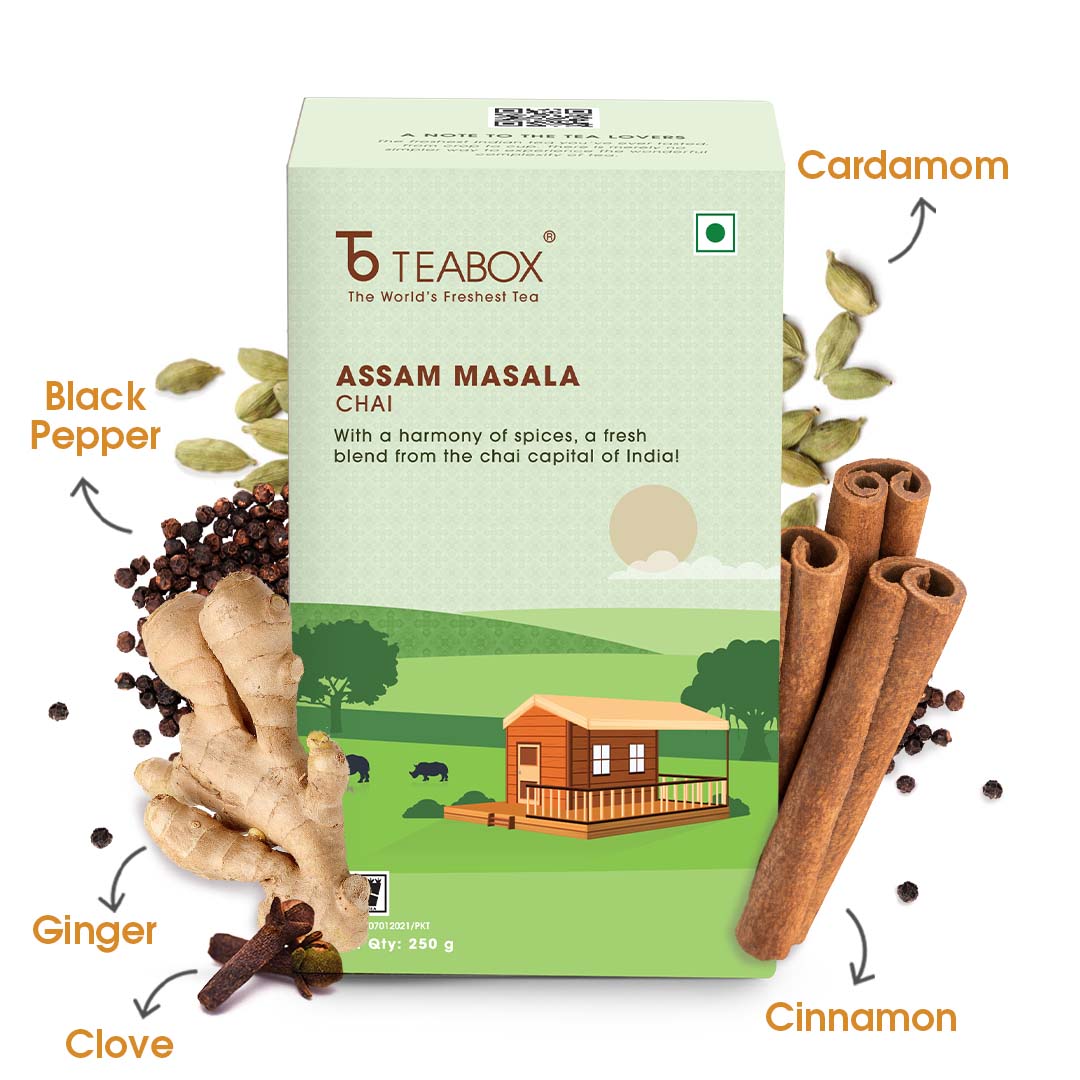
Cardamom brings a cool, floral sweetness; ginger adds lemony heat; cinnamon gives sweet warmth; clove adds depth; and black pepper gives a slow heat at the back of the throat. This page takes the five one at a time: what each tastes like, how much to use, and where it turns up in our own chais. For the short version, with a table of all five, start at Chai spices and chai masala.
What does cardamom add to chai?
Green cardamom gives chai its cool, fresh, floral lift and a sense of richness, and it is the signature spice of most chais.Read more
Peter Keen, writing for us in 2017, called green cardamom “the dominant chai flavor component,” and noted that “the roasted green pods provide pungent sweetness.” Our first Tea 101 put it more simply: “Cardamom lends a sweet taste to tea and is a popular addition while steeping chai.”
In our Wayanad Cardamom Chai
Our Wayanad Cardamom Chai is the plainest way to taste it, and its tasting note describes “the fresh and cool aroma of the green gem.” We half-beat the pods before mixing them with the tea so the flavor stays locked in until you brew. The product page calls cardamom chai one of the most popular varieties of chai across India, made by blending crushed cardamom pods with Assam CTC.
When we first wrote up the blend in 2016, the dry leaf was “black CTC tea and decorticated cardamom pods,” and the note on the cup read: “The first few sips are starkly reminiscent of those cardamom rolls you’d eat as a child. As the smooth, dense flavor of cardamom unravels, the brisk notes of black tea spring a welcome surprise.” Our writer summed it up: “Cardamom and tea are like Sherlock and Watson, both fine individually, but always better together.”

A Teabox story on ginger put the difference between the two leading chai spices neatly: cardamom tea “has a heavy, rich feel and it’s the tea you serve to formal guests.” Cardamom alone makes a chai of its own, covered in Cardamom (elaichi) chai.
Green, white and black cardamom
Buy green pods, and crack them yourself. Keen warned that cardamom seeds, powder and white cardamom are widely used as cheap substitutes, and that white cardamom is “second grade green bleached with hydrogen peroxide.”
Black cardamom is a different spice: “not truly cardamom but a botanical relative,” whose small seeds “add a smoky and peppery flavor.” It does not belong in an elaichi chai, but our 2018 training manual lists it among masala chai spices, and our Punjabi Masala Chai is described as CTC black tea with bits of cinnamon and black cardamom.
What does ginger add to chai?
Ginger gives chai its heat and its tang, and in our Assam Masala Chai it is the first spice you taste.Read more
Food writer Niki Segnit, quoted on our blog, describes fresh ginger as having “a lemony, woody and earthy tone with a kick of heat.” Young ginger is milder and sweeter; mature roots, the kind dried and ground into powder, are spicier and warmer. In ginger chai, “a small piece of ginger needs to be swiftly crushed or grated and dropped into the saucepan to boil along with the water for the tea.”
Where it grows changes it. The same story notes that ginger “was once native to Southeast Asia, but is now grown in all tropical countries,” and “needs a pronounced wet and dry season” for the root to come to harvest. Jamaican ginger, in Segnit’s words, has “an almost camphorous pungency that distinguishes it from the lemony varieties and brings it closer to cardamom.” Keen preferred it fresh: “Slices of its fresh root are much, much more flavorful than powdered or crystallized ginger.”
In our blends, ginger leads. Avishek of our procurement team, scripting a tasting of our chais, put ginger at the top of both Assam Masala Chai, where it “can be perceived immediately rendering a warm feeling,” and Kolkata Street Chai, where it opens alongside nutmeg. The two researchers behind the Chaiwallahs of India project, who drank their way through some 3,000 cups, make theirs ginger-first at home too: “lots of freshly grated ginger to keep it spicy, along with cardamom, cloves, black pepper, cinnamon, whole milk, and brown sugar.”
Fresh ginger has one catch: it can curdle milk that is only warm. Why, and how to avoid it, is in Whole vs ground spices.
What do cinnamon, clove and black pepper add?
These three are the supporting cast: cinnamon adds sweetness without sugar and ties the blend together, clove adds depth, and black pepper gives a masala chai its gentle, warming finish.Read more
Cinnamon (dalchini)
Cinnamon is the spice we reach for most. In our 2018 count it appeared in 13 of our blends, more than any other spice. In Assam Masala Chai it comes through with clove in the middle of the sip.
Know which cinnamon you are buying. True cinnamon is “made from the inner bark” and rolled into quills, and Keen noted that “the best comes from Sri Lanka but most of what is sold in the US is made from the cassia tree and is not as fiery.” Jerry Pinto’s home method for Mumbai chai uses a cinnamon stick “one inch long, well-thumped,” so the bark cracks and gives up its oils.
Clove (laung)
Clove is the strongest spice in the mix by far, so it goes in sparingly. Keen’s note: “Cloves add a pleasant bite to the tea that can offset the softness of the cardamom. A little goes a long way.”
Too much and it takes over. Pinto remembered the Marwari tea of his Mumbai childhood as “made with only milk and with cloves to kill,” and in his own pot a clove or two is the fallback when the cardamom and cinnamon run out.
Black pepper (kali mirch)
Black pepper gives a masala chai its gentle, warming finish. Keen found peppercorns “both warming and a surprisingly compatible addition,” and noted that “the coast of Malabar in India is noted for the best peppercorns.”
In Assam Masala Chai it is the last thing you notice: Avishek’s script places a “subtle hint of cardamom & black pepper” at the finish. A few crushed peppercorns are enough for one pot; whole ones barely give up their heat in the short simmer.
Keep reading
Sources
- Teabox blog: The Science Behind My Ginger Chai (2015), 8 Tips for Creating Your Own Tea Blends (2015), Ginger: Not just chai’s partner-in-crime (2016), A Blender of Teas (2015), Tea Blends That Didn’t Quite Make It (2015)
- Teabox blog: Would you like some sugar in your tea? Or a little tea in your sugar? (2017), The Journey of Our Beloved Chai (2020), A Mumbai tea story (2015), Cross Country in Search of the Chai Wallah (2015), The Sweet Palate, a Cup of Joy (2020), Behind the scenes: Making of our Diwali gifts (2016)
- Teabox blog (Still Steeping): How to make Indian masala tea, 2016; Chai: the way India drinks tea, 2015; My inconspicuous companion, 2015
- Teabox Tea 101: FAQs; Chai (masala chai entry); Popular teas around the world
- Teabox product blend notes: Assam Masala, Bombay Cutting, Kolkata Street, Kashmiri Saffron Rose, Wayanad Cardamom, Gujarati Mint Spice, Punjabi Masala, Ashoka Ras, Rajasik, Rasayana chais, Kadak Chai and The Chai Tea Gift Box, October 2026
- Teabox Drive: Teabox internal document, 2018; Teabox internal document; Teabox internal document, 2015; Teabox internal document, 2023; Teabox internal document, 2016; Teabox internal document, 2025; Teabox internal document, 2025; Teabox internal document, 2026; Teabox internal document, 2017; photos as credited
- Teabox on Instagram (@teabox.tea): Assam Masala Chai tasting note, Nov 2019, chai concentrate, Jan 2020, masala chai folklore, Sep 2020, Assam Masala Chai spices, Oct 2020, Choco-Orange Chai, Jan 2023, Jaipur Masala Chai, Aug 2023, blending sessions, Apr 2024, our blender, Jun 2024, chai popsicles, Sep 2024, Gujarati Mint Spice Chai, Oct 2024, Rajasik, Nov 2024, Rasayana, Nov 2024, Varanasi chai, Dec 2025
- Kausshal Dugarr on X (@Teapreneur): coconut oil in chai, Jan 2022, Kadak Chai sourcing, Jan 2022


Leave a comment
All comments are moderated before being published.
This site is protected by hCaptcha and the hCaptcha Privacy Policy and Terms of Service apply.