


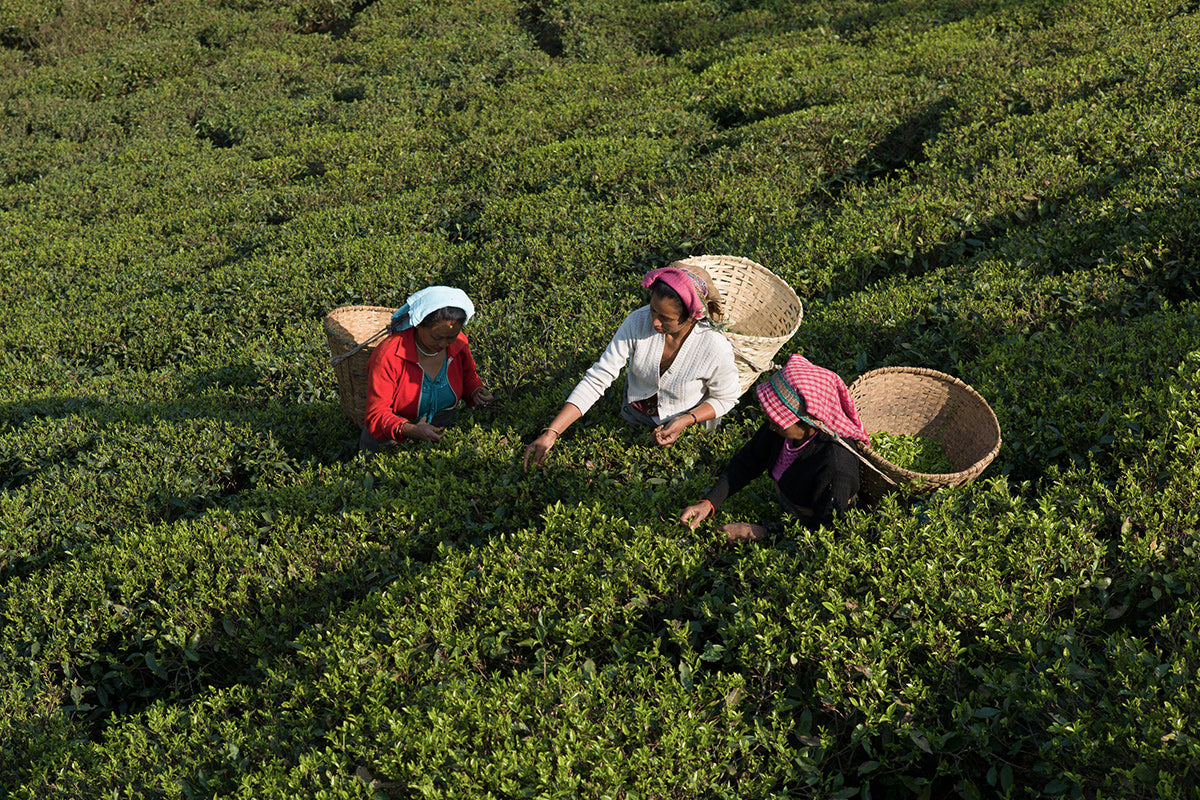
Nepal tea and Darjeeling tea grow in the same stretch of the Himalaya and taste alike, but Darjeeling tea comes only from registered gardens in the Darjeeling hills of India, and the name is legally protected. Nepal tea comes from the hills on the other side of the border.
How close are Nepal and Darjeeling teas?
Close enough that experienced drinkers struggle to tell them apart in the cup, though not on the price tag.Read more
The two are close enough that, according to a trade cliché quoted in our 2016 story on Germany, even knowledgeable tea lovers can struggle to tell a typical estate Darjeeling from a top-grade Guranse, Ilam, Antu Valley or Kanyam. They can, however, see the difference in price.
The border runs right through tea country. The same story notes that the Darjeeling district covers about 2,200 square kilometers and borders Nepal to the west and Sikkim to the north, with a short stretch of border with Bangladesh in the plains. Okayti, one of the Mirik gardens we buy from, lies on the Mechi river, the boundary with Nepal. The people are shared too: most workers on Darjeeling gardens such as Jungpana are Nepali.
| Nepal (eastern hills) | Darjeeling | |
|---|---|---|
| Where | Ilam, Panchthar, Dhankuta, Terhathum | Darjeeling hills, West Bengal, India |
| Altitude | About 1,000–2,500 m | About 600–2,000 m |
| First gardens | 1863 (Ilam) | 1850s |
| Who grows it | Mostly smallholders; regional factories | About 87 registered estates, most with their own factory |
| Bushes | Many younger gardens and newer clonal plantings | Old Chinary bushes alongside clonals |
| Name protection | Sold as Nepal tea, or as “Himalayan” tea | Geographical Indication since 2004 |
| Typical cup | Floral to fruity; softer, a little woodier | Floral first flush; muscatel second flush |
| Producer price, late 2016 | $5–10 a kilo | $10–15 a kilo |
The growing difference shows in the factory. Where Darjeeling’s estates almost all process their own leaf, Nepal’s regional factories buy leaf from farms that average less than an acre.
How do Nepal and Darjeeling teas taste side by side?
A Nepal black is usually a little softer and woodier than a Darjeeling of the same season; Nepal whites trade some aroma for more intense flavor; and Nepal greens can be the cleaner of the two.Read more
Our 2016 story’s verdict is that Nepal black tea is “very good indeed” but “not quite the same in taste as Darjeeling,” offering an attractive, less expensive complement except against the very best Darjeelings. Full tasting notes are in What does Nepal tea taste like?
- White tea: launching a Guranse spring white in 2017, we wrote that in the “inevitable comparison between a Darjeeling white and a Nepal white, the former scores in aroma while the latter ranks higher in the intensity of flavor,” and found the Guranse “a floral and mellow cup, with intense flavors.”
- Green tea: our 2016 story judged Nepal’s Japanese-style greens, with their extra zip and very clean taste, to be, if anything, ahead of Darjeeling’s.
- Oolong: when Frank Miller cupped Himalayan oolongs for us, he concluded that “India and Nepal oolongs are turned out using the orthodox black tea template with tweaks at the withering stage and at fermentation,” which is why they taste closer to a Darjeeling black than to a Taiwan oolong.
Our view: a good Nepal tea is no longer a cheaper stand-in but a tea in its own right. Our 2017 email to customers said the same: “Once thought of as the Darjeeling’s lesser cousin, Nepal’s gardens have, over the years, focussed on quality.” The best way to taste the difference is side by side, one Nepal spring black against one single-estate Darjeeling. See also First flush vs second flush Darjeeling. Sikkim, the small Indian state that also borders Nepal, is a third point of comparison: read Sikkim tea and the Temi tea garden.
The labeling issue: is some Darjeeling really Nepal tea?
For many decades, some of the tea sold around the world as “Darjeeling” has contained tea from Nepal.Read more
Before roads reached the Nepal hills, leaf was smuggled across the border and sold as Darjeeling, and our 2016 story describes a smuggling trade that “continues to flourish.” Nepal leaf was close in taste, younger Nepal bushes gave brighter-looking leaf than Darjeeling’s aging ones, and blending in the cheaper tea helped keep Darjeeling profitable.
“Getting your Darjeeling tea from the market? There is a good chance you are drinking a little or more Nepal tea as well. The blending of Darjeeling & Nepal tea is an old affair.”
The scale was large. Our 2017 guide to choosing a Darjeeling repeats the often-quoted consensus that Darjeeling produced about 10,000 tonnes of tea a year while some 40,000 tonnes were sold under its name, “with much of the counterfeit and adulteration coming from Nepal.” See The Beginner’s Guide to Choosing a Darjeeling.
How the rules changed
Two things have changed this. Darjeeling became India’s first Geographical Indication in 2004, so only tea from its registered gardens may carry the name in India, and protection in the European Union, the biggest market for Darjeeling, has tightened what blends can be called. Our 2016 story on Germany notes that German packers had long sold blends of 51% Darjeeling as Darjeeling, a practice the new European rules were ending. At the same time, Nepal’s own tea has improved so much that many buyers now want it under its own name, and a “Himalayan” label built largely on Nepal tea has grown up in Germany.
The other 49% in those German blends, the story explains, could come from Sri Lanka, other Indian regions, Bangladesh or Africa. The European Union takes about half of all Darjeeling exports, with Hamburg the main shipping and processing hub. “In the era of mass smuggling, Nepalese tea was good but not great,” the writer added. “Now, a lot of it is great.”
We watched the change closely. In 2015 our founder wrote on our blog that from early 2016 all teas sold as “Darjeeling” would have to be 100% Darjeeling, “and not a blend of 51% Darjeeling with other teas that we are seeing now.” Teabox itself holds the Tea Board of India’s license to use the Darjeeling certification trademark, first issued to us in March 2015.
How can you tell what you are buying?
Read the label: a named garden, flush and country tell you far more than the word “Darjeeling” alone, and price is the last check.Read more
- Look for an estate. A Darjeeling that names its garden and flush, such as “Okayti, first flush,” is far less likely to be a blend than one labeled only “Darjeeling.”
- Look for the country. A good Nepal tea will say so, and usually names its district or garden: Ilam, Guranse, Kanyam, Antu Valley.
- Check the price. A cheap “Darjeeling” with no estate on the label may well be partly Nepal tea; better to buy Nepal tea as Nepal tea.
Our own labels have always worked this way. One of our first Nepal teas, the 2014 Kanyam Black, carried its country, its garden, its flush (first, spring), its grade (SFTGFOP1) and the words “single estate” on the pack. The 2016 story on Germany found that some of the better American loose tea brands were already using the “Himalayan” name for their Nepal teas, so that word on a pack is now a clue too.

Keep reading
Sources
- Teabox blog: Nepal: Innovation in the high Himalayas (2016); Tea in Germany & its Darjeeling Connection (2016); The beginner’s guide to choosing a Darjeeling (2017); India vs. Taiwan: The oolong challenge (2017); The Muscatel Master (2021); God in the Tea Gardens (2015)
- Teabox blog (Still Steeping, not currently published): Nepal Earthquake Appeal, 2015; The Future of Darjeeling’s Tea, 2015; Tea in Islamic cultures, 2016
- Teabox Tea 101: The Nepal tea (original article); The Darjeeling tea
- Teabox product pages for Okayti, Thurbo and Temi, 2026 season
- Teabox Drive: Teabox internal document, 2017; Teabox internal document, 2017; Teabox internal document, 2017; Teabox internal document, 2016; Teabox internal document, 2016; Teabox internal document, 2014; Teabox internal document, 2023; Teabox internal document, 2020; supplier estate data (2019); Nepal procurement tour record (June 2018); Teabox license records; product listing files (2014 to 2022); Guranse visit photos (May 2017), Nepal green tea product photos, Darjeeling estate photos
- Teabox on Instagram (@teabox.tea): Panchkanya spring black, Jul 2015, sampling teas from Nepal, Aug 2015, new gardens in Nepal, Jul 2017, Kanyam visit, Jul 2017, Ilam Tea Estate, Aug 2019, iced Ilam green, Jan 2020, 2.5 g samples, Apr 2021
- Kausshal Dugarr on X (@Teapreneur): Nepal teas at Teabox, Apr 2014, blending Darjeeling and Nepal, Oct 2021, Nepal black tea, Oct 2021

Leave a comment
All comments are moderated before being published.
This site is protected by hCaptcha and the hCaptcha Privacy Policy and Terms of Service apply.