


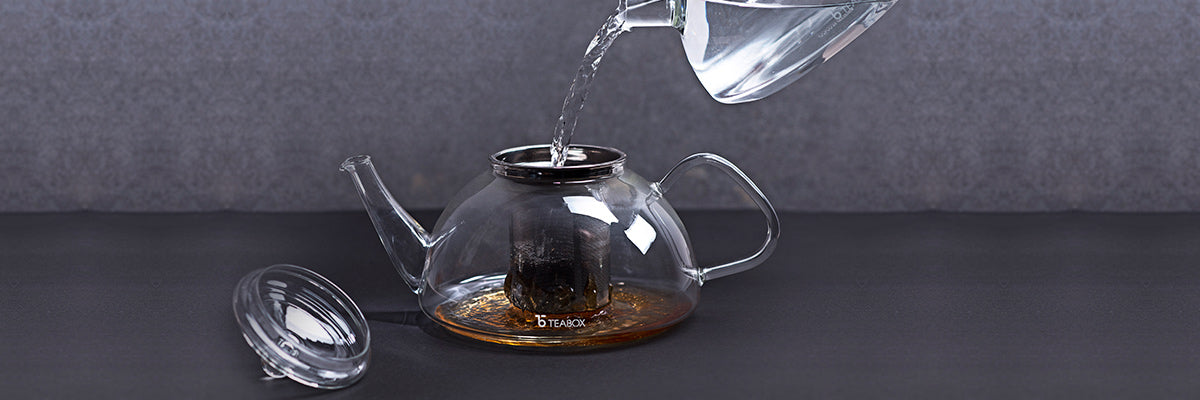
White tea wants water at 80–85°C for 3 to 5 minutes; green tea a little cooler and shorter, at 75–80°C for 2 to 3 minutes. Both are brewed with about 2 to 2.5 g of leaf per 250 ml (8 oz) cup and drunk plain. Here are our methods for each, how many times to steep, and what to do when a green tea turns bitter.
What water temperature do white and green tea need?
Both need water well short of boiling: 80–85°C (176–185°F) for white tea and 75–80°C (167–176°F) for green tea.Read more
Neither likes boiling water: as our blog puts it, “in boiling water, delicate green and white teas will overcook, leaving less of their delicate flavors to reach the senses.”
The finer the tea, the more the water matters. Keen wrote that the rare teas, “especially the most subtle whites and greens, demand meticulous handling,” and that they deserve water that “brings out the best of both tea and taster.” Read the full piece: Microwaved, tepid, rolling boiling? Water for tea!
You do not need a thermometer. Boil the water, then let it stand for a few minutes: a little longer for green tea than for white. A kettle with temperature settings makes it easier still.
How do you brew white tea?
Weigh about 2 to 2.5 g of white tea, pour over water at 80–85°C, steep for 3 to 5 minutes, and then steep the same leaf again.Read more
- Weigh the leaf if you can. Fluffy buds weigh much less than a spoonful of rolled tea, so 2 to 2.5 g of white tea is more than a single teaspoon by volume. Our product records put 2.5 g of our whites at 2 to 3 teaspoons.
- Heat the water to 80–85°C, well short of boiling.
- Steep 3 to 5 minutes, tasting at 3. White tea is forgiving: Keen found it “more tolerant of temperature and time in brewing than greens.”
- Steep again. Good whites give two or three more infusions; add a minute each time. Our Badamtam Moonlight can be steeped up to four times, “unfurling different flavors with every steep.”
How many times to steep
It depends on how much leaf is in the tea. For the buds-only Silver Needle, our tasters recommend a single infusion for the most expressive cup; you can steep the buds again, a little longer, but later cups are softer. The Moonlights, with their young leaves, hold up longer: our 2026 cards say to steep Badamtam and Margaret’s Hope three times, and the Exotic Moonlight and Castleton Summer twice.
In 2021 we gave the Badamtam Moonlight this method: 2.5 g of leaf, water at 80–85°C, steeped for 5 minutes, and “at least 3 times.” One customer went cooler still. He brewed our Badamtam Spring White three times at 70°C, for 4, 5 and 6 minutes, and “easily got 3 brilliant infusions.”
Over ice
White tea is lovely iced, and a later steep is the one to use. When our tasters worked through the Badamtam spring white in 2022, they poured the third steep over ice and found green mango.
Our note for the Margaret’s Hope Moonlight says the same of its second steep: “best served iced.” Brew it as usual and pour it over a full glass of ice.
How do you brew green tea?
Steep about 2 to 2.5 g of green tea in water at 75–80°C for 2 to 3 minutes, tasting at 2, then strain it promptly.Read more
- Heat the water to 75–80°C, or let boiled water stand for a few minutes.
- Use about 2 to 2.5 g of leaf, roughly one heaped teaspoon.
- Steep 2 to 3 minutes, tasting at 2 the first time, then strain promptly so it does not turn harsh.
- Serve plain, or with a little honey or lemon. Milk and sugar hide the flavor of both teas.
Rolled green leaf is denser than white tea, so a heaped teaspoon is usually enough. Whole-leaf greens can be steeped more than once: our Darjeeling Green Tea’s product page suggests two steeps.
Japanese greens need the most care. Keen’s figures for sencha were exact: a deep-steamed fukamushi at 150°F (about 66°C) for 1.5 minutes, a light-steamed asamushi at 160°F (about 71°C) for 1.5 minutes. “At 170°/2.5 minutes,” he wrote, “both these teas are transformed from exquisite to truly execrable.” Matcha is whisked, not steeped; see How to make green tea.
Why does green tea turn bitter when white tea rarely does?
Green tea turns bitter when the water is too hot or the steep too long, and broken leaf makes it worse; white tea, brewed a little warmer from whole buds, is far more forgiving.Read more
If green tea tastes bitter, the water was probably too hot or the steep too long. Leaf size matters too. As our tasters explained in 2021, dust and fannings have far more surface area than whole leaf, so they release their tannins quickly and make a much more bitter cup; whole leaf releases them slowly.
Steeping longer does not help. Keen put it plainly: “Longer does not mean stronger, only more bitter. The median time is just three minutes, with black teas up to five and Japanese green teas as short as 1.5 minutes.” For a stronger cup, add a little more leaf instead.
Forgiving is not careless, though, even for white tea. In 2015 one of our writers found a Namring Exotic White “a disappointment,” adding, “It is possible that the tea required more skilled preparation.” Every tea type is in one chart in How to brew loose leaf tea, and more causes of bitterness are in Why tea tastes bitter.
Keep reading
Sources
- Teabox Tea 101: The difference between white and green tea; What is white tea?; What is green tea?; How to make green tea; Caffeine in tea
- Teabox blog (Still Steeping): How is tea made? (2015), The Element of Water: Get Your Tea Right (2021), The Unusual Pairing of Green Tea with Cheese (2015), Moonlight Sonatas: The Great White Teas (2016), Going Clonal: How About a Nice Cup of AV2? (2016), Microwaved, tepid, rolling boiling? Water for tea! (2016), In Kangra, for a tour of the tea gardens (2017), A Secret Tea Garden in the Clouds (2015), The Beginner’s Guide to Choosing a Darjeeling (2017)
- Teabox blog (Still Steeping) stories: The true colors of the white tea, 2016; White tea: a quick and dirty guide, Kausshal Dugarr, 2014; A tour of TANTEA estate, Nilgiris, Gopal Upadhayay, 2016; The Teabox Top 10 Teas of 2015; How Not To Make A Bitter Cup Of Tea, 2015; Clonals: the tea of the future, 2016; 10 most expensive teas in the world, 2021
- Teabox product descriptions, product data, tasting notes, FAQs and selection notes, 2026 season: Special Spring Silver Needle White, Special Spring White, Badamtam Spring Moonlight White, Castleton Summer Moonlight White, Margaret’s Hope Spring Moonlight White, Darjeeling Exotic Moonlight White, Darjeeling Green Tea, Nilgiri Glendale Autumn Twirl Green
- Teabox Drive: Teabox internal document (2026 single estate launches: picking dates, caffeine ratings, steeping cards); Teabox internal document, 2015; Teabox internal document, 2022; Teabox internal document, 2023; Teabox internal document, 2023; Teabox internal document, 2018; photos as credited
- Teabox on Instagram (@teabox.tea): least processed, Nov 2017, Glendale Silver Needle, Jul 2015, Badamtam tasting, Mar 2022, Badamtam steeps, Mar 2019, customer brew, Apr 2022, bitterness and leaf size, Sep 2021, Silver Needle launch, Mar 2024, Mim Exotic Spring White, Apr 2018, our procurement and tasting team, Jun 2024
- Teabox on YouTube, From The Source: Badamtam Heritage Moonlight Spring White, Badamtam: A Tea Tale, MIM Exotic White Tea


Leave a comment
All comments are moderated before being published.
This site is protected by hCaptcha and the hCaptcha Privacy Policy and Terms of Service apply.