


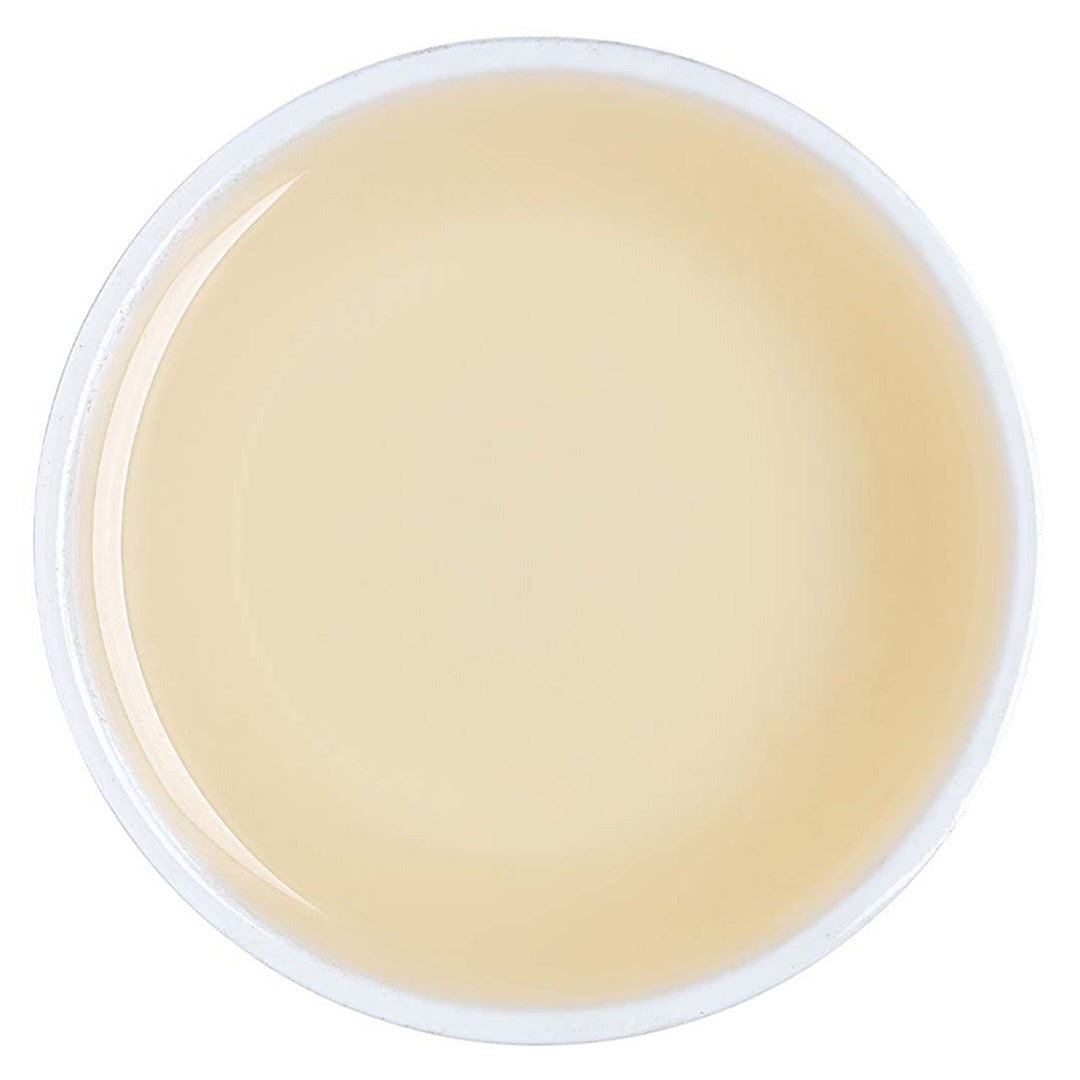
Our current tasting notes show how far apart white and green tea can sit, even when they come from the same hills. White tea leans to flowers, honey and fruit; green tea to grass, greens and toasted nuts. This page sets our own notes side by side, follows one white through three steeps, and suggests food for each.
How does white tea taste compared with green tea?
White tea tastes soft, sweet and floral, with almost no astringency; green tea tastes fresher and more savory, with a vegetal or toasty character and a little more grip.Read more
A good white is “surprisingly full while also delicate, so that its flavors expand in your mouth,” Keen wrote, “subtle and smooth with a hint of sweetness and no astringency.” Of Darjeeling’s Moonlight whites he added that they are “surprisingly full in taste, with none of the watery blandness that is found in very delicate China greens.”
Green tea has more range, because the way it is heated shapes the flavor. Tea 101 describes green teas running “from cooked vegetables and charred greens to grass, nuts, and citrus.” Pan-fired teas, as in China and India, lean toward toasted grain and nuts; steamed Japanese teas toward cut grass and the sea. Indian greens tend to be softer and rounder, often gently floral.
Our training deck gives the words we reach for at the tasting table when a green is in the cup: vegetal, grilled greens, grassy, toasty, nutty and herbaceous, with a cooked-vegetable, cooked-corn flavor. Kangra’s makers describe their greens as having “citrusy and often nutty flavors, with very little bitterness.”
Part of the difference starts in the factory. Rolling breaks the cell walls of green tea, so its flavor comes out quickly when you brew; an unrolled white bud gives up its flavor more slowly. That is one reason a green turns harsh with careless brewing, while Keen found white tea “more tolerant of temperature and time in brewing than greens.” For how each is made, see White tea vs green tea.
How do our white and green teas compare in the cup?
In our own range the whites run from creamy, lightly floral Silver Needle to a bright orange summer Moonlight full of apricot, while the greens taste of cooked corn, fresh greens and soft florals.Read more
Our current tasting notes show how far apart the two can sit, even when they come from the same hills:
| Tea | Type | Cup | Tasting notes |
|---|---|---|---|
| Darjeeling Special Spring Silver Needle White | White, buds only | Champagne | Lightly floral, creamy, smooth; raw mango and citrus |
| Badamtam Spring Moonlight White | White, buds and leaves | Champagne | Geranium, white lilies, raw mango, a hint of muskmelon |
| Castleton Summer Moonlight White | White, summer | Bright orange | Honeysuckle, apricot, orange blossom, lily, a citrus tang of lemongrass |
| Nilgiri Glendale Autumn Twirl Green | Green, twisted leaf | Spring-green | Refreshing green notes balanced by subtle, sweet undertones; cooked corn, a floral middle, a sweet jasmine finish |
| Darjeeling Green Tea | Green, whole leaf | Light green | Cooked corn and fresh legumes, celery-like greens, muted floral undertones |
The Darjeeling Green is a plain, everyday whole-leaf green with nothing added; our note says it “starts on softer tones of cooked corn” before “sweet-green flavors; akin to fresh legumes and celery-like greens.” The Glendale opens with “a soft start of cooked corn,” has “a delightful floral essence in the middle” and ends on “a sweet jasmine finish.” Our tasting card for a Glendale lot picked on 23 October 2023, from the CR 6017 cultivar, found the same corn: aroma “cooked corn, earthy and floral.”
Why Darjeeling whites taste of melon and flowers
Much of it is the bush. Our Badamtam spring white is “made from a mix of the fragrant AV2, P126, and B157 clones,” which give it “a thick, sweet floral length that’s rare in Darjeeling whites.” Keen credited AV2 with “a marked but subtle floral boost, often described as ‘melon,’” and found it “not at all astringent.”
Our Margaret’s Hope Spring Moonlight is “light-bodied, velvety smooth,” with Asiatic lilies, hyacinth and muskmelon. For the Darjeeling Exotic Moonlight White, our tasters “assessed over a hundred standout lots from across Darjeeling” and found lily, fuchsia peony, muskmelon and something “grape-like.”
The buds-only Silver Needle is quieter. Its record notes corn silk and dry fruits in the dry leaf and “a silky mouthfeel” in the cup. When we launched the 2024 lot, our notes read: white flowers, sweet honey and a refreshing finish, with a quality rating of 9 out of 10.
Not every green wins over the tasters. Our team has noted that Indian green teas have a reputation for being a bit bitter, and that a few stand apart, like the greens of Barnesbeg in Darjeeling.
How does a white tea change from steep to steep?
A fine white tea changes noticeably from one steep to the next: the first cup is the most floral, the second turns fruitier, and a third is often best over ice.Read more
Fine whites also change from steep to steep. When our tasters sampled fresh Badamtam spring white in March 2022, the first steep gave white lilies, raw mango and muskmelon; the second, vine peach, green apple and flowers; the third, poured over ice, green mango.
The table could not agree on the color. Avishek, of our procurement team, said the first cup was “almost like white wine”; Arun Kumar Gomden insisted it was “almost like Champagne,” and was still saying so at the second steep. By the third, Avishek had a different complaint: “I dislike how complex it is.”
Our Margaret’s Hope Moonlight does the same in its own way: its second steep brings out raw mango, and our note says it is “best served iced.” Greens are usually given fewer steeps: our Darjeeling Green Tea’s product page suggests two. How to get the most from each is in How to brew white tea and green tea.
Weather leaves its mark on a white too. In spring 2018, a bit of hail over the Mim estate “released flavors never before tasted” in a white plucked for us.


Which foods go with white tea and green tea?
Green tea is the more natural partner for food, even cheese; a fine white is best sipped on its own, so nothing competes with its aroma.Read more
Green tea’s nutty, roasted and vegetal notes can even work with cheese, as a 2015 piece on our blog found: The Unusual Pairing of Green Tea with Cheese. Longjing with a salty Fromage de Meaux, it found, makes “a round, creamy mouthfeel,” and green and white teas both suit “delicate cheeses like bocconcini.”
Keep a fine white for sipping on its own, where nothing competes with its aroma. If a cheese plate is on the table, the mildest fresh cheese is the one to try with a white.
Keep reading
Sources
- Teabox Tea 101: The difference between white and green tea; What is white tea?; What is green tea?; How to make green tea; Caffeine in tea
- Teabox blog (Still Steeping): How is tea made? (2015), The Element of Water: Get Your Tea Right (2021), The Unusual Pairing of Green Tea with Cheese (2015), Moonlight Sonatas: The Great White Teas (2016), Going Clonal: How About a Nice Cup of AV2? (2016), Microwaved, tepid, rolling boiling? Water for tea! (2016), In Kangra, for a tour of the tea gardens (2017), A Secret Tea Garden in the Clouds (2015), The Beginner’s Guide to Choosing a Darjeeling (2017)
- Teabox blog (Still Steeping) stories: The true colors of the white tea, 2016; White tea: a quick and dirty guide, Kausshal Dugarr, 2014; A tour of TANTEA estate, Nilgiris, Gopal Upadhayay, 2016; The Teabox Top 10 Teas of 2015; How Not To Make A Bitter Cup Of Tea, 2015; Clonals: the tea of the future, 2016; 10 most expensive teas in the world, 2021
- Teabox product descriptions, product data, tasting notes, FAQs and selection notes, 2026 season: Special Spring Silver Needle White, Special Spring White, Badamtam Spring Moonlight White, Castleton Summer Moonlight White, Margaret’s Hope Spring Moonlight White, Darjeeling Exotic Moonlight White, Darjeeling Green Tea, Nilgiri Glendale Autumn Twirl Green
- Teabox Drive: Teabox internal document (2026 single estate launches: picking dates, caffeine ratings, steeping cards); Teabox internal document, 2015; Teabox internal document, 2022; Teabox internal document, 2023; Teabox internal document, 2023; Teabox internal document, 2018; photos as credited
- Teabox on Instagram (@teabox.tea): least processed, Nov 2017, Glendale Silver Needle, Jul 2015, Badamtam tasting, Mar 2022, Badamtam steeps, Mar 2019, customer brew, Apr 2022, bitterness and leaf size, Sep 2021, Silver Needle launch, Mar 2024, Mim Exotic Spring White, Apr 2018, our procurement and tasting team, Jun 2024
- Teabox on YouTube, From The Source: Badamtam Heritage Moonlight Spring White, Badamtam: A Tea Tale, MIM Exotic White Tea


Leave a comment
All comments are moderated before being published.
This site is protected by hCaptcha and the hCaptcha Privacy Policy and Terms of Service apply.