


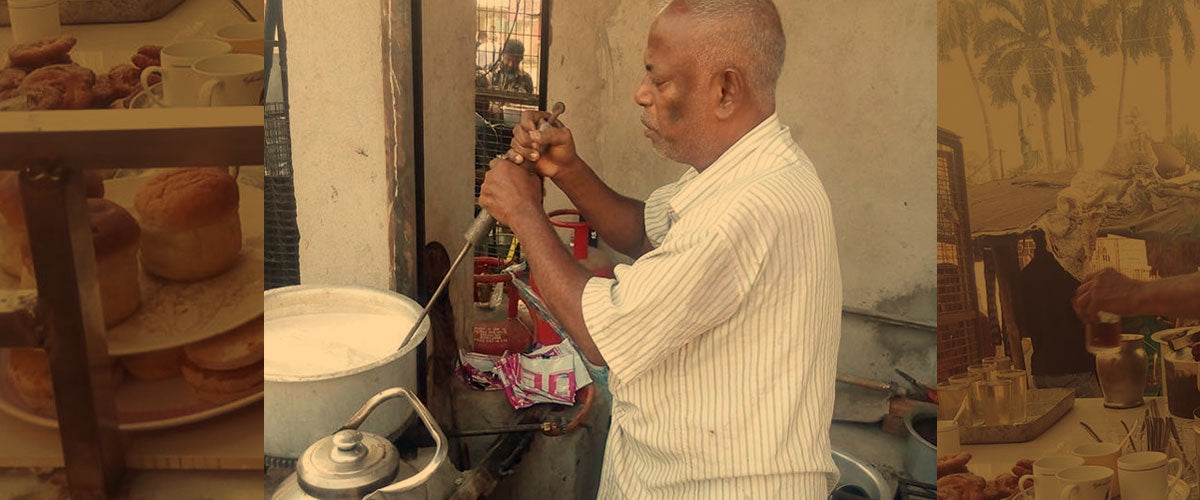
Most of India drinks its tea as chai: strong black tea, usually Assam CTC, boiled in one pan with milk and sugar, often with spices such as cardamom and ginger. That spiced version, masala chai, is what the rest of the world calls Indian spiced tea or “chai tea.” But the style changes every few hundred miles. This part of our complete guide to Indian tea tours those styles, then shows how to make chai and how to brew whole-leaf tea.
What are India’s main ways of drinking tea?
India’s main tea styles are masala, kadak, cutting and kulhad chai, Kashmir’s kahwa and noon chai, and plain whole-leaf tea, each tied to a city or region.Read more
Our own tour of the country goes like this: on a Srinagar houseboat the chaiwallah asks, “noon or kahwa?”; at a Punjab dhaba the chai is spicy; Bombay takes cutting chai breaks; Kolkata pours it into kulhad clay cups; Assam steeps its “quintessential malts”; and in Darjeeling you know you have arrived when you are “engulfed in the mist.”
| Style | Where | What it is |
|---|---|---|
| Masala chai | Across India | Chai boiled with spices: cardamom, ginger, cinnamon, clove, pepper |
| Kadak (karak) chai | Across India | Extra strong, long-boiled chai |
| Cutting chai | Mumbai | Half a glass of strong chai, for a quick break |
| Kulhad chai | Kolkata and the north | Chai served in an unglazed clay cup |
| Kahwa (kehwa, kawa) | Kashmir | Green tea with saffron, cardamom, cinnamon and almonds; no milk |
| Noon chai | Kashmir | Pink, salted milk tea |
| Lal cha | Assam | A light brew: leaf added to hot water and poured out at once, without milk |
| Plain “liquor” tea | Tea estates, connoisseurs | Whole-leaf tea steeped and drunk without milk |
Mumbai and Kashmir
In Mumbai, “just the word cutting itself means chai,” and many stalls keep the tea and the milk in separate pots so customers can order it stronger or milkier: paani kam doodh, less water and more milk, or the reverse. Kashmiri kahwa, by contrast, is made with green tea and is a celebratory drink, often served at brunch.
In the valley, kahwa is poured from the samovar into a small brass cup called a khos, and alongside it Kashmiris drink dodh and mith chai as well as the pink noon, or sheer, chai.

The northeast and the Nilgiris
In Assam, home of the strongest tea in India, many households drink it lightest. Lal cha is “a light brew where the tea leaf is added to hot water and poured out immediately without adding milk,” as Julie Kagti described it for our blog. The novelist Shona Patel, a planter’s daughter who grew up on an Assam estate, told us she drinks “several cups of ultra-strong Assam (CTC) tea” while she writes each morning. Assam even cooks the small white tea flowers, like a sabzi.
Meghalaya, which now grows fine tea of its own, has a huge tea-drinking culture, but of boiled milk tea with sugar. The writer Anjum Hasan told us Shillong was “a Brooke Bond culture,” and that her parents “only drink CTC… The idea of brewing their tea, rather than boiling it, is quite alien to them.” In the Nilgiris, Nilgiri tea comes with Coonoor’s Varkey biscuits, including the “tea Varkeys” made for dunking.
Read more in What is chai?, the regional styles in Types of chai in India, and the Kashmiri green tea in Kashmiri kahwa.
Why does India drink chai rather than its finest teas?
For generations the best Indian leaf was exported and Indians drank cheap CTC as chai; that is now slowly changing.Read more
India grows some of the world’s finest teas, but at home “what the population best enjoys is chai, a sweetened milky tea made from CTC tea.” Most of Darjeeling’s tea still goes to Europe, the United States and Japan, “leaving much of our own population in India unaware of the wide variety of teas the region has to offer,” as our own notes on single-estate tea put it.
For generations the best leaf went abroad. As Mrityunjay Jalan, then the young director of Chota Tingrai in Assam, told our blog in 2015: “Traditional tea companies have always exported the best teas and the leftovers were dumped here. It’s time to offer Indians a quality product.” Our founder put it more bluntly, quoting the writer Vir Sanghvi: “No matter how much tea it produces, India does not drink real tea itself.”
That is changing. More Indians now buy single-estate Darjeeling and whole-leaf Assam to drink plain, and good whole leaf makes better chai too. As one of our posts asked, why not celebrate the terroir of India’s tea estates the way we appreciate the terroir of wine?
How do you make Indian chai?
For Indian-style chai, boil water with strong black tea for about two minutes, add milk and sugar, and simmer until it turns a toffee brown.Read more
The two methods in this part suit different teas: CTC and strong Assams can take boiling, while delicate hill teas are spoiled by it.
This is the method our team shared with a reader who had “been searching for a good chai recipe for years.”
You will need ¾ cup (about 180 ml) water, 1 full teaspoon CTC black tea or a strong, full-bodied Assam leaf, about ½ cup (120 ml) full-cream milk, and sugar, to taste. If you like, add 2 crushed green cardamom pods, ½ teaspoon grated fresh ginger or an inch of cinnamon stick.
- Boil the tea. Bring the water to a boil with the tea, and any spices, and let it boil for a good 2 minutes, until the liquor is dark brown.
- Add milk and sugar. Pour in the milk and add sugar to taste. Adding the milk after the tea has boiled lets you control how strong or milky the chai is.
- Simmer. Let it come to a boil again, and once more after that, for about 2 minutes, until it “looks like toffee, well, almost.”
- Strain and serve. Strain into a cup and drink it hot.
For our own Kadak Chai we buy premium CTCs from Assam gardens. For the full masala version, with spice ratios, see How to make masala chai at home.
How do you brew whole-leaf Indian tea?
For a fine whole-leaf tea such as Darjeeling, steep it instead, in hot water, and drink it plain.Read more
Use about 2 to 2.5 g of leaf, roughly a heaped teaspoon, for a 250 ml (8 oz) cup, and adjust the water and time to the tea:
| Tea | Water | Steep | Milk? |
|---|---|---|---|
| Darjeeling first flush | 85–90°C (185–195°F) | 3–4 min | No |
| Darjeeling second flush | 90–95°C (195–203°F) | 3–5 min | Best plain; a splash if you like |
| Darjeeling autumn flush | 90–95°C | 4–5 min | Plain or a splash |
| Assam orthodox black | 95–100°C (203–212°F) | 4–5 min | Welcome |
| Nilgiri black and frost teas | 90–95°C | 3–4 min | Usually not |
| Green tea | 75–80°C (167–176°F) | 2–3 min | No |
| White tea | 80–85°C | 3–5 min | No |
| Oolong | 85–95°C | 3–5 min; rebrew 2 to 4 times | No |
Why 2.5 grams
The 2.5 g measure comes from the estates’ own tasting rooms. Darjeeling tasters weigh each sample against an old 25-paisa coin, which weighs exactly 2.5 g, “the exact amount of tea required for sampling and arriving at an appropriate sale price.” At Goomtee the coin dates from 1974, Namring uses a Pakistani quarter-rupee, and the habit goes back to the British managers before 1947.
Our own buyers start from the same cup. When a sample comes in, our tea buyer Ravi Kothari explained, they check “moisture of the tea sample, the percentage of flakes in tea, and the flavor profiles.” Brewing at home the same way, with the same weight of leaf each time, is the easiest way to compare two teas fairly.
When a cup goes wrong
If a tea tastes bitter, the water was too hot or it steeped too long; for more strength, add leaf rather than time. Darjeeling has its own guide: How to brew Darjeeling tea.
Keep reading
Sources
- Teabox blog (Still Steeping): Bombay’s Lifeline – Cutting Chai (2020), The Changing Face of Tea Gardens in the Nilgiris (2016), A chronicler of the Nilgiris, S. Muthiah (2017), When King Coffee Bowed Out to Tea (2016), On a food trail through the Nilgiris (2016)
- Teabox blog (Still Steeping): Meet the man who created the Darjeeling oolong (2015), Tea in Germany & its Darjeeling Connection (2016), A balancing act in the Darjeeling tea gardens (2015), The Steep Road Ahead (2020), Teatime, Talktime (feat. Anjum Hasan and Zac O’Yeah) (2017)
- Teabox blog (Still Steeping): The Teabox team in Assam (2016), Assam Diaries: The Jalans at Chota Tingrai (2016), Of tea, wildlife and stories of yore from Assam (2017), A Beginner’s Guide to Assam Teas (2017), Spinning Yarn, Weaving Tales (2017), Writing Novels, Drinking Assam Tea (2015), A bazaar in my backyard (2016)
- Teabox blog (Still Steeping): The Flavors of the Valley (2020), Meet the team: Ravi Kothari, Tea Buyer (2015), Remembering the days of manual tea auction (2016), Mountain Megabrands (2016)
- Teabox blog (Still Steeping): A breath of fresh air in India’s tea gardens, 2015; The top tea growing regions of India, 2015; All about Indian tea terroir, 2014; Chai: the way India drinks tea, 2015; Manual Tea Auction: The Last Citadel, 2016; How Teabox ensures its teas are fresh, 2015; Pairing Tea with Tech, 2015; From Coonoor to Mincing Lane: The History of the Nilgiri Tea, 2016; A tour of TANTEA estate, Nilgiris, 2016; Raising Our Cups to Maniram Dewan, 2021; The Delight of Margaret’s Hope, 2016; How much does good tea cost?, 2016
- Teabox Tea 101: An overview of the tea industry in India; Top 10 tea producing regions of the world; Geographical Indication (GI); Assam; Darjeeling; Nilgiri; Kangra; Munnar; Sikkim; Meghalaya
- Teabox Tea 101 guides: Darjeeling tea; Sikkim tea; Famous tea estates of India; Seasons of tea; What is chai?
- Teabox Drive: Teabox internal document, 2023; Teabox internal document, 2018; Teabox internal document; Teabox internal document; Teabox internal document, 2023; Teabox internal document, 2017; Teabox internal document, 2020; photos as credited
- Teabox product records: estate descriptions, invoice numbers, freshness journeys and tasting notes, 2026 season (Castleton, Temi, Namsang, Doomni, Seeyok, Badamtam, Halmari, Banaspaty, Havukal, Lakyrsiew)
- Teabox on Instagram (@teabox.tea): tea workforce, Mar 2024, 24 roles, Sep 2022, estate names, Sep 2022, the first nursery, Jan 2022, Chubwa, Sep 2018, rivers and soils, Sep 2021, first flush tasting, Mar 2023, not from the auction, Jun 2021, and the other posts linked where used
- Kausshal Dugarr on X (@Teapreneur): auction share, Oct 2021, London auctions since 1679, Oct 2021, and the other posts linked where used; Teabox on YouTube, linked where used

Leave a comment
All comments are moderated before being published.
This site is protected by hCaptcha and the hCaptcha Privacy Policy and Terms of Service apply.