


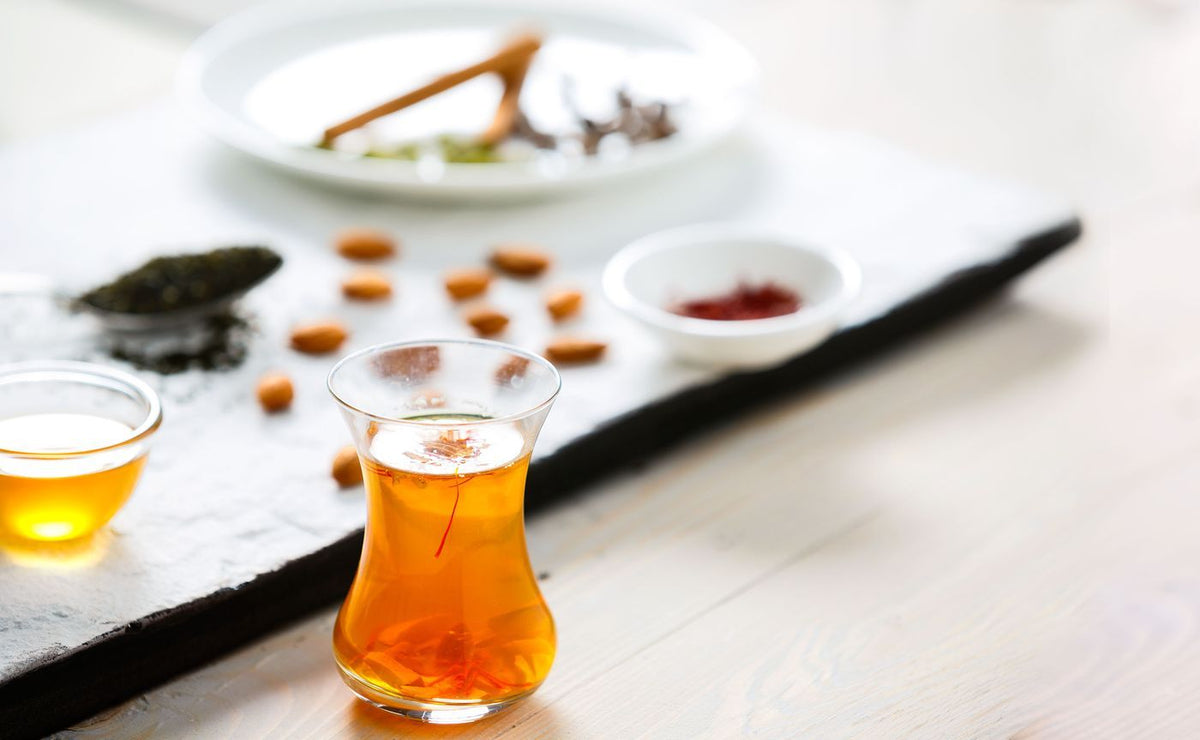
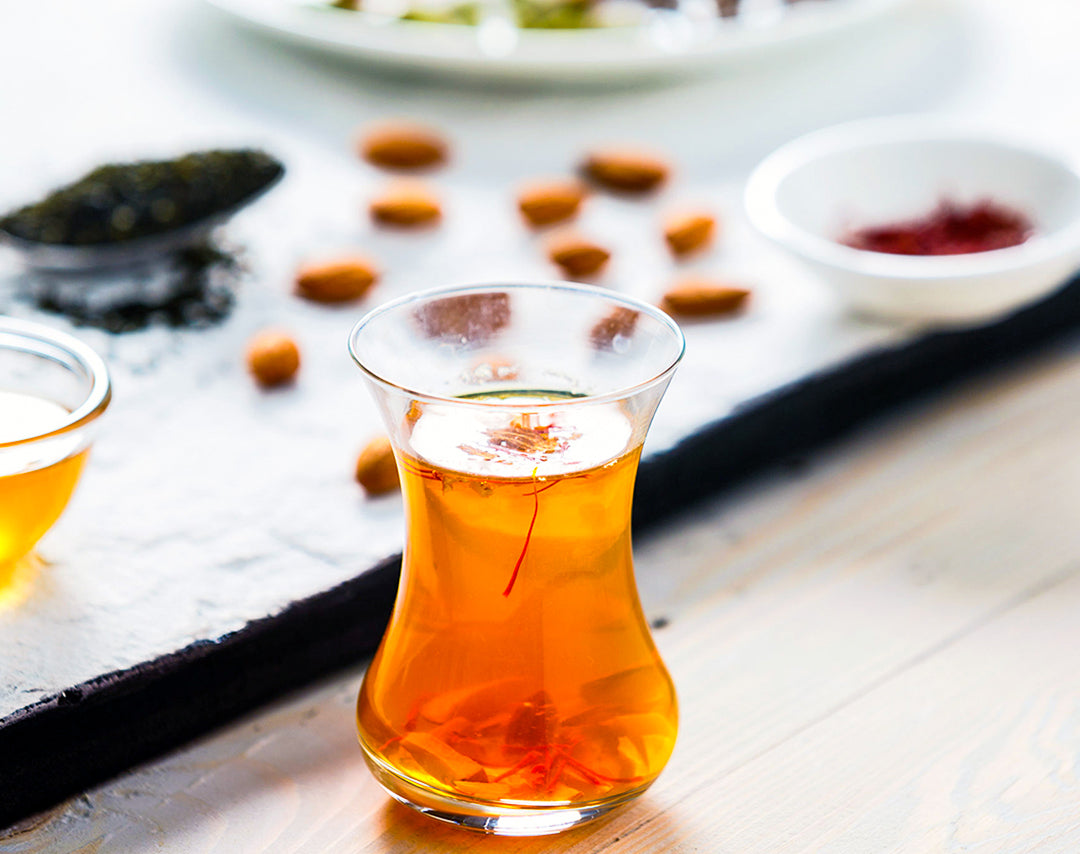
Kashmiri kahwa is a clear, golden green tea from Kashmir, brewed with saffron, green cardamom, cinnamon and cloves and served with slivered almonds, usually sweetened and never with milk. It is the tea Kashmir offers guests, pours at weddings and drinks at dawn in winter. You will also see it spelled kehwa, kawa or kahwah, and sold as Kashmiri green tea.
At a glance
- Also spelledKehwa, kawa, kahwah
- FromThe Kashmir Valley; also drunk in Afghanistan and northern Pakistan
- BaseGreen tea
- SpicesSaffron, green cardamom, cinnamon, cloves
- Finished withSlivered almonds; sugar or honey
What is kahwa?
Kahwa is a spiced green tea: green tea leaves brewed or simmered with saffron, cardamom, cinnamon and cloves, then poured over crushed or slivered almonds and sweetened to taste.Read more
The kahwa drink belongs to a small family of Kashmiri teas, and it is the one made without milk. Our 2018 staff training manual files it among our chais under the name “Classic green chai - Kashmiri Kawah.” Our Tea 101 answer to customers has always been that it is the one chai “only drunk plain as it’s made with a green tea base.”
Kahwa is drunk across Afghanistan and parts of northern Pakistan too, but it is above all a Kashmiri drink. The writer of our 2016 story On Kashmiri Roots and Teas traces it to a confluence of Buddhist, Hindu, Muslim and Sikh traditions in the valley, which forged a distinct language, culture and tea-drinking habit. A Srinagar travel consultant once described it to our blog as “a liquid identity of Kashmir.”
For Kashmiris who live elsewhere, a daily pot at home keeps a connection to a place they may not often visit. The same writer, whose mother is Kashmiri, used to drink it only on visits home; living in Mumbai, she began brewing it herself, first from dried green leaf her mother brought on visits to Mumbai and later from ready kahwa mixes sold in shops across India. Our own loose Kashmiri Kahwa has been on our store since 2014, and the tea bag version since 2016.
Unlike most of India’s chai, kahwa is made with green tea, not black tea, and it is never boiled with milk. That makes it lighter and more fragrant than a cup of masala chai, closer to a spiced green tea than to a milk tea. For the wider picture, see What is chai? and Types of chai in India.
What is in Kashmiri kahwa?
Traditional Kashmiri kahwa is made from six things: green tea, saffron, green cardamom, cinnamon, cloves and almonds, plus sugar or honey.Read more
Families vary the balance, and some ready blends add dried rose petals. Our own blend keeps to the classic six: its ingredient list reads green tea, saffron, cinnamon, cardamom, almond and clove, with no rose and no added flavoring.
| Ingredient | What it does in the cup |
|---|---|
| Green tea | The base. Gives body and a light, savory, woody tea flavor. In Kashmir it is dried green leaf, often bought loose. |
| Saffron (kesar) | The signature. Turns the cup golden yellow and gives kahwa its warm, honeyed aroma. |
| Green cardamom | Sweet, floral spice. Crushed lightly so the seeds open. |
| Cinnamon | Gentle sweetness and warmth. Whole sticks keep the cup clear. |
| Cloves | A sharp, lingering note. Our tasters find it last on the palate. |
| Almonds | Slivered or crushed into the cup. They add a soft crunch at the bottom. |
| Sugar or honey | Optional. Most households sweeten kahwa; some drink it plain. |
Saffron, the color and the scent
Saffron is what people remember. We have long put it plainly: kahwa’s “signature flavor is derived from the use of saffron strands.” We have also described our own blend as green tea “from one of the best tea gardens, top notch almonds and the finest of cinnamon, cardamom and clove,” with saffron, “the golden spice,” at its heart.
You can see what saffron does by watching the leaf. Our tasters note that the wet leaf turns a dark olive green, as any green tea would, yet the liquor comes out golden yellow, with “a lifted aroma of saffron and sweet spices.” The tea alone would give a paler, greener cup; the gold is the saffron’s.
The almonds at the bottom
Those almonds are often the best part. One reader of our 2016 story, who first tasted kehwa at a Kashmiri friend’s home, remembered “the crunch of the almonds with every other sip … and finally using a spoon to scoop up the residual almond cardamom cinnamon mix.” In another Still Steeping story, a writer sipping kahwa in New Delhi is teased by her Kashmiri friend for always wanting “more almonds than we normally put into our kahwa.”
The almonds also make kahwa different on the label. Across our whole chai and green tea range, Kashmiri Kahwa is the only blend that declares an allergen, and that allergen is almond.
Kahwa shares three of its spices with masala chai. For how cardamom, cinnamon and cloves behave on their own, see Chai spices and chai masala and Cardamom (elaichi) chai; for the base leaf, see What is green tea?
How do you make kahwa at home? (Kashmiri kahwa recipe)
Simmer cardamom, cinnamon and cloves in water for a few minutes, add green tea and saffron, let it steep for two to three minutes, then strain it over slivered almonds and sweeten to taste.Read more
This saucepan method is the everyday home version. Our blog describes the same steps: boil dried green tea leaves with a little crushed cardamom, a few cinnamon sticks and, “for some real panache,” strands of saffron, then add sugar and crushed or slivered almonds.
Ingredients
- 2 cups (about 500 ml) water
- 1 to 1½ teaspoons green tea leaves (about 2 to 3 g), or 2 teaspoons of a ready kahwa blend
- 2 green cardamom pods, lightly crushed
- 1 small cinnamon stick (about 2.5 cm, 1 inch)
- 2 cloves
- 6 to 8 saffron strands
- 6 to 8 almonds, slivered or crushed
- Sugar or honey, to taste
Method
- Wake the saffron. Soak the saffron strands in 1 tablespoon of warm water while you start the spices. This draws out the color.
- Simmer the spices. Put the water, cardamom, cinnamon and cloves in a saucepan, bring to a boil and simmer for 3 to 5 minutes.
- Add the tea. Turn the heat to its lowest, or off, and add the green tea leaves and the saffron with its water.
- Steep. Leave it for 2 to 3 minutes. Taste: it should be fragrant and golden, not bitter.
- Prepare the cups. Put a few slivered almonds in each cup, with sugar if you take it.
- Strain and serve. Strain the kahwa into the cups, stir and drink hot. If you use honey, add it once the kahwa has cooled a little.
Make it your way
Many Kashmiri homes boil the leaves along with the spices, which gives a stronger, more astringent cup; steeping off the heat gives a softer one. The difference comes from the green leaf: boiling draws out more of its bitter, drying side, while the spices stand up to the heat either way. For a plain early-morning cup, one of our writer’s uncles skips the sugar and almonds and uses just a few kahwa leaves, ground cinnamon and cardamom.
Our tasting team’s own brewing sheet sets the same limits for our blend: drink it plain or with honey or sugar, and leave out the lemon and the ice.
Do not worry if the first pot is not quite right. Kahwa takes a little practice even for keen tea makers: two American chai brewers we interviewed in 2015 tried kahwa among the recipes they brought home from India, “with varying degrees of success.” Read their story in Cross Country in Search of the Chai Wallah.
How does Kashmir drink kahwa?
Often and at set times: many Kashmiris drink kahwa several times a day, from a samovar at dawn in winter to a cup for every guest.Read more
Our two Kashmir stories, both written from inside Kashmiri families, describe the samovar of coals that keeps it boiling, the tiny metal cups too hot to hold, the 3 a.m. cup, and the big weddings where Kashmiri waiters now pour it from samovars.
Read nextKahwa in KashmirThe samovar, the khos cups, morning kahwa in the snow and the tea of guests and weddingsWhat is the difference between kahwa and noon chai?
Kahwa is a clear green tea with saffron, spices and almonds, usually sweet and never made with milk; noon chai (Kashmiri pink chai) is green tea boiled with baking soda, then made with milk and salt.Read more
Both start from green tea and both come from Kashmir, but they taste nothing alike. In Srinagar the difference matters enough to be the first question the chaiwallah asks (see Kahwa in Kashmir).
| Kashmiri kahwa | Noon chai (pink chai) | |
|---|---|---|
| Base | Green tea, brewed or simmered | Green tea, boiled hard with baking soda |
| Milk | No | Yes |
| Seasoning | Saffron, cardamom, cinnamon, cloves, almonds; often sugar | Salt; sometimes cardamom or cinnamon; nuts on top |
| Color | Clear gold | Soft rose pink |
| Taste | Fragrant, sweet, spiced | Creamy, savory, gently nutty |
| Traditional vessel | Samovar, small metal cups (khos) | A heavy pan |
| Time to make | About 15 minutes | About 45 minutes |
Kashmir’s third tea, and the newcomer
Kashmir has a third tea as well: dodh chai or mith chai, the same tea leaves boiled with milk and sugar and blended with aromatic herbs, which tradition allows to be served to revered guests with taktich, a sweet, hard bread from the Kashmiri bakery. Noon chai, also called sheer chai and “royal pink in color,” is the one drunk after a big meal of rogan josh, tabak maaz or dum aloo.
Around the 1970s black CTC tea arrived too, and at first only the well-off drank it. The writer of our 2020 story says her mother had her first sip of CTC chai on finishing college in 1981. By the end of 1985, every household in Kashmir knew it, and the shops of SR Ganj in Srinagar sold it alongside kahwa and noon chai.
Over the border the pink tea takes a slightly different form: our old Tea 101 archive notes that in Pakistan, noon chai is a bright pink flavored with pistachios and cardamom.
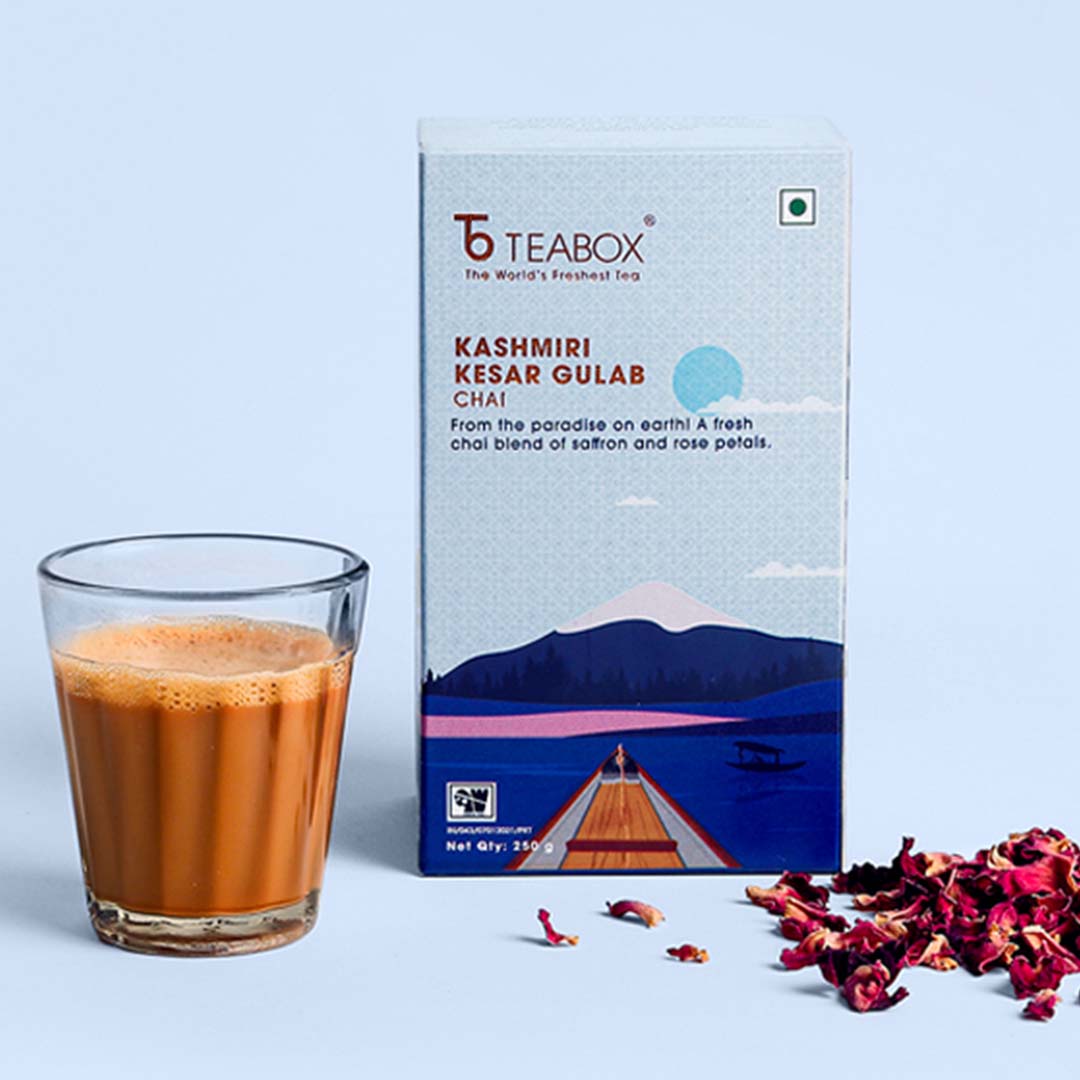
The full story of the pink one, with its recipe and why it turns pink, is in Kashmiri pink chai (noon chai). If you want saffron in a milk chai rather than a green tea, our Kashmiri Saffron Rose Chai blends chai with saffron, rose petals and green cardamom. Our tasters describe it as a bright, brisk, medium-bodied cup: saffron on top, rose in the middle and green cardamom lingering at the finish.
How to make kahwa with Teabox Kashmiri kahwa
Our Kashmiri Kahwa blend already contains the green tea, saffron, cardamom, cinnamon, cloves and almonds, so you only need hot water: about 1 teaspoon (2 to 2.3 g) per 150 ml cup, at 90–95°C, for 3 minutes.
These are the steeping instructions on the product page, and they match our tasting team’s own brewing sheet, which gives one steep only. Sweeten with sugar or honey if you like; skip the milk and lemon.
Why it is brewed hotter than other green teas
On that sheet kahwa is the only green tea brewed at 90–95°C; every other green is brewed cooler. The leaf is high-fired, and whole cardamom, clove and cinnamon need near-boiling water to give up their oils in 3 minutes. Cooler water would leave the spices faint.
What our tasters find in the cup
Our tasters describe the blend this way: the dry leaf is lightly rolled and black-green, with cardamom, clove, almond and saffron through it, and a racy fragrance of clove and cardamom. In the cup, “saffron lends itself to a scrumptious yellow liquor which is uncommon for a green tea.” The flavor starts savory and woody, typical of a high-fired green tea, before a clove note arrives and lingers. They mark it for the afternoon, served hot.

- Loose leaf. One level teaspoon per cup, brewed in a pot or an infuser. Strain into cups. A 100 g pack makes about 50 cups.
- Tea bags. One bag (2 g) per 150 ml cup, 3 minutes. Our Kashmiri Kahwa tea bags hold the same mix of green tea, saffron, spices and almonds, in boxes of 25, 50 or 100.
- For a stronger, homestyle cup. Simmer an extra cardamom pod and a piece of cinnamon in the water first, then steep the blend off the heat.
- Finish. Add a few fresh slivered almonds to each cup for the crunch, as Kashmiri homes do.
What drinkers say
It wins over people who think they don’t like green tea. One customer, “never a fan of green tea,” came around after a sister-in-law bought our Kashmiri Kahwa at a local market in Bangalore; another told our founder that with the Kashmiri Kahwa Saffron Green, “the fragrance just lifts you.”
On our store it is one of our best-reviewed teas. As of 21 October 2026, the loose blend averaged 4.9 out of 5 from 130 reviews and the tea bags 4.9 from 203; ratings change, so read these as a snapshot of that day. One reviewer summed it up as “a soft note of saffron and other ingredients with top notch quality of green tea.” It was among the best-selling blends we poured at our Bengaluru airport store in 2019.
Kashmiri kahwa FAQ
Does kahwa have caffeine?
Yes. Kahwa is made with green tea, so it contains caffeine, though usually less than black tea or coffee. Tea 101 puts a cup of green tea at about 20 to 45 mg, against about 50 mg for black tea; the spices and almonds add none. Caffeine varies with the amount of leaf, the water temperature and how long you steep. See Caffeine in tea.
Can I drink kahwa every day?
Many Kashmiris do, often several cups a day, as a daily habit rather than a special treat. Keep in mind that it contains caffeine from the green tea, that it contains almonds (so it is not for anyone with a nut allergy), and that sugar adds up if you sweeten every cup.
Is kahwa made with or without milk?
Without. Kahwa is a clear green tea with saffron, spices and almonds, and our tasting sheet marks our blend for drinking plain. Kashmir’s milk teas are noon chai (salted and pink) and dodh chai (sweet); see Kashmiri pink chai.
Is kahwa the same as kehwa or kawa?
Yes. Kahwa, kehwa, kawa and kahwah are different spellings of the same Kashmiri spiced green tea. It is also sold as Kashmiri green tea or kahwa tea.
Is kahwa a green tea or an herbal tea?
It is a green tea with spices, not an herbal tisane, because it is made with leaves of the tea plant. Ready blends that leave out the tea leaves are herbal drinks and have no caffeine; check the ingredients.
Can I drink kahwa iced?
We do not suggest it. Our tasting team marks Kashmiri Kahwa as a tea to drink hot, without ice or lemon: the saffron and spices are at their most fragrant in a hot cup.
How many cups does a pack of kahwa make?
About 50 cups from 100 g of our loose blend, at one level teaspoon per 150 ml cup. Each tea bag makes one cup.
What do you eat with kahwa?
Our product notes suggest spicy Middle Eastern food, or kahwa in place of mimosas at a Sunday brunch. Our blenders’ pairing sheet puts it with cheese croissants, jalapeño toast, lemon loaf cake or a Greek salad, and names Gouda as its cheese. In Kashmir, morning kahwa comes with tomul chott, the rice-flour bread.
How long does a kahwa blend stay fresh?
Store it airtight, away from light, heat and strong smells, and use it within a few months of opening, while the saffron and cardamom are still fragrant. See How to store tea.
Keep reading
Sources
- Teabox blog: On Kashmiri Roots and Teas, 2016, including reader comments
- Teabox blog: The Flavors of the Valley, Samvit Kher, 2020
- Teabox blog: Tea Loaf Capers (Recipe Included), Aditi De, 2016
- Teabox blog: Cross Country in Search of the Chai Wallah, Aravinda Anantharaman, 2015
- Teabox blog: The Samovar: Kettle, Stove, Teapot and History, Peter G. W. Keen, 2016
- Teabox Tea 101: FAQs; Tea producing regions; caffeine figures (house set)
- Teabox product pages, tasting notes and product data (ingredients, infusion and liquor notes, best time, cups per pack, launch dates, reviews as of 21 October 2026): Kashmiri Kahwa Saffron (Kesar) Green, Green Tea Kashmiri Kahwa (Teabags), Kashmiri Saffron Rose Chai, Vivant, October 2026
- Teabox Drive: Teabox internal document, 2022; Teabox internal document, 2018; Teabox internal document, 2026; Teabox internal document; Teabox internal document, 2022; photos as credited
- Teabox on Instagram (@teabox.tea): saffron signature, Nov 2017, customer repost, Dec 2017, Bengaluru airport store, Jul 2019, blend ingredients, Nov 2020, “noon or kahwa?”, Aug 2021, Vivant, Sep 2021, Vivant, Mar 2022
- A customer reply on X: Oct 2022

Leave a comment
All comments are moderated before being published.
This site is protected by hCaptcha and the hCaptcha Privacy Policy and Terms of Service apply.