


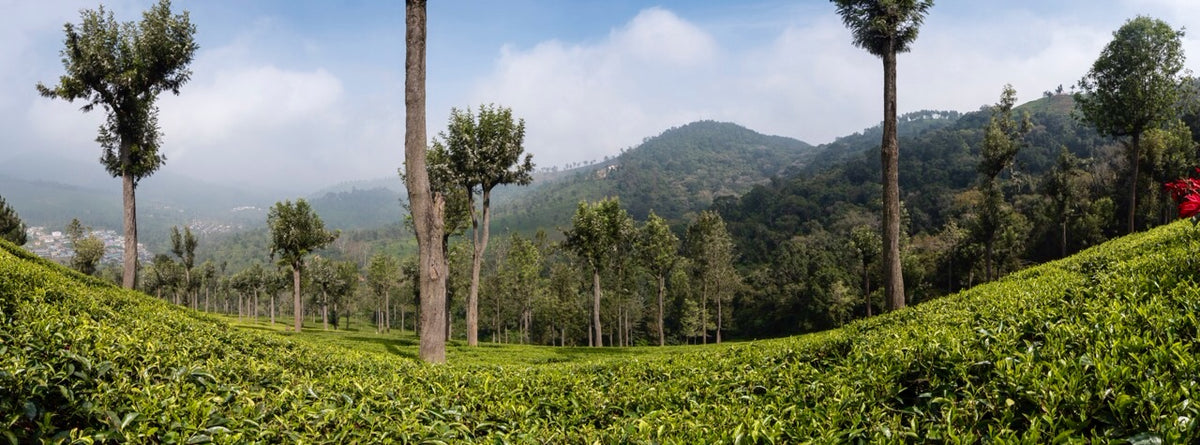
Teabox currently buys from Glendale, Havukal, Korakundah and Billimalai. This page follows those four and the other gardens our buyers know well, from Craigmore’s protected forest to the government-run TANTEA estates, with their histories, their people and what goes into their tea. For the region and how its teas taste, start with Nilgiri tea; for this season’s frost lots and their picking dates, see The Nilgiri frost tea estates.
Which are the best Nilgiri tea estates?
Among the Nilgiris’ best-known gardens are Glendale, near Coonoor, known for its twirled teas and frost teas; Havukal, a family-run estate famous for winter frost black tea; and Craigmore, one of the oldest gardens, which guards a virgin shola forest.Read more
The Nilgiris make a great deal of tea, and not all of it is fine. Peter Keen, writing for us in 2016, named Craigmore, Havukal and Glendale among the estates making “some really top-rate teas,” while much of the region’s output goes into low-price tea bags.
Our own 2018 training deck lists the best Nilgiri gardens as Glendale, Chamraj, Havukal and Craigmore, and counts 21 Nilgiri plantations among the gardens we buy from, against 29 in Darjeeling and 35 in Assam. Our buyer’s approach is the same in every hill: “Although I travel to buy teas, a big part of my job is to actually get to know the place, the people and, through them, their teas.”
Glendale
Glendale is a high estate near Coonoor, with a history going back to 1835, best known for its twirled black and green teas and its winter frost Twirl.Read more
Glendale is “a valley within a valley” near Coonoor, at 5,000 to 6,500 feet, and its history goes back to 1835. The Nilgiri toy train runs right through the estate. The estate has long been known for its green teas.
The Glendale Twirl
Its best-known tea, the Glendale Twirl, was created by Swaminathan, the estate’s longest-serving factory manager, who chose a clone to capture “the high-grown floral character that defines a good Nilgiri tea.” It was launched in 2005 after two years of research. When our buyer met him in 2016, Swaminathan had worked at Glendale for over 40 years and was “an authority on Nilgiri teas.”
Our notes describe the frost Twirl as made “in the famed twirl-style that all good Nilgiri teas have come to be associated with.” After the first wither, the leaf is carefully rolled or twisted into its curled shape. Glendale is also one of the gardens leading the move to clonal bushes: Peter Keen counted it among “the world leaders in making the transition to most of its teas being clonals.”
Autumn greens and a living estate
Glendale makes our Nilgiri autumn green as well. The autumn flush here “typically occurs from late October through early December,” and our 2023 lot was picked on 25 and 26 October, the earliest of all our autumn teas that year. Between the tea, the estate grows flowers such as geranium for its blends. The estate shares its land with Malabar giant squirrels, bison and hornbills, and has made a corridor so elephants can pass through the tea.

On the same visit our buyer met Naresh, who had just opened a miniature tea factory where tourists can learn how tea is made and taste it.
Havukal
Havukal is a family-run estate on the eastern slopes of the Nilgiris, planted in 1910, and the garden most closely tied to winter frost black tea at Teabox.Read more
Havukal lies on the eastern slopes of the Nilgiris at 5,500 to 6,000 feet, and is the estate most closely tied to winter frost black tea at Teabox. Tea was first planted here in 1910, and the estate now grows quality clones such as CR 6017 and TRF 4 alongside its original plantings. Our product page puts it simply: “With the Havukal teas, there are no surprises. It’s always the most flavorful pick of the season.”
One family since 1957
The first planter, Hugh Graham Fennell, sold the garden in 1957 to Mr. Thangavelu, and his family has run it ever since. Its fields grow around natural boulders, edged with vetiver, a native grass. Today the owner and managing director is Mr. Jayaraman Thangavelu, who also runs the Warwick estate, and his son Karthik Jayaram works with him; in 2022 Mr. Thangavelu spoke to our Meet the Growers series about crafting “one of the best winter harvests in India.”
A modern factory
The family took over at a time when it was hard to raise the garden’s output, and Havukal now runs one of the most modern factories in the industry; according to the estate, its average yield has exceeded 4,000 kg of finished tea per hectare since 2009. The grower films below are a good way to meet the estate.


Craigmore
Craigmore is one of the oldest gardens in the hills, opened in 1884, and since then it has kept a stretch of virgin shola forest untouched among its tea.Read more
Craigmore dates back to 1884 and is among the oldest gardens in the hills. It spreads over 1,200 hectares, with views of the Blue Mountains and a waterfall nearby. Since it opened, the estate has kept between 100 and 200 acres of virgin shola forest untouched, guarded around the clock. Its gardens run from a little over 1,200 meters to about 1,800 meters, in the rain shadow of the hills, and rather than irrigate, the estate harvests rainwater and digs contour trenches to hold water in the soil.
A protected shola forest
Shola forest grows in three layers, small trees, dense shrub and a thick carpet of moss, and the Nilgiris have more than 25 kinds of native trees. Sholas hold the monsoon rain and release it slowly through the year, keeping the water table charged, yet many of them were cleared for cinchona, eucalyptus, wattle and tea. In 2010 the estate’s owners paid for a 14-month biodiversity survey by the Wildlife Trust of India across all their estates.
Every drop of rain
Mr. M.N. Bopanna, managing director of Craigmore Plantations in 2016, told us how the estate works with so little rain.
- Trenches: When a field is pruned, 800 trenches per hectare, about two feet deep, are cut along the contour so rainwater soaks in instead of running off; on steep sections they go three to four feet.
- Prunings: The bushes are pruned once in three and a half years, and the cut leaves and branches are buried in the trenches to rot down and help the soil hold water.
- Roofs: Rain from the roofs of bungalows, offices, factories and hospitals runs to filtration pits and then to a water body that supplies the 5,000 people who live on Craigmore.
- Road edges: Every road edge is planted with vetiver, or khus, to stop soil erosion.
Craigmore in the cup
Craigmore belongs to a group of five estates with Glencairnie, Pascoes Woodlands, Manar and Palmyrah. Pascoes Woodlands, one of Craigmore’s two factories, makes high-grown pan-fired greens, close to 0.7 million kg a year. Our procurement team’s 2017 note on a Craigmore winter black reads: “brisk & lively with hints of spices. Robust & full bodied tea with high grown characters of the Blue Mountains.”
Korakundah, Billimalai and TANTEA
Korakundah is one of the highest tea gardens in the world, Billimalai is a century-old garden on “Goat Mountain,” and TANTEA is the Tamil Nadu government’s own tea corporation.Read more
Korakundah
Korakundah grows tea at about 8,000 feet, among the highest gardens in the world, and its product page lists organic, Fair Trade and Rainforest Alliance certifications for the estate. Our 2018 training deck records it in the Limca Book of Records, at 8,060 feet, as the highest tea garden in the country. The estate lies inside the Nilgiris Biosphere Reserve, where elephants, Nilgiri tahr, barking deer and wild boar share the hills with the tea. Our tasters found its 2024 frost lot medium-bodied, with snowdrop, muskmelon and a sweet lingering finish.
Billimalai
Billimalai, “Goat Mountain,” sits at 2,000 meters and has made tea for over a century. Its leaf is plucked by hand at dawn, then gently withered, carefully rolled and slowly oxidized, and the estate credits the high altitude and cool winter air with “concentrating their flavors and aromas.” Our team visited the estate in January 2019 and came back sipping its Special Winter Frost White.
TANTEA
TANTEA, the Tamil Nadu government’s tea corporation, runs estates around Coonoor and Gudalur, including Naduvattam, where the old jail built for convict labor is now a museum. Because its gardens were built long after the British, there are no colonial bungalows or factories; at Gudalur, 1,000 meters up, our buyer stayed in a wooden government guesthouse. Most of the tea is CTC, harvested with shears, while the specialty silver needle is plucked by hand and left to dry in the sun rather than in a machine, even though that takes longer.
Our buyer went expecting a government estate to be run indifferently and came away corrected: TANTEA was “run as well as any of the private estates,” and its long-serving staff spoke of their teas “like a parent showing off a newborn child.”
Which other Nilgiri gardens should you know?
Beyond the big names, a handful of gardens turn up again and again in our records: the old estates of Dunsandle and Thiashola, and Devashola, Kodanad, Burnside, Adderley and Chamraj.Read more
- Dunsandle and Thiashola: Two of the earliest estates. Dunsandle, near Sholur, is now owned by the Bombay Burmah Trading Company, and Thiashola still has its Jail Thottam; their story is in The history of Nilgiri tea.
- Devashola: The estate run by Balaji Rao, where many of the workers come from the area bordering West Bengal and Nepal; it provides free housing and health care.
- Kodanad: Our 2017 tasting sheets found its black tea’s infusion full of “menthol, camphor,” “reminiscent of a prominent frosty tea character,” and a Kodanad clonal winter black went into our 2019 Blue Hills Box.
- Burnside: Rolls its green tea into semi-balls, and our notes credit its high-fired flavor to heavy roasting and pan firing; a Burnside spring green was also in the Blue Hills Box.
- Adderley: One of the few Nilgiri gardens our notes record as making orthodox hand-rolled tea.
- Chamraj: Named among the best Nilgiri gardens in our 2018 training deck, beside Glendale, Havukal and Craigmore.
For more great gardens across the country, see Famous tea estates of India, and for life in the hills beyond the tea, That Nilgiris Bubble.
Keep reading
Sources
- Teabox Tea 101: The Nilgiris: blue mountains, shola forests, and aromatic tea; What are winter flush teas?
- Teabox blog (Still Steeping): When King Coffee Bowed Out to Tea (2016); The Changing Face of Tea Gardens in the Nilgiris (2016); Prisoners’ tales from the Nilgiris (2016); That Nilgiris Bubble (2016); Mountain Megabrands (2016); A chronicler of the Nilgiris, S. Muthiah (2017); A House for Chinna Dorai – Estate Bungalows in the Nilgiris (2017)
- Teabox blog (Still Steeping): The Beginner’s Guide to Winter Flush Teas from the Nilgiris (2017); The Winter of Our Teas (2015); An Interlude Called Autumn (2015); A Nilgiri girl in Darjeeling (2017)
- Teabox blog (Still Steeping): From Coonoor to Mincing Lane: The History of the Nilgiri Tea (Nina Varghese, 2016); A Hundred Acre Forest in the Nilgiris (2016); A tour of TANTEA estate, Nilgiris (2016); It’s time for tea from the Nilgiris (2016); The Badagas of Nilgiris (2016); Clonals: the tea of the future (Peter GW Keen, 2016)
- Teabox product tasting notes, picking dates, grades, altitudes, FAQs and estate descriptions for Havukal, Glendale, Korakundah and Billimalai Winter Frost Black and Glendale Autumn Twirl Green, 2022 to 2026 lots
- Teabox Drive: Teabox internal document, 2018; Teabox internal document, 2023; Teabox internal document; Teabox internal document, 2017; Teabox internal document, 2019; Teabox internal document, 2025; Teabox internal document, 2025; photos as credited
- Teabox licence records: Tea Board certification trade mark licence for Nilgiri Orthodox, 2015 to 2026 (internal file, not linked)
- Teabox on Instagram (@teabox.tea): toy train at Glendale, Jan 2016, Adderley post office, Feb 2016, Glendale Twirl, Apr 2016, Mint Cooler, Apr 2016, Craigmore, May 2016, Nilgiri White, Nov 2016, Orange Sorbet, May 2017, January trip south, Jan 2019, Havukal fields, Jan 2019, Havukal factory and yield, Jan 2019, Havukal history, Jul 2020, Glendale, Aug 2020, tea gardens and wildlife, Sep 2021, mountain railways, Jan 2022, the Blue Mountains, Feb 2022, Meet the Growers, Sep 2022, waiting for the winter flush, Dec 2022, the Blue Mountains in winter, Jan 2023, Glendale tasting, Feb 2023, Korakundah 2024, Glendale 2024
- Kausshal Dugarr on X (@Teapreneur): Nilgiri teas, Dec 2016, how tea came to the Blue Mountains, Oct 2021, INDCO procurement rates, Oct 2021, INDCO and small growers, Oct 2021, Meet the Growers season 2, Jul 2020. Teabox on YouTube: Karthik Jayaram, Havukal Tea, Nilgiris

Leave a comment
All comments are moderated before being published.
This site is protected by hCaptcha and the hCaptcha Privacy Policy and Terms of Service apply.