


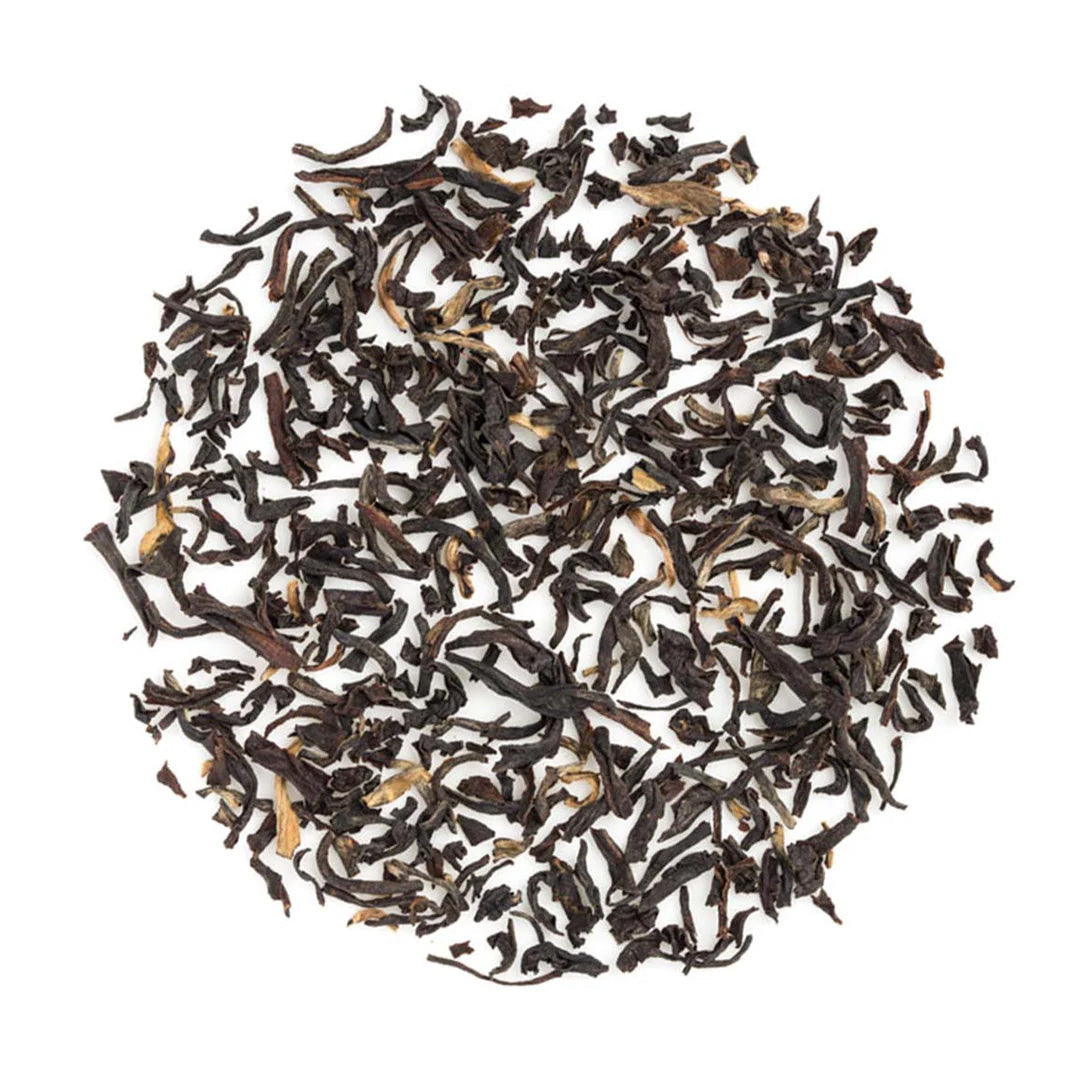
Tea’s polyphenols come in two families: the catechins of the fresh leaf, led by EGCG, and the theaflavins and thearubigins that form from them when the leaf is oxidized. Oxidation decides the balance: the less a leaf is oxidized, the more of its original catechins it keeps; the more it is oxidized, the more of them become theaflavins and thearubigins. The tea maker controls this, step by step, and storage keeps changing it after the tea leaves the factory.
What are catechins and EGCG?
Catechins are the main polyphenols in the fresh tea leaf, and EGCG (epigallocatechin gallate) is the most abundant of them.Read more
Catechins are flavan-3-ols, a branch of the flavonoid family. Tea 101 lists six main ones: catechin, gallocatechin, epicatechin, epigallocatechin, epicatechin gallate and epigallocatechin gallate, better known as EGCG. EGCG is the most abundant catechin in tea and the one most often named on green tea labels.
Why “gallate” matters to taste
The “gallate” in a name means the molecule carries an extra galloyl group, a ring with three more OH groups. Gallated catechins such as EGCG and ECG are the most astringent and bitter of the set, which is one reason a strong green tea can bite.
What changes the amount
Writing on our blog in 2016, Peter G. W. Keen put catechins at about 25% of the weight of the dry leaf, and noted that seedlings, clonal varieties, elevation and season all greatly affect them.
The pluck matters as much as the bush. Tender young shoots, the “two leaves and a bud” our tasters ask for, contain more polyphenols than the lower leaves, which is one reason they make finer tea than mature leaf.
India also sets a floor for green tea. The Indian Standard for green tea, IS 15344, requires total catechins of at least 9.0% of the dry matter, measured by HPLC, a lab method that separates and weighs each compound.
What are theaflavins and thearubigins?
Theaflavins and thearubigins are the larger polyphenols that form when catechins react with air during oxidation; they give black tea its color, briskness and body.Read more
When leaf is oxidized to make black or oolong tea, catechins join together into larger molecules. Pairs of catechins form theaflavins; Tea 101 names the four main ones as theaflavin (TF1), theaflavin-3-gallate (TF2A), theaflavin-3′-gallate (TF2B) and theaflavin-3,3′-digallate (TF3). Larger, more varied chains form thearubigins, which make up most of the polyphenol in a cup of black tea. Both still behave as antioxidants in the lab.
Our 2016 history of rolling machines put the sequence in one line: the polyphenol oxidase enzyme “starts the oxidation of green catechins that form orange theaflavins. These then polymerize into brown thearubigins.”
What they do in the cup
Tasters know them by what they do: golden-orange theaflavins bring brightness and briskness; reddish-brown thearubigins bring depth of color and body. Our training deck says the same: theaflavins give tea “its briskness and bright taste as well as its yellow color,” and thearubigins “depth, body and its reddish color.”
Keen summed it up: very roughly, catechins contribute lightness and sweetness, and the others fullness and boldness. He repeated it in his piece on water for tea, which is still on our blog.
How much is in a tea bag
Published research shows how far the balance tips in everyday black tea. In a study of commercial tea bags, thearubigins were the most abundant flavonoids, at 9.5 to 12.2% of the leaf by weight and 58 to 75% of its phenolics.
How does processing change tea’s polyphenols?
Oxidation decides it: the less a leaf is oxidized, the more of its original catechins it keeps; the more it is oxidized, the more of them become theaflavins and thearubigins.Read more
What happens inside the leaf
In the living leaf, catechins and an enzyme called polyphenol oxidase are kept apart in the cell. Rolling breaks the cells, the two meet with oxygen, and the leaf browns, “similar to the browning of bananas, apples and other foods,” as our blog puts it. The tea maker stops it when the tea calls for it.
Our training deck names two enzymes, polyphenol oxidase and peroxidase, as the most important in the leaf: they cause the browning that begins once the cell walls are broken. As the catechins become theaflavins and thearubigins, the leaf’s chlorophyll turns into darker pigments called pheophytins and pheophorbides, which give dry black tea its black-brown color.
Rolling “extracts polyphenols and enzymes from leaf cells, and this sap oxidizes,” wrote a tea buyer for our blog; those oxidized polyphenols create the color, clarity, briskness, taste and aroma of the brewed tea.
The clock starts at plucking
The chemistry starts before the factory: the leaf’s compounds begin reacting within an hour or less of plucking, which is why fresh leaf has to be processed quickly. During withering, the first step, our training deck notes that moisture falls by about one-third to one-half, chlorophyll begins to break down and grassy aromas fade.
Type by type
- Green tea is heated soon after plucking, by steaming or pan-firing. Heat switches the enzyme off, so the catechins stay. The Indian Standard defines green tea by exactly these steps: enzyme inactivation, rolling or cutting, and drying.
- White tea is simply withered and dried, so it also keeps most of its catechins. Our training deck notes that almost all white teas are withered until they are dry, which wears out the enzyme activity responsible for oxidation.
- Oolong is oxidized part of the way, then heated, so it holds a mix of catechins and theaflavins.
- Black tea is oxidized fully. Cut into small granules, CTC tea oxidizes fast and gives a dark, strong cup. See Orthodox vs CTC tea.
As Tea 101 puts it, black tea’s total antioxidant content after oxidation is similar to what it was before: the compounds change form rather than disappear. Lab assays are less tidy; a review in our research library found antioxidant capacity falls the more a tea is processed. The full journey from plucking to packing is in How tea is made.
Orthodox, CTC, season and garden
The way black tea is made shows up in the numbers. In the tea bag study above, CTC-heavy blends kept only 4 to 8% of their phenolics as catechins, against 22% in the blend rich in orthodox teas.
Season and garden matter too. A Darjeeling first flush is lightly oxidized for a black tea, so its cup is pale, green-tinged and brisk. Keen described Darjeeling’s first and second flush, picked from the very same bushes a few months apart, as “same lab, different chemistry.”
What happens to tea’s polyphenols in storage?
They keep changing: oxygen, heat and moisture slowly break down catechins and theaflavins after the tea is made, and the cup turns flat.Read more
What the research measured
A review in our research library reports that when green tea bags were stored for 6 months in their original boxes at room temperature, in the dark, their EGCG fell by about one-third and their ECG by about half. Over storage of up to 12 months, black tea lost more theaflavins when it was orthodox (around 37%) than when it was CTC (22%), while for thearubigins the pattern was the opposite.
What stale tea tastes like
Oxygen keeps working on finished tea too: “oxidized tea leaves will make flat tea with no flavor or briskness or astringency,” our team wrote, which is why we vacuum pack our teas.
After packing, our teas are kept at -5°C until they ship. We also buy against a moisture limit: our training deck sets a procurement threshold of 4% moisture.
At home, see How to store tea.
Keep reading
Sources
- Teabox Tea 101: What are antioxidants in tea
- Teabox blog (Still Steeping), not republished: The chemistry of tea: a lab, not a leaf (Peter G. W. Keen, 2016), with its infographic The composition of the tea leaf; How to judge the quality of tea (Frank Miller, 2015); Roll Britannia: the early history of machinery in tea making (2016; draft in Drive: Teabox internal document)
- Teabox blog: How is tea made? (2015), Microwaved, tepid, rolling boiling? Water for tea! (Keen, 2016)
- Teabox internal documents (Google Drive): Teabox internal document; Oxidation.jpg
- Published research and standards held in the Teabox research library: Lakenbrink, Engelhardt et al., Teabox internal document, J. Agric. Food Chem. 48 (2000); Kosińska and Andlauer, Teabox internal document (book chapter); Bureau of Indian Standards, Teabox internal document, 2003
- Teabox on Instagram (@teabox.tea): Stale tea and vacuum packing, May 2020, Storage at -5°C, May 2020

Leave a comment
All comments are moderated before being published.
This site is protected by hCaptcha and the hCaptcha Privacy Policy and Terms of Service apply.