


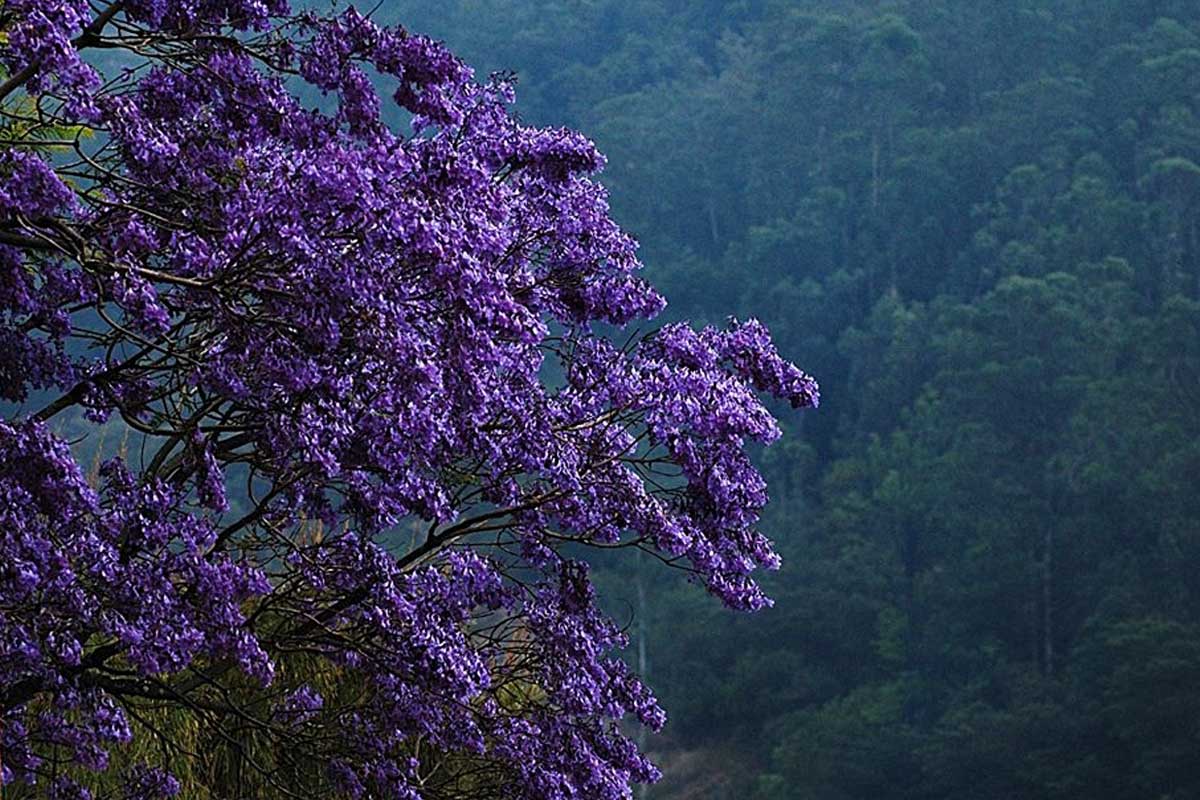
Darjeeling is not the only place with an autumn flush. Assam, Sikkim and Meghalaya make autumn teas before their own winter rest, and the Nilgiris, which pluck all year, make fresh, aromatic autumn teas just as their best season begins. This page goes region by region, with the autumn teas we have tasted and sold from each. For the season itself, start with Autumn flush tea.
Is there an Assam autumn flush?
Yes: Assam makes autumn teas, lighter and less strong than its summer teas, though we do not sell one at present.Read more
In Assam, the Dooars and the other plains regions known for orthodox and CTC tea, autumn teas are less strong and lighter in body than the summer second flush. The liquor is still bright and brisk, though less brisk than in summer. Tea 101 ranks them second in quality, after the summer flush.
Assam’s prized season comes earlier. Its second flush runs from late May into July and gives the golden-tipped, maltiest teas. By autumn the plains bushes, like Darjeeling’s, are slowing toward their winter rest, which goes some way to explaining why the cup is lighter. For the whole Assam year, see Assam tea.
What is Sikkim autumn tea like?
Sikkim makes autumn teas in the Darjeeling style, smooth and well rounded, and the Bermiok garden has given us autumn teas since 2017.Read more
Just north of Darjeeling, Sikkim makes autumn teas in the same style. In 2017 we launched Bermiok Classic Autumn Black, the first tea we offered from this Sikkim garden: “immensely smooth, brisk and exceptionally well rounded,” with intense floral notes and a pronounced fruity sweetness.
We have gone back for more. In November 2021, when our founder, chief procurement officers and master tasters traveled across Darjeeling and Sikkim to sample fresh autumn cups, Bermiok was one of the gardens on the route. Our film crew was there in autumn too: the Bermiok clips in our archive were shot on 5 November 2017.


What makes Meghalaya’s autumn tea special?
Meghalaya’s best-known autumn tea comes from Lakyrsiew, a small garden by Umiam Lake whose autumn black runs from peach to caramel and nuts.Read more
In Meghalaya, Lakyrsiew, a boutique garden on the southern bank of Umiam Lake, is known for its autumn teas. Its Autumn Clonal Black, picked from a dedicated section at about 4,000 ft, opens with peach and moves into woody, caramelized notes and a nutty finish in a bright orange cup.
Lakyrsiew picks late. Our 2022 lot was picked on 9 and 10 December 2022, nearly three weeks after our Jungpana autumnal that year (21 and 22 November), and the garden is 514.3 km from our facility in Siliguri. Our product record suggests it as an evening tea.

How are Nilgiri autumn teas different?
In the Nilgiris autumn is not an ending, because the gardens pluck all year: the season brings fresh, aromatic teas just as the hills’ best months begin.Read more
In the south, the Nilgiris make tea all year round, so autumn here is not an ending. Late autumn brings fine selections from the Nilgiris, “where the season’s only beginning to peak,” with “heady mountain flavors and spicy accents.” The Nilgiris’ most prized teas come a little later, in winter (see Winter and frost teas from the Nilgiris).
Our notes place the Nilgiri autumnal from “late October through early December,” with “cooler temperatures and clear post-monsoon skies.” It is also the earliest autumn tea we buy each year: our Nilgiri lots were picked on 25 and 26 October 2023, 12 and 13 November 2024 and 10 and 11 November 2025, before any Darjeeling autumnal.
Glendale Autumn Twirl Green
Our Nilgiri autumn tea this year is a green: Glendale Autumn Twirl Green, from a garden established in 1835 and grown at 5,000 to 6,500 ft. Picked on 10 and 11 November 2025 from clonal bushes, it brews a spring-green, light-bodied cup that opens with a sweetness like steamed corn, then soft florals and fresh greens, and ends on a trace of jasmine.
Our tasters’ card for the 2023 lot reads much the same: “AROMA: Cooked corn, Earthy and Floral. PALATE: Sweet-floral, Brisk, Hint of greens.” The bushes are the clonal cultivar CR 6017. Our product data rates its caffeine as low. Brew it at 75–80°C (167–176°F) for 2 to 3 minutes.
Does Nepal have an autumn flush?
Yes: just across the border from Darjeeling, Nepal’s high gardens follow the same calendar, with spring, summer and autumn harvests.Read more
Peter Keen, writing for us in 2016, noted that “as with Darjeelings, there are the first flush, second flush and autumnal harvests.” His full report is in Nepal: Innovation in the high Himalayas.
Our 2023 training deck lists the autumn flush for Darjeeling, Nepal and the Nilgiris, from mid-October to the end of November, with “Mellow, Fruity-woody notes.” It leaves Kangra, in the western Himalayas, out of the autumn row.
Kangra has made autumn tea, though. In 2012 our predecessor, DarjeelingTeaXpress, listed a Special Kangra Dharamshala Autumn Flush Handrolled Oolong with big, twisted, dark leaf and floral, sweet scents of almond, fruit and vanilla.
Keep reading
Sources
- Teabox blog: An Interlude Called Autumn (2015), The beginner’s guide to choosing a Darjeeling (2017), Teabox: 100 countries and counting (2017), 8 tips for creating your own tea blends (2015), The secrets of tea-tasting (2017), From Europe and food to Asia and tea (2015), Teatime, Talktime (feat. Anjum Hasan and Zac O’Yeah) (2017), Nepal: innovation in the high Himalayas (2016)
- Teabox blog: Tea flushes: your guide to tea harvest (2014); The delight of Margaret’s Hope (2016)
- Teabox Tea 101: Your essential guide to autumn teas or fall teas; Seasons of tea
- Teabox product tasting notes, FAQs, pairings, picking dates (freshness journeys) and steeping instructions: autumn lots 2021 to 2025, including Okayti, Giddapahar and Jungpana Autumn Chinary, Glendale Autumn Twirl Green, Lakyrsiew Autumn Clonal Black and Assam Masala Chai, and the draft Seeyok, Selimbong, Singell, Singbulli, Goomtee and Okayti Clonal autumn records
- Teabox Drive: Teabox internal document, 2024; Teabox internal document, 2016; Teabox internal document, 2012; Teabox internal document, 2017; Teabox internal document, 2023; Teabox internal document; Teabox internal document, 2017; Teabox internal document, 2015; Teabox internal document, 2016; Teabox internal document, 2015; Teabox internal document, 2023; Teabox internal document, 2012; Teabox internal document, 2017; photos as credited
- Teabox on Instagram (@teabox.tea): Thurbo autumn oolong, Feb 2017, Bermiok Classic Autumn, Oct 2017, fall blends, Oct 2018, autumn descriptors, Nov 2019, autumn sampling trip, Nov 2021, 60 samples a day, Nov 2021, tasting turnout card, Nov 2021, cup count, Oct 2022, autumn profile, Nov 2022, tasting room set-up, Nov 2022, 4 am plucking, Dec 2023, end of picking, Dec 2023, Giddapahar autumn, Nov 2024, Jungpana autumn, Nov 2024
- Kausshal Dugarr on X (@Teapreneur): autumn tasting, Nov 2021, a short season, Nov 2021
- Teabox on YouTube: Different Indian tea flushes, Bermiok Tea Estate, Lakyrsiew Tea Estate

Leave a comment
All comments are moderated before being published.
This site is protected by hCaptcha and the hCaptcha Privacy Policy and Terms of Service apply.