


A blend mixes teas from different gardens or regions, sometimes with flowers, fruit oils or spices, so that the cup tastes the same every time you buy it. These famous tea blends are the ones almost every tea lover has met: English and Irish Breakfast, Earl Grey, Russian Caravan, masala chai, and the scented green teas of China and North Africa, jasmine tea and Moroccan mint. The last section shows how our own blends are made in Siliguri.


What is English Breakfast tea?
English Breakfast is the classic morning cup: a strong, coppery blend of black teas that stands up to milk.Read more
Malty Assam gives it body, and Ceylon and Kenyan teas round it out; some blends add teas from Malawi or Indonesia. Peter Keen, writing for us in 2016, listed what each part adds in a typical blend:
- Assam: fullness and maltiness, the backbone of the cup.
- Ceylon: “a brisk and bold flavor” on top of the malt.
- Kenya: an “inexpensive heavy base” for color and weight.
- China Keemun: “a lighter, smoky overtone,” and in his words, “Keemun signals a superior tea.”
Darjeeling, he added, “isn’t a standard ingredient since it gets overwhelmed by the stronger main ones.” Our own English Breakfast Black goes further toward Assam: its product record names a second flush Assamica tea of grade FTGFOP1, with tightly rolled, long black leaves and a deep red cup.
Where the name comes from
Despite the name, it was probably not invented in England: the two leading stories place it in New York in the 1840s or with a tea merchant in Edinburgh. What is clear is that strong black breakfast blends took over from Chinese teas in Britain during the 1800s, as tea from India and Ceylon arrived.
The name is misleading: the famous blend may have had nothing to do with England at all. The New York story goes back to 1843 and an immigrant apothecary named Richard Davies.
The Edinburgh story has a name and a date in our 2017 story: a tea master called Drysdale, who in 1892 made a black tea blend “designed for its strength”; Queen Victoria is said to have tasted it in Scotland and taken it back to London. Keen adds that the Edinburgh blender called his tea an “eye-opener” and used “the now standard base of Keemun, Assam and Ceylon.”
Our English Breakfast Black starts mellow and sweet and builds to strong and high-fired, with notes of honey and malt and a hint of tobacco. The full story, from its disputed birthplace to how to brew it with milk, is in What is English Breakfast tea?
What is Irish Breakfast tea?
Irish Breakfast is a tribute to Ireland’s love of strong, dark tea, even maltier than English Breakfast and almost always drunk with milk.Read more
Irish Breakfast leans even harder on malty Assam, often with higher grades of Kenyan broken pekoe. The taste has history behind it. In Peter Keen’s account for our blog, for a long time in Ireland “only poor quality and weak leaf was affordable,” and “the Irish taste has been for the very heaviest of teas, with plenty of milk and cream to soften the harshness.”
Assam is the natural base for that kind of cup. Our training deck notes that Assam teas are used extensively for “Breakfast teas/chais” and to increase the blend strength and color of other teas.
Try our Irish Breakfast Black, and see how the two breakfast blends compare in Irish breakfast tea.
What is Earl Grey tea?
Earl Grey is black tea flavored with oil from the rind of the bergamot orange, a citrus fruit grown above all in Calabria, in southern Italy.Read more
It smells of sweet orange peel with a floral edge, and it is usually drunk without milk. The tea is named after Charles Grey, the second Earl Grey and a British prime minister, though nobody recorded exactly how the blend began: stories range from a gift from a Chinese mandarin to a blend made to suit the hard, limy water at his home, Howick Hall in Northumberland.
It has spawned a whole family: Lady Grey, Yorkshire Grey and caffeine-free rooibos versions, plus lavender and cream Earl Greys. Earl Grey sits at the bold end of the scented teas. Our 2016 story on jasmine tea puts it at one end of a spectrum, from “the bold and fruity citrus bergamot flavor of Earl Grey” to the soft scent of jasmine, rose and osmanthus petals at the other.
Our Earl Grey
Our Classic Earl Grey Citrus Black puts premium Assam black tea under pure bergamot extract, so the cup is sweet, malty and caramel-like underneath a brisk citrus lift. Our tea masters built it by taking the traditional blend apart: the product description says they “deconstructed the traditional Earl Grey blend to create a signature Teabox version of the classic.”
The tasting record shows what the Assam base brings. The leaf is a TGFOP1 grade, short and brownish-black with a few golden tips; the cup is rich reddish-brown, with aromas of caramel, malt and bergamot and a long, sweet, citrus finish. Our tasters mark it to drink plain, with neither milk nor lemon. Everything else, from bergamot to brewing, is in Earl Grey tea.
What is Russian Caravan tea?
Russian Caravan is a full-bodied, smoky blend of Chinese teas: Lapsang Souchong for smoke, Keemun for body and smoothness, and an oolong or a Yunnan black tea for a woody roundness.Read more
Its name comes from the camel caravans that carried tea overland from China to Russia from the late 1600s, a journey of many months. Legend says the tea picked up the smoke of the caravans’ campfires along the way, and the Russians, who liked their tea strong, were happy to drink it that way. Read the whole story in Russian Caravan tea.
We once sold a Russian Caravan of our own: in December 2015 a food writer paired our Russian Caravan with her holiday spread. It is no longer in our range.
Smoke, on purpose and by accident
In an Indian tea factory, smoke in the cup is usually a fault. Our quality team’s glossary, based on India’s IS 4541 standard, defines “smoky” as a taste “caused by a defect in the drier.” In Lapsang Souchong, and so in Russian Caravan, the smoke is the whole point: the leaf is smoked deliberately.
We have tried it ourselves. In 2015 we wrote that “smoking tea over wood is pretty darn good,” and that different woods, “teak, sal, pine,” make it better still. One experiment went too far: when we smoked rose petals with the wood, “the rose burned,” leaving “a burnt ashiness that made the tea completely unpalatable.”
If you like a smoky edge without Chinese leaf, try our Teabox Roasted Darjeeling Black, “a house-special blend of the lighter muscatels of the year.” Its tasters’ notes find firewood in the dry leaf, mild smoky accents in the wet leaf, and burnt wood and a hint of red berries in the cup.
What is masala chai?
Masala chai is India’s most famous tea drink, and one of the subcontinent’s best-known exports: strong black tea, usually Assam CTC, boiled with milk, sugar and spices until it turns a milky brown.Read more
Ginger, cardamom, cinnamon, cloves, fennel and even bay leaves can go in, and every region and every home has its own version. Our 2016 history of blending calls it “the national tea of India.”
Home cooks have always blended chai; professional blending of it is newer. As our 2015 profile of our first blender put it, “Moms across the country have always thrown spices into the chai,” but “professionally, tea blending is still pretty new in India.”
Not every chai idea works. Our worst was a saffron vanilla chai: “CTC chai, vanilla, saffron, spices,” brewed with milk. We changed the spices, the saffron and the vanilla again and again: “Fifteen versions of the chai were made and drunk that day. It was the worst tea we’ve ever made.”
Our Assam Masala Chai blends Assam leaf with cinnamon, black pepper, cardamom, clove and ginger. Start with What is chai?
What are jasmine tea and Moroccan mint tea?
Two of the world’s best-loved scented teas are green: jasmine tea, a Chinese tradition, is green tea scented with jasmine flowers, and Moroccan mint tea is green tea brewed with fresh mint.Read more
Jasmine tea
Fine jasmine tea is scented with fresh flowers, not flavoring. In the method our 2016 story describes, fresh petals are laid next to the leaf as it dries; it takes about four hours for the tea to absorb the scent, then the petals are removed. The process is repeated 2 to 3 times for ordinary grades and up to 10 times for the best.
Jasmine is no longer only Chinese. The same story notes that Nilgiri and Darjeeling producers are using jasmine in their green teas “to enhance fine leaf rather than add taste to a so-so base.” In 2015 our office favorite was a Jasmine Jade, which Gopal, then our head of procurement, called “a perfect blend, where dry jasmine flower and curly tea leaves truly complements each other.”
Our Green Tea Jasmine Soothe blends jasmine flowers with whole-leaf green tea for a mellow, fragrant cup; its ingredient list is green tea, jasmine and natural jasmine flavor.
Moroccan mint
Moroccan mint tea is usually Chinese gunpowder green tea, rolled into tight pellets, brewed with fresh nana mint and served hot in colorful glasses; it also makes a lovely iced tea in summer. We sold a Moroccan Mint Green Tea until at least December 2020, when it was one of nine teas in a grand holiday gift box. It is no longer in our range.
For how flowers, fruit and spices get into tea, see Flavored tea blends, and for the rituals around these cups, from Moroccan glasses to Russian samovars, Tea cultures of the world.
How does Teabox make its blends?
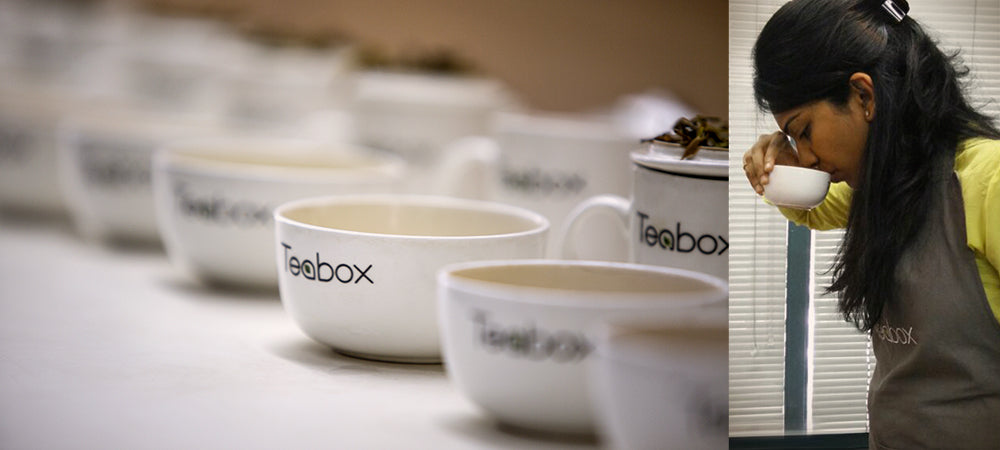
Our blends are made in-house by a small R&D team working with our tasters in Siliguri, and each one goes through weeks of testing before it goes on sale.Read more
The test is the cup: our R&D team keeps tasting “till we are completely satisfied with liquor, aroma, appearance and taste.”
The people
- Shruti Tripuraneni: our first in-house blender, a food technology graduate with a master’s from the University of Arkansas, who became a tea blender as a product developer with Starbucks in Seattle before joining us in Siliguri. She sampled “between 40 and 45 teas in a week,” left home by half past six on tasting days “without even a morning cuppa,” and wore no perfume, because “they affect the flavors when I am tasting or blending.” Her first Teabox blend was Kesar Delight, Darjeeling white tea with saffron strands, lemongrass and chamomile flowers.
- Nagendranath Chiluvuru: our R&D head in 2016, working from our Siliguri office. For that year’s Diwali gifts, “From 15 ideas in the beginning, we arrived at 6 blends.”
- Ravi: today the procurement team’s “Blend Boss,” with more than 15 years as a taster, buyer and blender, who started as a trainee in a tea broking firm.
- Megha: in 2020 the only woman in our R&D team, in charge of flavored tea production, ingredients procurement and new product development.
Shruti also had a tester she trusted. Most colleagues nodded politely at her cups, but “a rare few like Gomden sir (an old tea hand) will offer critical feedback.” Arun Kumar Gomden is the veteran Darjeeling tea maker and master taster credited with naming the muscatel teas at Castleton in the mid-1980s.
How many cups a blend takes
Our caffeine-free Summer Blends of 2022, made with kokum, jamun and grapes, took 31 sherbets, 26 variations and 56 trial cups before they launched on 12 May 2022.
One of our longest-running flavored blacks, Mountain Rose Black, was first created by Shruti in 2015, inspired by Indian desserts. Today it is “sweet and intensely floral,” with flavors of pink rose, jasmine and cardamom.
Some ideas never make it. Pumpkin spice tea defeated us: “we got some fresh pumpkin. Nothing. We tried dried pumpkin. Still nothing. We tried freeze-dried.” Pumpkin’s flavors were simply too mild to come through in a cup. Read the full confession in Tea Blends That Didn’t Quite Make It.
Our blender’s rules for blending at home
Our 2015 guide to home blending, written with Shruti’s input, gives rules any reader can follow.
- Keep the tea the hero: nearly two-thirds of the blend should be tea, and the lighter the tea, the less of anything else you add.
- Match the strength: with a first flush Darjeeling, avoid strong, intensely aromatic flavors like cardamom or ginger; try delicate spring flowers such as lavender or chamomile.
- Match the size: use ingredients of similar density and size, or the heavy, small pieces settle at the bottom and the blend separates.
- Use dry ingredients: dried flowers, fruit and spices have more concentrated flavors and brew better than fresh ones; rose, for instance, “pairs impeccably with a winter flush Nilgiri black tea.”
- Start small: begin with one or two ingredients and build the layers slowly.
More recipes and ideas are in 8 Tips for Creating Your Own Tea Blends, and the history behind the craft in Tea: A Blended History.
Keep reading
Sources
- Teabox Tea 101: Popular teas around the world (the base for this guide); English Breakfast; Earl Grey tea; Russian Caravan; History of black tea; Darjeeling; Geographical Indication (GI); Assam; Green tea; Guide to spring teas; Tea producing regions
- Teabox blog (Still Steeping): Tea: A Blended History (2016), A Blender of Teas (2015), 8 Tips for Creating Your Own Tea Blends (2015), Tea Blends That Didn’t Quite Make It (2015), Behind the scenes: Making of our Diwali gifts (2016), Jasmine Teas: A Scent of Perfection (2016)
- Teabox blog (Still Steeping): English Breakfast: The Baseline Black Tea (2016), Wake Up to the Year of the Rooster (2017), Irish tea, history and elevenish (2017), Microwaved, tepid, rolling boiling? Water for tea! (2016), A short lesson on Asian green tea (2017), Adam’s Peak: Higher and higher, better and better (2017), The Muscatel Master (2021)
- Teabox blog (Still Steeping): 10 Most Expensive Teas in the World, 2021; The Life and Legend of Thomas J. Lipton, 2021; Russian Caravan: The accidental tea, 2015; The Teabox Top 10 Teas of 2015, 2015
- Teabox product records, October 2026: English Breakfast Black, Irish Breakfast Black, Classic Earl Grey Citrus Black, Assam Masala Chai, Green Tea Jasmine Soothe, Mountain Rose Black, Teabox Roasted Darjeeling Black, Classic Assam Black, Mangalam Gold Summer Black, Darjeeling Badamtam Spring Moonlight White
- Teabox Drive: Teabox internal document, 2023; Teabox internal document, 2016; photos as credited
- Teabox on Instagram (@teabox.tea): Mountain Rose launch, Jun 2015, our Russian Caravan, Dec 2015, R&D team, Mar 2020, how we blend, May 2020, Moroccan Mint in a gift box, Dec 2020, Mangalam oxidation trial, Sep 2021, Summer Blends 2022, May 2022, Darjeeling cup count, Oct 2022, our procurement and tasting team, Jun 2024
- Kausshal Dugarr on X (@Teapreneur): Lipton, Sep 2021, Thomas Lipton, Sep 2021, most expensive teas, Oct 2021, Da Hong Pao, Oct 2021, smelling tea, Oct 2021, Nepal and Darjeeling, Oct 2021, English Breakfast origin, Dec 2021, English Breakfast origin, Dec 2021, First Flush 2022 verdict, May 2022, Japan’s way of tea, Jun 2022, Ceylon tea in figures, Jul 2022, Black Friday 2024; and a customer’s post, Nov 2025


Leave a comment
All comments are moderated before being published.
This site is protected by hCaptcha and the hCaptcha Privacy Policy and Terms of Service apply.