


The most famous single-origin teas are named for their place: Darjeeling and Assam from India, Keemun and Dragon Well (Longjing) from China, and Ceylon from Sri Lanka. A single-origin tea comes from one region, and the best from one estate and one season, so its taste carries the mark of where and when it grew. Some of the best black tea in the world comes from China, India and Sri Lanka. We buy from more than 250 Indian estates, so the Indian teas below are the ones we know from our own tasting room; the Chinese and Sri Lankan classics are described from our writers’ and tasters’ accounts.
What makes Darjeeling tea famous?
Darjeeling is often called the Champagne of teas, and for a similar reason: it comes from one small, protected region in the Himalayan foothills of West Bengal, and its flavor changes with every season.Read more
Only tea from the district’s 87 registered gardens can be sold as Darjeeling, and in 2004 it became India’s first Geographical Indication. Most of it is made as a light, aromatic black tea, and it changes with the season: first flush teas in spring are floral and brisk, and second flush teas in summer carry the famous grape-like muscatel flavor. Darjeeling first and second flush are two of the most prized black teas in the world.
It is also small. Our training deck puts the total area under tea at 17,820 hectares and annual production at only 8 to 9 million kg, grown from about 90 to 2,050 meters above sea level, with 3,000 to 3,300 mm of rain a year.
How we taste it
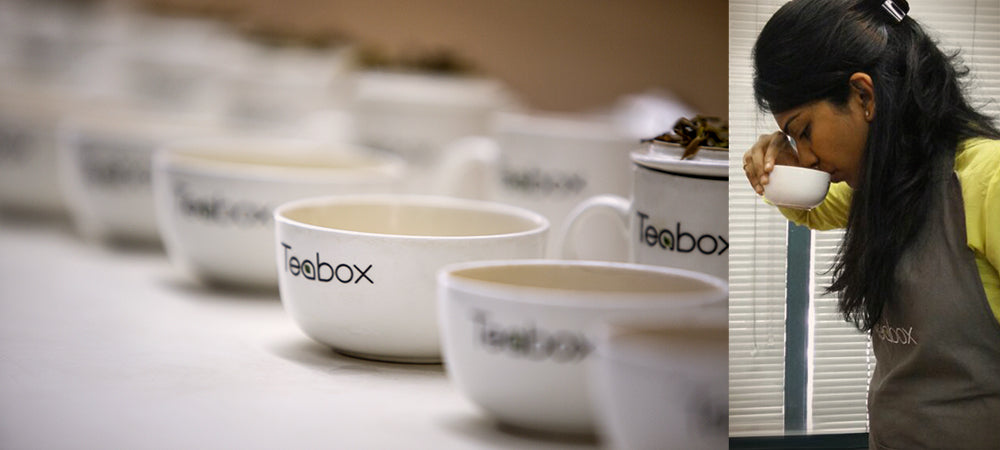
We taste our way through every Darjeeling season: our tasters reckoned they had sampled close to 11,456 Darjeeling cups by late October 2022.
That tasting is also how we judge a year. After sampling over 1,578 cups of the spring 2022 harvest, our founder, Kausshal Dugarr, concluded that the First Flush 2022 did not compare with the past few years: in quality and flavor, “it lacks the soul of Darjeeling teas.”
Tasting is also the only safe test of origin. Nepal grows its tea just across the border, and its black tea is good, though not the same in taste as Darjeeling: an attractive and less expensive complement that is typically slightly softer and a little woodier. The blending of Darjeeling and Nepal tea is an old affair, so a market “Darjeeling” may well contain some Nepal leaf. Buying by estate and invoice, as we do, is how you avoid that.
More in Darjeeling tea and Second flush tea and muscatel, or browse all our Darjeeling teas.
What makes Assam tea famous?
Assam is black tea from the low, hot Brahmaputra valley in northeast India, made from the region’s native large-leaf plant, Camellia sinensis var. assamica.Read more
It brews a strong, brisk, malty cup, deep amber to reddish, which is why it is the backbone of most breakfast blends and of Indian chai. The finest are the golden-tipped summer teas of the second flush, rich and smooth enough to drink on their own.
It is also India’s workhorse. Our training deck notes that Assam contributes more than 50% of India’s total tea, that its teas are used extensively for “Breakfast teas/chais” and to increase the blend strength and color of other teas, and that with milk an Assam makes “a bright yellowish-orange cup.”
The best single estates show what the blends leave out. When our master tasters and procurement managers sampled Mangalam Gold Summer Black at four oxidation times in 2021, they chose 3 hours 30 minutes for “a perfect combination of strength, briskness with notes of maple syrup and hints of cocoa.” Peter Keen, writing for us, suggested a really good Assam, “such as a Halmari,” for anyone who wants a strong tea that gives a “Ruler of the Universe feeling even at dawn’s bleary light.”
Read Assam tea, try Assam Mangalam Gold Summer Black or Halmari Summer Black, or browse all our Assam teas.
What is Keemun tea?
Keemun is a smooth black tea from Qimen in Anhui province, China, and a cornerstone of the classic blends: it goes into many English Breakfast blends, and it gives Russian Caravan its richer body.Read more
The story goes that in 1875 a man named Hu Yuanlong traveled to Fujian to learn how black tea was made, and came home to Qimen to make his own.
Inside a blend, Keemun is the refined note. Peter Keen, writing for us in 2016, said it adds “a lighter, smoky overtone” to English Breakfast and that “Keemun signals a superior tea. It is the most subtle of the main choices for the blend.” He also suggested drinking it on its own as “a wonderful tea, if you want something a little lighter in its flavors.”
Because it is subtle, it does not want boiling water. Keen’s advice for “a Darjeeling or subtle China Keemun” is 205°F (about 96°C), “around half a minute off the boil.” We do not sell Keemun ourselves.
What is Dragon Well (Longjing) tea?
Dragon Well, or Longjing, is China’s most famous green tea, with flattened, spear-shaped leaves, picked in spring and fixed by hand in hot pans.Read more
Longjing is one of the prized “famous teas” that are still plucked and made largely by hand, and its leaves are fixed slowly in hot pans for two to three minutes, which gives a soft, light-to-medium-bodied cup. The best is picked in spring, before the rains; Tea 101 called it a good example of a first flush green tea, “rich with crisp spring flavors”: in a word, fresh.
It grows in the hills around Hangzhou in Zhejiang, one of the southern provinces, with Fujian and Anhui, where most of China’s green tea is made. Our 2017 lesson on Asian green tea explains why it tastes as it does: pan-firing, an action “akin to stir-frying,” gives Chinese greens yellower leaves and a taste that “tends toward the vegetal, nutty and floral,” where Japan’s steamed greens are vivid green and marine. Read A short lesson on Asian green tea.
For how Chinese and Indian teas differ, see Indian vs Chinese tea, and for green tea in general, What is green tea?
And Japan?
Japan’s famous teas are steamed greens. In 1738 the tea producer Soen Nagatani invented the method of fixing the leaf by steaming rather than frying, and regular sencha now accounts for about 70% of the green tea produced in Japan. Shade-grown tencha, used for gyokuro and matcha, is among the few Japanese teas still hand-picked. The ritual drinking of tea in Japan, Chado or the way of tea, has existed for over 500 years. To taste a shade-grown tea, try our Pure Matcha Green Tea.
What is Ceylon tea?
Ceylon is tea from Sri Lanka, still sold under the island’s old name, and its black teas are the mellow partner to Assam in the original English Breakfast.Read more
Ceylon was a coffee country until a fungus wiped out its coffee between 1869 and 1878, and tea took its place. In 1890 a Glasgow grocer, Thomas Lipton, stepped off a ship in Colombo, bought tea estates, and sold their tea “direct from the tea garden to the teapot,” making Ceylon a household name.
The brand Lipton built is still news. When Unilever put the brand on the block in 2021, it was the world’s largest tea brand and 131 years old, and its founder’s story began in Glasgow, where he was born on 10 May 1850 to Irish parents who had fled the potato famine.
Ceylon’s black teas are the mellow partner to Assam in the original English Breakfast, as Tea 101 tells it, and its highland white teas are renowned too. One of them, the silver-needle white tea of Adam’s Peak, is grown on 60-degree slopes and limited to about 3,000 pounds a year; a 2017 guest post on our blog called it the first white tea made outside China. Read Adam’s Peak: Higher and higher, better and better.
The island is a large producer of orthodox tea: nearly 300 million kg a year, about 5% of all the world’s tea, of which it exported 95% before its economic crisis, earning about US$1.3 billion a year. For a named estate to start with, Peter Keen suggested in 2016 that if you want “that big wake-up burst of taste, a Ceylon Kenilworth is as inexpensive as a branded tea bag.”
What is the most expensive tea in the world?
The rarest teas fetch prices that rival fine wine, and Da Hong Pao, a rare oolong from Wuyishan in Fujian, is often regarded as the most expensive of all; India’s priciest are rare Darjeelings.Read more
In a 2021 roundup of the world’s most expensive teas, the top one was valued at “around a whopping $1.2 million per kg,” and Da Hong Pao, produced only in Wuyishan, Fujian, was named as “often regarded as the most expensive in the world.”
India’s most expensive teas
India’s own entry on that list was a Darjeeling: our Badamtam Moonlight White, a spring white tea from the Lebong Valley, then sold at about $2,800 per kg. It is still in our range as Darjeeling Badamtam Spring Moonlight White.
Its product record explains the price. It is made in limited quantities from “a mix of the fragrant AV2, P126, and B157 clones,” its cup is champagne-colored, and our tasters found geranium, white lilies, raw mango and hints of muskmelon in the liquor.
Record prices are an old Darjeeling story. Arun Kumar Gomden, the veteran Darjeeling tea maker and master taster credited with naming the muscatel teas at Castleton in the mid-1980s, remembers what happened when that first muscatel batch went to auction: “it broke all records and created a new one. It sold at Rs. 583, a monumental figure, and only a week later it went on to create another record by selling at Rs. 1,460.” The tea, he says, “went on to be savored by the former Emperor of Japan, Hirohito.” Read The Muscatel Master.
And over Black Friday and Cyber Monday 2024, when we shipped to 68 countries, the priciest tea we sold went for $3,500 per kg.
Keep reading
Sources
- Teabox Tea 101: Popular teas around the world (the base for this guide); English Breakfast; Earl Grey tea; Russian Caravan; History of black tea; Darjeeling; Geographical Indication (GI); Assam; Green tea; Guide to spring teas; Tea producing regions
- Teabox blog (Still Steeping): Tea: A Blended History (2016), A Blender of Teas (2015), 8 Tips for Creating Your Own Tea Blends (2015), Tea Blends That Didn’t Quite Make It (2015), Behind the scenes: Making of our Diwali gifts (2016), Jasmine Teas: A Scent of Perfection (2016)
- Teabox blog (Still Steeping): English Breakfast: The Baseline Black Tea (2016), Wake Up to the Year of the Rooster (2017), Irish tea, history and elevenish (2017), Microwaved, tepid, rolling boiling? Water for tea! (2016), A short lesson on Asian green tea (2017), Adam’s Peak: Higher and higher, better and better (2017), The Muscatel Master (2021)
- Teabox blog (Still Steeping): 10 Most Expensive Teas in the World, 2021; The Life and Legend of Thomas J. Lipton, 2021; Russian Caravan: The accidental tea, 2015; The Teabox Top 10 Teas of 2015, 2015
- Teabox product records, October 2026: English Breakfast Black, Irish Breakfast Black, Classic Earl Grey Citrus Black, Assam Masala Chai, Green Tea Jasmine Soothe, Mountain Rose Black, Teabox Roasted Darjeeling Black, Classic Assam Black, Mangalam Gold Summer Black, Darjeeling Badamtam Spring Moonlight White
- Teabox Drive: Teabox internal document, 2023; Teabox internal document, 2016; photos as credited
- Teabox on Instagram (@teabox.tea): Mountain Rose launch, Jun 2015, our Russian Caravan, Dec 2015, R&D team, Mar 2020, how we blend, May 2020, Moroccan Mint in a gift box, Dec 2020, Mangalam oxidation trial, Sep 2021, Summer Blends 2022, May 2022, Darjeeling cup count, Oct 2022, our procurement and tasting team, Jun 2024
- Kausshal Dugarr on X (@Teapreneur): Lipton, Sep 2021, Thomas Lipton, Sep 2021, most expensive teas, Oct 2021, Da Hong Pao, Oct 2021, smelling tea, Oct 2021, Nepal and Darjeeling, Oct 2021, English Breakfast origin, Dec 2021, English Breakfast origin, Dec 2021, First Flush 2022 verdict, May 2022, Japan’s way of tea, Jun 2022, Ceylon tea in figures, Jul 2022, Black Friday 2024; and a customer’s post, Nov 2025


Leave a comment
All comments are moderated before being published.
This site is protected by hCaptcha and the hCaptcha Privacy Policy and Terms of Service apply.