


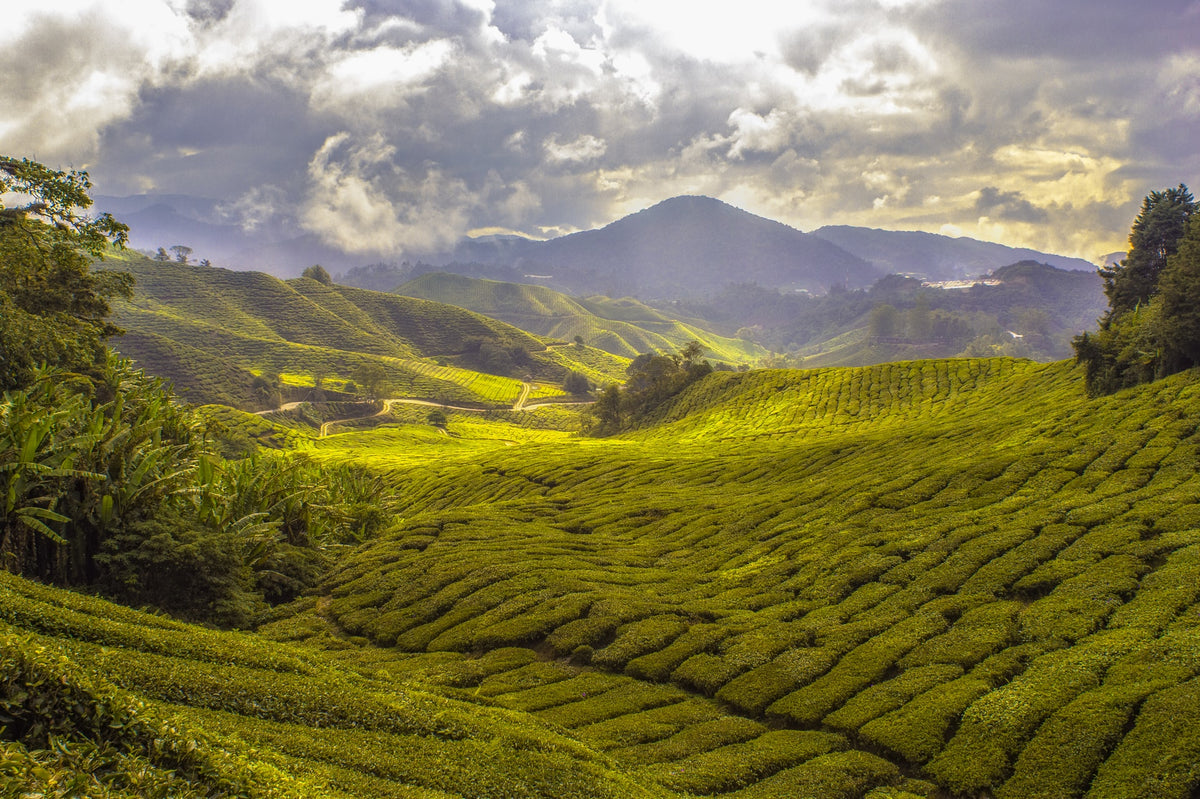
Tea is grown in warm, wet tropical and subtropical regions, and China is the largest tea producer in the world, with India second and Kenya third. Sri Lanka, Turkey, Vietnam, Indonesia and Japan are other big tea producing countries, while Taiwan and Nepal are small but famous for quality. Every one of them grows the same plant, and every one makes it taste different.
At a glance
- The plantCamellia sinensis, in two main varieties
- Where it growsTropical and subtropical regions, plains to high hills
- What it needsAbout 15–30°C, 150–250 cm of rain a year, acidic soil
- Largest producerChina, over 30% of the world’s tea (Tea 101, 2017)
- SecondIndia, about 25% (our founder, 2020)
Where is tea grown?
Tea is grown wherever the tea plant, Camellia sinensis, gets enough warmth and rain, which means a broad belt of tropical and subtropical countries across Asia and Africa, with smaller pockets in South America, Australia and elsewhere.Read more
Every true tea, from a pale white to a dark breakfast black, comes from this one evergreen plant. More on the plant in What is tea?
What the tea bush needs
Our staff training notes set out the conditions plainly. The bush wants a tropical to subtropical climate with high humidity and heavy rain: about 150 to 250 cm a year on average, with temperatures between about 15°C and 30°C (59°F and 86°F). It prefers acidic soil. Within those limits it grows anywhere from about 50 m to 2,500 m above sea level, or about 165 to 8,200 feet.
Within that belt, gardens range from hot river plains near sea level to steep slopes high in the Himalayas. Low, warm gardens grow fast and give large crops of bold, strong tea; high, cool gardens grow slowly and give small crops of fine, aromatic tea. That is why Assam, on the plains of the Brahmaputra, and Darjeeling, high in the Himalayan foothills, make such different cups.
The numbers show the trade-off. Our 2023 training deck gives Darjeeling 17,820 hectares under tea and an annual crop of only 8 to 9 million kg, while Tea 101 credits Assam’s estates with close to 507 million kg a year. Less leaf, grown slowly in the cold, is what gives a Darjeeling its flowery lift.
Two plants, carried around the world
Two varieties do most of the work. The small-leafed China plant, known in India as Chinary, is native to the lands of northern Myanmar and China’s Yunnan and Sichuan provinces. The large-leafed Assam plant, Camellia sinensis var. assamica, grows wild in northeast India and can become a small tree if left unpruned.
Apart from southern China and northern Myanmar, Assam is the only region with native tea plants. Everywhere else, tea arrived as seed or cuttings carried by traders, monks and colonial planters.
Most of what all those gardens make is black tea. Our training notes say more than 75% of all tea produced in the world is black and about 20% is green, with oolong and white tea making up the rest.
Tea is, as our founder Kausshal Dugarr likes to point out, “the world’s most consumed beverage after water,” which makes it a vital crop for millions of farmers and plantation workers in the countries below.
Which country produces the most tea?
China produces the most tea in the world, followed by India and then Kenya.Read more
Our Tea 101 archive put China at over 30% of the world’s tea in 2017 and ranked the top five as China, India, Kenya, Sri Lanka and Turkey.
The order below the top two shifts with weather and markets from year to year, so we give only the figures our own sources state, each with its year. They are not one dataset, so read them as a rough picture rather than a league table.
Share of the world’s tea production, as stated in each source and year. Kenya and Turkey are ranked third and fifth in our 2017 Tea 101 posts, without a figure.
| Rank (2017) | Country | Mainly makes | Known for |
|---|---|---|---|
| 1 | China | Green, plus every other type | The birthplace of tea; Longjing green; oolongs |
| 2 | India | Black, both orthodox and CTC | Assam, Darjeeling, the Nilgiris, and chai |
| 3 | Kenya | Black | Black teas for breakfast blends |
| 4 | Sri Lanka | Black, mostly orthodox | Ceylon tea; rare high-grown whites |
| 5 | Turkey | Black | One of the largest tea markets in the world |
| Smaller | Japan, Taiwan, Nepal | Green; oolong; orthodox black and green | Matcha and sencha; high-mountain oolong; Himalayan teas |
Producing a lot is not the same as selling a lot abroad. Sri Lanka, with nearly 300 million kg a year, exports 95% of its crop. Kenya exports 96% of its teas. Turkey, fifth in production, drinks almost all of its own tea, as Japan does, while China and India drink a large share of theirs. More on each country in Kenya, Sri Lanka and beyond.
China, Japan and Taiwan: East Asia’s tea countries
China is the largest tea producer in the world and makes every type of tea, Japan grows mostly green tea and keeps most of it at home, and Taiwan is known less for the size of its crop than for its oolongs.Read more
India: the second largest producer, and the biggest region
India is the world’s second largest tea producer, making about a quarter of the world’s tea, and its state of Assam has long been described as the largest single tea-growing region on earth.Read more
Our founder put India’s share at 25% in 2020, adding that there was still “no global tea brand from India,” which is the gap Teabox set out to close. Tea 101 credits Assam’s estates with close to 507 million kg a year. “Did you know that Assam is the single largest tea producing region in the world?” we asked back in 2015.
India’s regions
The British planted tea in India to break China’s hold on the trade, but the Assam plant was already growing wild in the northeast. Today India grows tea from the Himalayan foothills to the hills of the far south, and each region has its own character:
- Assam: low, hot and humid plains along the Brahmaputra; bold, malty black teas, best in the summer second flush.
- Darjeeling: small, high Himalayan gardens, many still growing old Chinary bushes; floral spring teas from the first flush and muscatel summer teas.
- The Nilgiris: the Blue Mountains of the south, plucked year round, with fragrant winter frost teas.
- Smaller regions: Sikkim (the Temi garden), Kangra, Meghalaya, Munnar and Arunachal Pradesh.
The small regions can surprise. Arunachal Pradesh has far fewer estates than Darjeeling or Assam, but its Donyi Polo garden, founded in 1985, sold a “Golden Needle” tea at Rs 40,000 per kg in 2018, which our post called the world’s most expensive tea that year. And in 2021 a tea from Temi, in Sikkim, was sipped on air on The Late Show in New York; our founder wrote that he was “immensely excited to see Indian Teas reach every corner of this world.”


What India drinks, and where its tea goes
India also drinks a great deal of what it grows. It produces some of the world’s finest teas, but what most of the country loves best is chai, a sweet, milky tea made from strong CTC black tea. Tea is also the country’s second largest employer of organized labor.
Much of India’s tea is still sold at auction, a system older than Indian tea itself. The first tea auction was held in London in early 1679, set up by the East India Company, which held a royal monopoly on goods brought in from India and China.
We buy direct from the gardens instead, and ship from India. Our Upper Namring Spring Black reached our 120th country, the Falkland Islands, in November 2021, and a Goomtee Spring Chinary Black our 121st in April 2022.
For the whole story, start with Indian tea: the complete guide, then explore region by region in Indian tea regions and garden by garden in Tea estates of India.
Nepal: Darjeeling’s Himalayan neighbor
Nepal makes small amounts of fine orthodox tea in the hills next to Darjeeling, with the same spring, summer and autumn flushes, and its black teas are typically a little softer and woodier than Darjeeling’s.Read more
Tea arrived in Nepal in the 1860s, and Ilam, one of the first estates, is still an elite producer. Its black teas grow at elevations of about 7,000 feet. Until fairly recently Nepal made its tea for home use, and up to the 1950s there were no roads into the tea region at all.

Unlike Darjeeling, where almost every estate has its own factory, Nepal is mostly smallholders, with an average farm of less than an acre, selling leaf to regional factories. Women make up 80% of the pluckers. At Guranse, more than seventy small farms formed a cooperative so they could sell their leaf in larger lots.
That structure makes Nepal flexible and inventive: gardens such as Guranse grow from clones, and Nepal has been making fine, Japanese-style green teas. Its high hill bushes take around seven years to mature for plucking, against three to five years for the lowland bushes that make most of its cheap CTC.
The seasons track Darjeeling’s. Our 2023 training deck puts Nepal’s spring flush from mid-February to mid-April, the summer flush from 5 June to the end of June (“full-bodied, sweet, fruity”), the monsoon flush from mid-July to the end of September and the autumn flush from mid-October to the end of November, with “mellow, fruity-woody notes.” The whole story is in Nepal tea and in our blog story Nepal: Innovation in the high Himalayas.
Kenya, Sri Lanka and the other tea producing countries
Kenya is the world’s third largest tea producer and the leader in Africa, Sri Lanka sells its orthodox black tea to the world as “Ceylon,” and tea is also an important crop in Turkey, Indonesia, Vietnam, Iran and Argentina, with smaller amounts grown as far away as Australia.Read more
Which country makes the best tea?
No country makes the best tea; each makes the best of a style.
China leads for green tea and variety, Taiwan for oolong, Japan for matcha and sencha, Sri Lanka for bright Ceylon blacks, and India for the widest range of black tea, from malty Assam to floral Darjeeling. As our old Tea 101 page put it, “the only right answer to the best tea in the world is your favorite one.”
Even within one style, the old map is being redrawn. Peter Keen, writing for our blog, ranked the great whites as Moonlight, Silver Needle, White Peony and Shou Mei, and noted that they were historically the preserve of Yunnan, “but Fujian, Sri Lanka and Darjeeling are producing ones to rival any of the best.” Our Castleton Summer Moonlight White is one of those Darjeeling whites.
What matters more than the country is the estate, the season and the year. A single-estate tea from a named garden and flush will almost always beat an anonymous blend from a famous country. Our founder sees growers everywhere moving the same way: “Be it China, India, or Sri Lanka the focus has shifted on producing consistent quality tea irrespective of flush/season.”
We are biased, of course: we buy only from India, from more than 250 estates, and taste every lot in Siliguri before it is listed. In a single month of the 2022 first flush, our tasters sampled more than 1,578 cups. The best way to find your own answer is to taste regions side by side. Start with these, or browse the most famous names in Famous teas of the world.
Tea producing countries FAQ
Which country produces the most tea?
China, by a wide margin; our Tea 101 archive put it at over 30% of the world’s tea in 2017. India is second, at about a quarter of world production, and Kenya is third.
Which country drinks the most tea per person?
Turkey is usually ranked first for tea drunk per person, and Tea 101 calls it one of the largest tea markets in the world. A 2016 Teabox story put the Turkish average at over 3,000 cups per person a year, about nine a day, with Morocco second and Ireland and Mauritania next, ahead of the UK; our 2017 Irish tea story also places Ireland alongside Turkey at the top. By total volume, the giants are China and India, which drink a large share of their own crops, yet by the 2016 count none of the big four producers (China, India, Kenya and Sri Lanka) was in the top 20 per person.
Is tea grown in Europe?
Only on a small scale, because most of Europe is too cold for the tea plant. Small gardens exist in a few mild, wet spots, such as the Azores (Portugal), Georgia on the Black Sea and Cornwall in England, while Turkey’s large tea region lies on its Black Sea coast.
What is the largest tea-growing region in the world?
Assam, in northeast India, is usually described as the largest. Tea 101 credits its estates with close to 507 million kg of tea a year, mostly bold, malty black tea. See Assam tea.
Where is tea grown in India?
Mainly in Assam, Darjeeling and the Nilgiris, with smaller regions in Sikkim, Kangra, Meghalaya, Munnar, Arunachal Pradesh and elsewhere. See Indian tea regions.
Is Ceylon tea the same as Sri Lankan tea?
Yes. Ceylon was the island’s name under British rule, and the tea is still sold as Ceylon tea. Most of it is orthodox black tea, and about 95% is exported.
Keep reading
Sources
- Teabox blog (Still Steeping): Nepal: Innovation in the high Himalayas (2016), Adam’s Peak: Higher and higher, better and better (2017), Tea at Serendip (2017), India vs. Taiwan: The Oolong Challenge (2017), When Tea Came to Australia (2017)
- Teabox blog (Still Steeping): The finest cup of tea in Beijing (2017), A short lesson on Asian green tea (2017), Irish tea, history and elevenish (2017), A Nilgiri girl in Darjeeling (2017), Moonlight Sonatas: The Great White Teas (2016), What Became of the Small Leaf Tea? (2015)
- Teabox blog (Still Steeping), stories: People Who Love to Drink Tea From Morning to Evening, 2016; Tea in Islamic cultures, 2016; Clonals: the tea of the future, 2016; A Biography of the Tea Bush, 2016; Who’s Drinking Tea in America?, 2015
- Teabox Tea 101: Top 10 tea producing regions of the world (2017); History of tea (2017); Popular teas around the world (2017); Assam (2017); Geographical indication; The tea plant; Guide to spring teas; English Breakfast
- Teabox Drive: Teabox internal document, 2023; Teabox internal document, 2021; photos as credited
- Teabox product pages: Castleton, Halmari, Havukal, Temi, Glenburn, Castleton Summer Moonlight White and Pure Japanese Matcha, 2026
- Teabox on Instagram (@teabox.tea): Assam, Dec 2015, Donyi Polo oolong, May 2019, 120th country, Nov 2021, Arunachal Pradesh, Feb 2022, 121st country, Apr 2022
- Kausshal Dugarr on X (@Teapreneur): Japanese Darjeeling prices, Apr 2010, Indian tea industry, May 2020, India’s 25%, Jun 2020, Temi on The Late Show, Jul 2021, tea auctions, Oct 2021, quality over quantity, Jan 2022, first flush cups, May 2022,Sri Lanka, Jul 2022
- Teabox Masterclasses on YouTube: Assam, Arunachal Pradesh

Leave a comment
All comments are moderated before being published.
This site is protected by hCaptcha and the hCaptcha Privacy Policy and Terms of Service apply.