


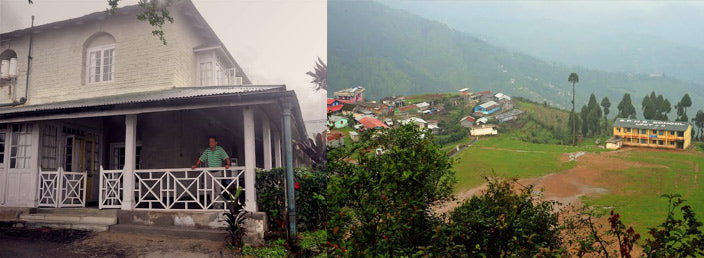
Most Indian tea estate names come from local words, Lepcha, Nepali, Assamese, Bodo-Kachari or Khasi, from the British planters and their families, or from a local legend. Okayti was renamed after London tasters said simply “OK,” Margaret’s Hope remembers a manager’s daughter, and Dikom means “sweet water.” Here is what the best-known names mean, garden by garden.
Why do Indian tea estates have such unusual names?
Because most gardens were named, or renamed, by the people who cleared and worked them: local communities named hills and rivers in their own languages, and British planters and missionaries added names of their own.Read more
Several gardens changed names as they changed hands. Castleton was once Kumseri, Margaret’s Hope was Bada Rington, Okayti was Rangdoo and Risheehat was first called Tshering Bagan.
Some names record who settled the hills. German missionary families, the Wernickes and the Stolkes, founded several Darjeeling gardens, and one of them, Steinthal, is still known informally as the “priest’s tea garden.” Others carry the name of a town or valley: Kurseong’s name is usually traced to the Lepcha for “land of the white orchid.”
Knowing the story behind a name will not change what is in your cup, but it does tell you something real about the garden: its altitude, its river, its first crop, or the people who made it.
What do Darjeeling estate names mean?
Darjeeling’s garden names mix Lepcha and Nepali words for places and animals, Hindi and Nepali words for people, and a few British stories.Read more
| Estate | What the name means |
|---|---|
| Okayti | Originally Rangdoo. London tasters said simply “OK,” and the garden was renamed. |
| Giddapahar | “Eagle’s mountain”: gidda (eagle) and pahar (mountain). |
| Badamtam | Lepcha for “bamboo water carrier.” |
| Makaibari | From makai (maize): the land was a maize field before tea. |
| Thurbo | Probably from the Nepali for “tent,” after British troops camped here in the war against Nepal. |
| Mim | From mem, the local word for a British lady; the garden was once run by one. Today it is Darjeeling’s only garden owned by the Government of India. |
| Singbulli | “Home of the birds”; established 1924. |
| Risheehat | “Home of holy saints,” after meditators who sheltered here; first called Tshering Bagan. |
| Castleton | After a castle-like bungalow that overlooked the garden; it was once known as Kumseri. |
| Margaret’s Hope | After a manager’s young daughter, Margaret, who loved the garden and died on the voyage home to England; it was once Bada Rington. |
| Jungpana | From a local legend: a nobleman named Jung, fatally wounded by a leopard, asked for paani (water) with his last breath. |
The stories behind three of them
Okayti’s renaming is the one tasters love. The garden, in Mirik on the Mechi river at the Nepal border, was Rangdoo until London auctioneers judged its tea simply “OK,” and the name stuck; its factory dates from 1888.
Mim’s name comes from Mem ko Kaman, “the garden run by the British lady,” which locals shortened to Mim. Makaibari’s founder, Girish Chandra Banerjee, is said to have seen local people growing maize on the slope at about 4,800 ft in 1852 and planted tea in its place.
Castleton’s “castle” may be humbler than it sounds: our brief suggests it was probably just a building left behind by a long-ago money lender. The gardens themselves are described in Famous Darjeeling tea estates.
What do Assam estate names mean?
Assam’s garden names come mostly from Assamese and Bodo-Kachari words for water, coal, rice and tea, and from the Ahom kings and queens who ruled the valley.Read more
- Dikom takes its name from the Bodo-Kachari words di (water) and kom (sweet), after the Sessa river. It is also nicknamed the “Queen of Jokai.”
- Harmutty is said to be named after Queen Hiramati, wife of King Arimatta, and her burial mound lies near the estate’s middle bungalow.
- Koilamari is named after the coal (koila) once mined from its soil. “The name ‘Koilamari’ is from a local word ‘koyla’ for coal,” Khyati Shah, whose grandfather took over the garden, told us; its pluckers, mostly Karbi or Dafla, live across the border in Arunachal Pradesh.
- Chubwa claims Assam’s first successful plantation, in 1836; its name comes from the local words chah (tea) and bowa (planting).
- Chubwa, in our 2015 notes: the name comes from Chah Bowa, Assamese for “tea planting,” and Chubwa is probably the first tea plantation in Upper Assam.
- Majulighur is named for Maju Rani, wife of the 17th-century Ahom king Pratap Singh, and her bathing tank is still on the estate.
- Basmatia is named for the basmati rice once grown there, though today it is famous for golden, tippy tea.
- Banaspaty literally means “flora and fauna,” fitting for a garden that has worked since 1905 to conserve the plants and animals around it.
For the gardens themselves, see the Assam section of Famous tea estates of India and Assam tea estates.
What do Nilgiri and northeast estate names mean?
In the Nilgiris and the northeast, names describe the land, a mountain or a forest, or express a hope, as Lakyrsiew’s “awakening” does.Read more
- Lakyrsiew, Meghalaya. Its name means “awakening” in Khasi.
- Billimalai, Nilgiris. The name means “Goat Mountain”; the garden sits at about 2,000 m and its frost teas are hand-picked at dawn.
- Thiashola, Nilgiris. One of the first Nilgiri estates, opened in 1859; its name means “mother of the forests.”
Names inside an estate: divisions, sections and special lots
Large estates are divided into divisions and numbered or named sections, and the best lots often carry the section’s name, so the names on a label can point to one patch of one hillside.Read more
- Castleton’s sections carry local names: Bhalu Khop (bear cave), Dhobitar (the washerman’s line), Baseri and Jim Basha (the manager’s domain).
- Margaret’s Hope has three divisions, Margaret’s Hope, Dilaram and Maharani. It also names special lots: “Delight” is given to teas treated with special handling.
- Namring’s divisions are Poomong, Jinglam and Namring, and most of its bushes are watered by springs from Tiger Hill.
- Badamtam’s Lamas division, section 9, gave our 2023 Moonlight white.
- Seeyok’s sections 9YT, 10YT and 11YT, with bushes about 100 years old, gave our June 2021 summer muscatel.
- Risheehat’s two divisions are Risheehat and Liza Hill.
- Jungpana’s Malderam division is full of old Chinary bushes.
On a pack, these names sit beside the invoice number of the lot. How to read the whole label is explained in Famous tea estates of India.
Keep reading
Sources
- Teabox blog estate visits: Castleton, Margaret’s Hope, Jungpana, Goomtee, Glenburn, Avongrove, Dikom, Craigmore, TANTEA, the Singpho village and Nilgiri estate bungalows (2014–2021)
- Teabox blog (Still Steeping): Tea in Germany & its Darjeeling Connection (2016), Of tea, wildlife and stories of yore from Assam (2017), Assam Diaries: A portal to the past (2016), In Assam for the summer flush (2015), Assam Diaries: Princess Majuli’s Home and More Tea (2016), Exploring co-existing spaces: wildlife and tea (2021)
- Teabox blog stories: The legend of Jungpana (2015), The delight of Margaret’s Hope (2016), The history of the Nilgiri tea (2016)
- Teabox product estate descriptions, 2026 season: Castleton, Okayti, Thurbo, Mim, Singbulli, Risheehat, Upper Namring, Dikom, Harmutty, Koilamari, Billimalai
- Teabox Drive: Teabox internal document, 2020; Teabox internal document; Teabox internal document, 2021
- Teabox on Instagram (@teabox.tea): Kurseong, Mar 2021, Giddapahar, 2020, Badamtam, 2024, Makaibari, Jul 2021, Margaret’s Hope, Jul 2020, Margaret’s Hope Delight, Jul 2020, Chubwa, 2018, Lakyrsiew, 2018, Badamtam Moonlight, Mar 2023

Leave a comment
All comments are moderated before being published.
This site is protected by hCaptcha and the hCaptcha Privacy Policy and Terms of Service apply.