


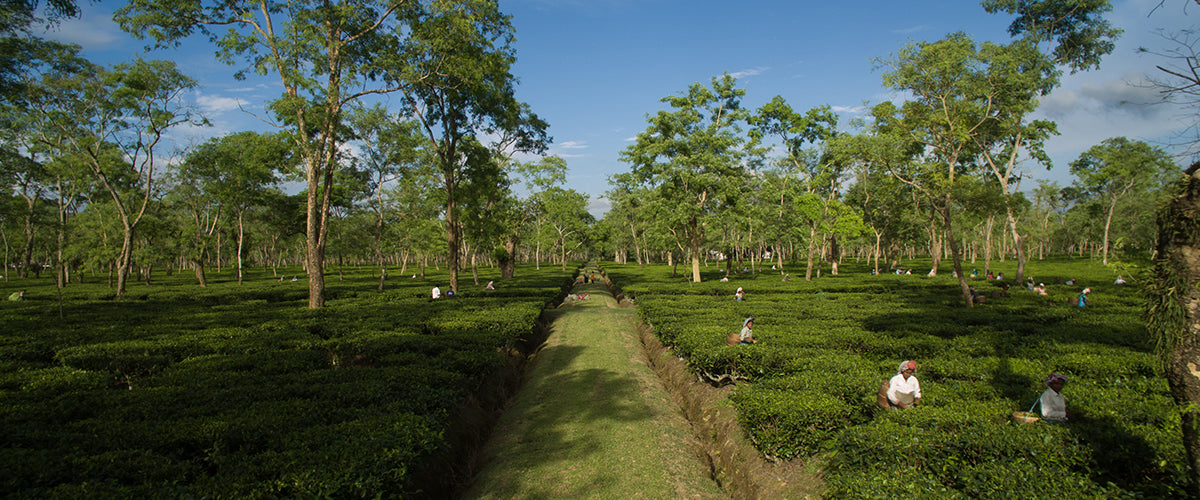
Teabox buys Assam tea directly from single estates, including Halmari, Mangalam, Dikom, Namsang, Harmutty, Doomni, Meleng, Chota Tingrai, Singlijan, Banaspaty, Koilamari, Dejoo, Dinjoye and Chardwar. We visit every summer for the second flush and choose lot by lot.
Our Assam estates at a glance
Our Assam teas come from old and new gardens across the valley, from Namsang, planted in 1837, to Mangalam, planted in 1973.Read more
| Estate | District | Founded | Known for |
|---|---|---|---|
| Namsang | Upper Assam | 1837 | One of the oldest gardens, carved from rainforest; 277 bird species |
| Meleng | Jorhat | 1856 | Birthplace of the P126 clone, now grown across Assam; 1,340 ha, 840 of them under tea |
| Dikom | Dibrugarh | 1875 | About 70% high-quality clones; tippy, malty orthodox teas; named for “sweet water” |
| Harmutty | North Lakhimpur | 1878 | One of Assam’s oldest gardens; smooth, not bitter |
| Halmari | Dibrugarh | Over a century ago | 374 ha; quality-first under the Daga family since the 1980s; golden tips |
| Chota Tingrai | Tinsukia | 1943 | Family-run; a third of the garden organic by 2016 |
| Mangalam | Sibsagar | 1973 | All-clonal, densely planted; famed for golden tips |
| Doomni | Baksa | – | Mostly CTC, with prized orthodox lots; “creamy and speckled with gold tips” |
| Singlijan | Dibrugarh | – | 271 ha; named for Hingoolijan, “river of the Hingooli fish”; full-bodied orthodox |
| Koilamari | North bank, Arunachal border | – | Named for coal; north bank brightness with south bank malt |
| Banaspaty | Karbi Anglong | – | 160 acres; Elephant Friendly certified, near Kaziranga |
| Coombergram | Barak valley | Before the 1880s | Records from 1913; a garden of southern Assam |
The estates are a long way from us. They sit about 400 to 900 km from our facility in Siliguri: Doomni is the nearest at 403.8 km, then Singlijan (681.3), Harmutty (741.8), Banaspaty (772.9), Coombergram (791), Mangalam (834.7), Halmari (846.3), Dikom (887.7) and Namsang, the farthest, at 897.1 km.
How do we choose our Assam teas?
We go to Assam every summer, taste at the gardens, and buy only the lots that match what we are looking for that season.Read more
“Every summer, we make our annual visit to Assam for the summer flush,” wrote Ravi Kothari of our procurement team in 2017, his third summer on the trip. As our team told a reader in 2016, the procurement team goes to the estates each season to taste, select and buy, so what you see in our store is the best we find that season, and it changes from year to year.
Our buying brief sets the target: dark amber cups of malt, date palm, yellow raisins and vanilla, from jet black leaf full of golden buds. It names the gardens we expect the season’s highlights from: Halmari, Dikom, Doomni, Chubwa, Singlijan and Murphulani. In our 2023 and 2024 summer reports, the partner estates named for the season were Halmari, Doomni, Mangalam, Dikom and Harmutty.
We taste the samples two ways. A horizontal tasting sets different gardens from the same season side by side, as we did in 2021 with Harmutty, Halmari, Mangalam, Doomni and Coombergram. A vertical tasting compares sections of one garden planted with different clones, as at Halmari.
Speed matters as much as choice. At Halmari, processing starts almost as soon as the leaf is plucked, and our writer learned there that it takes only about 24 hours for freshly plucked leaf to reach the cup.
Stories from the gardens
Many have stories as rich as their teas.Read more
- Chota Tingrai: Avantika and Mrityunjay Jalan, a sister and brother running their family garden, moved part of it to organic farming in the face of resistance from almost everyone, senior management included. Read their story in Assam Diaries: The Jalans at Chota Tingrai.
- Halmari: read about a day with Halmari’s manager in Assam Diaries: A tour of Halmari.
- Khobong: At Khobong, one of Assam’s largest estates, specific clonal bushes make teas that taste of raspberry jam. The estate puts the flavor down to the section’s location and soil, and makes about 1.85 to 1.9 million kg of tea a year.
Halmari
Halmari’s general manager when our team visited in 2016, D.K. Arora, had served in the army before he chose tea, and he ran a tight ship. He started each morning with the plucking charts, because each section is plucked once every six days, and he knew every part of the 374-hectare garden. In the afternoon he oversaw the weighing of the leaf, each basket sorted and then weighed against the day’s target, before tasting the day’s batch with our Ravi Kothari. His summary of the job: “This is a job where you need to be alert, taking things from past, present and future into consideration which at the end of the day makes a perfect cup of tea.”
The garden’s turn to quality came in the 1980s, when the Daga family began a quality-first approach in field and factory. Saachi and Soham Daga run it today. A small warning for visitors: there are two Halmari estates in Assam, about 180 km apart, and our team first arrived at the wrong one.
Chota Tingrai
Chota Tingrai was set up in 1943 by Murleidhor Jalan, one of the first Indian entrepreneurs to own a tea estate in Upper Assam, and it has stayed in the family for four generations. When our team visited in 2016, Mrityunjay was 24 and ran the 600-hectare estate with Avantika. Every newly planted patch was organic, and three years after she began, a third of the garden was. They hired young field assistants such as Deepa, the cook’s daughter, and Mahendra, whose mother was a plucker. “We don’t want to judge people by the number of years of experience they bring but by what they have learned in the years they have worked,” Mrityunjay told us.
Dikom and Namsang
Dikom lies about 32 km from Dibrugarh town. Its manager in 2017, Samar Chaliha, had joined as an assistant in 1994, and the estate grows the N436 and P126 clones. Ravi Kothari found the teas “tippy, strong and malty.” The garden was established in 1875 by Dutch settlers, and its name comes from the Bodo-Kachari words for water and sweet, after the Sessa River that runs through it.
Namsang, between the Jeypore biosphere and the Burhi Dehing river, was bought by Rossell Tea in 2012. We called its 2018 summer teas some of the best we had tasted in Assam.
The north bank and the hills
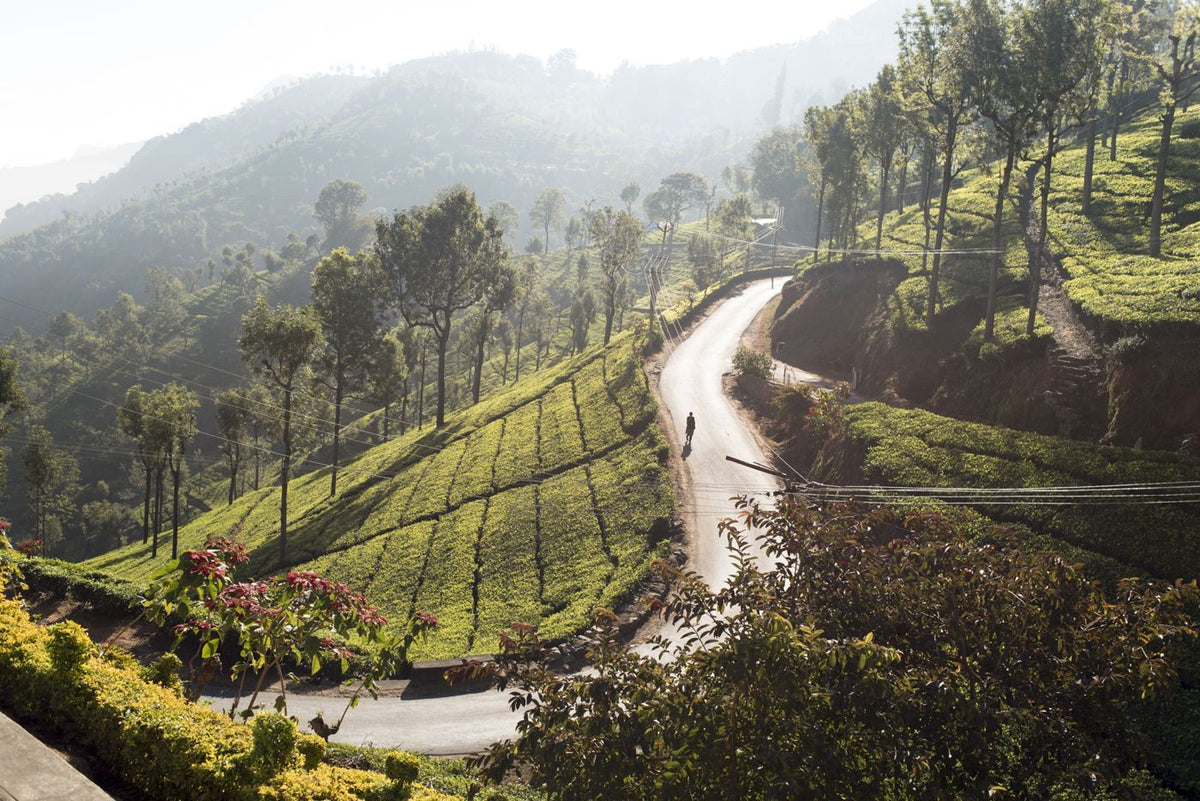
North of the Brahmaputra and in the Karbi Anglong hills, our gardens sit right against the forest, and their stories are as much about rivers, queens and wildlife as about tea.Read more
Harmutty and Koilamari
Harmutty, on the fast-flowing Dikrong river, is said to be named for Queen Hiramati, wife of King Arimatta; the remains of her burial mound lie near the estate’s Maj, or Middle, Bungalow. It grows the P126 and N436 clones.
Koilamari takes its name from koyla, coal, which was mined there until the early 1980s. It now joins two divisions: Koilamari and Joyhing, once a larger estate named for its hing (asafoetida) trees, whose factory was swept away in the 1969 Ranganadi flood. In 2016 its factory employed 2,276 people, and its teas went to Russia, Iran, Dubai, Germany and the UK.
Majulighur and Gingia
Majulighur, in Sonitpur on the north bank, means “Maju’s home,” after Maju Rani, a wife of the 17th-century Ahom king Pratap Singh. Her bathing tank is still on the estate. The family that owns it describes its black tea as a classic example of super large leaf second flush Assam: malty, with a clear golden cup. Its sister garden Gingia, 45 minutes away, covers 453 hectares.
Banaspaty, Doomni and Meleng
Banaspaty, whose name means “flora and fauna,” covers 160 acres in the Karbi Anglong hills near the Nagaland border, and is run by the third generation of the Mohan family. Its Elephant Friendly certification comes from a partnership between WFEN and the University of Montana. The garden protects native Hollong, Acacia, Khair and Mekai trees, and wreathed hornbills, great Indian hornbills and pygmy hogs now flock to a garden that supports more than 400 workers and their families.
Doomni, in Baksa, was a sugar plantation before it was a tea garden, and now spans 2,020 acres. Meleng, founded in 1856 by J.E. Todd on the Meleng River near the Gibbon Wildlife Sanctuary, still grows the P126 clone on 20 hectares.
The people who make Assam tea
Assam tea is made by large communities of pluckers, field staff and factory workers who live on the estates, and their skill decides the cup as much as the soil does.Read more
The pluckers
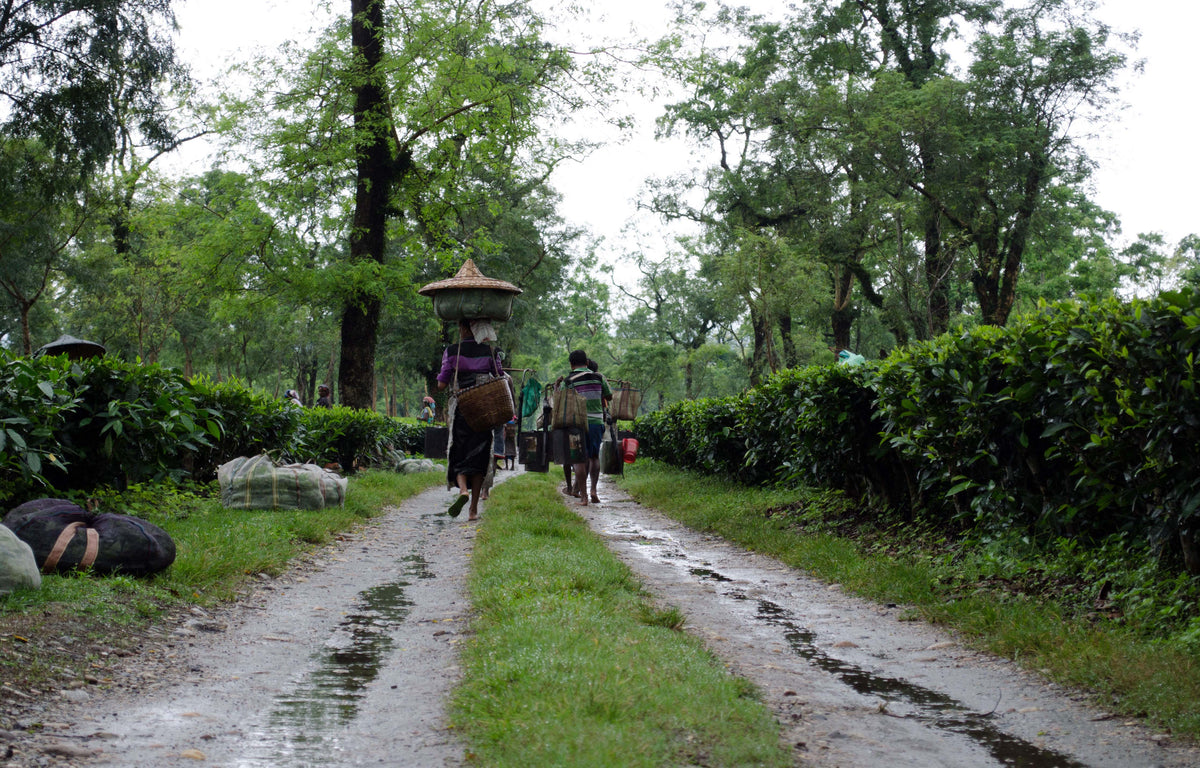
It is hard, skilled work. A tea plucker in Assam picks two or three baskets of green leaf a day, each holding about 8 kg, “but finally, only 3-5 kgs of tea is made.”
At Koilamari, most pluckers belong to the Karbi or Nyishi communities and live across the border in Arunachal Pradesh. They make their own straw hats, called japi, against sun and rain, and carry a bottle of a homemade rub for their feet to keep leeches away.
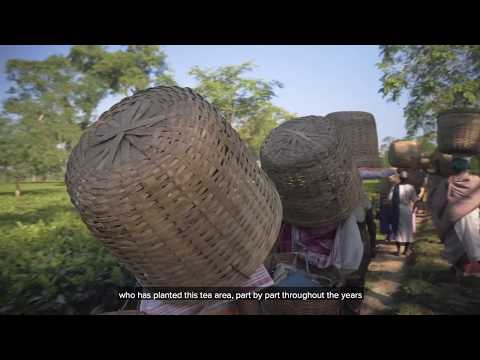 Halmari Tea Estate, AssamFrom The Source · 2:40
 Namsang Tea Estate, AssamFrom The Source · 1:17
 Singlijan Tea Estate, AssamFrom The Source · 1:22
 AssamTeabox Masterclass · short
In the field and the factory
At Balijan (H), which our buyers visited in 2015, the field assistant Manisha Singh managed about 400 pluckers across 189 hectares. She grew up on a tea estate, took a master’s in plantation management at Dibrugarh University, and started her career at 22. In peak season, from April to the Durga Puja, her day began at 6 am and ended after 7 pm; in winter she was in the field by 4:30 or 5 am to oversee pruning. Of winning over her colleagues she said: “First they judge you, and then they accept you.”
Estate life produces other talents too. At Zalouni, near Duliajan, we met Mahaver Kisan, a self-taught painter whose father worked on the estate and who now teaches painting to the estate children. More gardens, and the stories behind their names, are in Famous tea estates of India.
Keep reading
Sources
- Teabox Tea 101: Assam: Wildlife, history and native tea
- Teabox blog (Still Steeping): Assam Diaries: A tour of Halmari (2016), A tour of the Tocklai Tea Research Institute (2016), Assam Diaries: The Jalans at Chota Tingrai (2016)
- Teabox blog (Still Steeping), Assam Diaries: Margherita, the Singphos and Coin Tea, 2016; Of tea, wildlife and stories of yore from Assam, 2017; A Beginner’s Guide to Assam Teas, 2017; Raising Our Cups to Maniram Dewan: The Father of Assam Tea, 2021; In Assam for the summer flush, 2015
- Teabox blog (Still Steeping), further stories: Assam Diaries: Margherita, the Singphos and Coin Tea (Richa Gupta, 2016), The Teabox team in Assam (Ravi Kothari, 2016), Of tea, wildlife and stories of yore from Assam (Ravi Kothari, 2017), A Beginner’s Guide to Assam Teas (Peter GW Keen, 2017), In Assam for the summer flush (2015), Assam Diaries: Princess Majuli’s Home and More Tea (2016), Assam Diaries: A Portal to the Past (Zahra Amiruddin, 2016), Exploring Co-Existing Spaces: Wildlife and Tea (2021), Tigers and Tea (Romita Ray, 2017), What a Progressive Tea Industry Needs (2015), A bazaar in my backyard (Shivani Kagti, 2016), Spinning Yarn, Weaving Tales (Julie Kagti, 2017), Writing Novels, Drinking Assam Tea (2015), The Secrets of Tea-Tasting (Frank Miller, 2017), English Breakfast: The Baseline Black Tea (Peter GW Keen, 2016), Forgive Me Chai, It’s Summer (Iced Chai Recipe) (Meeta Sharma, 2015)
- Teabox blog (Still Steeping): Raising Our Cups to Maniram Dewan: The Father of Assam Tea (2021)
- Old Tea 101 posts: The Assam tea; What are Winter Flush Teas (Drive content edit, Teabox internal document, 2018)
- Teabox product estate descriptions, 2026 season
- Teabox product pages, read 21 October 2026: Halmari, Mangalam Gold, Dikom, Namsang, Harmutty, Doomni Gold, Singlijan, Koilamari Summer Raspberry, Meleng, Chota Tingrai, Banaspaty, Coombergram, Classic Assam Black, including estate distances from our facility (product location data)
- Teabox company files (Google Drive): Teabox internal document (buying brief); Teabox internal document (2017); Teabox internal document (July 2023); Teabox internal document (June 2023); Teabox internal document (June 2024); Teabox internal document (2024 to 2026 single estate launches); Drive photos as credited in the captions
- Teabox on Instagram (@teabox.tea): Jul 2021, Sep 2018, Jun 2018, Jun 2018
- Kausshal Dugarr, Teabox founder, on X (@Teapreneur): X · Jul 2020, Aug 2022
- Teabox on YouTube: Halmari Tea Estate, Assam, Namsang Tea Estate, Assam, Singlijan Tea Estate, Assam, Assam
- Teabox social posts used on these pages: Instagram Dec 2015, Sep 2016, Jul 2016, Jul 2017, Jun 2018, Jun 2018, Sep 2018, Sep 2018, Sep 2018, Sep 2018, Jun 2020, Jun 2021, Jul 2021, Jul 2021, Aug 2021, Aug 2021, Aug 2021, Sep 2021, Jan 2022, Jan 2022, Feb 2022; X Jul 2020, Sep 2021, Sep 2021, Aug 2022, Aug 2022; YouTube films linked in the video cards

Leave a comment
All comments are moderated before being published.
This site is protected by hCaptcha and the hCaptcha Privacy Policy and Terms of Service apply.