


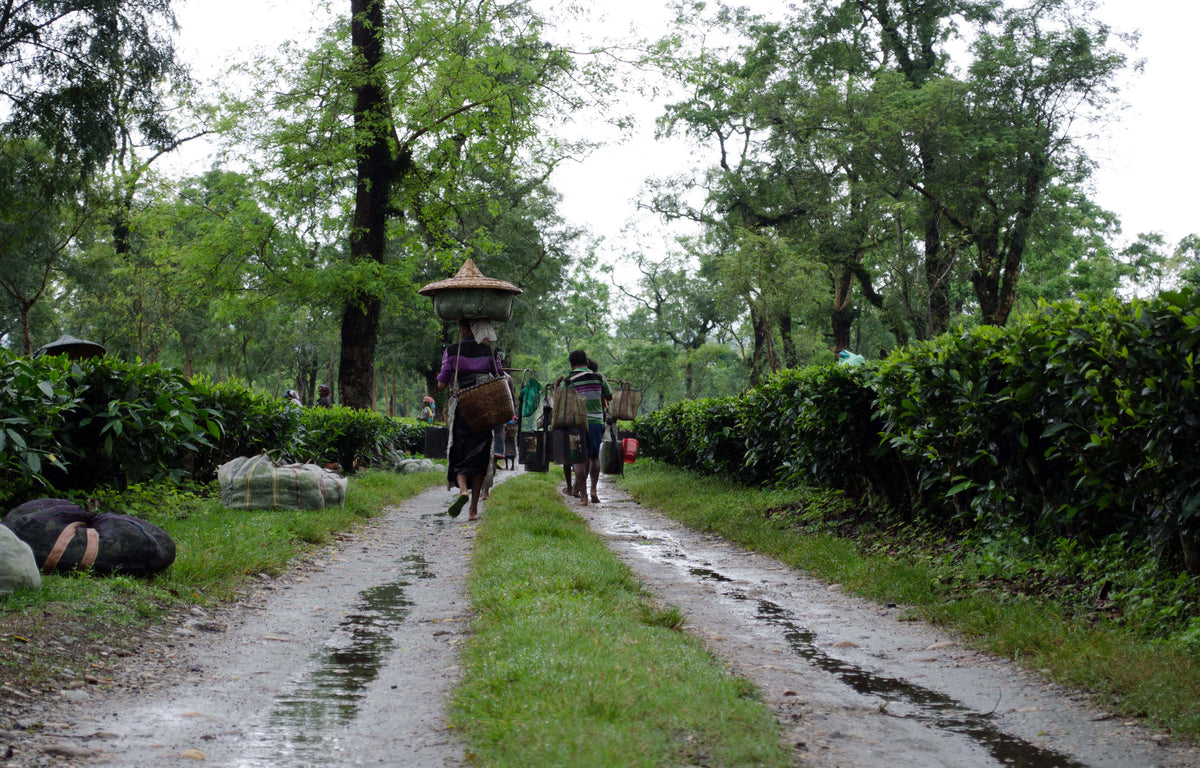
Tea grew wild in Assam, and the Singpho people were brewing it long before the British arrived; the outside world “discovered” it in 1823, when a Singpho chief showed the Scottish trader Robert Bruce how his people made tea.
The Singpho and their wild tea
The Singpho live in the forested far east of Upper Assam, and they were growing, making and drinking tea from Assam’s wild bushes before anyone else in India.Read more
The first tea was found in the lands of the Singpho people, in the forests of Upper Assam, and each Singpho family owned its own tea garden.
When our team visited the Singpho village of Margherita, every house still had tea in its backyard, some bushes 8 to 10 feet tall. At the home of Rajesh Singpho, the community’s unofficial leader, the whole family walked through the bushes picking leaves from the branches, and Ravi Kothari of our procurement team admitted he had never seen tea bushes that tall.
Rajesh told us, with quiet pride, that the Singpho were the first Indians to find and drink tea as we know it today. Their own folk tale tells of two hunting brothers who rested under a tree, chewed a few of its leaves and walked on refreshed; the leaves were tea. The village still works as a community, with one tea processing facility owned by everyone.
Margherita, in Tinsukia district, was later famous for its British collieries, and Robert Bruce is thought to have found the wild Assam plant right here. The town’s Italian name came from a railway engineer, Chevalas Roberto Paganini, who named it after a 19th-century Italian queen.
Smoked coin tea
They still make a smoked “coin tea”:
- The leaf is packed into bamboo hollows. First the women slow-roast the freshly picked leaf in a big wok, dry it in the sun and crush it.
- It is smoked above the hearth for up to two months, on racks over the cooking fire.
- It is then sliced into coins to brew. When it is ready, the whole stick of tea comes out of the bamboo and coin-sized pieces are cut for each pot.
The first cup our team was served came with a piece of jaggery on the side. It looked like any other black tea, but the taste was green, smoky and like nothing our writer had tasted before.
Ravi Kothari, a Darjeeling man all his life, found it reminded him of a Chinese pu-erh, fermented and smoky. It starts with a smoky note and ends on a very strong bitter one. Brewed for 3 minutes it tastes like a green tea; brewed for 5 minutes, like a black tea. In his words, an acquired taste.
Bruce, Maniram Dewan and a new variety
In 1823 Robert Bruce, on a trading mission, came to Rangpur, then the capital of the Ahom kingdom, and noticed tea-like plants growing wild.Read more
- He was reportedly directed by Maniram Dewan, an Assamese nobleman, to the local Singpho chief, who showed him how his people brewed the leaf.
- Bruce arranged for leaves and seeds but died soon after, before the plant was identified.
- In the early 1830s his brother Charles sent samples to the botanical garden in Calcutta, where the plant was confirmed as tea and later named Camellia sinensis var. assamica.
The first plantings still leaned on China. Charles Bruce set up the first nursery with 80,000 seeds from China, and two Chinese tea makers were hired to teach the craft. The 1834 Tea Committee was formed to judge both the commercial potential and the science of Assam tea.
Assam tea timeline
| When | What happened |
|---|---|
| Before 1823 | The Singpho grow, make and drink tea from Assam’s wild bushes. |
| 1823 | Robert Bruce sees wild tea near Rangpur; the local Singpho chief shows him how it is brewed. |
| 1834 | The East India Company’s Tea Committee begins assessing Assam’s potential. |
| Late 1830s | The first commercial gardens are planted in Upper Assam. Chubwa records its first successful planting of tea saplings in 1836; its name comes from chah bowa, Assamese for “tea planting.” Namsang dates its first formal plantings to 1837, still marked by a marble monument at its Section No. 1. |
| 1839 | The Assam Tea Company is formed, with Maniram Dewan as its Dewan. The same year, Indian tea goes on sale in Britain for the first time. |
| 1840 to 1860 | The Assam Company dominates growing and making in Upper Assam, with a workforce of local Kacharis. |
| 1862 | Assam has more than 160 gardens, owned by five public companies and 57 private players. |
| 1891 | A joint committee of the Indian Tea Association and the Agricultural and Horticultural Society of Bengal appoints the chemist M. Kelway Bamber to study tea growing in India. |
| 1911 | The Tocklai Experimental Station opens in Jorhat; by 2016 it was described as Asia’s largest and oldest tea research institute. |
| 1949 | Tocklai develops India’s first cloned tea plant, an Assam-China hybrid. |
Who worked the gardens
As the gardens spread, the British brought in workers from far away. The tea garden communities known as Adivasis came originally from present-day Jharkhand, Odisha, West Bengal, Telangana and Chhattisgarh, and their descendants have made Assam home, mixing their own customs with local ones. Their story continues on the Assam tea estates page.
Maniram Dewan, the “father of Assam tea”
Maniram Dutta Baruah, known as Maniram Dewan, was the first Indian to grow tea commercially in Assam.Read more
- The British rewarded him for opening the door to Assam’s tea. By 1839 he was Dewan of the Assam Tea Company.
- He grew disillusioned and left in the mid-1840s, after the British deposed the Ahom king Purandar Singha and he clashed with company officers.
- He set up his own gardens near Jorhat and in Sibsagar. His first garden was at Chenimore, in Jorhat, and he went on to trade in gold, salt, handlooms, boats and bricks, hiring local people wherever he could.
- After the 1857 uprising he was arrested for plotting against British rule and hanged at Jorhat jail with a fellow conspirator, Piyoli Baruah.
Folk songs still remember him as “the father of Assam tea.” These songs are known as “Maniram Dewan Geet,” a film was made on his life in 1964, and Dr. Bhupen Hazarika wrote and sang “Buku Hom Hom Kore” about the struggle he stood for. Read the full story in Raising Our Cups to Maniram Dewan: The Father of Assam Tea.
As our founder, Kausshal Dugarr, put it: “We all believed that it was the Britishers who discovered tea in India! But nothing could be further from the truth.”
At Tocklai, scientists told our team they believe he was hanged less for politics than for the competition his estates posed to British tea.
His legacy at Tocklai
His legacy runs through modern Assam tea in an unexpected way. At Tocklai, the mother plant of India’s first cloned tea, developed in 1949, still grows; it was raised from seed collected at Cinnamara, the estate that belonged to Maniram Dewan.
Cinnamara still lies just behind Tocklai, across the railway tracks, and some say Maniram Dewan is buried there. Tocklai itself grew into the adviser to more than 1,076 tea estates across India by the time our team visited in 2016, guiding old and new gardens on cultivars, nutrients, pest control and quality.
Read A tour of the Tocklai Tea Research Institute, and the wider story in The history of tea.

Assam tea in the Second World War
During the Second World War, Upper Assam’s tea country became an Allied base on the road to Burma, and several of the gardens we buy from still carry that history.Read more
Dibrugarh, now called the “tea city of India,” was a military base camp and a transit camp for evacuees from Burma. Nearby, the Chubwa airfield was a base for the Allies. Part of the Dikom estate served as headquarters of the 236th Signal Service Battalion, which supported the “Flying Hump” airlift of supplies to Chiang Kai-shek’s forces once the Japanese had cut the Burma Road.
When Ravi Kothari stayed at Dikom in 2017, he could still hear Indian Air Force planes taking off from Chubwa for night training. At Chubwa estate, a wartime bungalow served as a resting center for soldiers and the factory as a recreation center.
The war reached the research station too. Senior officers at Tocklai were drafted into service, since British citizens were expected to serve their time in the army. Dikom’s history goes back further still: its manager’s bungalow once held a cannon said to have been used by an Ahom king against the Burmese army in 1820, now with the archaeology department.
Keep reading
Sources
- Teabox Tea 101: Assam: Wildlife, history and native tea
- Teabox blog (Still Steeping): Assam Diaries: A tour of Halmari (2016), A tour of the Tocklai Tea Research Institute (2016), Assam Diaries: The Jalans at Chota Tingrai (2016)
- Teabox blog (Still Steeping), Assam Diaries: Margherita, the Singphos and Coin Tea, 2016; Of tea, wildlife and stories of yore from Assam, 2017; A Beginner’s Guide to Assam Teas, 2017; Raising Our Cups to Maniram Dewan: The Father of Assam Tea, 2021; In Assam for the summer flush, 2015
- Teabox blog (Still Steeping), further stories: Assam Diaries: Margherita, the Singphos and Coin Tea (Richa Gupta, 2016), The Teabox team in Assam (Ravi Kothari, 2016), Of tea, wildlife and stories of yore from Assam (Ravi Kothari, 2017), A Beginner’s Guide to Assam Teas (Peter GW Keen, 2017), In Assam for the summer flush (2015), Assam Diaries: Princess Majuli’s Home and More Tea (2016), Assam Diaries: A Portal to the Past (Zahra Amiruddin, 2016), Exploring Co-Existing Spaces: Wildlife and Tea (2021), Tigers and Tea (Romita Ray, 2017), What a Progressive Tea Industry Needs (2015), A bazaar in my backyard (Shivani Kagti, 2016), Spinning Yarn, Weaving Tales (Julie Kagti, 2017), Writing Novels, Drinking Assam Tea (2015), The Secrets of Tea-Tasting (Frank Miller, 2017), English Breakfast: The Baseline Black Tea (Peter GW Keen, 2016), Forgive Me Chai, It’s Summer (Iced Chai Recipe) (Meeta Sharma, 2015)
- Teabox blog (Still Steeping): Raising Our Cups to Maniram Dewan: The Father of Assam Tea (2021)
- Old Tea 101 posts: The Assam tea; What are Winter Flush Teas (Drive content edit, Teabox internal document, 2018)
- Teabox product estate descriptions, 2026 season
- Teabox product pages, read 21 October 2026: Halmari, Mangalam Gold, Dikom, Namsang, Harmutty, Doomni Gold, Singlijan, Koilamari Summer Raspberry, Meleng, Chota Tingrai, Banaspaty, Coombergram, Classic Assam Black, including estate distances from our facility (product location data)
- Teabox company files (Google Drive): Teabox internal document (buying brief); Teabox internal document (2017); Teabox internal document (July 2023); Teabox internal document (June 2023); Teabox internal document (June 2024); Teabox internal document (2024 to 2026 single estate launches); Drive photos as credited in the captions
- Teabox on Instagram (@teabox.tea): Jun 2020, Jan 2022, 2018, Sep 2018
- Kausshal Dugarr, Teabox founder, on X (@Teapreneur): Aug 2022, Sep 2021, Sep 2021
- Teabox on YouTube: How one man fought for India’s tea
- Teabox social posts used on these pages: Instagram Dec 2015, Sep 2016, Jul 2016, Jul 2017, Jun 2018, Jun 2018, Sep 2018, Sep 2018, Sep 2018, Sep 2018, Jun 2020, Jun 2021, Jul 2021, Jul 2021, Aug 2021, Aug 2021, Aug 2021, Sep 2021, Jan 2022, Jan 2022, Feb 2022; X Jul 2020, Sep 2021, Sep 2021, Aug 2022, Aug 2022; YouTube films linked in the video cards

Leave a comment
All comments are moderated before being published.
This site is protected by hCaptcha and the hCaptcha Privacy Policy and Terms of Service apply.