


Assam tea comes in two main styles, orthodox whole leaf and CTC, and its best teas are the golden-tipped second flush. Here is how each is made, how they taste and how to choose.
Orthodox vs CTC Assam: what is the difference?
Orthodox Assam is rolled to keep the leaf whole or in large pieces, giving a layered, sweet, malty cup; CTC Assam is crushed, torn and curled by machine into small pellets that brew a very strong, dark cup in minutes.Read more
Both are black tea from the same bushes; the difference is in the factory. At Tocklai, the plant breeder Devajit Borthakur told our team that its clones suit both CTC and orthodox black tea.
| Orthodox Assam | CTC Assam | |
|---|---|---|
| Leaf | Whole or broken leaf, often with golden tips | Small, hard, round pellets |
| How it’s made | Rolled to keep the leaf intact | Crushed, torn and curled by machine |
| Cup | Malty, layered, sweet, smooth | Very strong, dark and quick to brew |
| Best for | Drinking plain or with a little milk | Chai, tea bags, strong milky tea |
| Grades made | Whole leaf, broken, fannings and dust | Broken, fannings and dust only |
| Try | Halmari Summer Black | Assam Masala Chai |
CTC
In CTC (crush, tear, curl, or cut, tear, curl), the leaf passes through cylindrical rollers with serrated blades that turn it into small, even pellets. It was built for speed and strength, and most of Assam’s tea is now made this way, for tea bags, blends and chai.
The method only makes small grades. As our old Tea 101 post explains, only broken leaf, fannings and dust can be made by CTC, and our 2017 Assam guide puts it plainly: there is no whole-leaf CTC.
Good CTC is still a craft. Halmari, best known to our customers for its orthodox teas, has also set records for CTC: in July 2015 one of its CTC lots fetched INR 441 a kilogram at the Kolkata auction, and by 2016 it was selling the most expensive CTC and breaking its own record every year. Ravi Kothari of our procurement team went to Halmari partly to see why Assam CTC kept beating its own prices, and came away with his answer: plucking rounds held strictly to 5 or 6 days.

Orthodox
Orthodox tea is the older, slower craft, made in far smaller quantities by estates such as Halmari, Harmutty, Mangalam, Doomni and Chota Tingrai.
Even at those gardens it is a small share. Doomni makes about 88% CTC and 12% orthodox, and those orthodox lots are the ones that command premium prices. Some estates keep old machinery for it: Chota Tingrai’s orthodox factory still runs vintage rollers from the 1940s.
Others make orthodox on a large scale. Gingia, on the bank of the Brahmaputra, covers 453 hectares and makes about a million kilograms of orthodox tea a year, and its sister garden Majulighur has its own boiler house so that its tea stays free of taint. Estates also change their mix over time: in 2016 Koilamari told us it was “sticking to Orthodox only,” and today it makes both orthodox and CTC again.
Not only black tea
A few Assam estates now make other styles. Chota Tingrai set up what our team was told is the first fully automated green tea factory in Assam, and runs it with Japanese methods and equipment; in 2016 its manager was Simi, then 24, who had started as a management trainee. Our 2017 guide called it a new style of Assam, “different from” rather than “better than.”
How do you read an Assam tea grade?
Look at the last letters of the grade: an F means flowery whole leaf and a B means broken leaf, and the letters before them describe how tippy and golden the leaf is.Read more
Reading the grade
A useful tip from our 2017 buying guide: when choosing an orthodox Assam, look at the end of the grade.
- “F”: flowery whole leaf, as in FOP, the larger and slower-brewing grade.
- “B”: broken leaf, as in BOP, which is smaller but still good quality.
The smaller the leaf, the faster it gives up its flavor and the harsher it can be. The same guide decodes the rest. The top Indian grade is SFTGFOP, with TGFOP and GTGFOP1 below it; the letters describe the leaf (flowery, tippy, fine, golden), and OP, orange pekoe, has nothing to do with oranges. A broken-leaf Assam is close to a good English Breakfast, full and plain, while the best whole-leaf teas are mellower, maltier and more tippy. More in Orthodox vs CTC tea and Tea grades explained.
Golden tips and second flush Assam
Assam’s finest teas come from the second flush, the summer harvest from late May into July, when warm, humid weather brings fast growth, plenty of buds and the maltiest, most golden-tipped teas of the year.Read more
- First flush: March and April, giving a fresher, lighter, brisker Assam. We offered our first two spring Assams, from Chardwar and Dinjoye, in 2024.
- Second flush: Assam’s summer teas, Tea 101 notes, are fuller-bodied and sweeter, “therefore considered as superior to the first flush.”
- Winter rest: as in Darjeeling, the bushes rest in the cold months, from about December to February. In mid-December the estates enter a resting phase, prune the bushes and overhaul their factories.
See Seasons of tea, Assam tea flushes and Assam second flush tea.
What golden tips are
Golden tips are the unopened leaf buds in the finished tea. Covered in fine down and coated with leaf juice during rolling, they turn golden rather than black.
They matter to the cup as well as the eye. Our 2017 guide notes that the tips in a great Assam such as Harmutty help soften the astringency common to most Assams. They also set the price: our buying brief asks for jet black leaf with an abundance of golden buds, “which defines the price.”
Grades flag them:
- TGFOP: the T stands for “tippy,” a leaf with plenty of buds.
- GTGFOP: means “golden tippy,” where the buds have turned gold.
The clones behind the tips
At Halmari, our tasters compare sections planted with different clones: P126, also called Pani Tola, is “very high in pubescence, making for an attractive show of golden tips and nice, robust and malty cups,” while TV1 is used for good CTC. Halmari also grows T3E3 and S3A3, but much of the estate is planted with P126.
Other partner gardens plant the same way. Nearly 70% of Dikom’s bushes are high-quality clones, among them P126A, N436, S3A3, T3A3, CP1 and Tenali 17. Mangalam is planted entirely with clones, 18 inches apart with a plucking table of 2.6 feet, which gives 42,480 bushes per hectare. India’s first cloned tea plant, developed at Tocklai in 1949, still grows at Tocklai.
Through the season
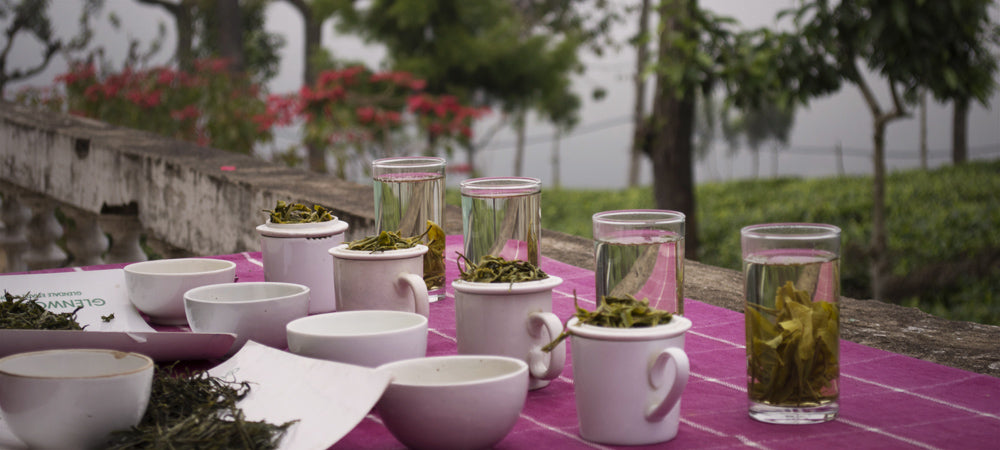
Second flush Assam keeps getting better as the season goes on. When the first summer samples arrive from Halmari, Dikom and Doomni, our tasters expect each week’s cups to be “maltier, sweeter, and mellower.”
Weather decides when that happens. In 2023 useful May rains let select estates in Jorhat, Moran, Dibrugarh and Tinsukia start their summer teas early, though our buyers noted the character had yet to peak. In the 2024 drought, we expected rich, malty cups only from about 20 June. Our summer buying then runs right through the monsoon months: in 2024 our Namsang lot was picked on 23 and 24 August, and in 2026 our Dikom and Namsang lots on 19 to 21 September.
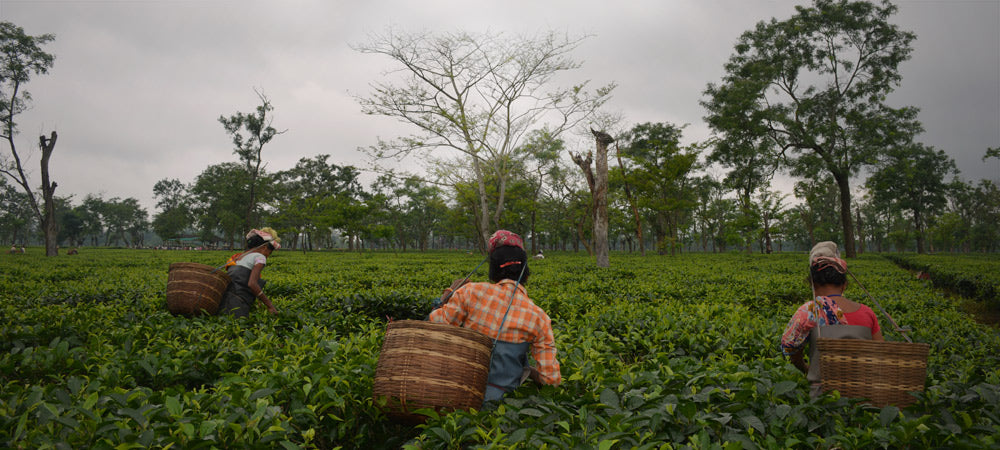
Plucking matters as much as weather: at Halmari each section is plucked every six days, and the leaf is picked small to keep flavor and juice. “One third of your job is done if the plucking is done correctly,” its manager told us.
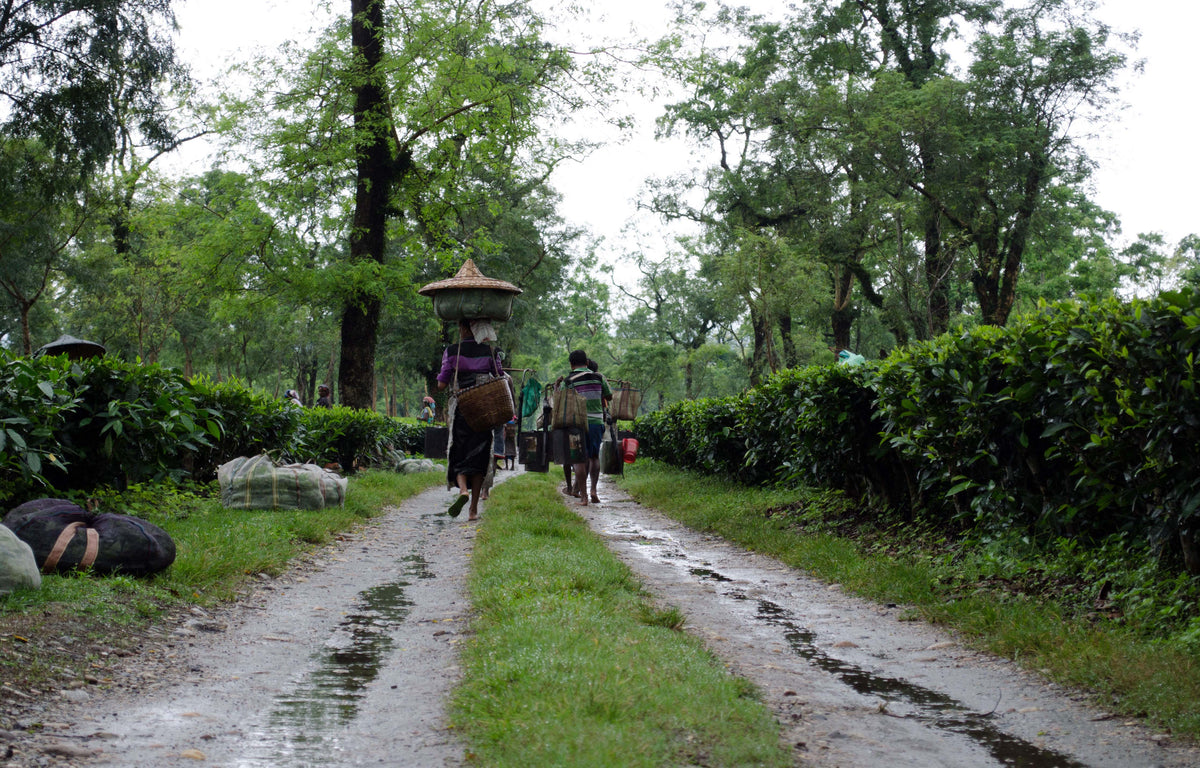
Halmari takes the same care with the leaf once it is picked. Pluckers there use only bamboo buckets, to keep the raw leaf from being damaged on the way to the factory. The full story of the summer harvest, in Assam and Darjeeling, is in Second flush tea and muscatel.
Keep reading
Sources
- Teabox Tea 101: Assam: Wildlife, history and native tea
- Teabox blog (Still Steeping): Assam Diaries: A tour of Halmari (2016), A tour of the Tocklai Tea Research Institute (2016), Assam Diaries: The Jalans at Chota Tingrai (2016)
- Teabox blog (Still Steeping), Assam Diaries: Margherita, the Singphos and Coin Tea, 2016; Of tea, wildlife and stories of yore from Assam, 2017; A Beginner’s Guide to Assam Teas, 2017; Raising Our Cups to Maniram Dewan: The Father of Assam Tea, 2021; In Assam for the summer flush, 2015
- Teabox blog (Still Steeping), further stories: Assam Diaries: Margherita, the Singphos and Coin Tea (Richa Gupta, 2016), The Teabox team in Assam (Ravi Kothari, 2016), Of tea, wildlife and stories of yore from Assam (Ravi Kothari, 2017), A Beginner’s Guide to Assam Teas (Peter GW Keen, 2017), In Assam for the summer flush (2015), Assam Diaries: Princess Majuli’s Home and More Tea (2016), Assam Diaries: A Portal to the Past (Zahra Amiruddin, 2016), Exploring Co-Existing Spaces: Wildlife and Tea (2021), Tigers and Tea (Romita Ray, 2017), What a Progressive Tea Industry Needs (2015), A bazaar in my backyard (Shivani Kagti, 2016), Spinning Yarn, Weaving Tales (Julie Kagti, 2017), Writing Novels, Drinking Assam Tea (2015), The Secrets of Tea-Tasting (Frank Miller, 2017), English Breakfast: The Baseline Black Tea (Peter GW Keen, 2016), Forgive Me Chai, It’s Summer (Iced Chai Recipe) (Meeta Sharma, 2015)
- Teabox blog (Still Steeping): Raising Our Cups to Maniram Dewan: The Father of Assam Tea (2021)
- Old Tea 101 posts: The Assam tea; What are Winter Flush Teas (Drive content edit, Teabox internal document, 2018)
- Teabox product estate descriptions, 2026 season
- Teabox product pages, read 21 October 2026: Halmari, Mangalam Gold, Dikom, Namsang, Harmutty, Doomni Gold, Singlijan, Koilamari Summer Raspberry, Meleng, Chota Tingrai, Banaspaty, Coombergram, Classic Assam Black, including estate distances from our facility (product location data)
- Teabox company files (Google Drive): Teabox internal document (buying brief); Teabox internal document (2017); Teabox internal document (July 2023); Teabox internal document (June 2023); Teabox internal document (June 2024); Teabox internal document (2024 to 2026 single estate launches); Drive photos as credited in the captions
- Teabox on Instagram (@teabox.tea): Sep 2016, Jul 2021, Jul 2021
- Teabox social posts used on these pages: Instagram Dec 2015, Sep 2016, Jul 2016, Jul 2017, Jun 2018, Jun 2018, Sep 2018, Sep 2018, Sep 2018, Sep 2018, Jun 2020, Jun 2021, Jul 2021, Jul 2021, Aug 2021, Aug 2021, Aug 2021, Sep 2021, Jan 2022, Jan 2022, Feb 2022; X Jul 2020, Sep 2021, Sep 2021, Aug 2022, Aug 2022; YouTube films linked in the video cards

Leave a comment
All comments are moderated before being published.
This site is protected by hCaptcha and the hCaptcha Privacy Policy and Terms of Service apply.