


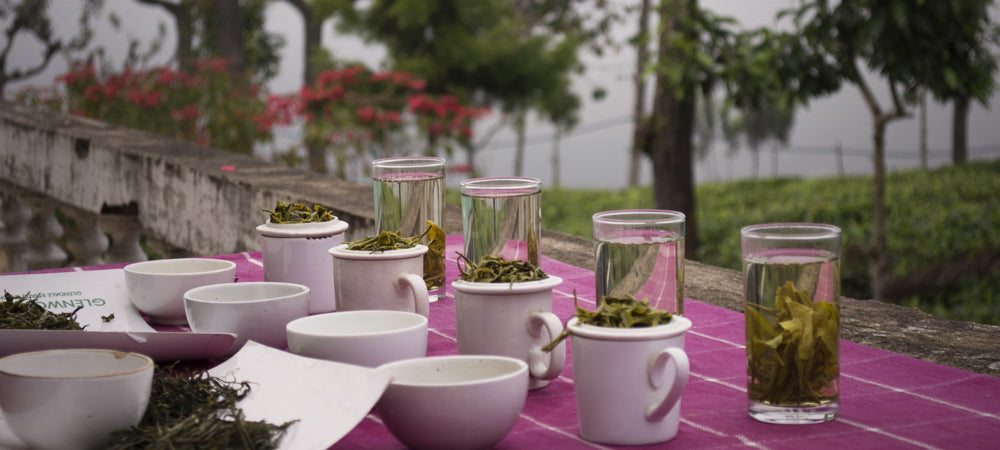
Darjeeling is called the Champagne of teas because, like Champagne, it comes from one small protected region, it changes with every season and estate, and its best lots sell for some of the highest prices in the tea world. Those prices are also why so much tea has been sold as “Darjeeling” that never grew there. This page covers both: what the best lots fetch and who buys them, and how to make sure the tea in your cup is the real thing.
What are the record prices for Darjeeling tea?
The best-known record is Castleton’s Rs 13,001 a kilogram for a 1992 muscatel, and single spring lots and Moonlight whites still sell for many times the price of ordinary tea.Read more
Castleton holds the best-known record. In 1992 its muscatel batch DJ-42, graded FTGFOP1, sold for Rs 13,001 a kilogram at the Calcutta auction, a world record at the time.
Spring teas can be just as prized. In March 2015 a UK importer judged a single 90 kg lot of Namring first flush the best among all 87 gardens’ first flush teas, and sold it in the UK for Rs 40 lakh (about Rs 4 million).
The gap between the best and the rest is wide. In early 2018, handcrafted Moonlight white lots opened at $290 to $300 a kilo, while ordinary teas gained only about $3 to $5 a kilo.
Who buys Darjeeling tea?
Most fine Darjeeling goes abroad: Germany is the largest importer, the EU takes half of all exports, and Japan and South Korea pay the most for the rarest lots.Read more
Germany is the largest importer of Darjeeling. The EU takes half of all Darjeeling exports, with Hamburg the main shipping and processing hub. Moonlight whites are most sought after in Japan, South Korea, Germany, France and the UK. In 2010 our founder noted Japanese sellers retailing Darjeeling bought at $100 a kilo for $550.
Buyers travel far for it. At Goomtee in 2015 we met a tearoom owner from Seoul who was choosing Goomtee and Jungpana first flush teas, and who later placed an order for about 9 kg of Jungpana’s second flush, then sent samples home to test before choosing.
How to tell if your Darjeeling tea is real
Real Darjeeling carries the Darjeeling logo, names its estate and flush, and costs more than ordinary black tea.Read more
For years, far more tea was sold around the world as “Darjeeling” than the hills could possibly grow, much of it blended or mislabeled. The oft-quoted figure in our 2017 guide was 10,000 tonnes made each year against 40,000 sold, and much of the blended “Darjeeling” was “a mix of machine-harvested Assam with Darjeeling broken grade leaf.” The GI tag and the logo exist to stop that.

- Look for the logo. The round Darjeeling logo with a woman holding tea leaves is owned by the Tea Board of India and licensed only to genuine Darjeeling.
- Look for an estate and a flush. “Margaret’s Hope, first flush” tells you exactly what you’re buying. A tea labeled only “Darjeeling” is usually a blend. For black teas, only first, second and autumn flushes are “pedigree”; monsoon, winter, in-between, “loose leaf” and “select” mean “you can do better.”
- Look at the leaf. Good Darjeeling is whole or large broken leaf, often a mix of green, brown and silver. Fine dust in a tea bag is a sign of a low grade.
- Be wary of a low price. With 20,000 hand-plucked shoots in every kilo of leaf, cheap Darjeeling rarely adds up.
Watch for Nepal tea. Blending Darjeeling with cheaper, slightly softer and woodier tea from eastern Nepal is an old practice, so a “Darjeeling” with no estate on the label may well contain some. See Nepal tea.

“One simple and firm rule for shopping for Darjeelings in a supermarket is: Don’t. The addendum is: Ever.”
How to read the grade
Labels also carry grades such as FTGFOP1, which describe the leaf’s size and how many tips it has, not the taste. There are over thirty grades, and SFTGFOP is the very highest; “orange” refers to the Dutch ruling house of Nassau Orange, from the days when the Dutch dominated the tea trade. Our guide to tea grades decodes them.
Keep reading
Sources
- Teabox blog: The Beginner’s Guide to Choosing a Darjeeling (2017), Meet the man who created the Darjeeling oolong (Namring, 2015), A Tryst with History (2020), The Muscatel Master (2021), A Postcard from Darjeeling (2015), The Kalpana Story (2022), A balancing act in the Darjeeling tea gardens (2015)
- Teabox blog: Tea in Germany & its Darjeeling Connection (2016), Seoul Searching for Darjeeling Tea (2015), In the wow zone at the Goomtee cottage (2015), God in the tea gardens (2015), Tea Diversity – How nature speaks through the flavors of tea (2020), Of Vivien Leigh, Peter Sarstedt & Toy Trains (2015), Going Clonal: How About a Nice Cup of AV2? (2016), Moonlight Sonatas: The Great White Teas (2016)
- Teabox blog: The Glenburn Boutique Hotel, Darjeeling (2017), The Steep Road Ahead (2020), A Nilgiri girl in Darjeeling (2017), Conversations from a tea garden (Jungpana, 2015), A Full Moon Harvest: Farming Biodynamically (Seeyok, 2021), Exploring co-existing spaces: wildlife and tea (2021), Hope and aspiration in Darjeeling’s tea gardens (2015), An Indian Summer in a Cup (2015)
- Teabox blog stories: the Castleton muscatel story; The Delight of Margaret’s Hope (2016); Creating Flavor in Mystical Isolation (2015); Pests welcome, say garden owners (2015); Clonals: the tea of the future (2016); The Future of Darjeeling’s Tea (2015); Walking Through Goomtee Tea Garden (2015)
- Teabox Tea 101 (old archive): The Darjeeling tea
- Teabox product descriptions and product data, 2026: Badamtam Exotic Spring White, Castleton Spring Chinary, Castleton Summer Muscatel, Castleton Moonlight Summer White, Okayti Spring and Autumn Chinary, Lopchu Golden Orange Pekoe, Exotic Moonlight White, Glenburn Spring Moonshine Oolong, Seeyok Summer Muscatel, Giddapahar Special Muscatel, Jungpana Spring Chinary, Mim Spring Chinary, Upper Namring Spring Clonal, Puttabong Spring Clonal, Singbulli Autumn Clonal, Risheehat Spring Chinary, Teabox Classic Summer Muscatel, Wonder Spring White
- Teabox Drive: Teabox internal document, 2020; Teabox internal document; Teabox internal document, 2023; Teabox internal document, 2023; Teabox internal document, 2024; Teabox internal document, 2018; Teabox internal document, 2017; Teabox internal document; Teabox internal document, 2016; Teabox internal document, 2023; Teabox internal document, 2018; Teabox internal document, 2017; Teabox internal document, 2024; photos as credited
- Teabox on Instagram (@teabox.tea): pluckers’ day, Mar 2022, Humans of Tea, Kurseong, Mar 2021, Margaret’s Hope bushes, Jul 2020, Giddapahar autumn, Nov 2024, toy train, Jan 2022, dormancy and 2022 season, Nov 2022, the 2.5 g sample, Apr 2021, Badamtam Moonlight, Mar 2023, Mim hail, Apr 2018, Singbulli oolong, May 2021, Goomtee first plucking, Mar 2018, Namring, Jun 2020, Books to Read at Namring, Dec 2020, Turzum, Aug 2021, Makaibari, Jul 2021, Jungpana bridge, Apr 2019, Darjeeling harvests, Feb 2022
- Kausshal Dugarr on X (@Teapreneur): the name Darjeeling, Sep 2022, First Flush 2022 tasting, May 2022, garden upkeep, May 2022, Second Flush 2022, Sep 2022, Nepal blending, Oct 2021, Darjeeling prices in Japan, Apr 2010
- Teabox on YouTube: What is a flush? (Masterclass), Is your Darjeeling tea fresh?
- Tea Board of India, Darjeeling Geographical Indication registration (2004)
- UNESCO World Heritage List, Mountain Railways of India (Darjeeling Himalayan Railway, 1999)

Leave a comment
All comments are moderated before being published.
This site is protected by hCaptcha and the hCaptcha Privacy Policy and Terms of Service apply.