


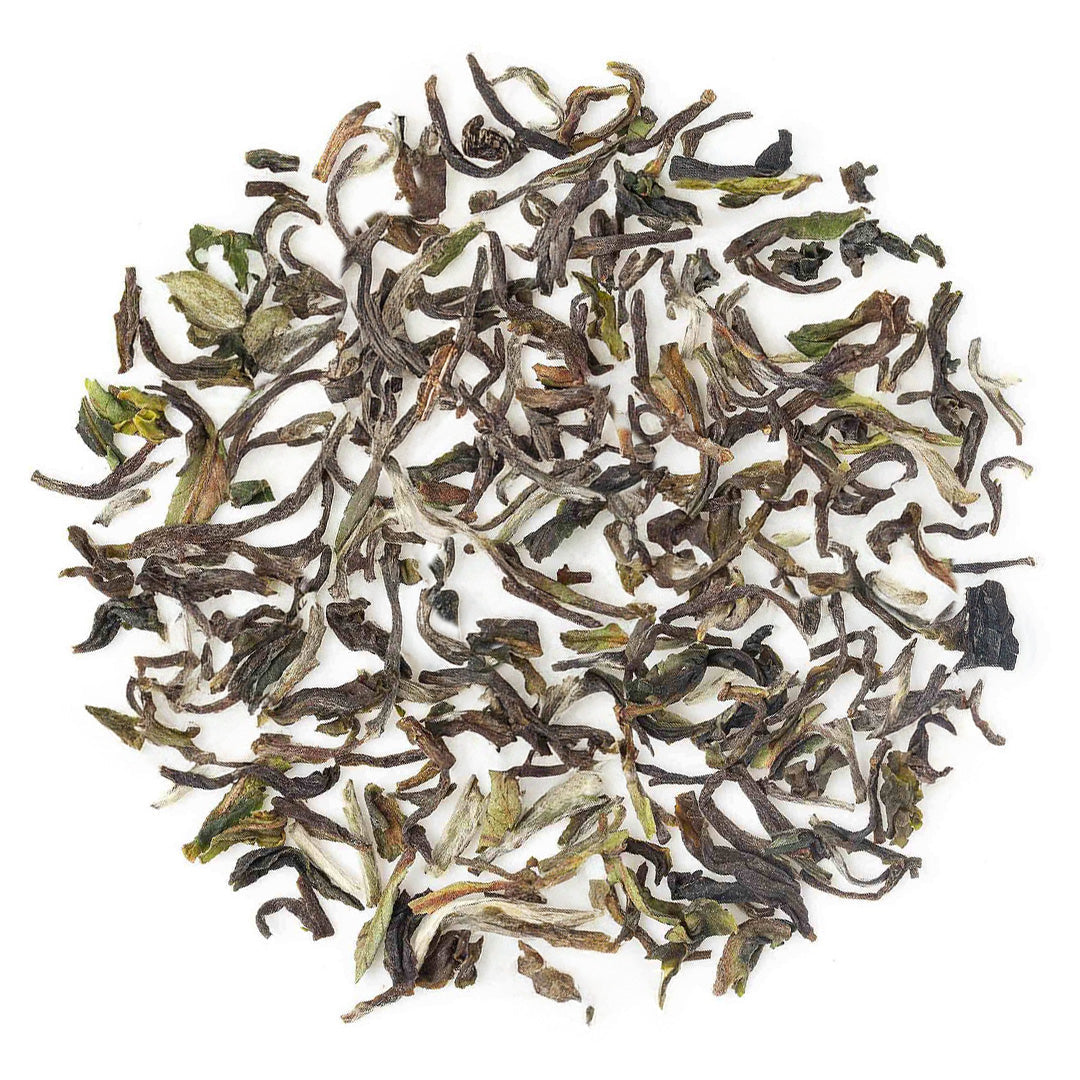
Most Darjeeling is made as black tea, but the gardens also make green, white and oolong teas from the same bushes. The difference is in the processing, mainly how much the leaf is allowed to oxidize. The bush matters too: old Chinary seedlings and newer clonals give different cups from the same hillside.
What is Darjeeling black tea?
Darjeeling black tea is the classic: an orthodox, whole-leaf black tea that is lighter and less oxidized than most black teas, especially in spring.Read more
That light touch is why a first flush can look half green in the packet. As our founder puts it, a Darjeeling “is as much an oolong as a black tea.” Our procurement team describes first flush dry leaf as having “a greenish hue,” with a liquor running from “sparkling gold to lighter shades of gold and even Champagne in case of Moonlight whites.”
The recipe changes with the season. “Unlike the Nilgiris, here every flush demands a different manufacturing pattern,” Veena Chordia of our procurement team told us in her first Darjeeling spring. Muscatel leaf, for example, is usually given a short wither and a longer oxidation, “cooked to perfection.”
Some black teas are made by hand on special nights. At Seeyok, an annual full-moon harvest sends 50 women out by lantern light to pluck the estate’s best section, and the batch is made into a muscatel. J.P. Gurung, one of Darjeeling’s most senior tea professionals, explained the custom to us. Seeyok still makes our summer muscatel: Seeyok Summer Muscatel Black.
How the leaf becomes black tea, step by step, is in How tea is made.
What is Darjeeling white tea?
Darjeeling white tea is made from young buds and leaves that are withered and dried with almost no other handling.Read more
Spring “Moonlight” whites from estates such as Badamtam, Castleton and Margaret’s Hope are among the most prized teas the hills make. See What is white tea?

How Moonlight whites are made
The Moonlight name comes from Yunnan’s Yue Guang Bai white tea. In Darjeeling the leaf gets minimal withering and the lightest of rolling, and the season is often just a week or so. A plucker collects just a few kilos in a special Moonlight round, against 10 to 12 kg on a normal day.
Quantities are tiny. Castleton’s Moonlight White came to just 4 kilograms for the 2015 first flush and 12 kg for the second. Around ten Darjeeling estates now make Moonlight whites. Peter Keen, writing for us, called the name “a fairly overt marketing claim: the mix of buds and leaf, harvesting, drying and expert judgment.”
Our whites, lot by lot
- Badamtam: our Spring Moonlight comes from section 9 of the Lamas division, at 4,500 feet, picked by specialist pluckers. It is made from a mix of the fragrant AV2, P126 and B157 clones.
- Mim: in spring 2018 a hailstorm before plucking “released flavors never before tasted” in our Mim white.
- Wonder Spring White: our master tasters evaluated over 150 white tea batches one spring and chose just 4 to 5 lots for it.
What are Darjeeling oolong and green tea?
Darjeeling oolong is partly oxidized, between green and black; Darjeeling green tea is heated soon after plucking so that it does not oxidize at all.Read more
Oolong
Darjeeling oolong was first made at Namring in the early 1990s, when Sumon Majumder experimented with Taiwanese methods. He was not happy with his first attempt, but it sold to Haelssen and Lyon of Hamburg, “the first time Namring had made and sold oolong.” In 1994 he joined Darjeeling Consolidated, then owner of Singbulli and Balasun, and took oolong with him.
Others followed. Singbulli makes oolong from AV2 bushes in its Tingling division. Goomtee bought a special Taiwanese machine to make oolongs, and Mim is known for oolongs from its clonal bushes. Glenburn’s Moonshine oolong is a modern example. More in What is oolong tea?
Green tea
Darjeeling green tea is heated soon after plucking to stop oxidation, giving a smooth, floral, gently vegetal cup. At Namring, green tea is made by “steaming the leaf and not fermenting it.” Our Darjeeling Green Tea is a whole-leaf example. See What is green tea?
What are Chinary and clonal Darjeeling teas?
Chinary teas come from the China-type bushes Darjeeling’s first gardens were planted with; clonal teas come from bushes grown from cuttings of selected plants, such as the fragrant AV2.Read more
Chinary: the old bushes
Darjeeling’s first gardens were planted with China-type seed, and many of those Chinary bushes are still producing. At Castleton, about 70% of the estate is Chinary, some of it over 130 years old. Margaret’s Hope works vintage Chinary bushes up to 100 years old, and Giddapahar’s autumn teas come from century-old China bushes.
Margaret’s Hope is about 90% Chinary, some very old and some just under 20 years. “With a good chinary you never know what to expect. It surprises you,” Arun Gurung, assistant manager of its Maharani division, told us. Goomtee’s first plucking of 2018 came from tea bushes over 50 years old, and its Chinary sections are more than 130 years old.
Clonals: the selected bushes
In recent decades, gardens have also planted clonals: bushes grown from cuttings of selected plants, such as the fragrant AV2 clone. Darjeeling clones are named for the estate that created them: AV2 stands for Ambari Vegetative, and its floral lift is “often described as ‘melon.’” A new clonal takes at least seven years from introduction to full-scale production.
AV2 is one of around thirty Darjeeling clonals; B157 comes from Bannockburn and P312 from Phoobsering. Gardens mix them with their old bushes:
- Margaret’s Hope: the 10% that is not Chinary is AV2, Takdah 7-8 (which “produces maximum tips”) and N-436.
- Castleton: its clones include AV2 and “Seeyok 1240.” AV2 leaves are short, grow stunted and look bright light green at the tips.
- Singbulli: our autumn tea there comes from AV2 clonals, an exclusive batch made for Teabox.
Which to choose
Labels often say which you are getting. Chinary teas tend to be more delicate and complex; clonal teas are often brighter, greener and more fragrant. Gomden puts the difference this way: Chinary flavors “differ significantly from place to place. Clonals, on the other hand, more or less produce the same flavor profiles, with varying intensities dependent on altitude.” See Chinary, Assam and clonal tea plants for more.
Keep reading
Sources
- Teabox blog: The Beginner’s Guide to Choosing a Darjeeling (2017), Meet the man who created the Darjeeling oolong (Namring, 2015), A Tryst with History (2020), The Muscatel Master (2021), A Postcard from Darjeeling (2015), The Kalpana Story (2022), A balancing act in the Darjeeling tea gardens (2015)
- Teabox blog: Tea in Germany & its Darjeeling Connection (2016), Seoul Searching for Darjeeling Tea (2015), In the wow zone at the Goomtee cottage (2015), God in the tea gardens (2015), Tea Diversity – How nature speaks through the flavors of tea (2020), Of Vivien Leigh, Peter Sarstedt & Toy Trains (2015), Going Clonal: How About a Nice Cup of AV2? (2016), Moonlight Sonatas: The Great White Teas (2016)
- Teabox blog: The Glenburn Boutique Hotel, Darjeeling (2017), The Steep Road Ahead (2020), A Nilgiri girl in Darjeeling (2017), Conversations from a tea garden (Jungpana, 2015), A Full Moon Harvest: Farming Biodynamically (Seeyok, 2021), Exploring co-existing spaces: wildlife and tea (2021), Hope and aspiration in Darjeeling’s tea gardens (2015), An Indian Summer in a Cup (2015)
- Teabox blog stories: the Castleton muscatel story; The Delight of Margaret’s Hope (2016); Creating Flavor in Mystical Isolation (2015); Pests welcome, say garden owners (2015); Clonals: the tea of the future (2016); The Future of Darjeeling’s Tea (2015); Walking Through Goomtee Tea Garden (2015)
- Teabox Tea 101 (old archive): The Darjeeling tea
- Teabox product descriptions and product data, 2026: Badamtam Exotic Spring White, Castleton Spring Chinary, Castleton Summer Muscatel, Castleton Moonlight Summer White, Okayti Spring and Autumn Chinary, Lopchu Golden Orange Pekoe, Exotic Moonlight White, Glenburn Spring Moonshine Oolong, Seeyok Summer Muscatel, Giddapahar Special Muscatel, Jungpana Spring Chinary, Mim Spring Chinary, Upper Namring Spring Clonal, Puttabong Spring Clonal, Singbulli Autumn Clonal, Risheehat Spring Chinary, Teabox Classic Summer Muscatel, Wonder Spring White
- Teabox Drive: Teabox internal document, 2020; Teabox internal document; Teabox internal document, 2023; Teabox internal document, 2023; Teabox internal document, 2024; Teabox internal document, 2018; Teabox internal document, 2017; Teabox internal document; Teabox internal document, 2016; Teabox internal document, 2023; Teabox internal document, 2018; Teabox internal document, 2017; Teabox internal document, 2024; photos as credited
- Teabox on Instagram (@teabox.tea): pluckers’ day, Mar 2022, Humans of Tea, Kurseong, Mar 2021, Margaret’s Hope bushes, Jul 2020, Giddapahar autumn, Nov 2024, toy train, Jan 2022, dormancy and 2022 season, Nov 2022, the 2.5 g sample, Apr 2021, Badamtam Moonlight, Mar 2023, Mim hail, Apr 2018, Singbulli oolong, May 2021, Goomtee first plucking, Mar 2018, Namring, Jun 2020, Books to Read at Namring, Dec 2020, Turzum, Aug 2021, Makaibari, Jul 2021, Jungpana bridge, Apr 2019, Darjeeling harvests, Feb 2022
- Kausshal Dugarr on X (@Teapreneur): the name Darjeeling, Sep 2022, First Flush 2022 tasting, May 2022, garden upkeep, May 2022, Second Flush 2022, Sep 2022, Nepal blending, Oct 2021, Darjeeling prices in Japan, Apr 2010
- Teabox on YouTube: What is a flush? (Masterclass), Is your Darjeeling tea fresh?
- Tea Board of India, Darjeeling Geographical Indication registration (2004)
- UNESCO World Heritage List, Mountain Railways of India (Darjeeling Himalayan Railway, 1999)


Leave a comment
All comments are moderated before being published.
This site is protected by hCaptcha and the hCaptcha Privacy Policy and Terms of Service apply.