


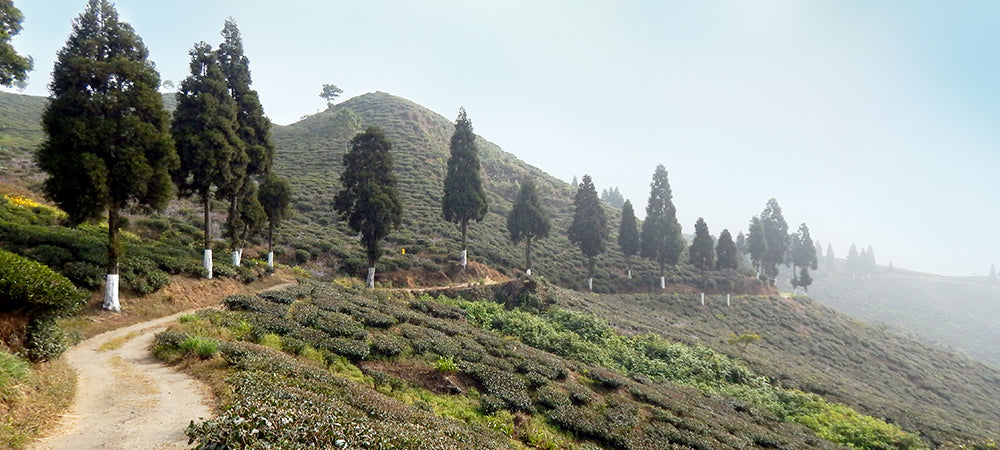
Darjeeling’s tea industry began in 1841, when Dr. Archibald Campbell planted China tea seeds in his garden, and the first commercial gardens followed in the early 1850s. Within a generation the hills were covered in tea. This page tells how it happened, who did the work, and what the gardens have lived through since independence.
How did tea come to Darjeeling?
Tea came with the British: the hill station was granted to the East India Company in 1835, and its first Superintendent, Dr. Archibald Campbell, proved in 1841 that China tea could thrive there.Read more

| When | What happened |
|---|---|
| 1835 | The ruler of Sikkim grants Darjeeling to the British East India Company as a cool hill station. |
| 1841 | Dr. Archibald Campbell, Darjeeling’s first Superintendent, plants China tea seeds and proves tea can thrive here. |
| 1850s | The first commercial gardens open; Alubari is planted in 1856. |
| 1866–1870s | Thousands of workers arrive from Nepal. Darjeeling has 39 gardens by 1866 and more than 100 by the 1870s. |
| 1881 | The Darjeeling Himalayan Railway, the “toy train,” reaches Darjeeling and starts carrying tea down to the plains. It became a UNESCO World Heritage Site in 1999. |
| 1947 | After independence, most British owners sell their gardens to Indian families and companies. |
| 2004 | Darjeeling tea becomes India’s first Geographical Indication. |
| Today | About 87 registered gardens produce roughly 7 million kg a year, a small fraction of India’s tea. |
When Campbell planted his seeds, he found about 25 families living on the ridge. As the land was parceled out, about 40% of each lot was cleared for tea and the rest left as forest.
Getting tea out of the hills was the next problem. The first road up from the plains, the Pankhabari road laid out by Lieutenant Napier, was replaced by a cart road in 1861, two decades before the toy train.
Some of the oldest gardens still trade on those years. Puttabong traces its start to 1852 “under the stewardship of Dr. Archibald Campbell.” Namring was founded in 1855 with “high quality Chinese tea bushes grown from seeds,” and Badamtam was first planted in 1858.
Who built the Darjeeling tea gardens?
Workers from Nepal built them: thousands came from the 1860s on, and their descendants still pluck, make and manage much of Darjeeling’s tea.Read more
The growth was fast. By 1866 there were 39 gardens making 21,000 kg of tea; four years later there were 56 gardens and 71,000 kg. Contractors such as Dakman Rai brought in thousands of Nepali workers, paid in seed, and Rai himself set up the Soureni (1878), Phuguri (1880) and Sampripani (1883) gardens.
Families stayed for generations. Arun Kumar Gomden, the veteran Darjeeling tea maker and master taster, is the fourth generation of his family in tea. His great-grandfather came from Nepal in the late 1870s as a labor contractor for the British planters and rose to the coveted post of Tea Maker Sardar. “In my family, there is a little joke,” Gomden told us: “there is more tea in our body than blood.”
Faith came with them. Most of Jungpana’s workers are Nepali Hindus, and a small Hanuman temple stands at the top of the garden’s “1,300-foot climb, up some 600 steps” to the factory. Missionaries left their mark too: German families founded Steinthal, still known informally as the “priest’s tea garden,” as well as Risheehat, Goomba and Tumsong.
How did the gardens grow into an industry?
Machines, money and the railway turned scattered gardens into an industry: by around 1900 there were 148 gardens on 18,475 hectares, and by 1947 they made 14 million kg a year.Read more
The planters mechanized early. W. O’Brien Ansell brought power rollers and sorting machines to the factories and laid electric cables to run them. The toy train, from 1881, took the finished tea down to the plains.
Independence changed who owned the gardens rather than how they worked. A few British planters, such as C.W. Emmett and T.J. Hardingham, stayed on after 1947. Over the following decades the estates passed to Indian families and companies:
- Namring: bought from Lord Inchcape in 1973 by the grandfather of Prateek Poddar, who runs it today.
- Goomtee: held by Henry Lennox from 1899 and by G.W. O’Brien until the Second World War, then by the royal family of Nepal, before passing to the Kejriwal family and Mahabir Prasad by the mid-1950s.
- Glenburn: owned for years by a large company with 52 estates, which sent a new manager every three years, until the Prakash family bought it; they spent their first night there on New Year’s Day 2001.
The story of the gardens themselves, from Castleton to Makaibari, is in Famous tea estates of India and in Darjeeling tea estates; the wider story is in The history of tea.
Who made Darjeeling’s first Silver Tips and muscatels?
Arun Kumar Gomden made the first Silver Tips at Thurbo in spring 1979, and is credited with naming the muscatel teas at Castleton in the mid-1980s; he later worked with Teabox’s tasting team.Read more
Gomden joined Singbulli in 1968 and moved to Thurbo in 1976. In spring 1979 he made a batch of 101 kg from buds with silver hairs, which took about a month “because a worker could only pluck about 100 g in a day.” At auction it sold for Rs 370, a world record at a time “when the best teas would fetch only about Rs. 100.”
In 1984 he was sent to Castleton as senior assistant and put in charge of building its new Springside factory. The muscatel he made there set new auction records, and the tea went on to be savored by Japan’s former Emperor Hirohito. The word itself, and the jassids and bushes behind it, are in Darjeeling muscatel tea.
What has Darjeeling tea lived through since 2000?
Darjeeling gained legal protection in 2004, but it has also lost output, a whole summer to the 2017 strike and much of a spring to the 2020 lockdown.Read more
Falling output
Today about 87 registered gardens produce roughly 7 million kg a year, down from 14 million kg in 1947. Margaret’s Hope, one of the best known, makes only about 230,000 kg of it.
The money is concentrated in a few months. “The central problem is that the entire year’s profitability depends on a small percentage of the production, produced between March and June every year,” Ashok Kumar, who owns Goomtee, told us in 2015. Prateek Poddar of Namring added: “The mistake we have always made is to put all our eggs in one basket. We focused on a single market, whether it was Russia or Germany.” Our 2018 market note puts the first flush at about 20% of the crop but about 40% of the revenue.
The lost summer of 2017
The Gorkhaland agitation of 2017 shut the gardens from mid-June to the end of September and wiped out the second flush; the plantations had made only around 20% of their summer teas before the halt. The demand for statehood is more than 100 years old, and the agitation of 1986 had been the worst until then. When work resumed, most gardens went into early skiffing, because the untended bushes had overgrown.
The lockdown spring of 2020
The pandemic lockdown came at the time of the most prized harvest of the year. Darjeeling lost about 0.8 million kg of prime spring flush tea, and when work restarted for the second flush, estates were allowed only 25 to 50% of their workforce.
What comes next
The quality is still there. In 2022 our founder found Darjeeling’s output excellent, with “excellent Moonlights and decadent spring teas,” but warned of a “dire need for upkeep of the gardens with proper pruning or skiffing.” Our buying team has also noted that the “new generation among plantation family itself doesn’t want to get into the business.”
Keep reading
Sources
- Teabox blog: The Beginner’s Guide to Choosing a Darjeeling (2017), Meet the man who created the Darjeeling oolong (Namring, 2015), A Tryst with History (2020), The Muscatel Master (2021), A Postcard from Darjeeling (2015), The Kalpana Story (2022), A balancing act in the Darjeeling tea gardens (2015)
- Teabox blog: Tea in Germany & its Darjeeling Connection (2016), Seoul Searching for Darjeeling Tea (2015), In the wow zone at the Goomtee cottage (2015), God in the tea gardens (2015), Tea Diversity – How nature speaks through the flavors of tea (2020), Of Vivien Leigh, Peter Sarstedt & Toy Trains (2015), Going Clonal: How About a Nice Cup of AV2? (2016), Moonlight Sonatas: The Great White Teas (2016)
- Teabox blog: The Glenburn Boutique Hotel, Darjeeling (2017), The Steep Road Ahead (2020), A Nilgiri girl in Darjeeling (2017), Conversations from a tea garden (Jungpana, 2015), A Full Moon Harvest: Farming Biodynamically (Seeyok, 2021), Exploring co-existing spaces: wildlife and tea (2021), Hope and aspiration in Darjeeling’s tea gardens (2015), An Indian Summer in a Cup (2015)
- Teabox blog stories: the Castleton muscatel story; The Delight of Margaret’s Hope (2016); Creating Flavor in Mystical Isolation (2015); Pests welcome, say garden owners (2015); Clonals: the tea of the future (2016); The Future of Darjeeling’s Tea (2015); Walking Through Goomtee Tea Garden (2015)
- Teabox Tea 101 (old archive): The Darjeeling tea
- Teabox product descriptions and product data, 2026: Badamtam Exotic Spring White, Castleton Spring Chinary, Castleton Summer Muscatel, Castleton Moonlight Summer White, Okayti Spring and Autumn Chinary, Lopchu Golden Orange Pekoe, Exotic Moonlight White, Glenburn Spring Moonshine Oolong, Seeyok Summer Muscatel, Giddapahar Special Muscatel, Jungpana Spring Chinary, Mim Spring Chinary, Upper Namring Spring Clonal, Puttabong Spring Clonal, Singbulli Autumn Clonal, Risheehat Spring Chinary, Teabox Classic Summer Muscatel, Wonder Spring White
- Teabox Drive: Teabox internal document, 2020; Teabox internal document; Teabox internal document, 2023; Teabox internal document, 2023; Teabox internal document, 2024; Teabox internal document, 2018; Teabox internal document, 2017; Teabox internal document; Teabox internal document, 2016; Teabox internal document, 2023; Teabox internal document, 2018; Teabox internal document, 2017; Teabox internal document, 2024; photos as credited
- Teabox on Instagram (@teabox.tea): pluckers’ day, Mar 2022, Humans of Tea, Kurseong, Mar 2021, Margaret’s Hope bushes, Jul 2020, Giddapahar autumn, Nov 2024, toy train, Jan 2022, dormancy and 2022 season, Nov 2022, the 2.5 g sample, Apr 2021, Badamtam Moonlight, Mar 2023, Mim hail, Apr 2018, Singbulli oolong, May 2021, Goomtee first plucking, Mar 2018, Namring, Jun 2020, Books to Read at Namring, Dec 2020, Turzum, Aug 2021, Makaibari, Jul 2021, Jungpana bridge, Apr 2019, Darjeeling harvests, Feb 2022
- Kausshal Dugarr on X (@Teapreneur): the name Darjeeling, Sep 2022, First Flush 2022 tasting, May 2022, garden upkeep, May 2022, Second Flush 2022, Sep 2022, Nepal blending, Oct 2021, Darjeeling prices in Japan, Apr 2010
- Teabox on YouTube: What is a flush? (Masterclass), Is your Darjeeling tea fresh?
- Tea Board of India, Darjeeling Geographical Indication registration (2004)
- UNESCO World Heritage List, Mountain Railways of India (Darjeeling Himalayan Railway, 1999)

Leave a comment
All comments are moderated before being published.
This site is protected by hCaptcha and the hCaptcha Privacy Policy and Terms of Service apply.