


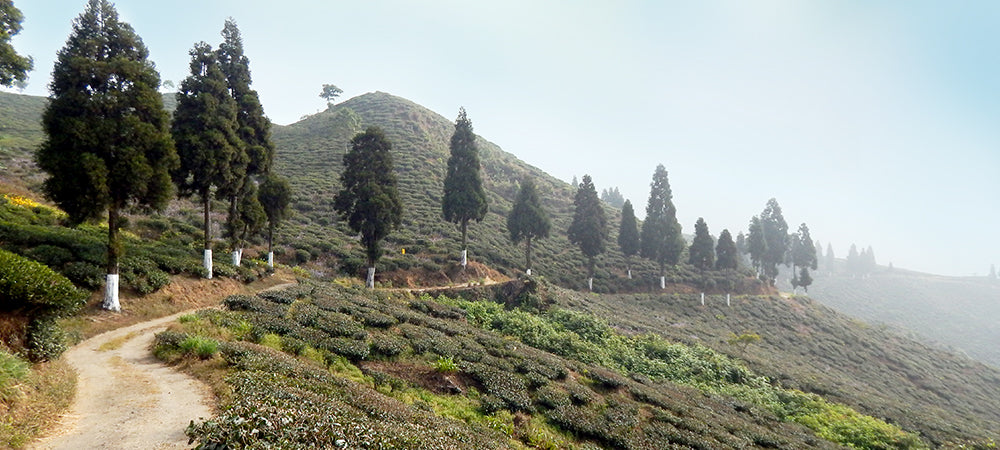
Teabox buys directly from estates across Darjeeling, including Castleton, Margaret’s Hope, Jungpana, Goomtee, Giddapahar, Okayti, Thurbo, Seeyok, Badamtam, Namring and Glenburn. Each has its own altitude, bushes and style, and many have a story behind the name: Jungpana from a dying nobleman’s plea for paani (water), Giddapahar from “eagle’s mountain,” Margaret’s Hope from a manager’s daughter who never made it back. Our guide to famous tea estates of India covers each garden, its history and its estate film.
Here they are valley by valley, with what we have learned on our visits. For where the valleys lie, see Where is Darjeeling tea grown?
Which Kurseong estates do we buy from?
In Kurseong we buy from Castleton, Margaret’s Hope and Giddapahar, among others, all gardens with old Chinary bushes and long records of fine summer teas.Read more
Castleton
Castleton was founded in 1885 by Dr. Charles Graham and was once known as “Kumseri”; it takes its name from a castle-like bungalow that once overlooked the garden. Our brief says the castle was “probably just a building left behind by a long-ago money lender.”
Its sections have names of their own: Bhalu Khop (the bear cave), Jim Basha (the manager’s domain), Dhobitar (the washerman’s clothes line) and Baseri (the resting place). About 70% of the estate is heritage Chinary. Castleton’s 1992 muscatel set a world auction record, and it won a gold medal at the North American Tea Conference in 2014.
Margaret’s Hope
The estate was “Bada Rington” until the time of J.G.D. Cruickshank, manager from 1896 to 1927. His young daughter Margaret loved it and promised to return, but died aboard ship on the way home to England.
Its 586.18 hectares fall into three gardens: Margaret’s Hope in the west, at 915 to 1,830 meters; Dilaram, at 762 to 1,951 meters; and Edenvale or Maharani, at 1,066 to 1,358 meters, bordering National Highway 55. The factory sign reads 4,590 feet above sea level. A school serves the children of its more than 1,200 employees, and no chemicals may be used within 30 feet of a path.
Care runs to the bushes and the wildlife. Each year the estate lab-tests the starch in the shoots to see which bushes can survive hard pruning. Salamander (Bhanjyang) Lake, dug in 1947 by manager L. Helegon, was abandoned in 1995 and revived in 2003 for its rare salamanders. Its pluckers know where the muscatel grows: “that part of the estate will emit a particular kind of fragrance.” Try it in Margaret’s Hope Spring Black.
Giddapahar
Giddapahar, “Eagle’s Mountain,” sits at 4,500 to 5,200 feet and has been worked by generations of the Shaw family since 1881. When we visited its owner, Sudhangshu Shaw, he went looking for ladybirds on the bushes, proof that he used no pesticide in his relatively small 240-acre garden; its second flush is “particularly coveted.”
What are Jungpana and Goomtee like?
Jungpana and Goomtee are neighboring Kurseong gardens, run by one family when we visited in 2015 and famous for their summer teas, and Jungpana is one of the hardest gardens in Darjeeling to reach.Read more


Jungpana
Jungpana lies 10 to 12 km south of Kurseong town, at 3,100 to 4,900 feet, and its Malderam division is full of old Chinary bushes. The factory has no access road: everything is hauled “some 600 steps” up the hillside, rations up and tea down, and in 2015 the rate was “Rs. 100 for every 50 kg up those steps.” The owner had to put up a tower to get a phone signal. The log bridge over the waterfall on the way up has since been replaced by a concrete one.
The isolation pays off in the cup. In 2015 Shantanu Kejriwal, who owned it then, showed us the 2013 front page of Kolkata’s The Telegraph, “A New Champion Rises in Darjeeling,” after Jungpana won its category at the North American Tea Championship. We describe its spring teas as “unripe fruits, sweet greens, and wet wood.” Its pluckers judge the year by the rain: “Last year, the rains were bad. Not a good harvest,” they told us in 2015. Try Jungpana Spring Chinary Black.
Goomtee
Goomtee makes about 90,000 kg of tea a year, and in 2015 its general manager, B.N. Mudgal, had 40 years in the business. Its owner then, Ashok Kumar, is the uncle of Jungpana’s Shantanu Kejriwal, and visiting buyers to both gardens stay at the Goomtee cottage.
Which Mirik estates do we buy from?
In Mirik, the high western valley on the Nepal border, we buy from Okayti, Thurbo, Seeyok, Singbulli and Selimbong.Read more
- Okayti: formerly Rangdoo; the story goes that London auctioneers marked its tea “OK,” and the name stuck. It lies about 45 km from Darjeeling town, on the Mechi river at the Nepal border, and its factory dates from 1888.
- Thurbo: where Arun Kumar Gomden made Darjeeling’s first Silver Tips in spring 1979. Try Thurbo Classic Spring Chinary.
- Seeyok: founded in 1869, at 3,000 to 6,000 feet near the Indo-Nepalese border, and run by the third generation of the Mohan family as part of Tea Promoters India. It has 154 hectares under tea, interplanted with lemongrass, neem and native plants that hold the soil in the monsoon.
- Singbulli: “home of the birds,” established in 1924 between 2,500 and 4,500 feet; we travel there for its AV2 clonals.
Which other Darjeeling estates do we buy from?
Beyond Kurseong and Mirik we buy from gardens near Darjeeling town and along the Teesta and Rangeet rivers, including Badamtam, Namring, Glenburn, Puttabong, Mim and Risheehat.Read more
- Badamtam: planted in 1858 by the British planter Christine Barnes, with a name usually traced to the Lepcha for “bamboo water carrier.” It was commercially started by the Lebong Tea Company in the late 1860s; a suspension bridge over the Rangeet links it to Sikkim, and a 14-foot Buddha by the artist Meera Mukherjee was completed after her death in 1998.
- Namring: one of the oldest and largest factories in Darjeeling, making some 300,000 kg a year. Its three divisions, Poomong, Jinglam and Namring, lie between the eastern slopes of Tiger Hill and the Teesta. Our Books to Read initiative took books to Namring’s children in 2020.
- Glenburn: established in 1859 by a Scottish tea company, where the Rungeet and Rung Dung rivers meet the slopes. Its owners run a small hotel on the estate, and through their guests they sponsor 46 children at private schools in the region.
- Puttabong: near the Rangeet valley on the Sikkim border, stretching from roughly 2,000 to 6,500 feet.
- Mim: the only tea garden in Darjeeling owned by the Government of India. Its name comes from “Mem ko Kaman,” the British lady’s garden. A worker’s son there told us he wants to be a doctor: “We have to travel 20 km to see a doctor now.”
- Risheehat: first called Tshering Bagan after the local Tshering people, later renamed “Home of Holy Saints”; a compact 141 hectares, mostly east-facing, in two sections, Risheehat and Liza Hill.
- Turzum: planted around the 1860s in the Rungbong valley near Mirik, among wild Cymbidium orchids.
Not every garden has had an easy road. Avongrove had been closed for 28 years before new management reopened it. Makaibari dates its tea to 1852, when Girish Chandra Banerjee saw local people growing maize (makai) on the slopes at 4,800 feet.
Keep reading
Sources
- Teabox blog: The Beginner’s Guide to Choosing a Darjeeling (2017), Meet the man who created the Darjeeling oolong (Namring, 2015), A Tryst with History (2020), The Muscatel Master (2021), A Postcard from Darjeeling (2015), The Kalpana Story (2022), A balancing act in the Darjeeling tea gardens (2015)
- Teabox blog: Tea in Germany & its Darjeeling Connection (2016), Seoul Searching for Darjeeling Tea (2015), In the wow zone at the Goomtee cottage (2015), God in the tea gardens (2015), Tea Diversity – How nature speaks through the flavors of tea (2020), Of Vivien Leigh, Peter Sarstedt & Toy Trains (2015), Going Clonal: How About a Nice Cup of AV2? (2016), Moonlight Sonatas: The Great White Teas (2016)
- Teabox blog: The Glenburn Boutique Hotel, Darjeeling (2017), The Steep Road Ahead (2020), A Nilgiri girl in Darjeeling (2017), Conversations from a tea garden (Jungpana, 2015), A Full Moon Harvest: Farming Biodynamically (Seeyok, 2021), Exploring co-existing spaces: wildlife and tea (2021), Hope and aspiration in Darjeeling’s tea gardens (2015), An Indian Summer in a Cup (2015)
- Teabox blog stories: the Castleton muscatel story; The Delight of Margaret’s Hope (2016); Creating Flavor in Mystical Isolation (2015); Pests welcome, say garden owners (2015); Clonals: the tea of the future (2016); The Future of Darjeeling’s Tea (2015); Walking Through Goomtee Tea Garden (2015)
- Teabox Tea 101 (old archive): The Darjeeling tea
- Teabox product descriptions and product data, 2026: Badamtam Exotic Spring White, Castleton Spring Chinary, Castleton Summer Muscatel, Castleton Moonlight Summer White, Okayti Spring and Autumn Chinary, Lopchu Golden Orange Pekoe, Exotic Moonlight White, Glenburn Spring Moonshine Oolong, Seeyok Summer Muscatel, Giddapahar Special Muscatel, Jungpana Spring Chinary, Mim Spring Chinary, Upper Namring Spring Clonal, Puttabong Spring Clonal, Singbulli Autumn Clonal, Risheehat Spring Chinary, Teabox Classic Summer Muscatel, Wonder Spring White
- Teabox Drive: Teabox internal document, 2020; Teabox internal document; Teabox internal document, 2023; Teabox internal document, 2023; Teabox internal document, 2024; Teabox internal document, 2018; Teabox internal document, 2017; Teabox internal document; Teabox internal document, 2016; Teabox internal document, 2023; Teabox internal document, 2018; Teabox internal document, 2017; Teabox internal document, 2024; photos as credited
- Teabox on Instagram (@teabox.tea): pluckers’ day, Mar 2022, Humans of Tea, Kurseong, Mar 2021, Margaret’s Hope bushes, Jul 2020, Giddapahar autumn, Nov 2024, toy train, Jan 2022, dormancy and 2022 season, Nov 2022, the 2.5 g sample, Apr 2021, Badamtam Moonlight, Mar 2023, Mim hail, Apr 2018, Singbulli oolong, May 2021, Goomtee first plucking, Mar 2018, Namring, Jun 2020, Books to Read at Namring, Dec 2020, Turzum, Aug 2021, Makaibari, Jul 2021, Jungpana bridge, Apr 2019, Darjeeling harvests, Feb 2022
- Kausshal Dugarr on X (@Teapreneur): the name Darjeeling, Sep 2022, First Flush 2022 tasting, May 2022, garden upkeep, May 2022, Second Flush 2022, Sep 2022, Nepal blending, Oct 2021, Darjeeling prices in Japan, Apr 2010
- Teabox on YouTube: What is a flush? (Masterclass), Is your Darjeeling tea fresh?
- Tea Board of India, Darjeeling Geographical Indication registration (2004)
- UNESCO World Heritage List, Mountain Railways of India (Darjeeling Himalayan Railway, 1999)

Leave a comment
All comments are moderated before being published.
This site is protected by hCaptcha and the hCaptcha Privacy Policy and Terms of Service apply.