


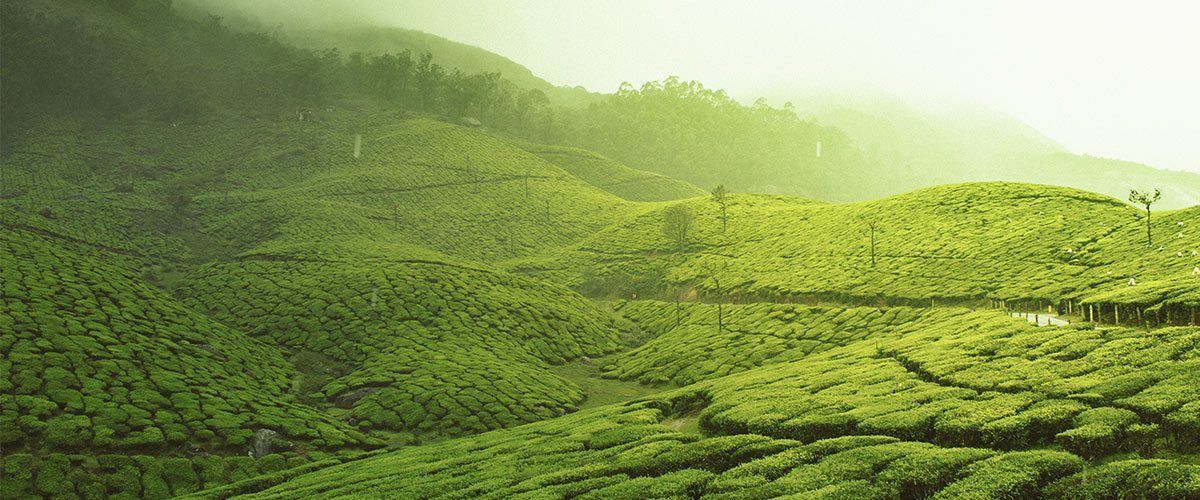
In the 19th century Munnar was part of the kingdom of Travancore, and its tea story begins with a lease of 1877 and a first planting in 1880. Large planting companies soon followed, and Munnar became a serious tea district. For the region today, its taste and the worker-owned estates, start with our guide to Munnar tea.
Who leased the Kannan Devan hills for tea?
In 1877 the local prince who held the Kannan Devan hills leased 136,600 acres of them to John Daniel Munro, a Briton working in Travancore, for a security deposit of Rs 5,000 and an annual rent of Rs 3,000.Read more
Munro is thought to be the first European to visit the area, in the 1870s. He was on his way to settle a boundary dispute between Travancore and the Madras Presidency when he stopped at Munnar and found it beautiful.
The hills belonged to a local prince, named in our sources as Kela Varma Raja. Munro called on him at his palace, and in 1877 the prince agreed to the lease.
The names behind the hills
Our 2017 research notes, written while we prepared the Tea 101 post, add more names. They say the hills were the “Jenmam land,” a hereditary holding, of the Poonjar royal family, and give the prince’s fuller name as Rohini Thirunal Kerala Varma Valiya Raja.
The same notes say Munro was “accompanied by Kannan Thevar, the tribal chief of Anchunadu,” and the hills still carry the chief’s name as Kannan Devan. So does the company that owns most of the estates today.
Who planted the first tea in Munnar?
The first recorded tea in Munnar was planted in 1880 by A. H. Sharp, after Munro’s planting society had tried out several other crops. Printed histories also credit a Chinese tea maker, John Ajoo, with an early 13-acre field there.Read more
By 1879, Munro had formed the North Travancore Land Planting and Agricultural Society, and its members began cultivating various crops. Sir Percival Griffiths’ history of the Indian tea industry (1967) names two of them: Henry Gribble Turner and his half-brother A. W. Turner, “joint concessionaires with Munro.” A. W. Turner cleared land at Devikulam for cinchona, the tree that gives quinine, and Munnar itself was first opened “with cinchona and coffee.”
Tea followed in 1880, when A. H. Sharp planted the first of it. Our 2017 research notes place that first planting on 50 acres at Parvathy, land that now belongs to the Seven Mallay Estate.
John Ajoo and the “Chinaman’s field”
In 2016 a descendant of John Ajoo sent us a family history that quotes three printed books on another early planting. UPASI’s 1953 history describes Ajoo as one of six Chinese tea makers who came to the Nilgiri Hills in the last days of the East India Company to advise on tea planting and manufacture.
Later, the same history says, H. G. Turner brought him to the High Range, where he planted a small field of tea around what is now the Munnar Estate manager’s bungalow. The field was 13 acres and “used to be known as ‘Chinaman’s field’.” Griffiths gives the credit to A. W. Turner, “with the help of a Chinese, John Ajoo,” for thirteen acres of tea at Munnar.
S. Muthiah’s centenary history of the planters’ association, A Planting Century (1993), adds that Ajoo’s son Anthony later owned a small estate called Vialkadavu, next to Talliar. We interviewed Muthiah, the chronicler of planting in south India, for our blog: A chronicler of the Nilgiris, S. Muthiah.
Neither book quoted gives a date for Ajoo’s field, so Sharp’s 1880 planting remains the first on record.
How did Munnar grow into a tea district?
Munnar grew through the big planting companies: Finlay Muir and Company bought up most of the estates by the 1890s, and the business later passed to the Tatas and, in 2005, to its workers.Read more
Soon after tea arrived, Finlay Muir and Company entered the region and acquired more than 30 estates. Our 2017 research notes put the number at 33, bought in 1895, and say the estates were later managed by the Kannan Devan Hills Produce Company, formed in 1897.
Things were progressing well until 1924, when Munnar suffered one of the heaviest monsoons on record. Floods and landslides brought loss of life and property, and it took several years for the community to regain its footing.
The Tata years
Finlay’s business merged with the Tatas in 1964, as the Tata-Finlay group, and by 1983 Tata Tea had been formally created. Tata Tea started out as Tata Finlay Ltd, operating alongside Finlay and Company of Glasgow; by the late 1990s it had set its sights on becoming a global name.
In 2005 the Tatas handed the plantations to a new company, Kannan Devan Hills Plantations, with its workers as the main shareholders. How that worked, and what it means today, is on our main Munnar tea page.
Munnar tea timeline
| When | What happened |
|---|---|
| 1870s | John Daniel Munro, traveling through Travancore, visits the Kannan Devan hills. |
| 1877 | The local ruler leases Munro 136,600 acres of the hills. |
| 1879 | Munro forms the North Travancore Land Planting and Agricultural Society. Its members try out several crops. |
| 1880 | A. H. Sharp plants the first tea. |
| Soon after | Finlay Muir and Company arrives and acquires more than 30 estates (33 in 1895, by our 2017 research notes). |
| 1897 | The Kannan Devan Hills Produce Company is formed to manage the estates (our 2017 research notes). |
| 1924 | One of the heaviest monsoons on record brings floods and landslides, with loss of life and property. Recovery takes years. |
| 1964 | Finlay’s business merges with the Tatas as the Tata-Finlay group. |
| 1983 | Tata Tea is formally created. |
| 2005 | Tata hands the plantations to a new company, Kannan Devan Hills Plantations, with its workers as the main shareholders. |
Who built the Munnar estates?
The estates were built by workers who came up from the plains of Tamil Nadu and Kerala, and run by British planters whose lives centered on the bungalow and the club.Read more
The labor movement grew early in this part of India. A Nilgiri planter told our blog that estate welfare in the neighboring Nilgiris began in the 1930s partly because trade unions were already taking shape in the princely states of Cochin and Travancore, present-day Kerala. Read more in The Changing Face of Tea Gardens in the Nilgiris.
Club nights
For the planters, the club was the center of social life. Ravi Mathews, a senior planter, has described Saturday nights at the Peermade Club, in another of Kerala’s planting districts, in the 1960s, when he was a “creeper,” as newly minted assistant managers were called.
“Saturday nights were Club Nights and once a month, films were projected on an ancient 35 mm projector,” he remembered, and the best part was a refill each time the projectionist changed the reels. Read the full story in Tea Days and Club Nights.
The old pattern of distant owners and resident managers ended in Munnar in 2005, when the estates passed to the people who work on them.
Keep reading
Sources
- Teabox Tea 101: Munnar, a community-run tea industry (2017); The Nilgiris: blue mountains, shola forests and aromatic tea (2017)
- Teabox blog: The Changing Face of Tea Gardens in the Nilgiris (Nina Varghese, 2016); Tea Days and Club Nights (Nina Varghese, 2016); Making the Perfect Tea (Bakula Nayak, 2015); The Authentic Indian Chai Experience (Prachi Jain, 2023)
- Teabox blog: A Nilgiri girl in Darjeeling (Aravinda Anantharaman, 2017); A House for Chinna Dorai – Estate Bungalows in the Nilgiris (2017); A chronicler of the Nilgiris, S. Muthiah (Nina Varghese, 2017)
- Teabox blog (Still Steeping), From Coonoor to Mincing Lane: The History of the Nilgiri Tea, 2016
- Printed histories, as quoted in an unpublished 2016 guest submission to Teabox (Teabox internal document, 2016): UPASI history volume (1953); Percival Griffiths, The History of the Indian Tea Industry (1967); S. Muthiah, A Planting Century: The First Hundred Years of the United Planters’ Association of Southern India, 1893–1993 (1993)
- Teabox Drive: Teabox internal document (2017, draft for Tea 101); Teabox internal document (2023); Teabox internal document; photos as credited
- Teabox purchase and correspondence records with Kanan Devan Hills Plantations, 2015 to 2019 (internal, not linked)
- Teabox product descriptions: Wayanad Cardamom Chai, Classic Assam Black, Nilgiri Havukal, Glendale and Billimalai Winter Frost Black, October 2026
- Teabox on Instagram (@teabox.tea): Wayanad Cardamom chai, Dec 2016, Café Biennale, Dec 2016, Kochi-Muziris Biennale, Jan 2017, most popular chai, Feb 2020
- Kausshal Dugarr on X (@Teapreneur): Tata Tea and Finlay, Jan 2023

Leave a comment
All comments are moderated before being published.
This site is protected by hCaptcha and the hCaptcha Privacy Policy and Terms of Service apply.