


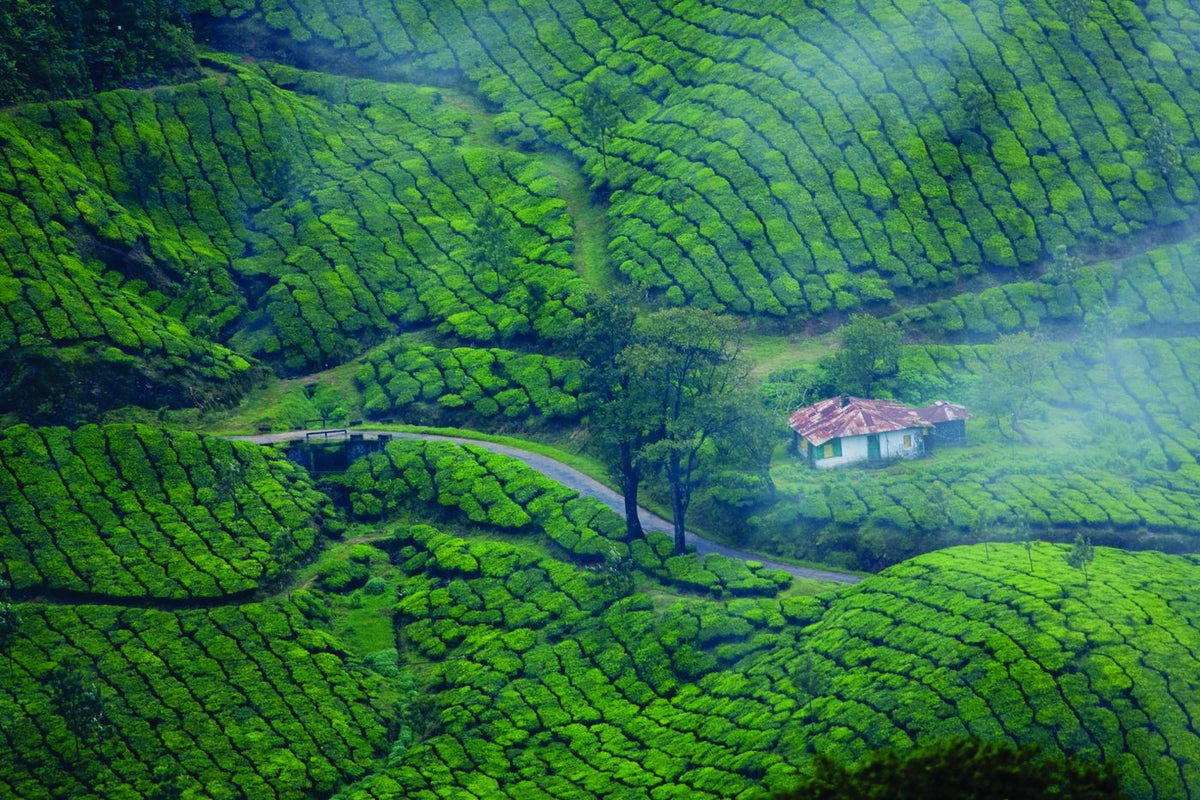
Munnar tea is tea, mostly black, grown in the Kannan Devan hills around Munnar, a hill town about 1,500 m up in the Western Ghats of Kerala, south India. Tea has grown here since 1880. The classic Munnar cup is strong and brisk, with a clean, biscuity aroma, and most of the area’s big estates now belong to a company largely owned by the people who work on them.
At a glance
- WhereMunnar, in the Western Ghats of Kerala, south India
- TasteClean, biscuity aroma; strong, brisk, rounded
- Brew90–95°C · 3–4 min · plain or with milk
Where is Munnar, and what is Kerala tea?
Munnar is a hill town in the Idukki district of Kerala, in the Western Ghats mountains that run down the west coast of India, and it is the heart of Kerala tea.Read more
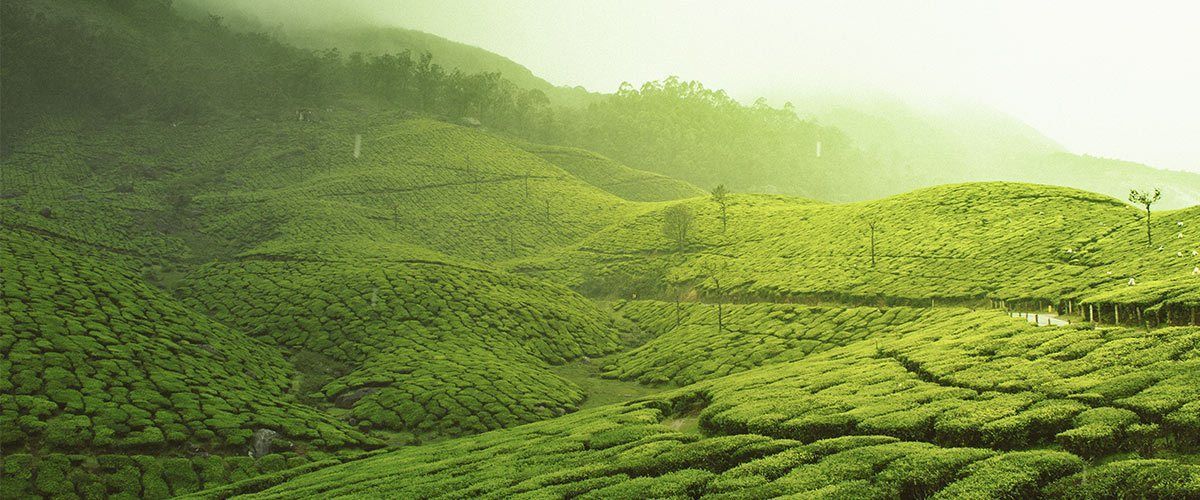
The town sits at about 1,500 m, and the tea gardens climb the slopes around it on every side. The hills here are the Kannan Devan hills, which planters have long called the High Range. The town’s own name is usually explained as “three rivers,” after the streams that meet there.
The plantation company that owns most of the estates gives its address as KDHP House, Munnar, Idukki District, Kerala, on the papers it has sent us over the years.
Shola country
Like the Nilgiris to the north, Munnar is shola country: pockets of dense evergreen forest in the folds of the hills, with open grassland on the ridges above. Cool air, heavy monsoon rain and rich forest soil make it one of the main tea regions of south India, and the best known in Kerala.
That forest matters for more than the view. As our blog noted in its profile of a Nilgiri-born member of our procurement team, two of India’s four biodiversity hotspots are in the two mountain ranges that hold its great tea hills, the Himalayas and the Western Ghats. Read A Nilgiri girl in Darjeeling.
Kerala tea beyond Munnar
Tea also grows in other hill districts of the state, such as Wayanad in the north, but when people talk about Kerala tea, Munnar is usually what they mean. Another old planting district, Peermade, appears in our blog’s story of planters’ club nights; it is told on our history of Munnar tea page.
India’s tea map runs from the Himalayas in the northeast to these southern hills. For the whole picture, see our guide to Indian tea regions, and for the bigger story of tea in India, Indian tea: the complete guide.
How did tea come to Munnar? A short history of the High Range
Tea came to Munnar in 1880, three years after a Briton named John Daniel Munro leased the Kannan Devan hills from a local ruler and began clearing them for plantations. Large planting companies soon followed, and Munnar became a serious tea district.Read more
The full story has its own page: Munro’s lease of 136,600 acres, the Chinese tea maker John Ajoo and his 13-acre “Chinaman’s field,” the Finlay estates, the 1924 floods and the Tata years.
Read nextHistory of Munnar teaFrom Munro’s 1877 lease and the first tea of 1880 to the Tata years and a timelineWho owns the tea estates in Munnar?
Most of Munnar’s big tea estates belong to Kannan Devan Hills Plantations (KDHP), a company that has been majority owned by its own employees since 2005. It is one of the best-known examples of a worker-owned tea business in India.Read more
In 2005 the Tatas decided to step back from running the Munnar plantations. Instead of selling them, they proposed a participatory model and handed the business to the people who worked on it.
According to the figures in our 2017 Tea 101 post, about 98% of the 13,000 workers became shareholders, together owning around 68% of the company. Tata Tea kept 18%, and a trust and other stakeholders held the remaining 14%. Each worker held at least 300 shares.
The change turned a loss-making business back into a profitable one, and in Munnar the model has worked well for the industry and for the workers alike. It is a very different story from the old plantation pattern of distant owners and resident managers.
Teabox and KDHP
We know the company as a supplier, not only as a story. Teabox has bought tea directly from KDHP, dealing with its marketing office in Munnar, and our team has kept in touch with the company since at least 2015.
On its own papers the company spells its name Kanan Devan, with one n in Kanan; most writers, and this guide, use Kannan. No Munnar tea is in our shop today, and the last section of this guide suggests the closest teas we do sell.
Can you visit the tea gardens in Munnar?
Yes. Munnar is one of south India’s most popular hill stations, and walking through the tea gardens, touring a working tea factory and visiting the tea museum are the main things visitors come for. Many people who look up a Munnar tea plantation are planning a trip.Read more

The cool weather and green hills made Munnar a favorite retreat long ago, and today tea and tourism are its twin trades. A trip usually takes in:
- The tea gardens: roads and estate tracks run right through the gardens, so you see the bushes up close, often with pluckers at work on the slopes.
- A tea factory: a factory visit shows how fresh leaf becomes black tea, through withering, rolling, oxidation, drying and sorting. Our guide to how tea is made explains each step.
- The tea museum: run by the plantation company in Munnar, it shows the machines, photographs and methods used on the estates since the early days. Our 2017 research notes place it at KDHP’s Nallathanni Estate.
- A night on an estate: several old estate bungalows and tea valley resorts take guests, and waking up among the bushes is the best way to see the gardens in the early light.
When is the best time to visit Munnar?
The cooler, drier months after the monsoon, roughly September to March, are the most comfortable for walking in the gardens. The southwest monsoon brings very heavy rain from about June to August, when the hills are at their greenest but mist and landslides can close roads.
Once every twelve years or so, the slopes around Munnar turn blue when the kurinji shrub flowers, the same bloom that gave the Nilgiris, the “blue mountains,” their name.
Where to drink tea in Kerala
Outside the estates, Kerala drinks its tea at the chai kada, the small chai stall found on almost every corner of the state. Our blog’s tour of regional chai describes cups served with pazham pori and bonda, the local snacks, alongside.
Teabox once served tea in Kerala too, at the Kochi-Muziris Biennale in Fort Kochi; that story is in the last section of this guide.
What does Munnar tea taste like?
Munnar orthodox tea has a clean, biscuity aroma and a strong, brisk taste that rounds out in the cup. It is a full, wake-up black tea rather than a delicate one, with enough body to take milk.Read more
- Aroma: clean and biscuity, like a plain tea biscuit.
- Taste: strong and brisk, with a lively, clean edge.
- Body: rounded and full, strong enough for milk.
- Best with: plain for a bright morning cup, or with a splash of milk.
Orthodox and CTC
Munnar makes both orthodox tea, from whole and broken leaf rolled the traditional way, and CTC tea, with the leaf cut into small granules for a quick, strong brew. The orthodox teas are the ones to look for if you drink your tea plain.
The CTC teas go into strong blends and the milky, sweet chai of everyday tea stalls. Not sure of the difference? Read Orthodox vs CTC tea, and for strong CTC chai, Karak (kadak) chai.
A year-round harvest
Unlike Darjeeling and Assam, where the bushes rest from about December to February, tea in the south of India grows through most of the year, so the hills do not have the same sharp line of spring and summer flushes.
Our own notes on the Nilgiris, the nearest region we buy from, explain why. In winter and early spring the bushes there grow more slowly but are not pruned as they are in the north, so the factories keep making tea. Our 2023 training deck lists the Nilgiris as producing through the year. Our guide to the seasons of tea covers how this differs from region to region.
What we can and cannot tell you
Every tea we sell is tasted and selected by our team in Siliguri, and the cup notes on our product pages come from those tastings. We have bought tea from Munnar, but we have never listed a Munnar tea or published our own notes on one, so the description above comes from our 2017 Tea 101 guide rather than a current tasting.
What is the difference between Munnar and Nilgiri tea?
Munnar and Nilgiri teas are close cousins: both grow in the Western Ghats with a similar climate, but Munnar tea is known for a strong, brisk, biscuity cup, while Nilgiri tea is known for its fragrance, tropical fruit notes and winter frost teas. Munnar is in Kerala; the Nilgiris are just to the north, in Tamil Nadu.Read more
| Munnar | Nilgiri | |
|---|---|---|
| State | Kerala | Tamil Nadu |
| Hills | Kannan Devan hills (the High Range), Western Ghats | The Nilgiris (“blue mountains”), Western Ghats |
| Altitude | About 1,500 m at the town | About 1,000–2,500 m |
| Tea since | 1880 | Experiments from 1835; first commercial estates by 1859 |
| Harvest | Through most of the year | Year round, with a winter frost flush from late December to March |
| Typical cup | Strong, brisk, clean and biscuity | Aromatic; flowers and tropical fruit |
| Specialty | Worker-owned estates; tea tourism | Winter frost teas, picked in the coldest months |
| At Teabox | Not stocked | All Nilgiri teas |
The two regions share the same mountain chain, the same shola landscape and a similar history of British planters, so it is no surprise their teas resemble each other. The ties run into the buildings too: many early Nilgiri planters came over from Ceylon after the coffee blight, bringing Ceylonese carpenters and masons of Kerala origin, and the steep tiled roofs of the older Nilgiri bungalows show their work.
What our tasters say about the Nilgiri side
The Nilgiris have made a name for fragrant, high-grown orthodox teas and especially for frost teas, picked when cold, clear winter nights slow the bushes down. Our 2023 training deck puts the Nilgiri gardens at 1,000 to 2,500 m, making both orthodox and CTC tea.
Our tasters’ 2017 notes add two working details. Nilgiri tea generally does not turn cloudy as it cools, which is why it also makes good iced tea. And the winter teas are made from the new shoots that come 10 to 15 days after one or two December showers.
Read Nilgiri tea for the region, and Winter and frost teas from the Nilgiris for its most prized season.
How do you brew Munnar tea?
Brew Munnar orthodox tea with about 2 to 2.5 g of leaf (a heaped teaspoon) per 250 ml cup, in water at 90–95°C, for 3 to 4 minutes. For a milky cup, use water just off the boil (95–100°C) and steep for 4 to 5 minutes, as you would an Assam.Read more
- Measure: about 2 to 2.5 g of leaf, or one heaped teaspoon, for each 250 ml (8 oz) cup.
- Heat the water: 90–95°C (195–203°F) to drink it plain, or 95–100°C (203–212°F) if you plan to add milk.
- Steep: 3 to 4 minutes plain, 4 to 5 minutes for milk tea. Taste before you add anything.
- Strain and serve: plain, or with a splash of milk. If it is too strong, add a little hot water rather than steeping for less time next round.
The three ways a cup goes wrong
One of our writers met all of them on a family trip across Kerala. In boutique hotels and homestays alike, she found the tea “too milky in some places, too watery at others, and downright insipid at some others.”
One morning at a homestay she asked the lady of the house if she could make her own, and came back from the kitchen with two cups that finally pleased her mother. Her story, Making the Perfect Tea, is a good read before a trip. The fixes are the ones above: enough leaf, hot enough water, a full steep, and milk added only to taste.
CTC tea from Munnar is made for boiling with milk, sugar and spices. For that, follow How to make masala chai at home; for every other tea, our guide to brewing loose leaf tea has a full chart.
Which Teabox teas are like Munnar tea?
Teabox does not currently sell a Munnar tea; the closest teas in our range are the single-estate Nilgiri teas from the same Western Ghats, and, for Munnar’s strong, milk-friendly style, a classic Assam. For a taste of Kerala itself, our Wayanad Cardamom Chai takes its name from the Wayanad hills in the north of the state.
- For Munnar’s mountain character: Nilgiri Havukal Winter Frost Black, from eastern-facing slopes at 5,500–6,000 ft, or Nilgiri Glendale Winter Frost Twirl Black, with delicate florals, stone fruit and a sharp wintergreen finish.
- For a strong cup with milk: Classic Assam Black, full-bodied and malty, with yellow raisins, date palm and stone fruit. Read why in Assam tea.
- For Kerala in a cup: Wayanad Cardamom Chai, black tea blended with half-beaten cardamom pods. More on the spice and the drink in Cardamom (elaichi) chai.
Kerala and Teabox
When we built our range of regional chais, Wayanad Cardamom Chai stood for the south, alongside Punjabi Masala Chai from the north, Kolkata Street Chai and Assam Masala Chai from the east, and Bombay Cutting Chai from the west. Our 2023 training deck lists it among chai blends “inspired from all corners of our country.”
Wayanad Cardamom Chai has long been one of our most-loved chais. It has been in the range since at least 2016, when we were already calling it “our famed Wayanad Cardamom chai,” and in 2020 we called it our most popular.
Kerala and Teabox go back a while, too: in the winter of 2016–17 Teabox was the official tea partner of the Kochi-Muziris Biennale, serving fresh tea at Café Biennale in Aspinwall House, Fort Kochi, and at cafés across Kochi, all through the festival.
Munnar tea FAQ
What is Munnar tea known for?
Munnar tea is known for a strong, brisk black tea with a clean, biscuity aroma, grown in the Kannan Devan hills of Kerala since 1880. Munnar is also known for its worker-owned plantation company, Kannan Devan Hills Plantations, and for tea tourism.
When is the best time to visit Munnar’s tea gardens?
The cooler, drier months after the monsoon, roughly September to March, are the most comfortable. The heaviest rain falls from about June to August, when the gardens are lush but roads can be closed by mist and landslides.
Is Munnar tea the same as Nilgiri tea?
No, but they are close. Both grow in the Western Ghats with a similar climate. Munnar is in Kerala and is known for strong, brisk tea; the Nilgiris are in Tamil Nadu and are better known for fragrant teas and winter frost teas. See our Nilgiri tea guide.
Who owns the tea estates in Munnar?
Most of the big estates belong to Kannan Devan Hills Plantations, a company majority owned by its employees since 2005, when the Tatas handed the business to its workers and kept a minority share.
Who planted the first tea in Munnar?
The first recorded tea was planted in 1880 by A. H. Sharp. Printed histories also credit a Chinese tea maker, John Ajoo, with an early 13-acre field known as “Chinaman’s field.” See our history of Munnar tea.
Does Munnar tea have caffeine?
Yes. It is black tea, so it has about as much as any black tea: Tea 101 puts a cup at about 50 mg, against about 90 to 95 mg for coffee. The amount varies with the leaf, the quantity, the water temperature and the steeping time. See Caffeine in tea.
Does Teabox sell Munnar tea?
Not at the moment, though we have bought tea from Kannan Devan Hills Plantations. The closest teas in our range are our single-estate Nilgiri teas, from the same mountain chain, and Wayanad Cardamom Chai, named after Kerala’s Wayanad district.
Keep reading
Sources
- Teabox Tea 101: Munnar, a community-run tea industry (2017); The Nilgiris: blue mountains, shola forests and aromatic tea (2017)
- Teabox blog: The Changing Face of Tea Gardens in the Nilgiris (Nina Varghese, 2016); Tea Days and Club Nights (Nina Varghese, 2016); Making the Perfect Tea (Bakula Nayak, 2015); The Authentic Indian Chai Experience (Prachi Jain, 2023)
- Teabox blog: A Nilgiri girl in Darjeeling (Aravinda Anantharaman, 2017); A House for Chinna Dorai – Estate Bungalows in the Nilgiris (2017); A chronicler of the Nilgiris, S. Muthiah (Nina Varghese, 2017)
- Teabox blog (Still Steeping), From Coonoor to Mincing Lane: The History of the Nilgiri Tea, 2016
- Printed histories, as quoted in an unpublished 2016 guest submission to Teabox (Teabox internal document, 2016): UPASI history volume (1953); Percival Griffiths, The History of the Indian Tea Industry (1967); S. Muthiah, A Planting Century: The First Hundred Years of the United Planters’ Association of Southern India, 1893–1993 (1993)
- Teabox Drive: Teabox internal document (2017, draft for Tea 101); Teabox internal document (2023); Teabox internal document; photos as credited
- Teabox purchase and correspondence records with Kanan Devan Hills Plantations, 2015 to 2019 (internal, not linked)
- Teabox product descriptions: Wayanad Cardamom Chai, Classic Assam Black, Nilgiri Havukal, Glendale and Billimalai Winter Frost Black, October 2026
- Teabox on Instagram (@teabox.tea): Wayanad Cardamom chai, Dec 2016, Café Biennale, Dec 2016, Kochi-Muziris Biennale, Jan 2017, most popular chai, Feb 2020
- Kausshal Dugarr on X (@Teapreneur): Tata Tea and Finlay, Jan 2023

Leave a comment
All comments are moderated before being published.
This site is protected by hCaptcha and the hCaptcha Privacy Policy and Terms of Service apply.