


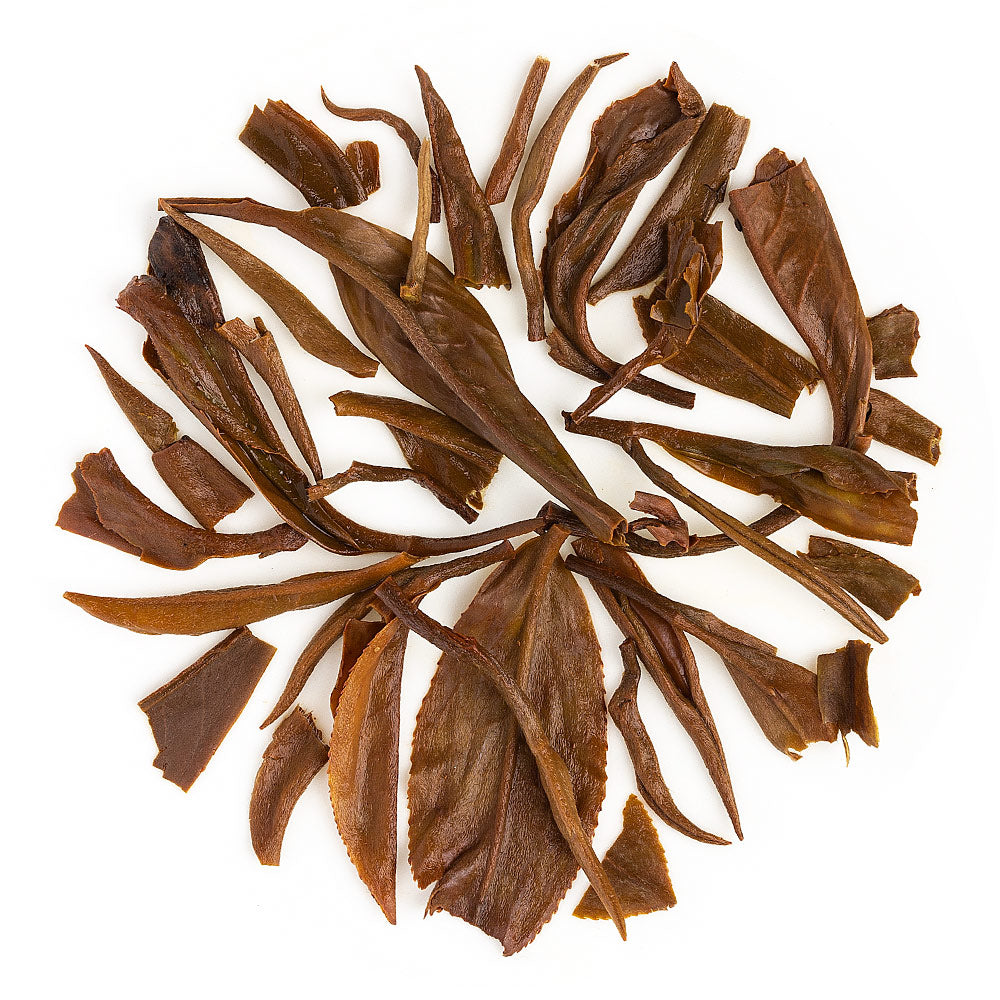
Kangra makes all four of the main tea types, from the same old China and China-hybrid bushes. Here is what the valley makes, with our own tasting notes where we have them. The Dharmsala Tea Company sums up its range simply: “We make the base teas (black, green, oolong and white) along with several signature blends.” For where Kangra tea grows and how it compares with Darjeeling, start with our Kangra tea guide.
What is Kangra black tea?
Kangra black tea is a light, orthodox black tea: nearly all of today’s 6,000 or so gardens make it, and the spring teas look greenish and brew a pale, bright cup.Read more
Spring blacks look greenish in the packet and give a light, bright cup, close to a first flush Darjeeling but more vegetal and earthy. The planters call it “a typical vegetal and earthy flavor that’s unmistakable,” and note that Kangra teas “do not have the typical muscatel touch” of Darjeeling.
The greenish look is a clue to how it is made. Like Darjeeling’s spring teas, these blacks are only partly oxidized, so the leaf keeps some of its green color and the cup stays light rather than coppery. That also explains why they are best brewed below the boil and drunk without milk.
We have sold Kangra blacks before. Our old store had a Wah Spring Kangra Black and a Mann Special Spring Kangra Black, and in 2016 a whole category page for Kangra black tea. Brewing figures are in How do you brew Kangra tea?
What is Kangra green tea?
Kangra green tea is the tea that made the valley famous: handmade, citrusy and often nutty, with very little bitterness.Read more
For a long time it was the main source of green tea for Central and West Asia and Russia. The Dharmsala Tea Company describes it as citrusy and often nutty, with very little bitterness. See What is green tea?
Some planters go further. “Some would go so far as to say that these green teas are the best in India,” the company told us, “largely driven by the nature of the bushes, the climate and the long experience with making green teas.” That experience goes back to the 19th century, when most of the valley’s handmade, orthodox green tea was sent through Pathankot and Amritsar to Afghanistan and the Middle East.
The low bitterness has a simple cause: green tea is never oxidized, and the small-leafed China bushes give a gentle leaf, so the fresh, vegetal flavor stays in the cup without a hard edge. In summer, we have counted the “earthy and smooth green teas from Kangra” among the rare teas of the season.

Estates like Wah produce high-quality green teas as well, and our 2018 training manual still lists Wah Classic Spring Green among our teas.
What are Kangra oolong and white teas?
Kangra oolong and white tea are made by hand in small lots: the oolongs are smooth and creamy, and the white teas include silver needle from unopened buds.Read more
Kangra oolong
Kangra oolong is made by hand in small lots. Mann Estate makes limited quantities of hand-rolled oolong, which its makers call smooth and creamy. “Our personal favorites are the oolongs, another Kangra specialty,” the Dharmsala Tea Company told us: “Hand-rolled, handcrafted, with a smooth, creamy flavor, more oriental in make.” Its handmade range has also included white peony, lapsang souchong, Formosa pouchong and monkey king oolong. See What is oolong tea?
Our procurement team cupped a first flush Dharmsala hand-rolled oolong in 2017. These are their notes:
- Dry leaf: “long, semi rolled greenish black leaves,” with some bold black leaf that looks dense, and a sweet aroma of fennel seeds with hints of jasmine and cardamom.
- Infused leaf: mixed greenish leaves that open fully in the water, with a raw green, vegetal smell.
- Cup: light, bright yellow, smelling of fennel seeds and jasmine.
- Taste: medium strength, floral and slightly raw and green, drying toward the finish; our tasters marked it as a morning or afternoon tea.
An autumn oolong could hardly be more different. In 2012 DarjeelingTeaXpress, the business that became Teabox, sold a Special Kangra Dharamshala Autumn Flush Handrolled Oolong, grade SFTGFOP1. Its listing described a big twisted leaf, “dark, rich, mahogany,” with olive, green and gold in it, and a deep, burnished gold cup with “a sweet, very floral attack (white flowers, rose, lily) followed by mango.” It called it “a rare oolong.” The darker leaf and fruitier cup come from autumn leaf and a longer oxidation, set against the greener, more vegetal spring lot.
Kangra white tea
A rarity: Mann Estate also makes small lots of silver needle white tea, from unopened buds. Because the buds are only withered and dried, never rolled, the cup is pale and soft. In 2016 our store had a category page for Kangra white tea, alongside the black, green and oolong pages. See What is white tea?
Keep reading
Sources
- Teabox Tea 101: Kangra, the fall and the rise of a tea industry
- Teabox blog: In Kangra, for a tour of the tea gardens (Aravinda Anantharaman with Anirudh Suri, Dharmsala Tea Company, 2017)
- Teabox blog: Missives from Gunehar: Leaving the city (Prachi Sibal, 2016), The bookseller of McLeod Ganj (Prachi Sibal, 2016)
- Teabox blog: An Indian Summer in a Cup (2015), The Winter of Our Teas (2015), What’s the fuss about the first flush? (2015)
- Teabox blog (Still Steeping) Teabox story: Rising from the embers: Kangra’s tea gardens, 2015 (Frank Miller)
- Teabox blog (Still Steeping) Teabox story: All about Indian tea terroir, 2014 (Kausshal Dugarr)
- Teabox Drive: Teabox internal document, 2017; Teabox internal document, 2012; Teabox internal document, 2018; Teabox internal document, 2023; Teabox internal document, 2016; photos as credited
- Teabox internal records (not linked): supplier estate records, 2019; certificate and license register, 2026
- Teabox product descriptions, 2026 season (closest teas): Giddapahar Spring Chinary Black, Castleton Spring Chinary Black, Darjeeling Green Tea, Glenburn Spring Moonshine Oolong
- Teabox on Instagram (@teabox.tea): Kangra tea Masterclass, Feb 2022, 118 countries, Apr 2021
- Kausshal Dugarr on X (@Teapreneur): India’s 4th tea region, Oct 2021, Jameson’s survey, Oct 2021
- Teabox on YouTube: Teabox Masterclass, Kangra

Leave a comment
All comments are moderated before being published.
This site is protected by hCaptcha and the hCaptcha Privacy Policy and Terms of Service apply.