


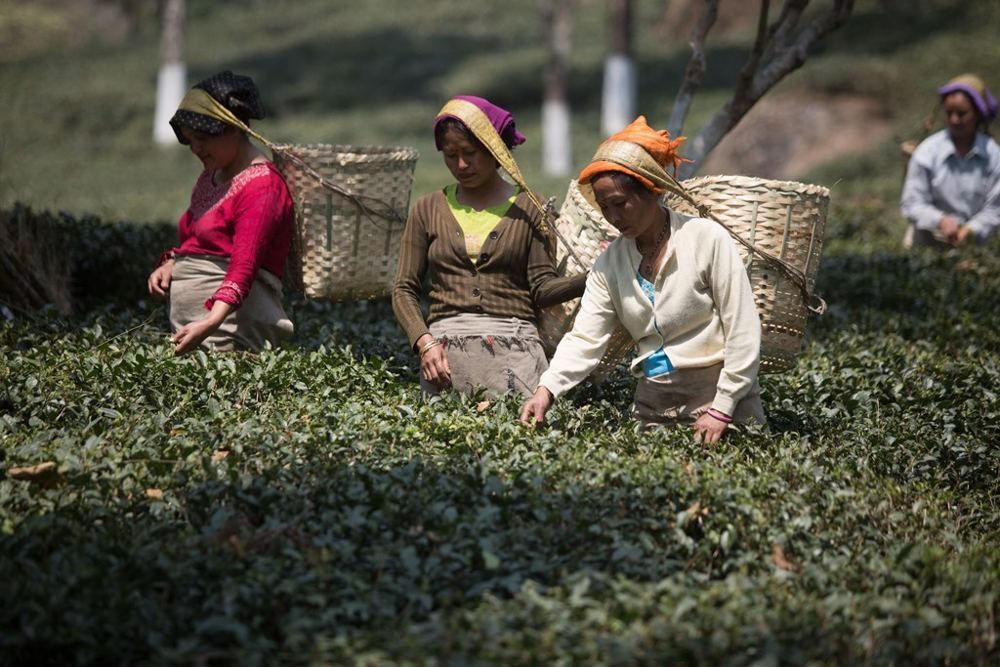
Tea grew wild in Assam long before the British arrived, and the Singpho people of Upper Assam brewed it from their own gardens. The British turned it into an industry from the late 1830s, to break China’s hold on the tea trade. This is the story in one chapter; the regions and teas of today are in Indian tea: the complete guide.
It is also the part of tea’s history closest to us. Teabox tastes and selects every tea it sells in Siliguri, at the foot of the Darjeeling hills, from more than 250 Indian estates, and our team has walked many of the gardens in this story.
Who drank tea in India before the British?
The Singpho people of Upper Assam did: they grew, made and drank tea from the wild bushes of their forests long before any British garden was planted.Read more
“The initial discovery of tea was in the lands of the Singpho people in Upper Assam’s forested areas,” our founder wrote in August 2022; “each Singpho family owned their respective tea gardens.” In the 16th century, the Dutch traveler Jan Huyghen van Linschoten described Indians eating tea leaves as a vegetable, with oil and garlic.
What our team found in Margherita
In 2016 our writer Richa Gupta traveled to the Singpho Eco Village in Margherita, in Assam’s Tinsukia district, with Ravi Kothari, then our procurement manager, and the Assamese photographer Tridib Konwar. Every household there grew tea in its backyard, and the village ran one processing facility owned by the whole community.
In the backyard of Rajesh Singpho, the community’s unofficial leader, the family plucked from tea plants at least 8 to 10 feet tall. Ravi, after many years in the trade, admitted he had never seen tea bushes that tall. Rajesh told us, with quiet pride, that the Singpho were the first Indians to find and drink tea as we know it today.
The Singpho have their own story of how tea was found. Rajesh told us of two brothers who rested under a tree after a long hunt, chewed a few of its leaves, and found they were neither thirsty nor hungry anymore. Those leaves, in the Singpho telling, were tea.
Smoked coin tea
The Singpho still make tea their own way. The leaf is slow-roasted in a wok, dried in the sun, crushed and packed into hollow bamboo, then left on racks above the cooking hearth to smoke for as long as two months, before it is cut into coin-sized pieces to brew. Our first cup came with a piece of jaggery on the side and tasted “green, smoky and like nothing I’d ever tasted before.”
Ravi found that it “reminded me of the Chinese pu-erh, fermented and smoky”: brewed for 3 minutes it tasted like a green tea, and for 5 minutes like a black. The Singpho story in full is in The history of Assam tea and on our blog, Assam Diaries: Margherita, the Singphos and Coin Tea.
How did the British find tea in Assam?
Slowly: they spent decades trying to grow Chinese tea in India before a Scottish trader was shown the Singpho’s wild tea in 1823, and it took another ten years for the East India Company to act on it.Read more
Chinese plants in Calcutta
The British came at it from the other direction. Chinese tea plants first trickled into the botanical garden at Shibpur, outside Calcutta, set up by the army engineer Lieutenant Colonel Robert Kyd, and skilled Chinese “gardeners” came with them, as Romita Ray writes on our blog. In 1788 the botanist Joseph Banks advised the East India Company to grow its own tea in India from Chinese bushes, missing the fact that tea already grew wild there; his idea was turned down.
Robert Bruce, 1823
In 1823 the Scottish trader Robert Bruce, on a trip to Rangpur, the capital of the Ahom kingdom, was shown how a Singpho chief and his people brewed the wild leaf; Tea 101 credits the Assamese nobleman Maniram Dewan with taking him there. One version, told in our Margherita story, has Maniram Dewan bringing Bruce to Margherita itself to see the wild bushes, and Margherita is where Bruce is thought to have found them.
Bruce died a few years later, and in the early 1830s his brother Charles sent samples to the botanical garden in Calcutta, where the plant was confirmed as tea and named Camellia sinensis var. assamica.
“We all believed that it was the BRITISHERS who discovered TEA in India! But NOTHING could be further from the TRUTH.”
China seed and a stolen harvest
When the East India Company lost its monopoly on the China trade in 1833, India suddenly looked like a profitable alternative. In 1834 the Company set up a Tea Committee to assess Assam’s potential. Charles Bruce set up a nursery with Chinese seed, some 80,000 seeds, and hired Chinese tea makers, but the China bushes struggled in the hot Assam plains.
In 1849 the Scottish botanist Robert Fortune, working for the East India Company, smuggled tea plants out of China’s Wuyi mountains in glass cases, packed with soil so they would grow on the way.
Where were India’s first tea gardens?
In Upper Assam, in the late 1830s; within twenty years tea was also planted in the hills of Darjeeling, and the Nilgiris in the south had their first commercial estates by 1859.Read more
Assam
The first British gardens were planted in Upper Assam in the late 1830s. Two Assam gardens claim the first plantings. Chubwa, whose name joins “chah” (tea) and “bowa” (planting), dates its first successful planting of tea saplings to 1836, after an attempt at the meeting of the Dibru and Brahmaputra rivers in 1835 failed. At Namsang, a marble monument in Section No. 1 still marks the first formal plantings of 1837.
In 1839 Indian tea went on sale in Britain for the first time: until then, only Chinese teas had been auctioned there. The same year the Assam Tea Company was formed, with Maniram Dewan as its Dewan, and by 1862 Assam had more than 160 gardens, owned by five public companies and 57 private planters. Science followed: in 1891 the chemist M. Kelway Bamber was appointed to study tea in Assam, and in 1911 the Tocklai Experimental Station opened at Jorhat.
Darjeeling and the hills
China seed did poorly in Assam but thrived in the hills. Dr Archibald Campbell planted it in his garden in Darjeeling in 1841, when about 25 families lived there, and the first commercial gardens followed in the 1850s, beginning with Captain Samler’s Alubari in 1856. By 1866 Darjeeling had about 39 gardens making 21,000 kg of tea.
Two German missionary families, the Wernickes and the Stolkes, founded Risheehat, Goomba and Tumsong, and Steinthal is still called the “priest’s tea garden.” In the mid-1840s, Peter Keen notes, there were fewer than 30 houses in the hills. The Darjeeling Himalayan Railway, the “toy train,” reached Darjeeling in July 1881 and carried tea down to the plains at Siliguri; UNESCO declared it a World Heritage Site on 2 December 1999. Siliguri is where our own facility stands today.
The Nilgiris, Kangra and the Dooars
Tea was planted in the Nilgiris in the 1830s too: Tea 101 records seed sown at Ketti in 1835, and the first commercial estates at Dunsandle and Thiashola in 1859. Nina Varghese, writing for us, records that Chinese prisoners from the Opium Wars were held at Thiashola when planting began there. In the far north, Kangra was surveyed by Dr William Jameson and declared suitable for tea in 1848.
Indians planted gardens too. Romita Ray, who writes for our blog, traces her family to Tarini Prosad Ray, a pioneering Bengali planter in the Dooars, whose first garden was the Mathura Tea Estate; he was a fierce nationalist and the founder chairman of the Indian Tea Planters Association.
The regions themselves are covered in Indian tea regions, with the deep histories in Assam tea, Darjeeling tea and Nilgiri tea.
Who was Maniram Dewan?
Maniram Dewan, the Assamese nobleman who opened the door to Assam’s tea, grew tea on his own account and died fighting British rule; folk songs remember him as the “father of Assam tea.”Read more
Maniram Dewan, the nobleman who opened the door to Assam’s tea, later set up gardens of his own, the first Indian to grow tea commercially in Assam. He was Dewan of the Assam Tea Company from 1839, grew disillusioned and left in the mid-1840s, and set up his own gardens near Jorhat and in Sibsagar.
He was hanged at Jorhat after the uprising of 1857, and folk songs in Assam still remember him. A 2016 post of ours records that he was allegedly buried at Cinnamara, his estate, though locals believe otherwise, since he was hanged 9 km away.
His legacy runs through modern Assam tea in an unexpected way. When our writer Zahra Amiruddin visited Tocklai in 2016, the mother plant of India’s first cloned tea, developed in 1949, was still growing there; it was raised from seed collected at Cinnamara, the estate that belonged to Maniram Dewan.
Our Steeping Indian Tea History videos tell his story and that of the Singpho.


How did India learn to drink tea?
Slowly: for decades almost all Indian tea was shipped abroad, and it took campaigns from 1903 onward, railway tea stalls and cheap CTC tea to make India a nation of chai drinkers.Read more
For decades almost all Indian tea was shipped abroad. At first most Indians were not taken with the drink and preferred their own, such as thandai and sherbet. The Tea Cess Committee of 1903, renamed the Indian Tea Market Expansion Board in 1937, set out to change that; the tea stalls at railway stations are a legacy of those campaigns.
After the First World War, Indian and Eurasian vendors with stoves and kettles began selling tea at the railway stations of Bengal, Punjab and the Frontier provinces. Posters in regional languages went up, and a few can still be found at Ballygunge, Naihati and Dum Dum stations.
In the 1930s William McKercher invented the CTC (crush, tear, curl) method, which made cheap, strong tea for the masses, and in 1953 the Tea Board of India declared tea “Swadeshi,” India’s own.

India made tea its own as chai, boiled with milk, sugar and spices: see What is chai? and The history of chai in India. By the 1970s India drank more tea than Britain; our 2014 story credits the tea break at work and the growing taste for spicy-sweet chai.
“The British built India’s tea industry to ship Indian tea to the world under a British flag. 79 years later, we ship from Siliguri to 125+ countries under our own.”
How has India’s tea been bought and sold?
Mostly at auction: India’s own tea auctions began in Calcutta in 1861, Siliguri’s followed, and the hammer gave way to online bidding in 2011.Read more
The first tea auctions in Calcutta were held in 1861, Ian Bersten notes on our blog. Calcutta is still home to J. Thomas, which Romita Ray calls the world’s oldest and largest tea brokers.
Ravi Kothari, our tea buyer, remembers the manual auction in Siliguri. It started at 9 am sharp on Thursdays, buyers had their samples at least two weeks ahead, and brokers had 1.3 minutes for every 3 lots before a bell rang. Once, two buyers fought over a single Parag BP lot and sent it from Rs 40 to Rs 120. The manual auction ended in October 2011, when Siliguri went online. Read his story, Remembering the days of manual tea auction.
Teabox works another way: our team tastes each tea at the garden once it is made, and the lots that pass reach our facility in Siliguri within 24 to 48 hours of production. How that works is explained in How tea is made.
Keep reading
Sources
- Teabox Tea 101: History of tea, Origins and history of green tea, A brief history of black tea, Assam, Darjeeling, Nilgiri, Tea and medicine, Tea producing regions, Brief history of the Indian tea industry, Chai
- Teabox blog (Still Steeping), early history: Where can we find the earliest reference to tea? (David Lyons, 2016); Tea: A Blended History (Adeline Teoh, 2016); How the Teacup Got Its Handle (Peter Keen, 2016); A short lesson on Asian green tea (Adeline Teoh, 2017); Women of tea (Adeline Teoh, 2017); Darye, the Korean tea ceremony (Adeline Teoh, 2015)
- Teabox blog (Still Steeping), Europe and the trade: How tea really became popular across the world (2014); At a fast clip: Shipping tea from China (Peter Keen, 2017); Tea in France: Not What You Might Expect (Peter Keen, 2016); Would you like some sugar in your tea? Or a little tea in your sugar? (Peter Keen, 2017); An Homage to a Box of Tea: Musings of an Art Historian (Romita Ray, 2016); A Mustache in a Teacup (Romita Ray, 2016); How tea helped in the fight for women’s rights! (Peter Keen, 2017); Welsh tea, only in Patagonia (Peter Keen, 2017); Irish tea, history and elevenish (Peter Keen, 2017); From history, a long and complicated relationship with tea (Peter Keen, 2017); Iced tea traditions from around the world (Paraj Singh, 2017)
- Teabox blog (Still Steeping), India: Assam Diaries: Margherita, the Singphos and Coin Tea (Richa Gupta, 2016); The Teabox team in Assam (Ravi Kothari, 2016); A tour of the Tocklai Tea Research Institute (Zahra Amiruddin, 2016); Tea in Germany & its Darjeeling Connection (Peter Keen, 2016); Prisoners’ tales from the Nilgiris (Nina Varghese, 2016); A Tryst with History (Vivek Pradhan, 2020); What Became of the Small Leaf Tea? (Ian Bersten, 2015); Remembering the days of manual tea auction (Ravi Kothari, 2016); A Mumbai tea story (Jerry Pinto, 2015)
- Teabox blog (Still Steeping): The Year Britain Bought Up All the Tea in the World (Peter Keen, 2016); When Tea Was Gesmokkeld and Verschrikkelijk (Peter Keen, 2016); From Coonoor to Mincing Lane: The History of the Nilgiri Tea (Nina Varghese, 2016); Raising Our Cups to Maniram Dewan: The Father of Assam Tea (Mohona Banerjee, 2021)
- Teabox product pages, 2026: Namsang, Puttabong, Castleton Summer Muscatel, Risheehat Spring Chinary, Assam Masala Chai, Pure Japanese Matcha, English Breakfast and Irish Breakfast
- Teabox Drive: Teabox internal document; Teabox internal document, 2017; photos Teabox internal document and Teabox internal document
- Teabox on Instagram (@teabox.tea): Boston Tea Party, Feb 2016, Lyons Corner Houses, Mar 2016, butter tea, Apr 2016, Maniram Dewan, Jul 2016, 100 countries, Jan 2017, Chubwa, Sep 2018, Chubwa name, Sep 2018, Ilam, Aug 2019, spittoon, Apr 2021, Mangalam oxidation trial, Sep 2021, how tea came to India, Jan 2022, how Indians started to drink tea, Jan 2022, toy train, Jan 2022, tea campaigns, Jan 2022, garden to pack, Jan 2026
- Kausshal Dugarr on X (@Teapreneur): Lipton, Sep 2021, tea in India thread, Sep 2021, assamica and 1839, Sep 2021, auction share, Oct 2021, 1679 auction, Oct 2021, 1942 purchases, Oct 2021, Lu Yu on water, Oct 2021, Kangra, Oct 2021, tea bowls, Nov 2021, how India learned to drink tea, Mar 2022, first flush 2022 verdict, May 2022, iced tea, May 2022, Singpho gardens, Aug 2022, Tata Tea, Jan 2023, under our own flag, Aug 2026
- Teabox on YouTube, Steeping Indian Tea History: True Story of Tea Cultivation in India, How One Man Fought For India’s Tea


Leave a comment
All comments are moderated before being published.
This site is protected by hCaptcha and the hCaptcha Privacy Policy and Terms of Service apply.