


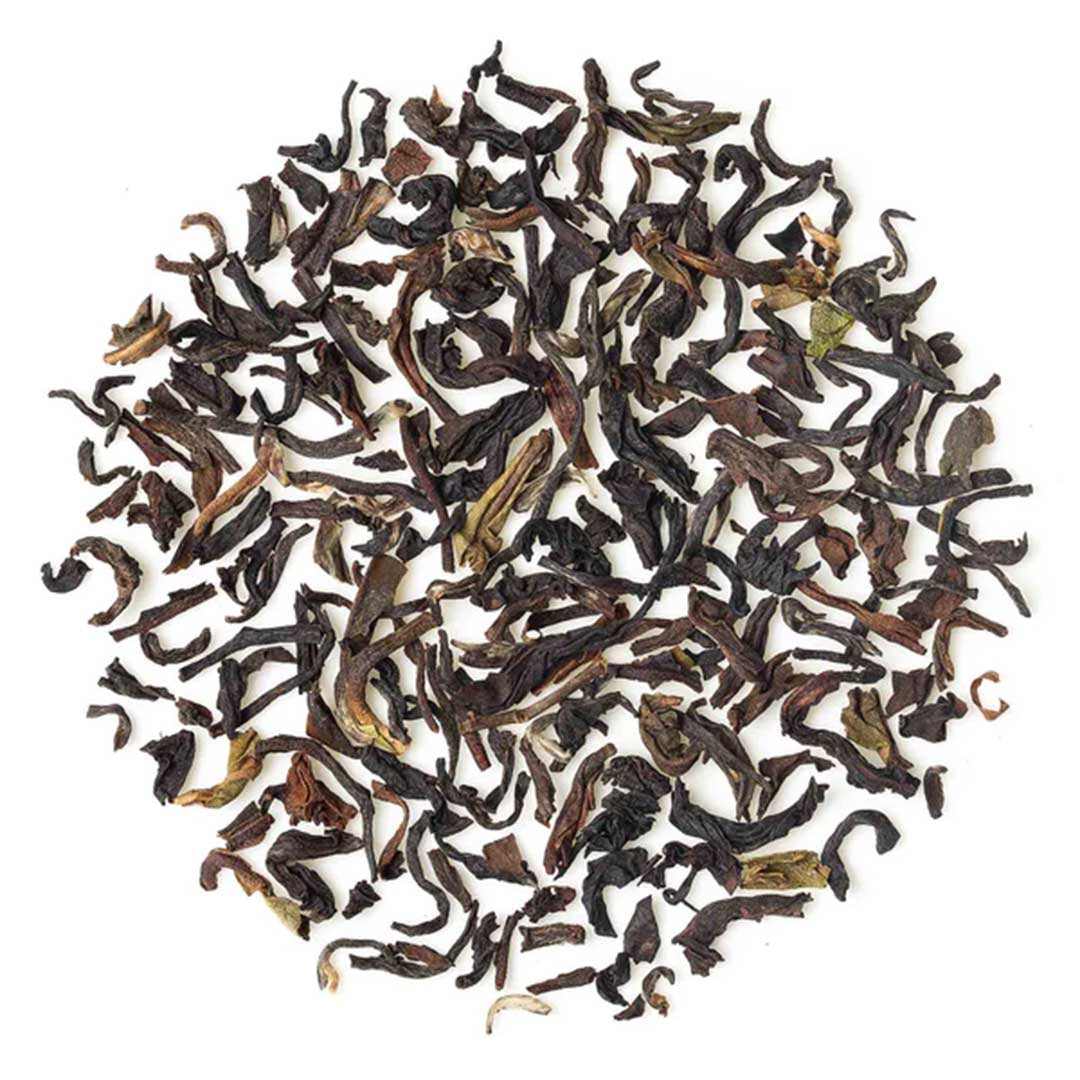
Tea has no hard expiry date, but it is an agricultural product and it goes stale. The longer it sits, the more aroma and flavor it loses, until the cup tastes flat. This page answers the freshness questions we are asked most: how long tea keeps, what the dates on a pack mean, whether tea bags go stale, how to store tea at home and what we do before it reaches you. For the full storage guide, see How to store tea.
Does tea expire or go bad?
Not in the way milk or bread does: tea goes stale, losing aroma and flavor, but old tea is rarely unsafe; it is just dull.Read more
“Much like vegetable and fruit, teas do go stale over time. They lose flavor and aroma and become flat.”
Old tea is rarely unsafe; it is just dull. The exception is tea that has got damp: if leaf smells musty or shows any sign of mold, throw it away. Read the pack for the date of manufacture, which matters more than the date of packing.
The tea trade has words for each stage. Our quality team’s glossary, based on India’s IS 4541 standard for tea terms, calls a tea “flat” when the fault “may result from age or storage,” and “stale” when it has been “stored for too long or under damp conditions,” sometimes because it was packed with too much moisture in the first place.
How to check tea at home
Use your fingers and your nose. Our tasting notes say fresh dry leaf “should ideally have a crunchy feel between your fingers,” and its aroma should be fresh, with no humid or musty smell.
How long does loose leaf tea last?
Kept airtight and away from light, heat and moisture, loose leaf tea stays fresh for about a year from the date it was made, and is best drunk within that time.Read more
After that it does not suddenly go bad; it simply tastes less of itself. Buy amounts you will finish, and look for the year on the label.
Peak flavor and the best-before date
Two figures are often confused. The first is how long a tea tastes its best, which is about a year for most teas. The second is the legal outer limit: our tin sleeves print “best before 24 months from mfg. date.” Our quality specification gives the same 24 months, under proper storage, for black, green, white, oolong and flavored teas, and a shorter 6 to 18 months for herbal tisanes.
Delicate teas fade first
The most delicate teas lose their high notes soonest. For Darjeeling, our founder wrote that the tea “is at its best for maybe 6 months, but well-stored it retains its flavors for a year.” Read The Beginner’s Guide to Choosing a Darjeeling.
Peter Keen gave our readers an even stricter rule: tea “begins to deteriorate and lose its special flavors and aromas within six weeks and should be consumed within six months of its being harvested.” His point was about the journey: a Darjeeling can take “two weeks or less” to reach a buyer with the best logistics, or “around six months” by the standard route. Read From Bush to Cup: The Logistics of Tea.
What do the dates on a tea pack mean?
A tea can carry up to three dates: when it was picked and made, when it was packed, and its best-before; the first tells you most about freshness.Read more
The picking and packing dates are not the same thing. As our 2014 post warned, the date of picking is “not to be confused with the date of packing; these are independent events.” A tea picked in spring may be packed weeks or months later, after the estate has made it, our tasters have chosen it and it has waited in cold storage.
Our product pages show what that looks like for one lot. Our Castleton Summer Muscatel was picked and processed at Castleton on 12 and 13 July 2022, reached our facility on 14 July, and was sorted, vacuum packed and stored at −5°C the same day, ready to ship on 15 July. Each single-estate page also gives the date of picking for its lot.
So when you compare teas, look first for the harvest year or the date of picking, then check the best-before. See Seasons of tea for when each flush is made.
Do tea bags go stale?
Yes, and usually faster than whole leaf, because the small broken leaf in most bags has far more surface exposed to air.Read more
Most mass-market tea bags hold small broken leaf or dust, which has far more surface exposed to air, so it loses aroma sooner and tends to brew a harsher cup. As we often say, fine teas are rarely available in bags.
When our founder announced our own tea bags in 2016, he explained the problem: “in the time it takes to fill, produce and ship the average tea bag, the quality of the tea has already deteriorated,” because in an ordinary bag “the tea is continuously exposed to air and therefore affected by moisture and oxygen.”

If you prefer bags, choose ones that hold whole leaf and are individually sealed. When we launched our tea bags, TeaPacs, in October 2016, each was packed in its own sachet sealed at the source with a natural nitrogen flush to keep the tea fresh. See our tea bags.
The idea came from potato chips, whose makers use a nitrogen flush: nitrogen is an inert gas that displaces the air around the food without reacting with it. Our R&D team spent six months of trials adapting it to single-serve packs of loose leaf tea. The whole story is in Introducing TeaPacs – Groundbreaking innovation from Teabox.
What ruins tea, and how should I store it?
Moisture, light, oxygen and heat ruin tea, so keep it airtight in a cool, dark, dry cupboard, away from the stove and strong smells.Read more
Tea has four enemies: moisture, light, oxygen and heat. Exposure to any of them makes tea stale and tasteless. Keep tea in an airtight container, in a cool, dark, dry cupboard, away from the stove and from strong smells, and close it straight after use.
What each enemy does to the leaf
Our training deck spells out what each one does, which is why each storage rule matters:
- Moisture: tea is hygroscopic, which means it draws water from the air, and damp “robs teas of the freshness.”
- Light: it changes the make-up of the leaf, “leading to more metallic notes in your liquor,” which is why a tin with a window belongs in a dark cupboard.
- Oxygen: air left in the pack “will make the tea flat with no flavor, briskness or astringency.”
- Heat: warmth from a stove or a sunny window “causes the leaves to perspire,” in the deck’s words.
Containers, the fridge and the monsoon
Choose the container with care. The same deck warns that “certain wooden containers, airtight tin caddies with strong-smelling rubber seals and plastic vessels can substantially deteriorate the quality,” because tea takes on smells as readily as moisture. It suggests repacking a large pack into small amounts, so the bulk of it stays sealed while you drink the rest.
A fridge is rarely needed. If you do keep tea cold, the deck’s advice is to “squeeze out as much air as possible” from the pack, and “never open the packet until it has reached your room temperature,” or water from the air will condense on the cold leaf.
Monsoon is the hardest season for tea at home: everything is damp, and tea readily absorbs moisture. That is the time to keep packs tightly sealed and to buy smaller amounts. Fresh tea is an agricultural product, just like your vegetables, and needs the same care.
How does Teabox keep its tea fresh?
By keeping the journey short and the tea sealed, dry and cold from the estate until it ships.Read more
Once a lot passes our tasters, it reaches our dehumidified facility in Siliguri, near the Darjeeling gardens, within 24 to 48 hours of being made and is bulk vacuum packed at once. It is then hand sorted, graded and vacuum packed again in 100 g packs for shipping. We buy just in time, keeping about 45 days of stock, so tea does not sit in a warehouse. And we hand sort almost every batch, because foreign matter does turn up in tea.
We do not buy black or green tea above 4% moisture, and we keep it at that level through cleaning, sorting, packing and shipping, in opaque packs lined with aluminum against light and moisture.
Cold, dry and logged
Between packing and shipping, the tea is kept at −5°C; the cold helps us control moisture. Our quality plan sets the packed-tea room at 40% relative humidity, with humidity and temperature logged every two hours. Bags come out of the cold room only after 6 pm and rest in a dehumidified area first, so that no moisture condenses on the cold leaf.
The same plan keeps fifteen 10 g samples of each lot at −10°C as shelf-life references, so the team can compare a tea against itself later. Orthodox teas leave us in 100 g vacuum packs and chais in 250 g packs. Our deck adds one exception: vacuum packing suits strong black teas, but it would crush long, delicately rolled white teas and oolongs, so those packs can be flushed with nitrogen instead.

Keep reading
Sources
- Teabox Tea 101: FAQs
- Teabox blog: Should you add milk to tea? (2015), The Element of Water: Get Your Tea Right (2021), Microwaved, tepid, rolling boiling? Water for tea! (2016), The Teaspoon: Measure, Stir, Display or Steal? (2016), Introducing TeaPacs – Groundbreaking innovation from Teabox (2016)
- Teabox blog: From Bush to Cup: The Logistics of Tea (2016), The beginner’s guide to choosing a Darjeeling (2017), Two-foot tea and the Bengali (2016), What I learned at my first ever tea tasting (2016)
- Teabox blog (Still Steeping): 5 lies you’ve been told about tea (2014), How Teabox ensures its teas are fresh (2015), Beyond the tea bag (2016), Tea vs health (2016)
- Teabox product descriptions and product data (tasting notes, invoice numbers, picking dates, freshness journey, cups per pack, caffeine ratings), October 2026: Pure Chamomile, Pure Japanese Matcha, Doomni Gold Summer Black, Margaret’s Hope Spring Moonlight White, Badamtam Spring Moonlight White, Classic Earl Grey Citrus Black, Darjeeling Green Tea, Castleton Summer Muscatel, Teabox Kadak Chai, Assam Masala Chai, Kashmiri Kahwa, Chamomile Green
- Teabox Drive: Teabox internal document (2023); Teabox internal document (Jan 2022); Teabox quality team glossary, based on IS 4541 (2016); Teabox internal document (Apr 2023); Teabox internal document (2021); Teabox internal document (2015); Teabox internal document (2021); Teabox internal document (Dec 2022); Teabox internal document (2016); photos as credited
- Teabox on Instagram (@teabox.tea): tea goes stale, Nov 2017, TeaPacs, May 2018, four enemies, Jun 2018, matcha, Feb 2019, -5°C storage, May 2020, chai with or without milk, Sep 2020, 2.5 g samples, Apr 2021, bitter green tea, Sep 2021, pack sizes, Nov 2021, one plant, Mar 2022, monsoon storage, Jul 2022, 11,456 cups, Oct 2022, garden to pack, Jan 2026
- Kausshal Dugarr on X (@Teapreneur): tea and chai, Jul 2020, Nepal and Darjeeling, Oct 2021, chai from tea bags, Dec 2021, traceability, Jan 2022, First Flush 2022 cups, May 2022, fine teas and bags, Aug 2022, 45 days of stock, Aug 2022, hand sorting, Dec 2022, 125+ countries, Aug 2026
- Teabox on YouTube: Why tea should be consumed fresh (Teabox Masterclass)

Leave a comment
All comments are moderated before being published.
This site is protected by hCaptcha and the hCaptcha Privacy Policy and Terms of Service apply.